
AI is changing how professionals create thought leadership content. Here's what you need to know:
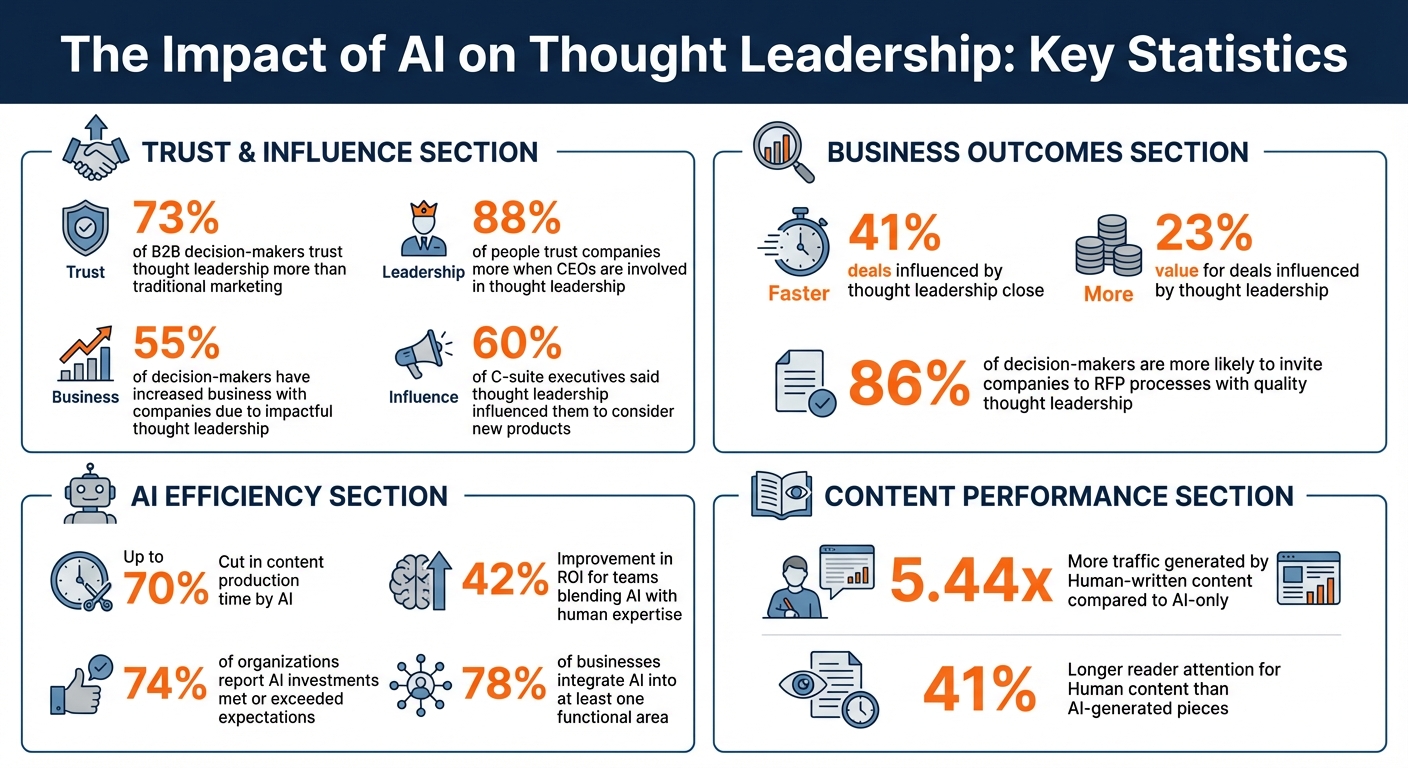
- 73% of B2B decision-makers trust thought leadership more than traditional marketing.
- Deals influenced by thought leadership close 41% faster and are worth 23% more.
- AI can cut content production time by up to 70%, helping professionals focus on insights instead of repetitive tasks.
AI tools streamline tasks like transcription, summarization, and formatting. They also analyze audience behavior, uncover gaps in industry coverage, and transform long-form content into multiple formats like social posts or infographics. This shift lets professionals focus on delivering original ideas and personal perspectives.
If you're short on time, AI can help you stay relevant by organizing knowledge, crafting drafts, and identifying trends. But remember, the human touch - your unique viewpoint and experiences - makes the difference. 55% of decision-makers say they’ve increased business with companies due to impactful thought leadership.
Key takeaway: AI supports speed and efficiency, but your expertise drives trust and engagement.
AI Thought Leadership Impact Statistics and ROI Data
How to Make Thought Leadership Content with AI
AI Tools and Technologies for Thought Leadership
AI tools are transforming the way thought leadership content is created and shared. A whopping 74% of organizations report that their investments in generative AI and automation have met or exceeded expectations, while 78% of businesses now integrate AI into at least one functional area. The real challenge lies in selecting the right tool for your specific needs - whether that’s crafting articles, improving your LinkedIn presence, or diving into audience insights. Below, let’s break down the AI tools that can elevate each stage of thought leadership creation.
AI Content Creation Tools
When it comes to generating ideas or crafting social media copy, ChatGPT is a go-to for its flexibility and ease of use. Jasper offers over 50 templates designed for a variety of formats, from blog posts to marketing emails. For turning raw interviews into polished narratives, Copy.ai is a standout.
If repurposing content is your goal, tools like Pictory and Lumen5 can transform long-form articles into engaging short videos for platforms like LinkedIn or TikTok. On the audio and video editing front, Descript simplifies the workflow by letting you edit through text-based transcripts, saving hours of production time. For SEO and intent alignment, Clearscope.io ensures your content meets high E-E-A-T standards (Experience, Expertise, Authoritativeness, Trustworthiness) and aligns with what users are searching for.
| Tool | Primary Strength | Best For |
|---|---|---|
| ChatGPT | Ideation and social copy | Quick drafts and brainstorming |
| Jasper | 50+ enterprise templates | Teams needing structured workflows |
| Copy.ai | Interview-to-content transformation | Extracting insights from conversations |
| Pictory/Lumen5 | Video creation from text | Multi-platform content repurposing |
| Clearscope.io | SEO and search intent alignment | Maximizing organic visibility |
Once your content is ready, ensuring it gains traction on social platforms is the next step.
AI for Social Media and LinkedIn Optimization
LinkedIn has emerged as the central hub for B2B thought leadership, with over 1 million profiles including the term "thought leader" back in 2020. Tools like Taplio and Shield help pinpoint the best times to post, track engagement trends, and analyze which topics resonate most with your audience. These platforms create useful feedback loops by leveraging engagement data to refine AI models, helping you uncover which themes or tones have sparked the most interaction over the past month.
AI also takes the hassle out of scheduling and optimizing posts, freeing you to focus on crafting meaningful insights. For those aiming to go beyond basic posting, platforms like Acedit integrate directly with LinkedIn to optimize bios with relevant keywords and plan content that aligns with your thought leadership strategy.
AI for Audience Analysis and Engagement
Understanding your audience has shifted from guesswork to precision thanks to AI. Tools like SparkToro and Brandwatch analyze audience behavior to reveal trending topics and pain points by examining what your target audience follows and values. GWI Spark takes it further, accessing global survey data from nearly 1 million consumers to provide deeper insights that go beyond social media.
For real-time sentiment analysis, Hootsuite’s Blue Silk AI scans millions of online conversations to track brand mentions and gauge audience sentiment as it unfolds. Meanwhile, HubSpot’s Breeze Intelligence identifies high-intent leads by combining website interaction data with public information. Another standout, Semrush’s AI Visibility Toolkit, tracks how your brand appears in AI-generated responses from tools like ChatGPT, Perplexity, and Claude, offering a way to measure your Share of Voice in a fast-evolving digital space.
As Content Matterz puts it, "AI makes it easier to move from guessing to knowing what your audience values". These tools work in harmony to keep your thought leadership relevant, timely, and precisely targeted.
How to Build Thought Leadership Using AI
This section explores how you can use AI to establish and solidify your reputation as an expert in your field. Thought leadership is about showcasing your expertise, and AI can take on repetitive tasks, giving you more time to focus on meaningful insights and authentic connections that highlight your unique perspective.
Creating a Consistent Content Strategy
Start by gathering your past articles, social media posts, and presentations, then feed them into tools like ChatGPT or Jasper. These tools can help you identify recurring themes and organize them into 3–5 content pillars - key topics that define your expertise and ensure consistency across platforms.
Instead of relying on AI for full drafts, use it for brainstorming. For instance, you could prompt it with: "Generate 10 post ideas about [your expertise] that challenge conventional thinking." From there, pick the most compelling idea and expand on it in your own voice. If AI suggests a title like "The Biggest Misconception About Remote Work Productivity", enrich it with personal stories or exclusive data that only you can provide.
You can also repurpose existing materials like keynotes or whitepapers into bite-sized LinkedIn posts, newsletter snippets, or infographics using tools like Copy.ai. Analyze engagement data - such as the best times to post or the topics that resonate most - and feed this back into your AI tools to refine your content strategy over time.
While AI can handle structure and grammar, your personal insights are what make the content stand out. Always fact-check AI-generated outputs and add your own experiences or unconventional viewpoints. As Nathan Thompson from Copy.ai puts it:
"AI for thought leadership transforms how brands create expert content by automating routine tasks while preserving human insights."
Once your content strategy is in place, you can use AI to enhance your networking efforts with a personal touch.
Networking with AI-Powered Personalization
Building trust-based connections is key to effective leadership, and while AI can assist, the human element remains irreplaceable. Let AI handle the groundwork, like research and administrative tasks, so you can focus on meaningful relationship-building.
Before reaching out to a potential contact, use AI to analyze 30–50 of their recent posts. This can help summarize their tone, key themes, and interests. Tools like Supergrow can even suggest thoughtful comments, ensuring you stay visible in their feed without spending hours crafting responses. When sending a connection request, use a personalized approach like the "Why me, why now, what's next" formula: reference a specific post they shared, explain why it resonated with you, and propose a clear next step. AI reminders can help you stay consistent by prompting you to engage with a comment or message every few weeks.
For real-time interactions, tools like Acedit offer AI-driven coaching to help you maintain a professional presence during interviews or networking events. Features like live question detection and response suggestions ensure you effectively communicate your expertise when it matters most.
The impact of thought leadership on business outcomes is undeniable. According to research, 86% of decision-makers are more likely to invite a company to an RFP process if they consistently produce high-quality thought leadership. Moreover, deals influenced by thought leadership close 41% faster and deliver 23% greater value.
Using AI to Stay Ahead of Trends
Staying ahead in your industry means identifying emerging trends before they gain widespread attention. Tools like SparkToro and Brandwatch can analyze audience interests and pain points, helping you spot trending topics early. Use AI to summarize these discussions and identify unanswered questions - these gaps represent opportunities for you to lead the conversation.
AI can also save you time by breaking down dense industry reports. Simply input a lengthy whitepaper into a summarization tool to extract key points in minutes, allowing you to focus on interpreting and contextualizing the information - this is where your expertise shines.
When major industry news breaks, AI can help draft an initial commentary or opinion piece. Add your unique perspective to these drafts to position yourself as one of the first authoritative voices on the topic.
You can even track whether your insights are being cited in AI-generated search results using tools like Attensira (starting at $99/month). As Robert Rose points out:
"The edge that once separated leaders from followers - the ability to see what others miss - is disappearing."
The real advantage today lies in how you interpret and connect ideas others may overlook. By using tools like Shield or Taplio, you can analyze engagement data to understand which themes resonate most with your audience. Feeding this data back into your AI workflows creates a feedback loop that keeps your content aligned with your audience’s interests, further cementing your role as an industry thought leader.
sbb-itb-20a3bee
Measuring the Impact of AI-Enhanced Thought Leadership
It's essential to track the success of your AI-driven thought leadership to understand how well it's connecting with your audience, driving engagement, and impacting your business.
Key Metrics for Thought Leadership Success
Start by focusing on audience reach and growth. Keep an eye on metrics like website traffic, unique visitors, and search rankings for industry-specific terms. Tools like SEMrush and Ahrefs can help you identify which expert-led content is performing well and being discovered organically through search engines.
However, reach alone doesn’t paint the full picture. The quality of engagement is far more telling than surface-level metrics like likes. To measure this, track comments, shares, and time spent on your content. These interactions reveal how deeply your audience values your insights. For example, "Average Time on Page" is a reliable indicator of how much readers engage with your material.
Another powerful metric is Share of Voice (SOV), which measures how much of the industry conversation you own compared to competitors. This includes tracking backlinks, media mentions, and guest post placements. As Andrew Holland aptly puts it:
"Brand mentions are the new backlinks".
Even unlinked mentions in respected publications can serve as trust signals, boosting your authority.
Metrics tied directly to your business outcomes are the most critical. For instance, thought leadership often drives lead generation, revenue, and even faster deal closures. Research shows that 55% of decision-makers have increased business with a company because of its thought leadership, and 60% of C-suite executives said it influenced them to consider products they hadn’t before.
Don’t forget to measure executive visibility. Track speaking engagements, podcast appearances, and follower growth on platforms like LinkedIn to evaluate the personal brand equity of key leaders. Additionally, with the rise of AI-generated content, monitor AI-specific visibility - how often your content appears in AI-driven search results like ChatGPT or Google’s AI Overviews. Tools like Semrush’s AI Visibility Toolkit can help with this.
AI Tools for Tracking and Improving Performance
AI-powered platforms like Brandwatch and Hootsuite Analytics are excellent for social listening and sentiment analysis. These tools help you gauge public opinion - whether it’s positive, neutral, or negative - by analyzing large volumes of online conversations.
Centralized dashboards like Pressmaster.ai or ChartHop (priced at $8 per user per month) make it easier to monitor your performance across multiple channels in one place.
To better evaluate engagement, consider creating a scoring system that assigns higher values to meaningful interactions like comments and shares over simpler metrics like likes. Some organizations combine multiple data points - search rankings, engagement scores, and business outcomes - into a unified "Thought Leadership Index" to track their progress over time.
For more precise insights, use marketing automation platforms like HubSpot or Salesforce to implement multi-touch attribution. These tools can identify when a lead interacted with your thought leadership content before converting, which helps quantify its impact on sales. For example, HubSpot reported a 40% increase in leads from educational thought leadership content in 2023.
Platforms like Shield and Taplio can further enhance your strategy by analyzing past performance to identify the best posting times and topics. This data helps you refine your content strategy for maximum impact. Competitive benchmarking is also key - regularly compare your engagement and visibility metrics with those of your competitors to understand your market position.
| KPI Category | Specific Metrics | AI/Analytics Tools |
|---|---|---|
| Reach & Growth | Traffic, SEO Rankings, Subscriber Growth | Google Analytics, SEMrush, Ahrefs |
| Engagement | Share Rate, Time on Page, CTR | Sprout Social, Hootsuite, Hotjar |
| Authority | Share of Voice, Backlinks, Media Mentions | Brandwatch, BuzzSumo, Mention |
| Business Impact | Lead Gen, Sales Velocity, CAC | HubSpot, Salesforce, Marketo |
| AI Visibility | Citations in LLMs/AI Overviews | Semrush AI Visibility Toolkit |
With these metrics and tools, you can effectively measure and refine your thought leadership efforts.
Scaling Thought Leadership with AI Support
Once you’ve measured your impact, leverage AI to expand your reach and influence. AI can reduce production time by as much as 70%, freeing you to focus on deeper strategic insights. Use performance data to identify your best-performing content, then scale its success by repurposing it into different formats. For example, a single whitepaper, keynote, or podcast can be transformed into LinkedIn posts, newsletters, infographics, and blog snippets. This "hero content" approach ensures you get the most mileage from your strongest ideas.
AI also shifts your role from being a "content factory" worker to an "insight curator." Let AI handle repetitive tasks like transcription, summarization, and formatting, while you focus on delivering unique perspectives and asking thought-provoking questions.
Employee-generated content (EGC) is another way to scale. AI tools can help employees create on-brand content by providing templates and design assets. Use UTM parameters to track how this content drives lead generation and revenue, making it easier to justify investments in employee advocacy programs.
For real-time opportunities, AI-driven social listening can help you identify breaking news and publish timely perspectives before competitors. This "newsjacking" strategy allows you to establish authority on trending topics early. For example, Tesla’s brand visibility rose by 14% in 2023 after its CEO engaged in thought leadership discussions, while Microsoft saw a 20% boost in its reputation score following Satya Nadella’s focus on "mobile-first, cloud-first" messaging.
Data shows that 88% of people trust companies more when their CEOs are actively involved in thought leadership. By automating repetitive tasks and focusing on what resonates, AI allows you to scale your thought leadership without losing the authenticity and unique insights that build trust with your audience.
Conclusion
AI has reshaped how thought leadership is approached, streamlining routine tasks while preserving the human connection that fosters trust and credibility. Teams that blend AI capabilities with human expertise see a 42% improvement in ROI.
This evolution shifts your role from merely creating content to curating insights and sparking meaningful conversations. Let AI handle tasks like research, transcription, and drafting, while you focus on asking thought-provoking questions, sharing personal stories, and building authentic relationships. Industry leaders echo this sentiment.
As Zach Chmael, Head of Marketing at Averi, aptly says:
"AI should amplify humans, not replace them."
While AI can produce technically polished content, it’s the human element that drives results. A striking 73% of decision-makers trust thought leadership more than traditional marketing, and content written by humans generates 5.44x more traffic and holds reader attention 41% longer than entirely AI-generated pieces. Maintaining credibility means staying engaged - responding to comments personally and weaving real-world insights into your messaging.
To put this into practice, start by capturing ideas through voice notes or short interviews. Use AI to draft up to 90% of your content, but leave space for your personal touch. Build a "voice bank" of your signature phrases and unique perspectives to guide AI tools, then layer in the anecdotes and emotional depth that turn data into compelling narratives. As Robert Rose wisely points out:
"The ones who thrive won't be those who control but those who connect."
The opportunity is undeniable: 86% of decision-makers are more likely to invite companies to RFP processes when they consistently produce high-quality thought leadership. With AI cutting production time by up to 70%, you can scale your efforts without losing authenticity. Striking the right balance between automation and expertise ensures you stay ahead. The future belongs to those who embrace AI as a powerful assistant while keeping their unique voice at the forefront.
FAQs
How does AI make creating thought leadership content faster and easier?
AI takes the hassle out of creating thought leadership content by handling tasks that usually eat up a lot of time - like drafting, editing, and research. It can transform interview notes or raw ideas into polished drafts in no time, fine-tune the tone and clarity of your writing, and even suggest attention-grabbing headlines. The result? Faster production without compromising on quality.
But AI doesn’t stop at writing. It can spot trending topics, create keyword-rich outlines, and test ideas using data, saving you countless hours of manual work. Think of it as your personal assistant, freeing you up to focus on the bigger picture - strategic storytelling and connecting with your audience. This way, your content stays relevant and genuine, even in fast-moving markets.
What are the best AI tools to boost thought leadership on LinkedIn?
To strengthen your presence as a thought leader on LinkedIn, AI tools can make content creation, audience analysis, and performance tracking much simpler. For instance, ChatGPT is excellent for drafting and refining posts, brainstorming ideas, and adjusting your tone to suit a professional audience. If you want to understand your audience better, tools like SparkToro can help by analyzing trending topics and aligning your content with subjects that matter most to your network.
Platforms like Copy.ai are handy for expanding on ideas, polishing drafts, and creating engaging formats such as carousels or articles. Meanwhile, analytics tools like Lately.ai can transform lengthy content into LinkedIn-friendly posts, track engagement metrics, and even recommend optimal posting times. These AI-driven tools streamline the process of producing high-quality content that connects with your audience.
How can AI help understand and connect with your target audience in thought leadership?
AI is an incredible asset when it comes to understanding and connecting with your audience. By sifting through massive amounts of social media posts, forums, and other online content, it can quickly highlight what grabs your audience's attention - whether that's their interests, challenges, or the latest trending topics. This kind of data-driven insight not only helps you create messaging that truly clicks with your audience but also saves you a ton of time compared to doing all this research manually.
But AI doesn’t stop at insights - it takes engagement to the next level by personalizing content for different audience groups. It can adjust headlines, examples, or even the tone of your message to make it feel more relevant and meaningful. On top of that, AI tools take care of time-consuming tasks like fact-checking, editing, and tracking how your content performs. This frees you up to focus on what really matters: crafting compelling stories and building genuine connections - both of which are at the heart of impactful thought leadership.