
Want to switch careers but not sure how to showcase your skills? Transferable skills - abilities you can apply across jobs and industries - are the key. From teamwork to data analysis, these skills matter more than ever as 40% of core skills will change by 2030. The challenge? Communicating them effectively.
AI tools simplify this process. They analyze your experience, identify hidden strengths, and translate skills into terms hiring managers value. For example, "managing teams" could become "conflict resolution" or "stakeholder management." Professionals using AI for skill mapping change careers 47% faster. Tools like Acedit even optimize resumes and provide real-time interview coaching.
Here’s how to get started:
- Identify your skills: Use self-assessment methods like the "Top 5" exercise or STAR framework.
- Match skills to jobs: Analyze job descriptions and align your skills with employer needs.
- Leverage AI: Use tools to detect, reframe, and quantify your skills for resumes and interviews.
- Quantify achievements: Back up skills with metrics like percentages or dollar figures.
AI isn’t replacing human effort - it’s helping you present your best self. With these strategies, you can stand out and transition to new opportunities faster.
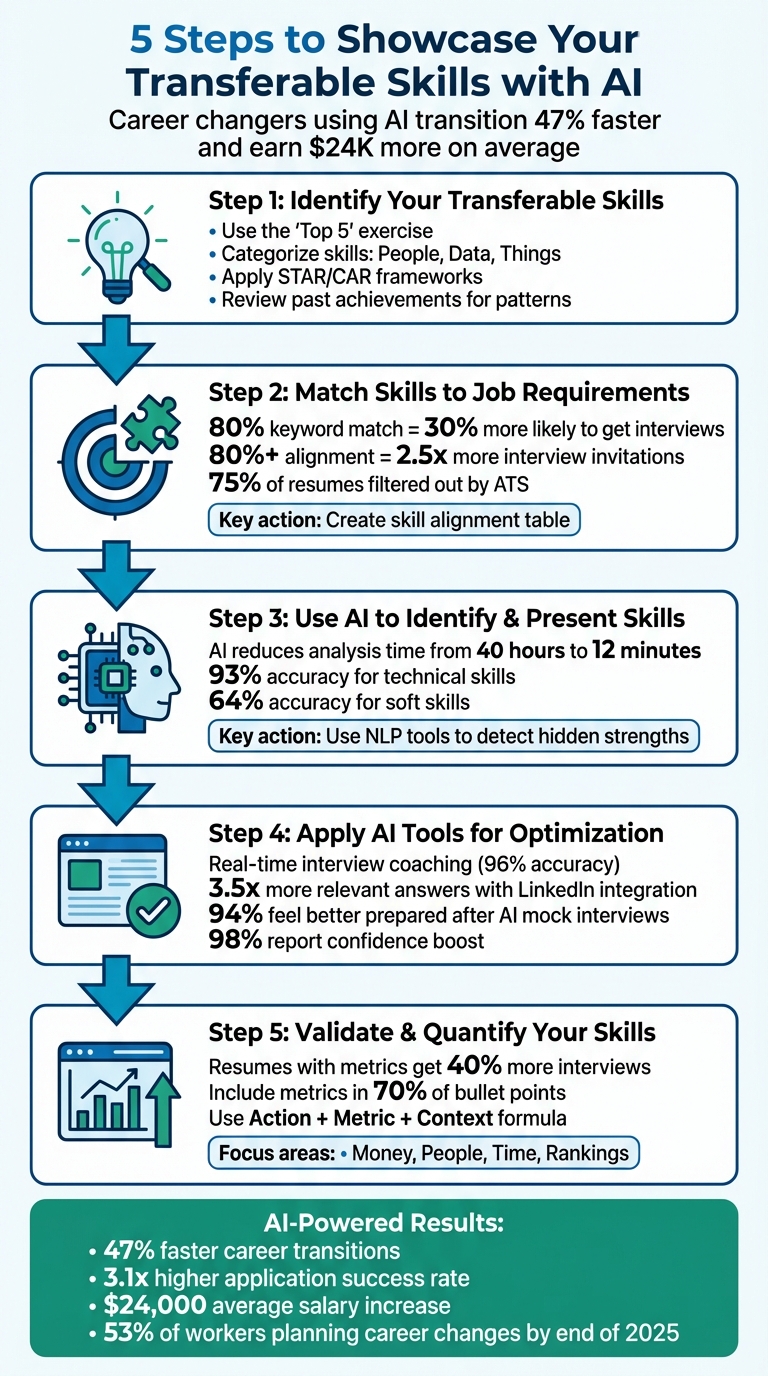
5-Step Process to Identify and Showcase Transferable Skills Using AI
How to Use ChatGPT to Find Your Transferable Skills (2025)
sbb-itb-20a3bee
Step 1: Identify Your Transferable Skills
Before showcasing your skills to potential employers, take time to identify the ones that can translate across different roles or industries, or use AI in your job search to find them. Many professionals don’t realize how valuable their everyday tasks - like managing teams, solving technical issues, or coordinating schedules - can be in a variety of settings.
Self-Assessment Methods
Start by organizing your skills into three main categories: People (e.g., communication, coaching, supervising), Data (e.g., research, analysis, data organization), and Things (e.g., equipment operation, software expertise). This approach, introduced by career expert Richard N. Bolles, can help you uncover the full range of your capabilities.
Another helpful tool is the "Top 5" exercise. Write down 10 skills you use frequently in both your professional and personal life. For each one, provide a specific example of how you’ve applied it. Then, narrow the list to the five most impactful skills, include a notable accomplishment for each, and rank them. This process helps you define what makes you stand out.
Remember, skills come from all areas of life - work, volunteering, personal projects, and more. If you’re unsure about your strengths, ask those who know you well, such as friends, family, or former coworkers. They might see talents you’ve overlooked.
Finally, review your past achievements for patterns that highlight your core strengths.
Find Patterns in Your Achievements
Reflect on times when you felt deeply engaged, proud, or in a “flow state”. These moments often point to your strongest abilities, such as critical thinking or problem-solving. Feedback from performance reviews or colleagues can also help you identify strengths that consistently stand out. For instance, if multiple managers have commended your ability to unite teams during high-pressure situations, it’s a strong indicator of collaboration and emotional intelligence.
To clearly articulate your achievements, use frameworks like STAR (Situation, Task, Action, Result) or CAR (Challenge, Action, Result). For example, if you successfully launched a product on a tight deadline, led a cross-functional team, and delivered it 15% under budget, you’re demonstrating project management, resource allocation, and leadership skills. Breaking down your accomplishments this way makes it easier to communicate your value to employers.
Step 2: Match Your Skills to Job Requirements
Once you've pinpointed your transferable skills, the next step is to align them with the specific qualifications employers are seeking. This process helps translate your experience into the language employers use, making your application stand out. Research shows that resumes matching at least 80% of the keywords in a job posting are 30% more likely to lead to interviews. Even better, candidates who align their skills with 80% or more of the listed keywords are 2.5 times more likely to secure an interview invitation. This level of precision sets the stage for a more compelling skills presentation.
Analyze Job Descriptions for Key Skills
Start by copying the entire job description into a document. This allows you to capture the employer's priorities in one place. Look for recurring terms like "project management", "SQL", or "cross-functional collaboration" - these often highlight the core competencies the employer values most.
Pay close attention to skills labeled as "must-have" or those mentioned repeatedly, as they carry more importance than non-essential requirements. You can also use resources like O*NET OnLine to uncover standard skills for the role, giving you insight into the industry-specific language that might not be explicitly stated. Keep in mind that 75% of resumes are filtered out by Applicant Tracking Systems (ATS) before reaching a human reviewer, often due to a lack of matching keywords.
Once you’ve identified the employer’s priorities, you can organize your skills for a targeted approach.
Create a Skill Alignment Table
A skill alignment table helps you tailor your skills to match the job posting in a clear and structured way. To build one, create a simple three-column table with these headings: "Target Job Requirement (Exact Phrase)", "Your Matching Transferable Skill," and "Quantifiable Example". Using the exact wording from the job posting - like "Proficient in Python" - ensures your resume aligns with ATS filters.
Next, rate your proficiency for each skill on a 1–5 scale (1 being novice, 5 being expert). Any skill where you rate yourself a 2 or lower highlights a potential gap. You can address this by either upskilling or emphasizing related skills that demonstrate your ability to adapt. In the "Quantifiable Example" column, provide concrete evidence of your expertise, such as "Built data pipeline for 2M+ records" or "Authored 30+ client proposals". This table will serve as a valuable reference for customizing your resume, cover letter, and interview responses.
| Skill Category | Target Job Requirement (Exact Phrase) | Your Matching Transferable Skill | Quantifiable Example |
|---|---|---|---|
| Technical | "Proficient in Python" | Data Scripting | Built data pipeline for 2M+ records |
| Communication | "Excellent written communication" | Stakeholder Reporting | Authored 30+ client proposals |
| Leadership | "Lead cross-functional teams" | Team Management | Managed 5-person Scrum team |
| Analytical | "Data-driven decision-making" | Statistical Analysis | Used SQL to identify $50,000 in annual savings |
Step 3: Use AI to Identify and Present Your Skills
After aligning your skills with job requirements, AI can help uncover hidden strengths and reframe them in ways that resonate with employers. The secret lies in understanding how AI analyzes your background and transforms it into compelling, employer-focused narratives.
AI-Powered Skill Detection
AI tools, powered by Natural Language Processing (NLP), can scan your resume and work history to identify skills you might not even realize you possess. For example, if you mention "managed cross-functional teams", AI can extract related competencies like leadership, conflict resolution, and stakeholder management. What might take you 40 hours to analyze manually, AI can accomplish in just 12 minutes.
To get started, upload your resume and use prompts like: "Analyze my resume to identify skills transferable to [Target Industry]" or "Identify patterns in my experience that match [Target Role] requirements". The AI will then compare your background to the job description, highlighting matching skills and pointing out any gaps.
While AI excels at identifying technical skills with about 93% accuracy, it's less adept at pinpointing context-driven soft skills like emotional intelligence, which it detects at a 64% accuracy rate. To ensure accuracy, validate AI-generated insights with feedback from industry professionals. This step ensures the skills and language used align with expectations in your target field.
Once AI has identified your transferable skills, the next step is crafting narratives that make these skills stand out to employers.
Create Tailored Skill Narratives with AI
After identifying your skills, AI can also help you frame them effectively with personalized answer suggestions. Use frameworks like PAR (Problem, Action, Result) for resumes or STAR (Situation, Task, Action, Result) for interviews. For instance, instead of a generic statement like "Responsible for team management", you could write: "Led a 5-person Scrum team to deliver three product releases 15% under budget, saving $50,000 annually."
To keep these narratives authentic, provide the AI with real examples from your work history rather than asking it to create content from scratch. You can instruct the AI to use your tone and specific accomplishments. This approach helps avoid "hallucinations", where AI fabricates details that don’t reflect your actual experience. Always review the output to ensure it accurately represents your achievements.
Additionally, AI can generate industry-specific keywords to optimize your resume for Applicant Tracking Systems (ATS). This ensures your resume passes initial screenings and enhances its visibility by aligning with relevant keywords.
Step 4: Apply Acedit for Skill Highlighting and Resume Optimization
Once you've pinpointed your transferable skills with AI, the next step is presenting them effectively. Acedit’s tools are designed to help you optimize your resume and interview responses by aligning them with job descriptions. Here’s how Acedit can refine your application materials and interview performance.
Real-Time Interview Coaching with Acedit
Acedit’s Chrome extension offers real-time assistance during live interviews. It listens to the questions being asked and provides instant, tailored response suggestions. Compatible with major video conferencing platforms, the tool pulls insights from your resume, the job description, and the company’s background to craft responses that align with the role’s specific demands.
The LinkedIn integration is a standout feature for showcasing transferable skills. By connecting your profile, Acedit extracts key skills, accomplishments, and career milestones, ensuring your responses reflect your professional brand. This feature boasts a 96% accuracy rate in representing professional experience and delivers 3.5 times more relevant interview answers compared to responses generated without LinkedIn data. Additionally, 88% of users report successfully leveraging their professional achievements during interviews with the help of this integration.
For pre-interview preparation, the AI Mock Interview feature is invaluable. It simulates interviews by mapping your background to job-specific requirements, helping you practice and build confidence. According to user feedback, 94% feel better prepared for real interviews after using this tool, and 98% experience a noticeable boost in their confidence.
Personalize Resumes and Cover Letters
Acedit’s automated cover letter generation (available with Premium plans) creates tailored letters by analyzing your writing style from your resume and LinkedIn profile. The AI customizes the content to align with the target job, ensuring your transferable skills are front and center. With its browser integration, Acedit can pull details directly from job listings, saving you time by automating the optimization process.
The skill matching and gap identification feature compares your qualifications to the job requirements, helping you emphasize the most relevant skills. By uploading your resume and the job description, the AI can identify strengths you might have overlooked. Connecting your LinkedIn profile further enhances this process, allowing the tool to uncover hidden skills and achievements.
Build STAR Examples for Your Skills
Acedit simplifies the process of creating STAR (Situation, Task, Action, Result) examples for interview questions and answers. It transforms your achievements into concise, impactful STAR narratives.
During interviews, the system provides real-time STAR-based suggestions, seamlessly incorporating your professional experiences into your responses. This ensures your answers are both authentic and effective. Users report a 91% improvement in the quality of their responses after practicing with this feature.
| Acedit Feature | How It Highlights Transferable Skills |
|---|---|
| Deep Profile Analysis | Extracts key strengths and achievements from LinkedIn to identify overlooked skills |
| Intelligent Experience Matching | Matches your background to job requirements for maximum relevance |
| Contextual Response Generation | Uses your work history to craft responses that demonstrate skill application |
| Automated Cover Letters | Creates personalized letters that emphasize skills tailored to the employer's needs |
Step 5: Validate and Quantify Your Skills
Support Skills with Metrics
Backing up your skills with numbers is a game-changer. Specific metrics not only remove ambiguity but also show real impact, making your resume stand out. In fact, resumes with measurable achievements get 40% more interview invitations compared to vague descriptions.
Zero in on four key areas to quantify your work: Money (like revenue generated or costs saved), People (team size, client numbers), Time (efficiency improvements), and Rankings (awards or ratings). If you don’t have precise figures, use ranges to maintain credibility - something like "handled 15–20 clients weekly" works well. The best time to track performance data is while you’re still in the role; trying to gather it after you’ve left can be tricky.
Use the Action + Metric + Context approach to turn generic job duties into compelling achievements. For example, instead of saying "managed social media", try "executed 12 cross-platform campaigns that boosted followers by 48% and increased web traffic by 30%." Aim to include specific metrics, percentages, or dollar figures in at least 70% of your resume bullet points. This isn’t just for human readers - Applicant Tracking Systems (ATS) also favor quantifiable data. A phrase like "increased sales by 27%" ranks higher than "increased sales" because it’s more specific.
To refine your resume and AI-generated cover letters further, use a quantification table to identify areas where metrics are missing.
Use a Skills Quantification Table
A skills quantification table is a practical way to transform vague descriptions into measurable accomplishments. Here’s an example of how original statements can be rewritten with quantifiable data. AI tools can also help by flagging vague terms and suggesting industry benchmarks to fill in the gaps.
| Original Skill Description | Quantified Achievement | Suggested Phrasing |
|---|---|---|
| Improved sales performance. | Boosted regional sales by 22%, generating $340K in new revenue. | "Strategically boosted regional sales by 22%, yielding $340K in additional annual revenue through targeted client acquisition." |
| Managed social media. | Increased follower count by 48% across 12 campaigns. | "Executed 12 cross-platform social media campaigns that drove a 48% increase in followers and a 30% lift in web traffic." |
| Responsible for client communications. | Raised satisfaction scores from 78% to 92%. | "Orchestrated client communication strategies that improved satisfaction ratings by 18% (from 78% to 92%) within six months." |
| Streamlined procurement. | Cut vendor onboarding time by 40% and saved $75K. | "Optimized procurement workflows, reducing vendor onboarding time by 40% and realizing $75K in annual cost savings." |
Whenever possible, include both percentages and baseline numbers to give a clear picture of your impact. For example, "increased sign-ups by 150% (from 200 to 500)" is more informative than just stating the percentage. Choose the unit that best highlights your contribution - dollar amounts for revenue, percentages for growth or efficiency, and raw numbers (like users or projects) for scale.
Conclusion
By following the five-step process outlined earlier, you now have a clear framework to showcase your transferable skills effectively. From self-assessment to quantifying your achievements, this approach helps you translate your experience into terms that resonate across industries. The integration of AI tools makes this process incredibly efficient, cutting review time from 40 hours to just 12 minutes.
For career changers, the benefits are striking. Those leveraging AI report transitions that are 47% faster, a 3.1x higher application success rate, and an average salary increase of $24,000. With 53% of workers planning career changes by the end of 2025, mastering these AI-driven strategies is no longer optional - it's a game-changer.
"AI won't replace the human side of hiring, but it can help you show up as your best self. Your experience, your ideas, and your personality are what employers remember. AI just helps you highlight them." - Spherion
Acedit takes these methods a step further, offering real-time coaching and tailored resume optimization. Whether you're crafting STAR examples during practice or benefiting from invisible coaching in live interviews, Acedit adjusts to your unique background and career goals. With 98% of users reporting a measurable confidence boost, this blend of preparation and real-time support gives you an edge that traditional methods simply can't match.
Use AI to map your skills, back them with solid metrics, and refine your story. Start with Acedit for as little as $45 to accelerate your job search and secure higher-paying roles.
FAQs
How does AI help me identify and showcase my transferable skills?
AI has transformed how you identify and present your transferable skills, making the process faster and more accurate. With advanced tools, it can analyze your résumé, LinkedIn profile, or work history to pinpoint key achievements, responsibilities, and actions. By linking these to universally valued skills - like project management, data analysis, or communication - AI helps you see how your strengths apply across different industries.
These tools go a step further by suggesting polished phrasing that grabs the attention of hiring managers and applicant tracking systems (ATS). For instance, instead of saying "managed a team of 5", they might recommend "led cross-functional teams to deliver projects on time and under budget." Some platforms even guide you on which skills to emphasize for specific roles, saving you hours of research and guesswork.
When using Acedit, this process becomes even smoother. Whether you're crafting a résumé, writing a cover letter, or preparing for an interview, Acedit identifies your transferable skills and offers personalized suggestions to showcase them effectively. It ensures your strengths shine consistently throughout your job search, giving you the confidence to stand out and make a lasting impression.
How can AI help improve my résumé and highlight my strengths?
AI has revolutionized how we optimize résumés, making the process quicker and more precise. It can scan job postings to pinpoint essential keywords, ensuring your résumé clears Applicant Tracking Systems (ATS) and lands in front of recruiters. Plus, it provides instant feedback on elements like layout, wording, and measurable achievements. This means you can highlight accomplishments, such as boosting revenue or improving performance metrics, to strengthen your chances of securing an interview.
Another game-changer is AI's ability to tailor your résumé for specific roles or industries. It adjusts phrasing, selects templates suited to the field, and aligns your transferable skills with the job’s requirements, giving your application a polished and customized feel. Tools like Acedit take it a step further by generating AI-crafted cover letters and syncing updates directly to your LinkedIn profile. The result? A cohesive, professional narrative that effectively highlights your strengths.
How can AI help me prepare for and excel in job interviews?
AI tools have transformed interview preparation, making it sharper and more tailored to individual needs. These tools can break down common interview questions for specific roles, anticipate the skills most sought after by employers, and guide you in turning your transferable strengths into compelling examples that leave a lasting impression on hiring managers.
One standout tool in this space is Acedit, a Chrome extension powered by AI. It goes beyond the basics by offering mock interview simulations, personalized feedback, and real-time coaching during live interviews. What’s particularly impressive is its ability to detect questions as they’re asked and provide context-aware suggestions on the spot. This ensures you stay composed and focused without interrupting the natural flow of the conversation.
AI's usefulness doesn’t stop at interviews. It can also take the hassle out of crafting tailored cover letters and fine-tuning your LinkedIn profile. By automating tedious tasks and delivering precise, actionable feedback, AI enables you to present a polished and cohesive narrative that highlights your strengths and helps you stand out in a competitive job market.