
Vous avez du mal à rédiger une lettre de motivation exceptionnelle pour un poste de responsable de produit technologique ? Les outils IA peuvent vous aider à gagner du temps, à répondre aux exigences de l'emploi et à améliorer les taux de réponse de 3,1 fois par rapport aux méthodes traditionnelles. Voici ce que vous devez savoir :
- Acedit : Personnalise les lettres de motivation en analysant votre CV, les descriptions de poste et LinkedIn. Il excelle dans l'intégration des exemples de la méthode STAR et l'alignement de votre expérience avec les besoins de l'entreprise.
- Outils IA généraux (par exemple, ChatGPT, Microsoft Copilot) : Options flexibles et abordables pour rédiger des lettres de motivation. Ils nécessitent des instructions claires pour générer des résultats efficaces.
- Outils basés sur des modèles : Offrent des cadres structurés pour les candidatures rapides, mais manquent de personnalisation approfondie.
Point clé : Utilisez l'IA pour le premier brouillon, mais personnalisez le contenu pour refléter votre voix et vos réalisations. Cette combinaison peut améliorer considérablement vos chances sur le marché du travail technologique compétitif. Vous pouvez également explorer d'autres façons d'utiliser l'IA dans votre recherche d'emploi pour rester en avance.
Comment VRAIMENT utiliser l'IA pour rédiger une lettre de motivation (selon une personne embauchée avec succès)
1. Acedit
Acedit est une extension Chrome conçue pour créer des lettres de motivation personnalisées en analysant votre CV, la description du poste et les informations sur l'entreprise. Elle aligne votre expérience avec ce que les employeurs potentiels recherchent [1]. Cette fonctionnalité est particulièrement utile pour les postes de responsable de produit technologique, où les responsables du recrutement veulent voir comment votre travail antérieur—et ses résultats mesurables—s'inscrit dans la résolution de leurs défis produits.
Analyse des descriptions de poste
Acedit extrait automatiquement les détails clés des offres d'emploi, tels que les compétences techniques requises, les qualités de leadership et les indicateurs d'alignement avec les valeurs de l'entreprise. Lorsque vous consultez une offre d'emploi de PM technologique sur n'importe quelle plateforme, l'extension analyse la description en temps réel et la compare avec vos antécédents professionnels [1]. Par exemple, si une offre d'emploi met l'accent sur la « prise de décision basée sur les données » et le « leadership interfonctionnel », Acedit identifie ces éléments et les intègre dans votre lettre de motivation [1]. Cette fonctionnalité fonctionne de manière transparente avec l'intégration du CV et de LinkedIn d'Acedit, garantissant une candidature cohérente et ciblée.
Intégration avec LinkedIn et les CV
La version premium d'Acedit pousse la personnalisation plus loin en analysant votre profil LinkedIn et votre CV pour capturer votre ton et votre style uniques [1]. Le résultat ? 94 % des utilisateurs signalent de meilleures réponses aux candidatures, et 89 % préfèrent les lettres générées par l'IA aux leurs [1]. Les utilisateurs premium peuvent également fournir des exemples STAR (Situation, Tâche, Action, Résultat), que l'IA utilise pour rédiger des récits détaillés et axés sur les métriques [1]. Cette intégration rend non seulement vos lettres de motivation plus attrayantes, mais garantit également qu'elles mettent en évidence vos réalisations d'une manière qui résonne avec les responsables du recrutement.
Narration axée sur les métriques
Dans le monde de la gestion de produits technologiques, les chiffres parlent beaucoup. Acedit transforme les données de votre CV en histoires puissantes qui relient vos réalisations au poste auquel vous postulez [1]. Par exemple, si votre CV mentionne « augmentation de la rétention des utilisateurs de 15 % », Acedit encadre ce succès d'une manière qui s'aligne avec les objectifs de l'entreprise prospective. Il prend également en charge les candidatures pour les postes de direction et de leadership, ce qui en fait un outil précieux pour les PM technologiques de haut niveau qui doivent démontrer une réflexion stratégique [1]. Cette concentration sur les résultats quantifiables est cruciale pour démontrer l'impact et la valeur que vous pouvez apporter à un nouveau rôle. Cette préparation est la première étape vers la perfection de votre préparation aux entretiens une fois que vous avez obtenu la réunion.
2. Générateurs de texte IA à usage général
Les outils IA à usage général tels que ChatGPT, Microsoft Copilot et Grammarly offrent des options abordables pour rédiger des lettres de motivation. Ces outils analysent votre CV et une description de poste pour identifier les compétences transférables, ce qui les rend particulièrement utiles pour des rôles comme la gestion de produits technologiques [6]. Décomposons comment ces outils gèrent les descriptions de poste, rédigent des récits basés sur les métriques et relèvent le défi de la personnalisation.
Analyse des descriptions de poste
Lorsque vous fournissez une description de poste et votre CV, ces outils peuvent analyser l'offre pour identifier les responsabilités et les exigences clés. Par exemple, au lieu de demander une lettre de motivation générique, vous pourriez demander à l'IA : « Comparez mon CV à cette description de poste et mettez en évidence ce que j'ai abordé et ce qui manque » [6]. Cette approche permet à l'IA de repérer les lacunes et de suggérer des améliorations. De plus, vous pouvez demander l'extraction de mots-clés pour mieux adapter votre candidature aux systèmes de suivi des candidatures. Cependant, contrairement aux plateformes dédiées, vous devrez saisir manuellement les données de votre CV et de la description de poste [13, 14].
Narration axée sur les métriques
Au-delà de l'analyse des descriptions de poste, ces outils peuvent transformer les données brutes en récits convaincants. Par exemple, ils peuvent prendre des réalisations techniques et les encadrer comme des histoires concises et orientées vers la valeur. Cela dit, il y a un risque d'inexactitudes—l'IA fabrique parfois des qualifications ou des expériences qui ne correspondent pas à vos antécédents réels [12, 14]. Vérifiez toujours le résultat. Si vous fournissez des métriques spécifiques, comme « augmentation de la rétention des utilisateurs de 15 % », l'IA peut vous aider à les transformer en déclarations persuasives. La précision de ces récits dépend fortement de la précision des données que vous fournissez [5] [4].
Le problème du toucher humain
Le contenu généré par l'IA manque souvent d'une touche personnelle, ce qui le rend facile à repérer pour les recruteurs. Les signes révélateurs courants incluent des formulations formulaïques, l'abus de certains signes de ponctuation (comme les tirets cadratin) ou des lignes d'ouverture génériques [2, 12].
« Les employeurs reçoivent des centaines de lettres de motivation exactement identiques mot pour mot. »
- Shoshana Davis, fondatrice d'un cabinet de conseil en carrière [2].
« Modifiez-la... ajoutez votre propre couleur, texture et ton, et faites-en quelque chose qui vous ressemble vraiment. »
- Expert en IA Dave Birss [2].
Traitez les brouillons générés par l'IA comme un point de départ. Ajoutez des anecdotes personnelles, des recherches spécifiques sur l'entreprise et un ton qui reflète votre individualité pour que votre lettre de motivation se démarque [2, 14]. En combinant l'efficacité de l'IA avec votre contribution personnelle, vous pouvez créer une candidature authentique qui résonne avec les recruteurs. Ces différences soulignent pourquoi les outils à usage général et les plateformes spécialisées comme Acedit servent des objectifs distincts.
sbb-itb-20a3bee
3. Outils de lettres de motivation basés sur des modèles
Après avoir exploré les capacités générales et personnalisées de l'IA, plongeons dans les outils qui offrent une approche plus structurée. Des plateformes comme Texta.ai et CoverDoc.ai fournissent des cadres prêts à l'emploi spécialement conçus pour rédiger des lettres de motivation pour les responsables de produits technologiques (TPM). Ces outils vous guident pour aborder les responsabilités principales telles que la définition de la vision produit, la promotion de la collaboration interfonctionnelle et l'analyse des données [7].
Conseils spécifiques au rôle
Les outils basés sur des modèles simplifient le processus en divisant votre lettre de motivation en sections qui s'alignent sur les exigences spécifiques au TPM. Par exemple, Texta.ai propose des modèles destinés à vous aider à articuler des aspects clés comme la priorisation de la feuille de route produit et la gestion des parties prenantes. Ces guides étape par étape garantissent que votre candidature répond directement aux exigences du rôle [7].
Analyse des descriptions de poste
Bien qu'ils manquent des capacités d'analyse avancées de certains outils IA, les plateformes basées sur des modèles excellent dans la fourniture de résultats structurés et efficaces. En collant simplement la description de poste, ces outils mettent en évidence les exigences critiques et tirent même les mises à jour récentes de l'entreprise. En moyenne, les utilisateurs économisent environ 35 minutes par candidature avec cette approche rationalisée [4]. Cette efficacité non seulement accélère le processus, mais vous aide également à rédiger un récit bien organisé et axé sur les métriques.
Narration axée sur les métriques
L'efficacité des outils basés sur des modèles dépend fortement de la qualité des données que vous fournissez. Des entrées faibles conduiront à des résultats génériques, il est donc crucial d'inclure des métriques spécifiques et vérifiables. Par exemple, les utilisateurs de CoverDoc.ai ont signalé une augmentation de 30 % de l'engagement lorsqu'ils incorporent des réalisations mesurables dans leurs lettres de motivation [4]. Cette concentration sur les chiffres souligne comment ces plateformes se distinguent des outils comme Acedit, qui mettent l'accent sur l'intégration personnalisée, et des générateurs à usage général, qui privilégient la flexibilité. Les plateformes basées sur des modèles brillent en offrant une solution structurée et économe en temps adaptée à la narration axée sur les résultats.
Forces et faiblesses
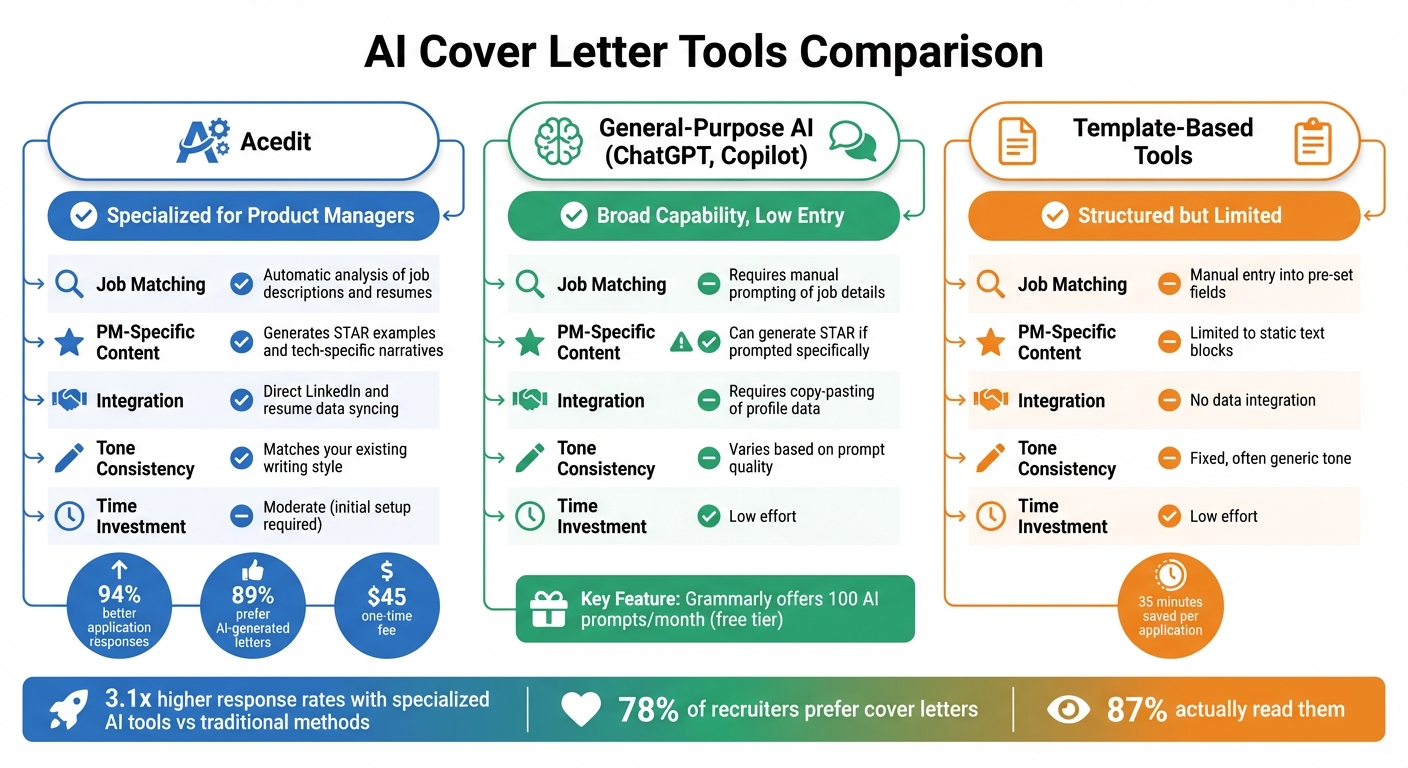
En approfondissant les types d'outils IA disponibles, examinons les avantages et les défis spécifiques qu'ils apportent. Acedit se distingue par sa capacité à rédiger des lettres de motivation hautement personnalisées. En analysant votre profil LinkedIn et votre CV, il crée des lettres qui reflètent votre style d'écriture unique et incluent des exemples STAR adaptés. Cependant, il y a une courbe d'apprentissage—les utilisateurs doivent installer une extension Chrome et intégrer leurs profils, ce qui peut sembler moins direct par rapport à des options plus simples.
Les générateurs de texte IA à usage général, comme ChatGPT, offrent une flexibilité inégalée et peuvent s'intégrer facilement dans votre flux de travail. Ces outils sont parfaits pour des tâches comme les modifications finales ou l'ajustement du ton. Par exemple, Grammarly offre même jusqu'à 100 invites IA par mois dans sa version gratuite (à partir de fin 2025) [9]. L'inconvénient ? La qualité du résultat dépend fortement de la spécificité et de la clarté de vos invites. Les instructions vagues conduisent souvent à des résultats génériques.
Les outils basés sur des modèles, en revanche, sont tous axés sur l'efficacité. Ils fournissent des formats structurés qui vous guident étape par étape à travers les sections essentielles. Cependant, comme le souligne Lori Shreve Blake du Centre de carrière de l'USC, ces outils ne suffisent pas en matière de persuasion :
« La lettre de motivation est aussi un texte persuasif... une lettre de motivation générée par l'IA ne peut pas [construire un argument sur la raison pour laquelle vous seriez un excellent candidat] » - [10].
Dans de nombreux cas, ils se contentent de reprendre votre CV plutôt que de connecter vos compétences et expériences directement au rôle.
Voici une comparaison rapide de la façon dont ces outils se comparent pour rédiger des lettres de motivation adaptées aux rôles de responsable de produit technologique :
| Fonctionnalité | Acedit | IA à usage général | Outils basés sur des modèles |
|---|---|---|---|
| Correspondance d'emploi | Analyse automatique des descriptions de poste et des CV [1] | Nécessite une saisie manuelle des détails de l'emploi [2] | Saisie manuelle dans des champs prédéfinis |
| Contenu spécifique au PM | Génère des exemples STAR et des récits spécifiques à la technologie [8] | Peut générer STAR si demandé spécifiquement | Limité aux blocs de texte statiques |
| Intégration | Synchronisation directe des données LinkedIn et du CV [3] | Nécessite le copier-coller des données de profil | Pas d'intégration de données |
| Cohérence du ton | Correspond à votre style d'écriture existant [1] | Varie selon la qualité de l'invite | Ton fixe, souvent générique |
| Investissement en temps | Modéré (configuration initiale requise) | Effort minimal | Effort minimal |
Cette comparaison met en évidence les compromis entre la personnalisation et la commodité. Pour les candidatures de responsable de produit technologique, quel que soit l'outil que vous choisissez, ajouter une touche personnelle et affiner la lettre manuellement est essentiel pour présenter efficacement vos réalisations.
Conclusion
Le choix du bon outil IA dépend entièrement de ce que vous avez besoin qu'il fasse. Si votre objectif est de soumettre plusieurs candidatures qui exigent un haut niveau de personnalisation, Acedit est un concurrent solide. Avec 94 % des utilisateurs signalant de meilleures réponses aux candidatures, c'est un choix solide pour les demandeurs d'emploi sérieux ciblant des rôles compétitifs en gestion de produits. Les frais uniques de 45 $ pour un accès Premium à vie en font une option abordable pour ceux qui valorisent la précision et la personnalisation.
D'autre part, si vous êtes à l'aise pour expérimenter des invites et que vous voulez plus de flexibilité, les outils à usage général comme ChatGPT peuvent être un excellent partenaire de brainstorming. Ces outils brillent lorsque vous explorez différents récits, comme le reencadrement des réalisations techniques pour un impact commercial plus large ou le pivot vers une nouvelle industrie.
Pour ceux qui préfèrent la vitesse et la simplicité, les outils basés sur des modèles peuvent fournir des documents rapides et polis. Cependant, ceux-ci manquent souvent de la profondeur de personnalisation nécessaire pour se démarquer. Comme le souligne Shoshana Davis, fondatrice d'un cabinet de conseil en carrière :
« Les employeurs reçoivent des centaines de lettres de motivation exactement identiques mot pour mot » [2].
Ces modèles peuvent servir de point de départ utile, mais ils nécessitent une personnalisation importante pour faire une véritable impression.
Il est à noter que 78 % des recruteurs préfèrent les lettres de motivation, et 87 % les lisent réellement [2]. Les outils IA spécialisés ont montré qu'ils génèrent 3,1 fois plus de réponses par rapport aux méthodes traditionnelles [1]. Pour les rôles de gestion de produits technologiques—où la démonstration de la réflexion stratégique et la capacité à traduire les concepts techniques en valeur commerciale est cruciale—les outils IA qui analysent les descriptions de poste et rédigent des exemples STAR peuvent vous donner un avantage majeur. En fin de compte, le meilleur outil est celui qui met en évidence vos forces uniques et s'aligne parfaitement avec les exigences des postes de PM technologiques.
FAQ
Comment Acedit crée-t-il des lettres de motivation personnalisées pour les rôles de responsable de produit technologique ?
Acedit utilise l'IA pour créer des lettres de motivation personnalisées en examinant la description du poste, votre CV et votre profil LinkedIn. Il identifie vos compétences et expériences les plus pertinentes, garantissant que le ton et le contenu s'alignent parfaitement avec les valeurs et l'environnement de travail de l'entreprise.
En adaptant votre lettre de motivation au rôle et à l'organisation spécifiques, Acedit vous aide à présenter vos qualifications d'une manière qui établit vraiment un lien avec les employeurs potentiels.
Quels sont les avantages d'utiliser des outils IA pour rédiger des lettres de motivation pour les rôles de responsable de produit technologique ?
Les outils IA rendent la rédaction de lettres de motivation personnalisées beaucoup plus facile en analysant les descriptions de poste, en identifiant les compétences et qualifications essentielles et en les alignant avec les détails de votre CV ou profil LinkedIn. Cette approche garantit que votre candidature met en évidence les expériences les plus pertinentes et s'aligne étroitement avec ce que les employeurs recherchent.
Au lieu de rédiger chaque lettre de motivation à partir de zéro, ces outils peuvent créer des brouillons polis en quelques secondes, vous faisant gagner un temps précieux. Ils aident également à maintenir la cohérence dans vos candidatures et profils en ligne, vous donnant une meilleure chance de vous démarquer sur le marché du travail technologique compétitif. En simplifiant le processus, les outils IA vous permettent de vous concentrer davantage sur d'autres tâches cruciales, comme le réseautage ou la préparation aux entretiens.
Comment puis-je rendre ma lettre de motivation générée par l'IA unique et percutante ?
Pour rédiger une lettre de motivation générée par l'IA impressionnante, exploitez Acedit pour analyser la description du poste et l'aligner avec votre CV et profil LinkedIn. Concentrez-vous sur la présentation de vos réalisations les plus pertinentes et ajustez le ton pour refléter les valeurs et l'environnement de travail de l'entreprise. Ajoutez une touche personnelle en incluant des anecdotes ou des perspectives qui mettent en évidence vos expériences uniques. Pour une personnalisation plus approfondie, vous pouvez explorer l'option premium, qui offre des fonctionnalités de personnalisation illimitées. Une lettre de motivation bien adaptée peut faire une impression mémorable.