
If I want reach, I use AI. If I want trust, I write the message myself.
Here’s the short answer: AI helps me handle LinkedIn work at scale - profile edits, contact sorting, draft messages, follow-ups, and interview prep. Manual networking takes more time, but it works better for referrals, senior contacts, and any conversation where tone matters. The best setup is both: let AI do the prep, then step in by hand when the message has more at stake.
A few numbers make the tradeoff clear:
- AI-assisted outreach can support 500+ contacts per week with about 1 hour of upkeep
- Manual outreach often takes 15–20 minutes per person
- AI-driven campaigns can reach 1,500–3,000 people per month
- Warmed-up automation can get 15%–22% response rates
- Cold automated outreach often lands around 8%–12%
- Heavy automation carries 60%–80% account restriction risk within 12 months
- About 20% of heavy automation users may face permanent bans
What I’d focus on:
- Use AI for: profile polish, first drafts, lead sorting, follow-up scheduling, and interview practice
- Use manual work for: referrals, executive outreach, career changes, and seen-but-ignored messages
- Switch to manual when: there’s hiring news, funding, a merger, or any sign the contact is getting flooded with templated notes
- Check every AI draft: if it sounds fake-personal, it can hurt replies
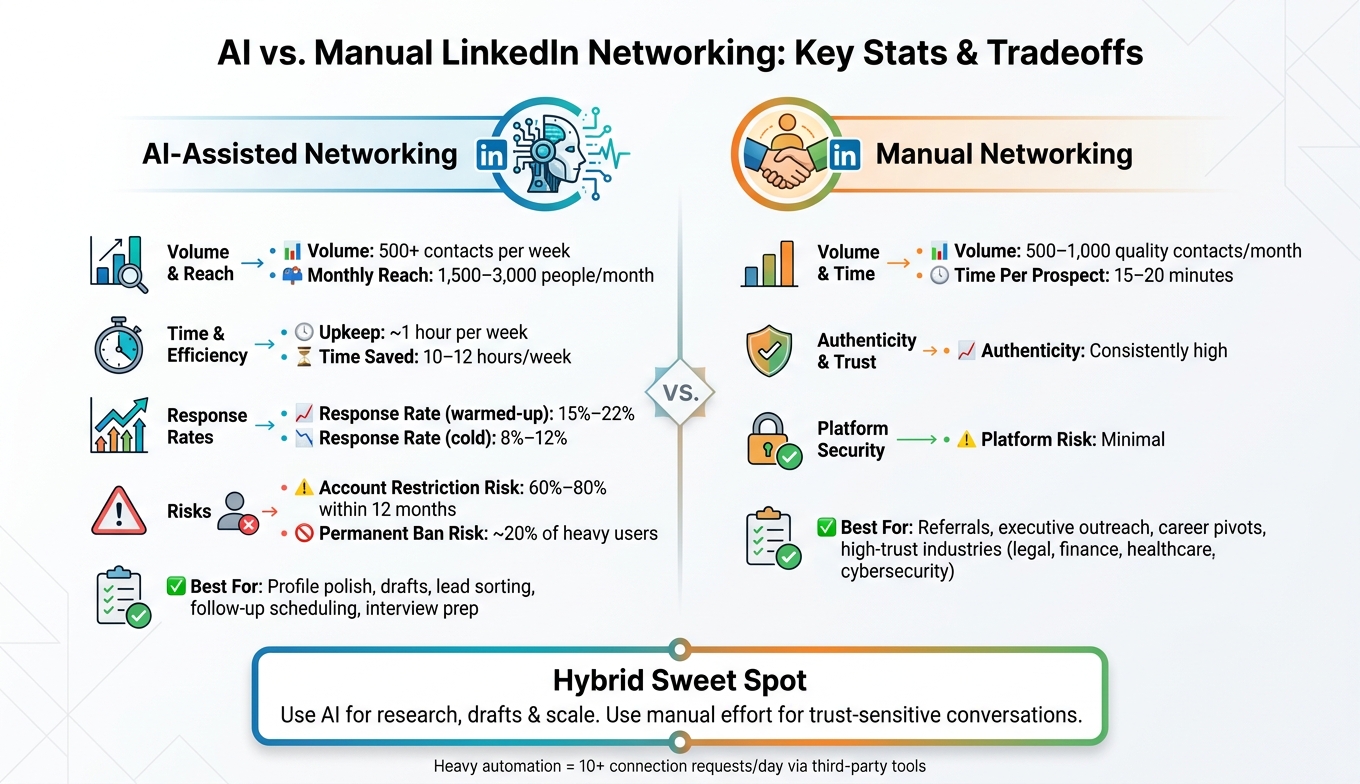
AI vs. Manual LinkedIn Networking: Key Stats & Tradeoffs
NetworkAI vs Manual Outreach: Scale LinkedIn Connections Fast (2026)
Quick Comparison
| Area | AI Tools | Manual Networking |
|---|---|---|
| Speed | High | Low |
| Volume | 500+ per week | Limited by time |
| Personal touch | Mixed | High |
| Best use | Research, drafts, follow-ups, prep | Trust-based outreach and live conversations |
| Risk | Higher if overused | Low |
| Best result | More pipeline | Better relationship depth |
So my takeaway is simple: AI saves time, but manual effort wins the moments that matter most. Use software for the repeatable work. Use your own judgment for the messages people will remember.
How AI Changes LinkedIn Networking
Faster profile updates and outreach drafts
AI can tighten up your LinkedIn headline, About section, and experience bullets in minutes. It uses keywords tied to the role and clearer impact-focused wording, which can save a lot of editing time.
Outreach is where the time savings hit even harder. Manual research for one prospect can take 15–20 minutes. AI can draft a message in seconds using details like job changes, mutual connections, and recent activity. If you're trying to reach the right people fast, that kind of speed is hard to ignore.
That said, you still need to check every draft before it goes out. If a message feels fake-personalized, people can sense it. That can trigger the "Uncanny Valley" effect and weaken trust.
Contact prioritization and interview preparation
AI can also help you decide who to contact first. Instead of scrolling through search results by hand, tools can group prospects by job function, seniority, or company fit. Some also look for signals of active interest and flag people who are already researching solutions.
That changes the job a bit. You spend less time sorting through names and more time putting manual effort where it has the best shot of paying off.
When a contact turns into a real conversation, AI can help on the prep side too. Acedit connects LinkedIn activity to interview prep with tailored Q&A and mock interviews.
The table below shows where AI saves time and where manual effort still matters.
Comparison table: AI tasks vs. manual equivalents
| Task | Manual Approach | AI-Supported Approach |
|---|---|---|
| Profile updates | Hours of manual editing and keyword research | Instant refinement using role-relevant keywords and impact language |
| Outreach drafting | 15–20 minutes per prospect for research and writing | Seconds to generate a draft using 75+ data points per prospect |
| Contact prioritization | Manual scrolling through search results and feeds | Auto-grouping by function, seniority, or signals of active interest |
| Follow-ups | Lower consistency due to manual inconsistency | More consistent follow-up via automated sequences |
| Interview prep | Manual research on company culture and likely questions | Tailored Q&A and mock interviews via Acedit |
sbb-itb-20a3bee
What Manual LinkedIn Networking Still Does Best
When speed matters, AI helps. When trust matters, manual outreach still has the edge.
Deeper personalization and trust
AI can draft messages fast. But manual outreach still does better on credibility because it shows actual research and human judgment. And that kind of detail is hard to fake in a convincing way.
High-value contacts notice the difference. A note that points to a real company update, a recent hire, or shared context feels far more intentional than a polished template. That matters even more now because more than 50% of businesses use AI assistants for connection request messages. As a result, many high-value contacts are getting more cautious about outreach that sounds templated.
A carefully researched, human-written note can cut through. For example, tying a recent company move to a specific business problem shows you've paid attention. That's the sort of message automation often struggles to match.
Human judgment in sensitive situations
Manual outreach matters most in career pivots, referrals, executive outreach, and other high-stakes conversations where tone can make or break trust. In those moments, human judgment does more than polish the wording. It shows the message came from actual attention, not generated personalization.
Referral requests are the clearest example. You're asking someone to put their own reputation on the line, so the message needs to feel personal, specific, and sincere. Anything vague or formulaic can hurt your odds fast.
There's also a simple rule for follow-ups: if a prospect has already seen a message and hasn't replied, stop the sequence. Then follow up manually with a short, useful insight or a brief voice note. That small shift can change how the message lands.
That tradeoff stands out most when you put manual outreach next to AI's speed and scale.
Comparison table: manual networking strengths and limits
The table below breaks down the main strengths and limits of manual networking.
| Factor | Manual Networking |
|---|---|
| Effort Required | High - roughly 15–20 minutes per prospect |
| Perceived Authenticity | High - feels unique and intentional |
| Scalability | Limited - quality drops as volume increases |
| Risk of Missteps | Low - human oversight catches errors before they go out |
| Best For | High-stakes outreach, referrals, executive contacts, and regulated or high-trust industries such as legal, cybersecurity, finance, and healthcare |
Direct Comparison: Results, Risk, and Long-Term Value
After speed and trust, the next thing to look at is results, risk, and long-term value.
Efficiency, personalization, and authenticity
AI wins on scale. Manual networking wins on depth.
AI tools can reach 1,500–3,000 prospects per month. A disciplined manual process usually tops out at around 500–1,000 quality contacts over the same stretch.
That gap matters. If your goal is more reach in less time, AI has a clear edge.
The same pattern shows up in response rates. Engagement-first automation - where you warm up a prospect by interacting with their content before sending a connection request - can lift response rates to 15–22%. Cold automation with no warmup usually lands at 8–12%.
Still, more outreach doesn't automatically mean better relationships. A message can be sent at scale and still fall flat. Manual outreach tends to feel more credible because it sounds researched, not generated.
Compliance, reputation, and relationship outcomes
Risk is where the two methods split the most.
Manual networking carries minimal platform risk because it stays within LinkedIn's normal usage patterns. Heavy automation is a different story: 60% to 80% of heavy automation users run into some kind of LinkedIn account restriction within 12 months. About 20% eventually face permanent bans.
There's also the reputation issue. Robotic messages chip away at trust, and that can hurt replies, referrals, and introductions.
Comparison table: AI vs. manual across key dimensions
| Dimension | AI-Driven LinkedIn Networking | Manual LinkedIn Networking |
|---|---|---|
| Efficiency | High - saves 10–12 hours/week | Low - ~15–20 minutes per prospect |
| Personalization | Data-driven (75+ data points) | Deep, context-aware, and unique |
| Authenticity | High if well-configured; low if templated | Consistently high |
| Platform/Account Risk | Moderate to High - 60–80% restriction risk within 12 months | Minimal - compliant with LinkedIn's Terms of Service |
| Long-Term Value | Strong for pipeline volume; weaker for deep trust | Strong for referrals, trust, and social capital |
That split leads to a hybrid workflow: use AI for prep work, and use manual effort for the outreach that carries the most weight.
Choosing the Right Approach and Combining Both
When AI fits and when manual works better
Use AI for scale. Use manual outreach for trust-sensitive moments. That’s the rule, and it works best in a hybrid setup.
AI is useful for high-volume outreach and early drafts. But sensitive messages still need human judgment. Senior leaders in tight-knit fields can spot a templated note almost immediately. And in those cases, one generic message can earn you a long-term block.
A practical hybrid workflow for job seekers
The easiest way to handle this is to split the work by task. Let AI help with research and first drafts, but keep the final message in your hands. And once a real conversation starts - a recruiter call, an informational interview, or a live interview - the human side needs to take over.
Acedit fits well at that stage. You can use it for interview simulations, practice questions, and real-time coaching so you show up ready.
Comparison table: hybrid workflow by task
The table below shows how that split can look in practice.
| Task | AI-Supported | Manual |
|---|---|---|
| Research | Mining LinkedIn data, finding gaps in your network, and surfacing past connections | Verifying contact relevance and assessing strategic or cultural fit |
| Drafting | Generating first-pass outreach messages using 75+ data points | Infusing personal voice, specific shared history, and emotional nuance |
| Final Personalization | Inserting variables like recent news or mutual interests | Reviewing tone, seniority fit, and ensuring it doesn't read as templated |
| Live Conversation | Using tools like Acedit to prepare for recruiter calls and interview questions | Real-time messaging, video calls, and building rapport through active listening |
| Post-Conversation Follow-up | Scheduling automated touchpoints to keep follow-ups consistent | Handling high-value negotiations and personal check-ins that deepen the relationship |
One of the clearest signs to switch from AI to manual is an intent trigger - like hiring, funding, or a merger - or a message that was seen but ignored. That’s usually the point when inboxes start filling with automated outreach, and a specific human note has a better shot at standing out.
Use AI for research, drafts, and consistency. Use manual effort for the conversations that depend on trust.
FAQs
When should I switch from AI to manual outreach?
Switch to manual outreach when the stakes are high or the situation has a lot of moving parts. That usually means enterprise deals above $10,000 or sales cycles that stretch over weeks or months.
Manual outreach also makes sense when you need a more personal approach, including:
- High-touch relationship building
- Reconnecting with existing contacts
- Niche-market reputation management
- Senior-executive outreach
- Crisis communications
- The final ask for a meeting or sale
At that point, a one-size-fits-all message usually won't cut it. You need careful timing, a clear point of view, and outreach that feels personal from the first line.
How can I use AI on LinkedIn without sounding robotic?
Use AI for structure, research, or a first draft. Then go back and review everything by hand. That last pass matters because it helps you strip out generic patterns, corporate jargon, and those tired phrases that make a message feel canned.
It also helps to add one specific, verifiable detail about the recipient. Maybe it’s a talk they gave, an article they wrote, or a recent job move listed on LinkedIn. That kind of detail shows you did the homework.
A good rule of thumb: don’t automate high-stakes networking or direct sales asks. Those messages carry more weight, and people can usually tell when they’ve been mass-produced.
If you want AI output to sound more like you, train your tools on your past successful conversations. Use replies, emails, or messages that got good results. That way, the draft starts to reflect your voice instead of sounding like everyone else on the internet.
What tasks should I always handle manually?
Handle high-stakes interactions and complex relationship-building by hand. That’s the best way to keep trust intact and the conversation human.
This covers pitches for meetings, sales, or partnerships, along with crisis communication and negative feedback. It also includes outreach to high-value enterprise accounts above $50,000, plus all engagement after a prospect responds positively.