
Struggling to answer tough interview questions? Building a personal story bank can change that. Here's how AI tools like Acedit make it easier than ever to prepare for interviews by organizing your experiences into clear, impactful stories.
- What is a personal story bank? A collection of 15–25 career-related stories tailored to common behavioral interview questions.
- How does it work? Stories are structured using the STAR framework (Situation, Task, Action, Result) to make your answers concise and effective.
- How does AI help? AI tools analyze your resume, LinkedIn profile, and job descriptions to quickly generate STAR-based stories and provide real-time coaching during mock interviews.
- Why use it? Research shows AI reduces interview stress by 89%, improves confidence by 98%, and makes responses 3.5 times more relevant.
Key steps to create your story bank:
- Gather your career highlights, including metrics and achievements.
- Use AI to refine and format stories into the STAR framework.
- Organize stories by skills like leadership, teamwork, and problem-solving.
- Practice delivering stories with AI mock interviews for better preparation.
AI tools save time, improve clarity, and help you feel prepared for any interview question. Ready to turn your experiences into success stories? Let AI streamline the process.
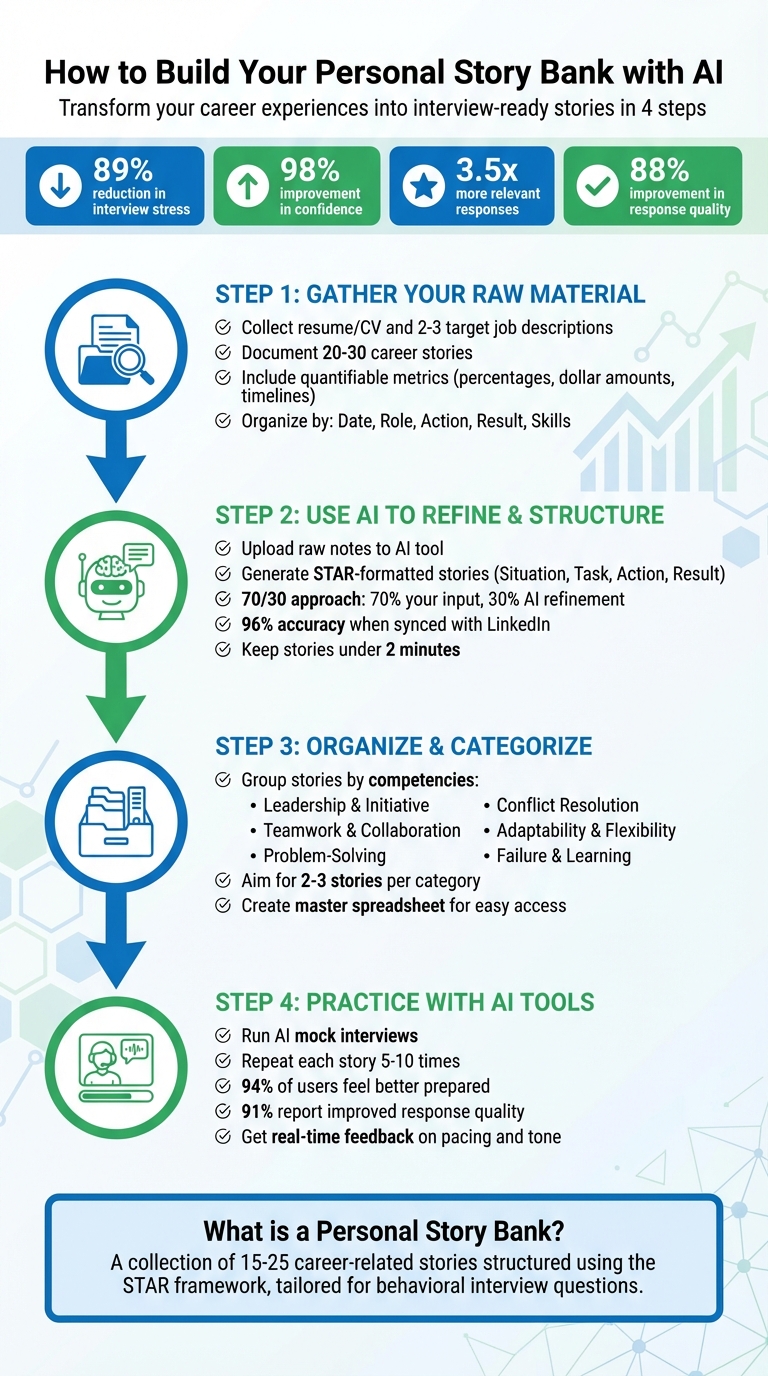
4-Step Process to Build Your AI-Powered Personal Story Bank for Interview Success
What Is a Personal Story Bank and Why You Need One
Defining a Personal Story Bank
A personal story bank is essentially a collection of 15–25 career-related stories tailored for behavioral interviews. Instead of memorizing individual answers, this approach equips you with flexible narratives that can be adjusted on the fly. For instance, one story about leading a team project can showcase your leadership, problem-solving, or teamwork skills - depending on how you frame it.
Without a story bank, candidates often ramble or forget key details when under pressure. By organizing your stories around specific competencies - like conflict resolution or teamwork - you can quickly match the right story to the question being asked.
Next, let’s explore how the STAR framework can help you structure these stories effectively.
How the STAR Framework Structures Your Stories
The STAR framework is a simple, structured way to present your stories, making them easy for interviewers to follow. It breaks your narrative into four parts: Situation (the context), Task (your role), Action (what you did), and Result (the outcome). This method keeps your answers concise - ideally under two minutes - and ensures they emphasize your impact.
Here’s an example of a STAR-formatted story:
- Situation: "In my sales role at XYZ Corp, quarterly targets dropped 20% due to market shifts."
- Task: "Revive the pipeline to meet goals."
- Action: "Analyzed data, pivoted to virtual demos, and trained the team on new scripts."
- Result: "Exceeded targets by 10%, earning a top performer award and a $5,000 bonus".
This story highlights adaptability, problem-solving, and sales expertise all at once, making it suitable for a variety of questions.
Now, let’s see how AI can make creating a story bank faster and easier.
How AI Changes Story Bank Creation
AI interview preparation can turn what used to take days into a process that takes just minutes. Instead of manually crafting and organizing dozens of stories, you can upload your resume bullet points, and AI will generate narratives in STAR format. Research shows that using AI for this task can improve efficiency by up to 80% compared to doing it by hand.
For example, Acedit, an AI-powered Chrome extension, can instantly create STAR-based stories from your resume and even provide real-time coaching and practice simulations. However, it’s important to review and refine AI-generated content to ensure it reflects your personality and unique experiences. A good rule of thumb is the 70/30 approach: 70% should come from your input, with AI fine-tuning the remaining 30%.
sbb-itb-20a3bee
Step 1: Gather Your Raw Material
What Information to Collect
Before AI can help you craft a solid story bank, you need to start with high-quality raw material. Begin by gathering your resume or CV, along with job descriptions from 2–3 roles you're targeting. This helps identify the skills and experiences employers are looking for. Add quantifiable metrics to your collection, like achievements such as:
- "Reduced project turnaround time from 10 days to 4 days"
- "Increased customer retention by 15%"
- "Led a team of 5 to deliver a $500,000 software upgrade under budget".
Also, document specific examples of challenges you've overcome or accomplishments you're proud of. These examples will form the base for your STAR-structured stories.
To dig deeper, review past performance reviews or other work-related documents for concrete examples. Reflect on questions like, "What was my biggest achievement last year?" or "When did I fail and bounce back successfully?" Aim to collect 20–30 stories that showcase a variety of skills, such as teamwork, conflict resolution, decision-making, process improvements, and learning from mistakes.
This collection of details lays the groundwork for AI to help you turn raw data into polished, STAR-formatted stories.
How to Prepare Your Input
Organize your notes digitally to make the process smooth. Use columns for Date, Role, Action, Result (with metrics), and Skills. Group stories by themes like leadership or innovation so you can quickly find what you need later. Be sure to include numbers wherever possible: percentages, dollar amounts (e.g., "$100,000 cost savings"), timelines (e.g., "completed in 3 months"), or scales (e.g., "benefiting 50 users"). If exact figures are unavailable, provide reasonable estimates like "approximately 30% improvement".
Focus on proven interview strategies by aligning your achievements with the job descriptions and cross-referencing your stories with the required skills. Highlight the ones that best showcase the abilities employers value most. Detailed, specific inputs are key - generic or vague details will only result in lackluster AI suggestions. Instead, ensure each story clearly answers the "who, what, when, where, why, and how" of your contribution. Avoid using impersonal "we" statements; make sure your role is front and center.
Once your input is well-organized and detailed, you're ready to let AI transform your raw material into compelling, STAR-based narratives.
How to Practice Mock Interviews with AI
Step 2: Use AI to Refine and Structure Your Stories
Now that you've gathered your raw material, the next step is shaping it into well-organized, engaging stories for your personal story bank. AI can be a powerful tool to help you refine and structure these narratives.
AI Prompts for Refining Stories
Transforming raw notes into polished narratives requires clear and specific instructions for the AI. For instance, you could prompt it with something like: "Turn this raw input into a concise STAR story, focusing on key metrics, challenges, actions, and results, and keep it under two minutes."
Tools like Acedit are particularly effective for this task. By connecting your LinkedIn profile, Acedit can align its outputs with your career history, achieving an impressive 96% accuracy in reflecting your experience. One standout feature is its "Custom STAR Examples", which lets you upload your raw notes. The AI then structures them into clear Situation-Task-Action-Result narratives, highlighting your personal contributions and measurable outcomes.
The process works best when approached iteratively. Once you receive the AI's first draft, review it critically and refine it further by asking follow-up questions. For example, you might say: "Make this more concise and impactful" or "Reframe this story to emphasize my problem-solving skills over the technical outcome." This back-and-forth process allows you to polish your story until it feels authentic and impactful. In fact, users have reported an 88% improvement in the quality of their responses when engaging in this iterative refinement.
This step not only sharpens your story but also ensures it stays true to your experience, making it both clear and compelling.
Keeping Your Stories Truthful
Refining your stories with AI is about enhancing how you tell them - not fabricating details or exaggerating your role. It's essential to start with genuine experiences and use AI solely to improve clarity, structure, and impact.
To maintain authenticity, ground your AI refinements in verifiable facts. Linking your resume or LinkedIn profile to the AI tool creates a solid foundation, reducing the risk of the AI generating inaccurate or misleading content. Be cautious with enhancements - reject anything that misrepresents your accomplishments or inflates your metrics. The goal is to showcase your real achievements in the best light, not to invent new ones.
As one user shared, "Acedit helped me refine my answers, giving me the confidence to secure a UX design role" – Amelia Harris.
After using AI, it's a good idea to have a trusted mentor or peer review your refined stories. Their feedback ensures your narratives remain honest and align with how you naturally communicate. This final step helps you present yourself authentically and confidently.
Step 3: Organize and Categorize Your Stories
Once you've polished your stories, the next step is to organize them in a way that makes them easy to access during interview prep. A well-structured story bank turns your experiences into a powerful tool for answering questions confidently. With the precision of AI, you can streamline this process, ensuring you're ready for any scenario. Here's how to group and manage your stories effectively.
Group Stories by Skills and Competencies
Start by categorizing your stories under key competencies such as Leadership & Initiative, Teamwork & Collaboration, Problem-Solving, Conflict Resolution, Adaptability & Flexibility, and Failure & Learning. These categories align with behavioral interview questions and answers.
Aim to collect 2–3 stories per category. This ensures you have options to tailor your answers to different questions. For example, if asked about teamwork, you can choose a story that highlights collaboration under pressure or one where you supported a struggling colleague. Including stories about setbacks is equally important, as they show self-awareness and a willingness to grow.
AI tools can make this process smoother. For instance, Acedit can analyze and sort your experiences into the appropriate competency categories. During a live interview, Acedit’s real-time question detection can even retrieve the most relevant story from your bank, helping your responses feel both natural and tailored to the interviewer’s questions.
Create a Story Bank Document
Once your stories are grouped, compile them into a single, easy-to-navigate document or spreadsheet. A master spreadsheet works well, with columns for the competency category, story title, and the key elements of your STAR framework (Situation, Task, Action, Result). Use concise bullet points for each STAR component so you can quickly scan the details without sifting through lengthy paragraphs.
Keep this document updated with new achievements. Before an interview, AI can analyze the job description and suggest which stories from your bank best match the role’s required skills. This targeted preparation ensures you’re presenting the most relevant examples, while the organized format gives you peace of mind and a reliable resource to draw from - even for unexpected questions.
Step 4: Practice Your Stories with AI Tools
Now that you’ve built your story bank, it’s time to bring those narratives to life. Having well-crafted stories on paper is one thing, but delivering them confidently in an interview is a whole different ballgame. This is where practice comes in. AI-powered tools offer a low-pressure way to rehearse your stories, helping you refine your delivery and build the confidence to handle real interview situations. Let’s explore how these tools can sharpen your responses.
Run Mock Interviews with AI
AI interview simulations are designed to mimic the dynamics of real conversations. These tools generate questions tailored to your job description and personal background, creating an experience that feels authentic. For example, Acedit provides real-time feedback to help you choose the most relevant stories for each question. During these sessions, you’ll get tips on improving your content, pacing, and tone - key elements that ensure your responses hit the mark.
According to research, 94% of users feel better prepared after using AI simulations, with 91% reporting improved response quality and a 3.5× boost in confidence. The more you practice within the same system, the more natural your delivery becomes, helping you approach interviews with ease.
Improve Delivery Through Practice
Once you’ve got the basics down with mock interviews, focus on polishing your delivery. Repeating each story 5–10 times helps you move from simply recalling the details to presenting them with confidence and adaptability. This practice ensures your answers don’t sound rehearsed but instead flow naturally, even when faced with follow-up questions or unexpected twists.
Aim to keep each story under two minutes to match real interview conditions. Recording yourself or relying on AI feedback can help you spot filler words like "um" and refine your pacing. Stories are up to 22 times more memorable than standalone facts, but only if they’re delivered with the right tone and emotion. The goal isn’t to achieve perfection - it’s to feel comfortable. With enough practice, your stories become versatile tools you can adjust on the fly, no matter how the conversation unfolds.
Stay Authentic While Using AI
Once you've honed your delivery through practice, it's essential to make sure your authenticity shines - even when using AI. These tools are meant to amplify your voice, not replace it. In fact, research shows that 88% of users feel confident using AI in your job search and interview prep after practicing in a safe environment.
"Think of AI as a coach whispering tips before a big game, not a substitute player on the field" – Sensei AI.
Avoid Memorizing AI Scripts Word-for-Word
Interviewers are more interested in your judgment and personality than in hearing perfectly rehearsed answers. Instead of memorizing AI-generated scripts, focus on mastering the structure of your story and the key points you want to highlight. AI can help you organize your skills and achievements, but the delivery needs to feel natural.
Here’s a helpful exercise: record yourself answering a question with AI support, then try again without it. Listen to both versions and decide which one feels more like you. That’s your baseline. The goal is to use AI to enhance your delivery, not overshadow it. Top candidates leverage AI to bring out their best qualities without losing their personal touch.
Pair AI with Human Feedback
While AI is great for creating a framework for your responses, human feedback adds the polish that makes your delivery memorable. Combine AI practice sessions with advice from mentors, career coaches, or trusted colleagues. They can point out when your responses feel stiff or miss the mark emotionally.
Using both AI and human insights helps you build a balanced skillset. AI can structure your stories, but human feedback ensures your tone feels genuine and engaging. For example, tools that sync with your LinkedIn profile can maintain 96% accuracy in representing your professional background. However, only human input can gauge whether your delivery inspires trust and connection. Together, AI and human feedback create a consistent, authentic narrative that aligns with your unique professional story.
Wrapping It All Together
Transforming your preparation into a compelling narrative starts with reflecting on your achievements, challenges, and pivotal career moments. Once you've gathered these experiences, AI can help fine-tune them into the STAR framework, ensuring your stories emphasize key skills and measurable results. By organizing these narratives by competencies in a structured document, you're setting yourself up for success. Then, by practicing with AI-powered mock interviews, you can refine your delivery until it feels second nature.
Take Acedit, for example. It evaluates your LinkedIn profile with an impressive 96% accuracy to ensure your stories align with your professional brand. It also customizes practice sessions based on your background and replicates real interview scenarios. Users have reported noticeable improvements in their interview performance, especially those who practice regularly. Plus, during live interviews, real-time coaching acts as a discreet safety net, offering the most relevant stories from your prepared bank right when you need them.
FAQs
How do I pick the best stories for a specific job?
To pick the most fitting stories for a job application, AI tools like Acedit can be incredibly helpful. These tools analyze both the job description and your professional background, offering tailored suggestions for examples that showcase your skills and experiences in a way that matches the employer's requirements. On top of that, features such as real-time feedback and AI-powered practice sessions can help you fine-tune your stories, making them more compelling and relevant for the role.
What if I don’t have strong metrics for my results?
If you don’t have solid metrics to highlight, AI tools like Acedit can help you focus on showcasing other key strengths - like your skills, problem-solving abilities, teamwork, or initiative. These tools can guide you in crafting responses using frameworks such as STAR (Situation, Task, Action, Result), which emphasizes the qualitative impact rather than just numbers. Plus, they offer real-time feedback and coaching to improve your clarity, boost your confidence, and refine your delivery. This ensures your answers stay compelling, even without heavy reliance on metrics.
How do I keep AI-generated stories sounding like me?
To make sure AI-generated stories match your personal style, start by sharing examples of your work, such as past writing samples or videos. These examples help the AI get a sense of your voice and tone. Many tools also come with features that let you tweak and personalize outputs, making it easier to shape the content to your liking. Be hands-on in the process - review and refine the AI's suggestions to keep the content true to your unique personality and style.