
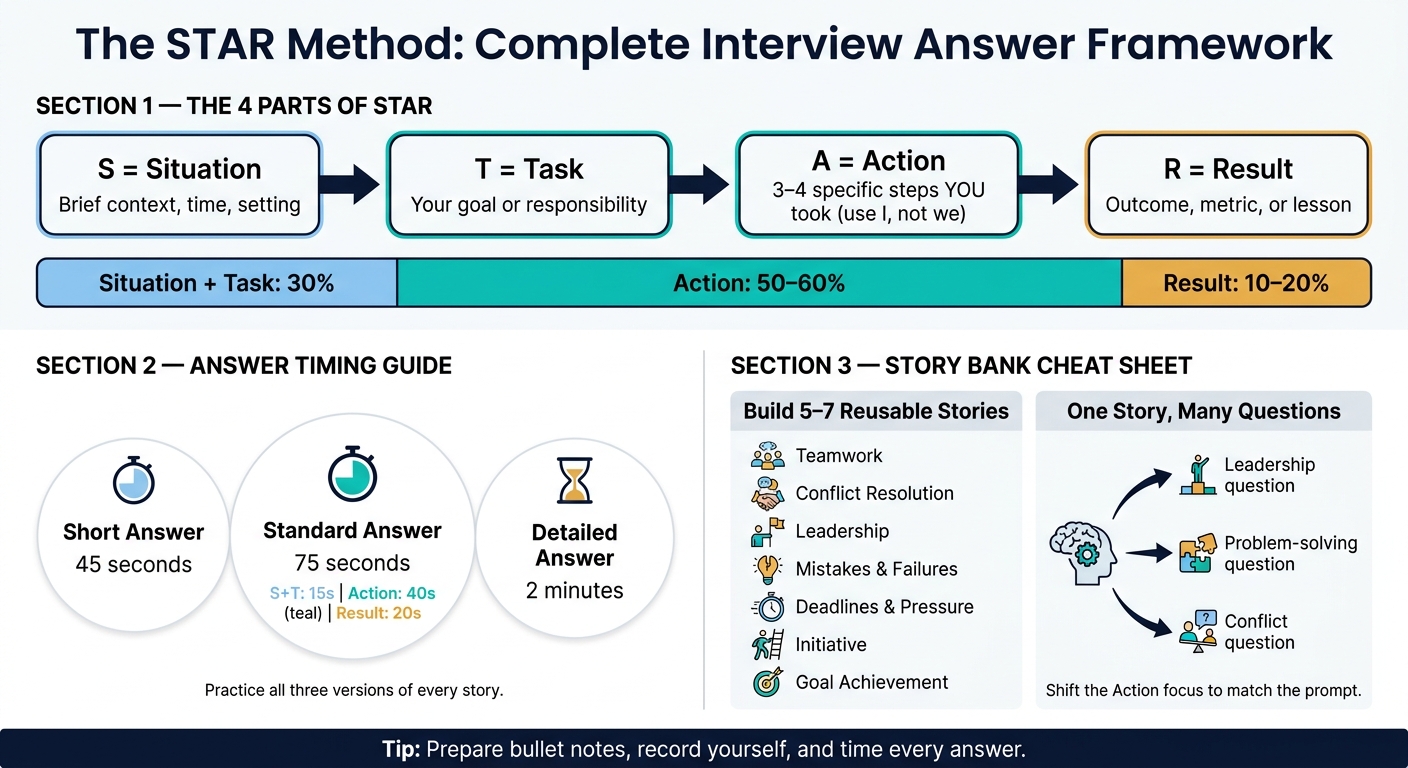
If I want stronger interview answers, I use one simple frame: STAR. It helps me answer behavioral questions in 60 to 90 seconds, keep the focus on my actions, and end with a clear result.
Here’s the short version:
- Situation: give brief context
- Task: state what I owned
- Action: explain the steps I took
- Result: show what changed, with a number if I can
A few points matter most:
- I keep Situation + Task short, about 30% of the answer
- I spend most of my time on Action, about 50% to 60%
- I keep Result to 1 to 2 sentences
- I prepare 5 to 7 stories before the interview
- I practice each answer in 45-second, 75-second, and 2-minute versions
Behavioral questions are meant to check how I handle pressure, solve problems, and make decisions. My examples do not have to come only from full-time jobs. I can use stories from internships, school projects, freelance work, part-time roles, or volunteer work too.
What helps most is this: I do not need a new story for every question. A small set of stories can cover topics like:
- teamwork
- conflict
- leadership
- mistakes
- deadlines
- initiative
- goal achievement
My best move is to build a small story bank, write short bullet notes, record my answers, and trim anything that drifts. That way, I sound clear instead of scattered.
| Part | What I include | Target share |
|---|---|---|
| Situation | brief context, time, setting | |
| Task | my goal or responsibility | |
| Action | 3–4 steps I took | 50%–60% |
| Result | outcome, metric, lesson |
In short, STAR gives me a repeatable way to answer tough interview questions without rambling, while still sounding direct and prepared.
STAR Method Framework: Structure, Timing & Story Bank Guide
STAR Method Interview: How to Answer Behavioral Questions (With Examples)
sbb-itb-20a3bee
The 4 Parts of the STAR Method
Each letter in STAR stands for Situation, Task, Action, and Result. Use STAR to tell a clear, focused story that shows what happened, what you owned, what you did, and what changed because of it. Keep it short. Once you understand the parts, the next move is to build STAR stories you can reuse.
Situation and Task: Set Up the Story Quickly
The Situation and Task are just the setup. Give the interviewer the context, when it happened, and the problem or goal. A simple time marker like spring 2024 helps anchor the story without dragging things out.
Your Task should be even shorter. One sentence is usually enough. The goal is to show what you were responsible for, not what the whole team was doing. For example, you might explain that your team missed a key reporting deadline after a new process launch, and you were responsible for coordinating the revised timeline.
Keep the Situation and Task to about 30% of your answer so you have room for the part that matters most next.
Action: Focus on What You Did
This is the most important part of your answer, and it should take up about 50% to 60% of your full response. This is where the interviewer sees how you think, make calls, and handle pressure.
Use I, not we. If you say, we coordinated the rollout, the interviewer still doesn't know what your part was. A stronger version sounds like this:
I mapped out the rollout timeline, flagged three dependency conflicts with the engineering lead, and drafted the communication plan for affected users.
That kind of detail does more work. It shows your role, your judgment, and the steps you took. Stick with concrete actions and direct verbs. You can also use personalized answer suggestions to refine these details based on your specific background. Skip vague phrasing that makes your contribution fuzzy.
Result: State the Outcome and What You Learned
When you can, use a number. That could be a percentage improvement, hours saved, dollar impact, or a customer satisfaction score. If you don't have an exact figure, that's fine. A clear outcome still works if you tie it to a business result, like a client renewing a contract or a process being adopted company-wide.
It also helps to add a short lesson at the end if it feels honest. For example, saying that the experience taught you to flag cross-team dependencies earlier shows self-awareness and growth. Many guides suggest ending this way. Keep the Result to one or two sentences and stay focused on impact.
That structure makes it much easier to prepare a small batch of stories and use them across different interview questions.
How to Prepare STAR Stories Before the Interview
Once you understand STAR, the next step is to build a small story bank. Do this before you start practicing answers out loud. It makes prep much easier, because you’re not scrambling for examples in the moment.
Pull Key Skills From the Job Description
Read the job posting closely. Pay attention to words and phrases that show up again and again in the responsibilities and qualifications. Common examples include leadership, problem-solving, and conflict resolution.
Then group similar phrases into 5 to 7 skill themes. For example, “cross-functional communication” and “stakeholder communication” can sit under the same theme.
Next, rank those themes. Give more weight to the ones that appear near the top of the posting or come up more than once. In most cases, those are the skills the hiring manager cares about most.
Each theme becomes a slot in your story library: one real example that shows you can do that kind of work. Put simply, those themes become the backbone of your story library.
Build a Library of 5 to 7 Reusable Stories
You don’t need a different story for every interview question. In most cases, 5 to 7 stories are enough to cover a lot of behavioral prompts if you choose them well.
Pick examples that match the main themes in the job posting. Good options often include:
- a tough challenge
- teamwork
- goal achievement
- conflict resolution
- a failure or mistake
- working under pressure
- initiative
One story can often do more than one job. A project rescue story, for example, might work for questions about leadership, handling pressure, and problem-solving. You just shift the part of the Action section you focus on.
Draft Each Story Using a Short STAR Notes Template
Write each story as short bullet points, not full sentences. That keeps your notes easy to scan and easier to remember.
For Situation and Task, you only need a few details to anchor the story, like the company, timeline, and your role. For Action, write down 3–4 specific steps you took yourself. For Result, include at least one number when you can, such as time saved, a percentage improvement, or dollar impact in USD.
If you don’t have exact numbers, it’s fine to use a careful estimate, but only if it reflects what happened.
A simple notes template might look like this:
- Situation: context and timeframe
- Task: your responsibility or goal
- Action: 3–4 specific steps you took
- Result: measurable outcome
How to Practice STAR Answers Until They Feel Natural
Brief bullet points are a good start. But you need to say the answers out loud. That's where the rough spots show up. Notes can look fine on paper and still fall apart the second you have to answer in a live interview.
Keep Each Answer to About 60 to 90 Seconds
Time every answer as you practice. A 60- to 90-second range gives you enough space to show depth without dragging. For a 75-second answer, a smart split is about 15 seconds for Situation and Task, 40 seconds for Action, and 20 seconds for Result.
Use your phone's timer every time. It sounds simple, but it keeps you honest.
If your answer keeps going past 2 minutes, cut the background and get to your role sooner. The interviewer cares most about what you did. It also helps to practice multiple versions of the same story:
- 45 seconds for short answers
- 75 seconds for your standard version
- 2 minutes for cases where the interviewer wants more detail
That range gives you room to adjust instead of sounding locked into one script.
Record Yourself to Find Weak Spots
Recording yourself is one of the fastest ways to spot problems. While you're speaking, it's easy to miss filler words, fuzzy wording, or a Result section that fades out right at the end. On playback, those issues stand out fast.
A simple loop works well:
- Record one answer
- Note 2–3 specific issues
- Revise your bullet points instead of writing a full script
- Record it again
Fix 2 to 3 issues per session. That's usually enough to make progress without overloading yourself.
If you're getting ready for a remote interview on Zoom or Teams, practice in the same setup you'll use that day. Put your webcam at eye level and use the same lighting. Small details like that can make the whole thing feel less awkward when it counts.
Once you start seeing the same mistakes show up again and again, a repeatable practice system can help you clean them up faster.
Use Acedit to Practice STAR Responses More Consistently
Acedit can help you practice on a steadier schedule. It can generate interview questions from a job description or LinkedIn profile, then run mock interview sessions with real-time prompts and response suggestions. That repetition helps STAR answers feel more automatic when the pressure kicks in.
Once your answers start to sound natural, the next step is practicing how to shift the same story to match different questions.
How to Use STAR Flexibly During the Interview
Shift the Same Story to Fit Different Questions
Once you have a story bank, the next step is knowing how to bend each story to fit the prompt.
You don’t need a brand-new example for every question. In many cases, you can reuse one STAR story and shift the emphasis based on what the interviewer is asking.
Pay close attention to keywords that point to leadership, teamwork, conflict, ownership, problem-solving, or adaptability. When you spot the skill being tested, pick the story that shows it best.
For example, one cross-functional launch story might work in several ways. You can frame it around leadership, conflict resolution, influence, or how you recovered after missing a target. Same story, different angle.
The key is to keep the Situation and Task short. That gives you more room to shape the Action and Result around the question in front of you. It also makes follow-up questions much easier to handle.
Handle Follow-Up Questions Without Losing Your Thread
Follow-up questions check whether you can go past your first answer without drifting off course. The simplest way to handle them is to treat them as a short extension of your original STAR response.
Start with the lesson you took from the experience. Then explain the behavior change you made after that. That keeps you grounded in the same story and shows the experience affected how you work.
When a follow-up comes in, map it to the part of STAR it’s asking about, then add only the detail requested.
If they ask what you learned, answer the lesson.
If they ask what you changed later, answer the change.
If they ask why you made a decision, go back to the Action.
That way, you stay clear, focused, and easy to follow.
FAQs
How do I use STAR if I have limited work experience?
The STAR method still works well, even if you don't have much job experience yet. You can pull examples from school projects, volunteer work, or personal projects that show skills like problem-solving, teamwork, and leadership.
Keep it simple and clear. Explain the situation, your role, the steps you took, and the result. Acedit can help surface examples from your background and suggest ways to put numbers behind your achievements.
What if I do not have exact results or metrics?
If you don’t have exact numbers, lean on qualitative results that still show your impact. That can include positive feedback from supervisors, trust you rebuilt with stakeholders, or new skills you picked up along the way.
You can also talk about what you learned and how your response led to better performance later on. Acedit can help you sharpen these stories and spot the parts of your experience that matter most.
How can I make one STAR story fit different questions?
Build a small story bank with a few strong examples you can reuse.
Then shape the Situation and Task to fit the question, while keeping the same core Action and Result.
Keep the Situation short. Make the Task clear and specific. Put most of your focus on Action and Result.
You can also tweak details or metrics so the story fits themes like teamwork, conflict, or decision-making. And when possible, mirror the language in the role or job description so your answer feels like a close match.