
75% of resumes never reach a recruiter. In 2025, AI-powered Applicant Tracking Systems (ATS) are the first hurdle for job seekers. These systems analyze resumes for relevance using advanced algorithms, rejecting most before a human ever sees them. To succeed, you need to optimize your resume for both AI and recruiters.
Key Takeaways:
- ATS Compatibility: Use standard formats, avoid tables or images, and ensure clear section headings.
- Smart Keywords: Focus on specific, job-relevant terms (e.g., "SQL query optimization") and include synonyms naturally.
- Quantifiable Results: Highlight achievements with metrics (e.g., "Increased sales by 28%, adding $450,000 revenue").
- AI Tools: Leverage tools like Acedit to tailor resumes, generate cover letters, and prepare for interviews.
Why it matters: With 97.8% of Fortune 500 companies using ATS, understanding how these systems work can boost your interview chances by 40%. Follow this guide to align your resume with AI-driven hiring practices and stand out in today’s competitive market.
How to write an ATS-optimized Resume with AI (according to research)
How to Optimize Your Resume for AI-Driven ATS
Creating a resume that gets past an Applicant Tracking System (ATS) takes more than just listing your skills and experience. To stand out, you need to understand how these systems analyze and rank applications. Here's how to craft a resume that performs well with AI while remaining appealing to human recruiters.
Using Keywords and Related Terms Effectively
At the heart of ATS optimization lies the smart use of keywords. But this isn't about stuffing your resume with random terms - it’s about understanding how modern ATS systems use natural language processing (NLP) to assess the context and relevance of your content.
Start by reviewing 3–5 job descriptions for roles you're targeting. Look for recurring keywords; these are the ones to prioritize. Keywords often fall into categories like required skills, certifications, industry jargon, job titles, and specific tools or software mentioned in the job posting.
Precision is key. Instead of broad terms like "data analysis", use specific phrases such as "SQL query optimization" or "Tableau dashboard creation." These targeted keywords not only resonate with ATS algorithms but also highlight your expertise. According to Jobscan's State of the Job Search 2025 report, 99.7% of recruiters rely on keyword filters in ATS systems to sort applications.
Incorporating synonyms naturally is also important. For example, if a job description mentions "customer service", you can include related terms like "client relations" or "customer support" where they fit within your experience.
Rather than forcing keywords into your resume, focus on telling a cohesive story about your experience. For instance, if you're applying for a data analyst role, describe a project where you applied specific tools: "Developed automated dashboards using Tableau, cutting manual data processing time by 15 hours weekly." This approach integrates keywords seamlessly while showcasing your skills in action.
Remember, quality beats quantity. A few well-placed keywords are more effective than a resume overloaded with irrelevant terms. Over-optimization - like repetitive phrases or awkward sentence structures - can make your resume seem unnatural and harm your chances with human reviewers.
Formatting Your Resume for ATS Compatibility
Even the best content won’t help if your resume’s format confuses the ATS. These systems rely on clean layouts to extract and organize your information accurately.
Stick to standard section headings like Summary, Skills, Experience, and Education. Avoid creative alternatives such as "My Journey" or "What I Bring to the Table", as they can disrupt parsing and cause key details to be overlooked.
Common formatting mistakes that lead to ATS rejection include:
- Using headers or footers for contact information
- Adding tables, columns, or images
- Using non-standard fonts or special characters
Instead, opt for a straightforward design. Use standard bullet points, maintain consistent formatting throughout, and avoid text boxes or complex layouts. Visually appealing designs might look great to you but can be unreadable to an ATS.
A good test? Save your resume as a plain text (.txt) file. If it’s still readable and makes sense, it’s likely to pass through an ATS without issues. Considering that 97.8% of Fortune 500 companies use ATS systems, and 75% of applications get filtered out before reaching a recruiter, proper formatting is crucial.
Adding Numbers and Metrics to Your Achievements
Quantifiable achievements not only validate your skills but also make your resume stand out to both ATS systems and human reviewers. Metrics help ATS algorithms identify the impact of your work and provide recruiters with clear evidence of your contributions.
Turn vague claims into measurable results. For example, instead of saying "Improved sales performance," write: "Increased quarterly sales by 28%, generating $450,000 in additional revenue through targeted outreach." This approach combines actionable data with specific accomplishments.
Go through each bullet point in your experience section and see where you can add numbers. Think about percentages, revenue increases, time saved, or other measurable outcomes. For example: "Led a team of 12 engineers to complete a cloud migration project three weeks ahead of schedule, reducing annual infrastructure costs by $120,000."
Be honest with your metrics - exaggerated or irrelevant figures can backfire during interviews. The goal is to showcase your real-world impact in a way that resonates with both ATS algorithms and recruiters.
How AI Tools Help with ATS Optimization
AI tools have reshaped how job seekers tackle resume optimization and interview preparation. Instead of spending hours manually refining resumes, these tools use advanced algorithms to analyze job descriptions, pinpoint gaps, and suggest specific improvements to help you clear ATS (Applicant Tracking System) filters.
With AI-driven optimization, you can complete the process in just 2–3 hours and potentially increase your interview rate by over 40%. Considering that 99.7% of recruiters use keyword filters in their ATS to sort through applicants, leveraging AI has become almost a necessity.
Acedit: Your AI Job Search Partner
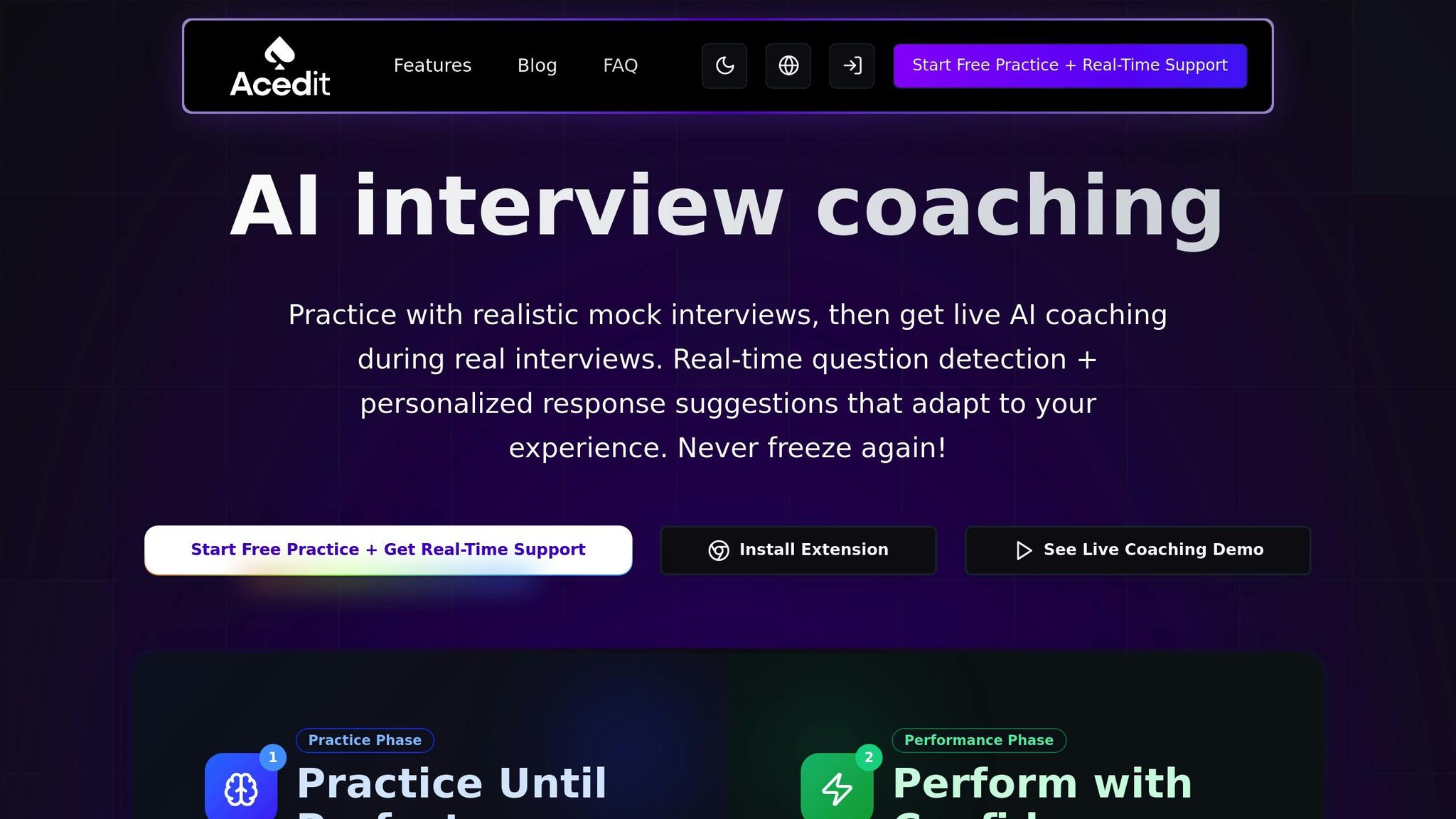
Acedit is a Chrome extension powered by AI that supports every stage of your job search, offering much more than simple resume formatting. It’s designed to meet the demands of today’s competitive hiring landscape by combining several powerful features.
For interviews, Acedit provides real-time coaching to help you answer questions with confidence. It also generates personalized practice questions based on job descriptions, ensuring you’re ready for scenarios specific to the role you’re pursuing. Its interview simulations go a step further by analyzing your responses and giving instant feedback on clarity, relevance, and confidence.
When it comes to application materials, Acedit creates tailored, AI-generated cover letters and ensures your LinkedIn profile aligns with your resume for a consistent professional image. It even helps craft STAR (Situation, Task, Action, Result) examples to effectively highlight your achievements, catering to both ATS systems and hiring managers.
Acedit offers three pricing options: a Free Plan with limited features, a Premium plan for $45 (lifetime access), and a Premium Plus plan for $75, which unlocks unlimited features.
On top of these tools, AI also plays a critical role in personalizing your resume for each job.
How AI Customizes Your Resume
A one-size-fits-all resume rarely makes it past modern ATS systems. AI tools analyze job descriptions to extract essential keywords, required skills, and qualifications, comparing them to your resume to identify areas for improvement. This ensures your resume is tailored for each specific role.
A smart strategy is to gather 3 to 5 job descriptions for roles you’re targeting and analyze them together. This helps AI tools spot recurring keywords and prioritize those that are most relevant to your industry.
These tools also refine your resume by connecting your experience to job requirements, suggesting industry-specific terminology, grouping related skills for better flow, and using machine learning to predict which elements will improve your ATS score. With the right keywords, your chances of getting your resume in front of a human recruiter can increase by up to 35%.
Once your resume is optimized, it’s time to focus on interview preparation.
AI-Powered Interview Preparation
Nailing the interview is just as important as getting your resume noticed. AI-powered tools create realistic interview simulations, allowing you to practice answering questions tailored to the job you’re pursuing. These simulations generate role-specific questions based on the job description, helping you prepare for what’s likely to come.
During practice, real-time coaching offers immediate feedback on your responses, helping you refine your clarity, structure, and confidence. Personalized Q&A sessions also highlight areas where your experience may fall short, providing targeted questions to help you address those gaps. This is especially useful for behavioral interviews, where crafting STAR-formatted responses can set you apart from other candidates.
sbb-itb-20a3bee
Advanced ATS Optimization Methods for 2025
Taking ATS optimization to the next level means leveraging predictive analytics and storytelling to make your resume stand out. Modern ATS systems analyze more than just keywords, so fine-tuning your resume to meet these advanced criteria is crucial.
How ATS Systems Use Predictive Analytics
Today’s ATS platforms rely on semantic analysis powered by natural language processing (NLP) to evaluate resumes. They don’t just scan for keywords - they assess how terms relate to each other, consider soft skills, and even gauge cultural fit and communication abilities. This shift means context matters more than keyword density. To adapt, you should craft a resume that tells a cohesive story while naturally incorporating relevant terms.
For example, when highlighting a skill like "project management", don’t just name it. Support it with examples such as managing cross-functional teams, meeting deadlines, or delivering projects within budget. These related experiences help ATS tools recognize the depth of your expertise.
Using Storytelling to Show Your Skills
Your resume should appeal to both the ATS and human reviewers, and storytelling is the key to achieving that balance. Instead of listing tasks or responsibilities, frame your accomplishments as compelling narratives that highlight your impact. For instance:
- Replace "data analysis" with: "Led a data analysis initiative that identified cost-saving opportunities, saving the company $250,000 annually."
This approach not only integrates keywords like "data analysis" and "cost-saving" but also provides context by outlining the challenge, your actions, and the results. The goal is to make keywords feel natural while demonstrating measurable achievements.
Testing and Improving Your Resume with AI
Regular testing is essential to keep your resume competitive in a constantly evolving job market. AI-powered tools can help you refine your resume by providing ATS compatibility scores and real-time feedback. Here are some performance metrics to track:
- Response rate: The percentage of applications that get any employer response. A rate below 10% might indicate ATS filtering issues.
- Interview rate: The number of applications that lead to interview invitations.
- ATS score: A compatibility rating (usually 0–100). Scores above 80 suggest your resume is well-optimized.
- Time to response: How quickly employers respond to your application.
- Application volume: The number of applications submitted over a given period.
- Quality score: How closely your resume matches job requirements.
A systematic testing cycle can help you fine-tune your resume. For example:
- Week 1: Use AI tools to audit your resume.
- Week 2: Apply keyword and formatting improvements.
- Week 3: Test your updated resume with real job applications.
When researching keywords, analyze 3–5 job descriptions for roles you’re targeting. Use AI tools to identify key terms, required skills, and common industry language. Modern ATS systems can understand variations like "project management", "project coordination", and "program oversight", so focus on job-specific terms rather than generic ones. Doing this can increase the likelihood of your resume reaching a human reviewer by up to 35%.
Conclusion and Key Takeaways
Navigating today’s job market requires a solid grasp of AI-powered applicant tracking systems (ATS) and sharp interview skills. By combining effective resume optimization with thorough interview preparation, you can give yourself a competitive edge - and significantly improve your chances of landing your dream job.
Main Tips for ATS Optimization
Getting past ATS systems boils down to three key strategies. First, use the right keywords. Since 99.7% of recruiters rely on keyword filters in their ATS systems, it’s crucial to weave job-specific terms naturally throughout your resume. These keywords should align with the skills and qualifications listed in the job description.
Second, stick to ATS-friendly formatting. This means using standard section headings like Summary, Skills, Experience, and Education. Avoid elements like tables, text boxes, or overly intricate designs - these can confuse the ATS and prevent your resume from being properly parsed. A clean, simple format might not be flashy, but it ensures your resume makes it through the system.
Finally, focus on quantifiable achievements to showcase your value. Use numbers to highlight your impact. For example, instead of saying you "improved sales", write that you "boosted quarterly sales by 42%, adding $380,000 in revenue over six months." Numbers like these stand out to both ATS algorithms and human recruiters, making your contributions crystal clear.
Spending just 2–3 hours optimizing your resume can increase your interview chances by over 40%. Even smaller improvements, like raising the odds of your resume reaching a recruiter by 35%, can make a big difference.
But remember, getting past the ATS is just the first step. To truly stand out, strong interview preparation is a must.
How AI Tools Help Job Seekers Succeed
Beyond resume tweaks, preparing for interviews is essential - and AI tools like Acedit are transforming how job seekers approach this process.
Acedit doesn’t just help with resumes; it also offers AI-powered mock interviews that simulate real-world conditions. With personalized feedback and role-specific questions, users have tackled over 179,000 practice questions, gaining confidence through exposure to a variety of scenarios. Its real-time AI coaching even provides on-the-spot response suggestions during interviews, tailoring advice to your unique profile.
The results speak for themselves: users report a 98% confidence boost and have successfully landed over 45 highly sought-after roles. Acedit also simplifies cover letter creation by analyzing job descriptions and generating letters that match your writing style, resume, and LinkedIn profile.
For organizations, these tools deliver benefits too - companies using ATS systems often see a 40% drop in turnover rates among new hires. With 70% of large companies and 20% of small to mid-sized businesses relying on ATS technology - and adoption rates continuing to grow - it’s clear that blending smart resume strategies with strong interview preparation is essential. AI tools make this process smoother, helping you present your best self at every stage of the hiring journey while staying authentic and confident.
FAQs
How can I make my resume stand out to both ATS systems and human recruiters?
To craft a resume that appeals to both ATS software and human recruiters, focus on simple formatting and strategic keywords. Stick to standard fonts, maintain consistent headings, and steer clear of overly elaborate designs that might trip up ATS systems. Be sure to incorporate key terms from the job description, as these systems are designed to scan for specific words to evaluate candidates.
For human recruiters, emphasize your accomplishments through clear, concise bullet points, and use strong action verbs to showcase your experience. Keep the design clean and professional, making it easy for them to spot the most critical details. By striking this balance, your resume can navigate ATS filters while remaining compelling to recruiters.
How can I effectively add keywords to my resume without it sounding unnatural?
Incorporating keywords into your resume is crucial for getting past ATS (Applicant Tracking System) scans, but it’s just as important to make them flow naturally. Begin by carefully analyzing the job description to pinpoint key terms and phrases that align with your skills and experience. Once you have these, weave them into your resume by adjusting job titles, bullet points, and skill sections to reflect those terms.
For instance, instead of awkwardly stuffing a keyword into your resume, tie it to a specific accomplishment: "Managed cross-functional teams to deliver projects ahead of deadlines." This approach ensures the keywords enhance your achievements rather than sticking out awkwardly. The trick is finding the right balance - don’t overload your resume with keywords, as it can come across as forced or repetitive.
How can AI tools like Acedit help streamline job applications and boost interview readiness?
AI tools like Acedit make the job application process smoother with features like AI-powered cover letter writing, customized interview preparation, and LinkedIn profile syncing. These tools help ensure your application stands out and is fine-tuned for success.
For interviews, Acedit offers real-time coaching, question recognition, and AI-suggested responses, giving you the confidence to shine. By simulating interview scenarios and providing personalized tips, it prepares you to tackle every phase of the hiring journey with ease.