
AI professionals are earning more than ever in 2025, with salaries outpacing overall wage growth by a wide margin. Here’s what you need to know:
- Tech Industry: AI-focused software engineers average $245,000 annually. Senior roles at companies like Meta and Google reach total compensation exceeding $1 million.
- Finance & Healthcare: Senior AI professionals in these sectors command up to $280,000+, with sign-on bonuses exceeding $200,000 in finance.
- Manufacturing & Retail: AI salaries in these industries are rising fast, with entry-level roles starting around $95,000 and senior roles exceeding $230,000.
Key Trends:
- Entry-level salary premiums are narrowing (6.2% in 2025 vs. 10.7% in 2024) due to more graduates entering the field.
- Senior professionals see higher premiums (18.7%), reflecting demand for experienced talent in applied AI roles like MLOps and LLM integration.
- AI-driven industries offer a 56% wage premium over non-AI roles.
Use tools like Acedit to tailor your applications and negotiate confidently, helping you secure high-paying roles in this competitive market.
The Highest Paying Jobs In The Age of AI According To AI
Tech Industry AI Salaries
The tech industry continues to set the bar for AI-related compensation. As of late 2025, AI-focused Software Engineers in the U.S. earn an average of $245,000 per year. These salaries often include a mix of competitive base pay, performance bonuses, and restricted stock units (RSUs), particularly for senior roles at major tech companies.
Let’s break down how salaries vary by experience level.
Entry-Level Tech AI Positions
Starting a career in AI within the tech industry offers rewarding pay, though competition has tightened. At LinkedIn, entry-level AI engineers earned $288,050 in late 2025, significantly higher than the $225,000 earned by their non-AI counterparts - a difference of over $63,000. Similarly, OpenAI offers entry-level AI engineers a starting salary of $238,000. According to the Robert Half 2026 Salary Guide, entry-level AI/ML Analysts can expect to earn about $119,250, while AI/ML Engineers typically start at $134,000.
However, the premium for entry-level AI roles has narrowed, dropping from 10.7% in 2024 to 6.2% in 2025. This change reflects a growing influx of graduates with AI skills. Companies are also shifting their focus from experimental roles, like "prompt engineering", to positions such as Applied Large Language Model (LLM) Engineers, who specialize in integrating AI systems into production environments.
Now, let’s explore how compensation evolves at the mid-level.
Mid-Level Tech AI Positions
Mid-level roles, generally requiring 4-6 years of experience, offer more stable and substantial salary increases. AI/ML Engineers at this level earn between $134,000 and $170,750, while Data Scientists see salaries ranging from $121,750 to $153,750, based on national averages. The salary premium for mid-level AI engineers remains steady at 11.9% over their non-AI peers.
At this stage, roles that directly impact revenue tend to command higher pay. Companies increasingly seek professionals skilled in managing MLOps, toolchains, and governance - essential for scaling AI from pilot projects to full-fledged systems. These positions have become critical, as businesses need experts who can bridge the gap between experimental models and operational systems.
Senior-Level Tech AI Positions
Senior-level AI roles in tech come with impressive paychecks. In 2025, Snap and Cruise paid senior AI engineers $635,000 and $513,000, respectively. At Intuit, staff-level AI engineers earned close to $917,000, while their non-AI counterparts earned around $515,000 - a nearly $400,000 difference.
Specialized positions at the senior level can reach even higher figures. For example, Meta offered senior Research Scientists (E6 level) in Menlo Park total compensation packages of up to $1,175,000, which included a $250,000 base salary, $750,000 in equity, and $175,000 in bonuses. Similarly, Google provided L6 Research Scientists in Mountain View with packages totaling $1,057,750, consisting of a $200,000 base salary and $793,000 in equity. A tech recruiter summed it up in the Financial Times:
Mid to senior research scientists can today expect total pay of $500k to $2m at Big Tech groups.
According to Robert Half, senior AI Architects can earn up to $196,750, while senior AI/ML Engineers reach $193,250. The staff-level premium has risen to 18.7%, up from 15.8% in 2024, highlighting the growing demand for experienced AI professionals capable of leading complex projects and driving strategic initiatives.
Understanding these salary trends can help you plan your career path in tech AI with precision and purpose.
Healthcare and Finance AI Salaries
Outside the tech world, industries like healthcare and finance are stepping up their game when it comes to compensating AI professionals. These sectors recognize the value of specialized AI skills and are offering competitive pay and incentives to attract top talent.
Healthcare AI Salary Premiums
AI roles in healthcare demand a unique mix of technical expertise and domain-specific knowledge, which drives up salaries. For example, in the Scientific Research and Development Services sector - which includes healthcare AI research - data scientists earn an average annual salary of $125,620. Positions in areas like bioinformatics and AI research often surpass this average due to the highly specialized skills required.
Pay in healthcare AI varies widely depending on experience. Entry-level roles start around $58,510 (10th percentile), mid-level positions average $103,500, and senior-level specialists can earn as much as $174,790 (90th percentile). These figures highlight the increasing demand for professionals who can bridge the gap between AI and healthcare expertise.
Meanwhile, the finance sector is also ramping up efforts to secure top AI talent with lucrative offers.
Finance AI Compensation Trends
The finance industry has significantly increased its focus on recruiting AI experts in recent years. Average salaries for AI professionals in finance (excluding executive roles) have jumped from $142,000 in 2020 to about $180,000 in 2025 - a 25% increase over five years. Ryan Bulkoski, Global Head of AI, Data, and Analytics at Heidrick & Struggles, describes the fierce competition:
"Nobody's leaving for less than 30% pay increases if they're coming from companies where they're already 'heads-down and doing well.'"
By the end of 2025, early-to-mid-career AI professionals in finance were receiving offers in the high six- to seven-figure range. Senior-level AI leaders, on the other hand, could command total compensation packages in the high seven- to eight-figure range.
To attract and retain these experts, finance firms are offering sign-on bonuses exceeding $200,000 and retention awards ranging from $500,000 to $1 million, typically vesting over three to four years. Bank of America, for instance, allocated $4 billion in 2025 for technology initiatives, with a significant portion directed at expanding AI-focused teams. The rising interest in "agentic AI" - autonomous systems requiring minimal oversight - has only heightened the demand for highly skilled professionals in this space.
Manufacturing and Retail AI Salaries
The manufacturing and retail industries are ramping up their use of AI, and it's reshaping salaries in these sectors. Across all industries, the median annual salary for AI roles reached $156,998 in Q1 2025. Even in traditionally lower-paying fields like manufacturing and retail, professionals with AI expertise are seeing notable pay increases.
In manufacturing, the demand for AI talent is intense. A staggering 71% of hiring professionals report challenges in finding candidates with the necessary AI and technical skills. This shortage is driving salaries higher. For example, while manufacturing roles typically start at a median of $46,500, adding skills like predictive maintenance can boost wages by 17%, bringing the median to $54,400. Mike Chmura from Chmura Economics & Analytics highlights this trend:
The fastest growing skill in [the manufacturing] sector is predictive maintenance - job postings for predictive maintenance have surged by 199% since last year!
The retail sector is experiencing similar shifts. AI-focused roles in retail are becoming more lucrative as companies prioritize AI-driven solutions. Retail and wholesale trade continue to lead in AI-related job postings, with this trend expected to persist through 2024 and into 2025. For instance, Amazon alone had 781 open AI positions in Q1 2025, aimed at scaling AI across its retail operations and improving customer experiences. Roles like retail AI strategists - who design machine learning systems for recommendation engines and automation - are particularly well-compensated. According to Burtch Works:
AI professionals earn a 9–13% higher cash compensation than Data Scientists. The gap is widest where scarce Gen-AI expertise adds the most value.
More broadly, industries heavily influenced by AI are seeing wages rise twice as fast as those with less AI integration. Workers with AI skills now command a 56% wage premium compared to peers in the same roles, a sharp increase from the 25% premium reported in 2024. This rapid growth highlights the transformative role of AI in shaping career opportunities. With manufacturers adopting autonomous "Agentic AI" for supply chain improvements and retailers investing heavily in predictive analytics and personalization, the demand for skilled AI professionals shows no signs of slowing down.
sbb-itb-20a3bee
AI Salary Comparison by Industry and Experience
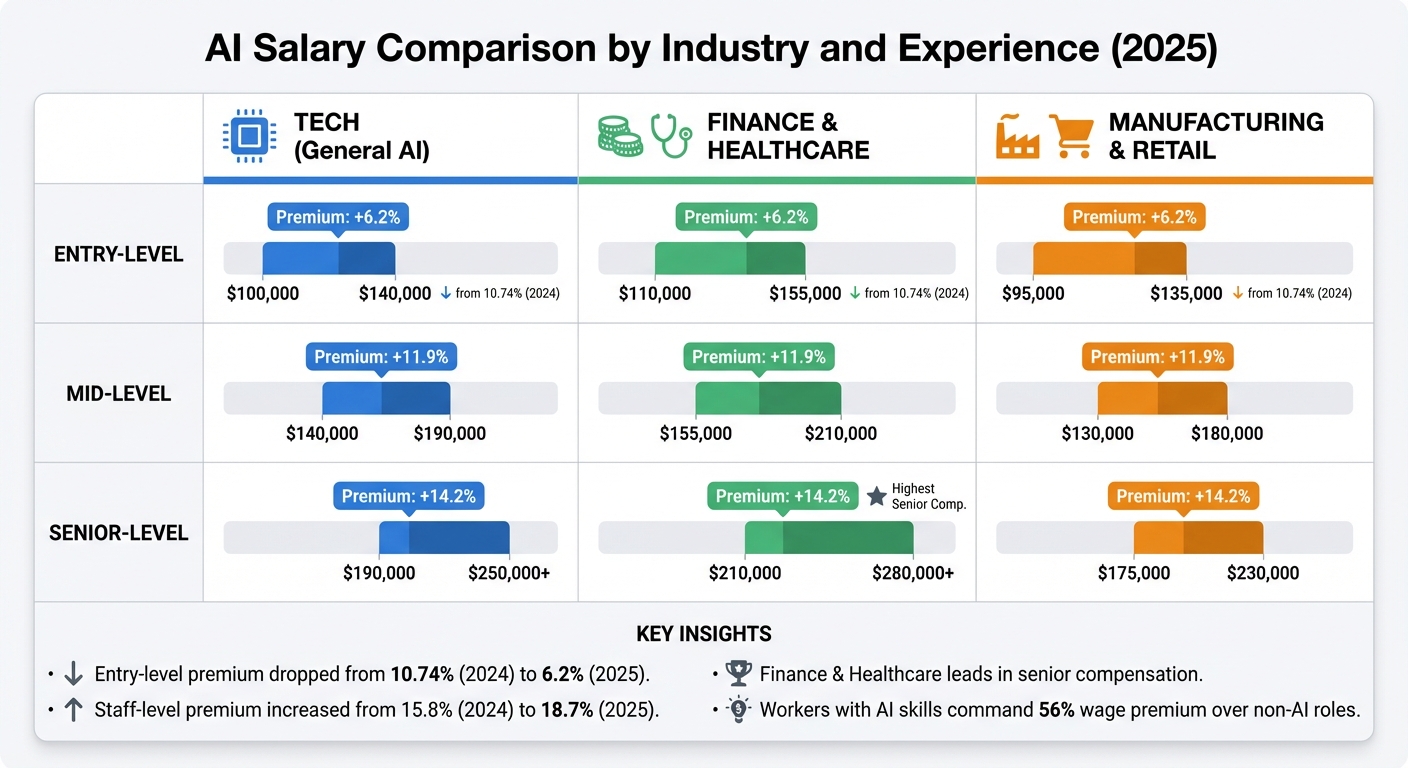
AI Salaries by Industry and Experience Level 2025
Understanding how AI salaries vary by industry and experience level can help you make informed career choices. Below is a breakdown of median compensation for AI professionals in 2025, highlighting differences across entry, mid, and senior roles.
| Experience Level | Tech (General AI) | Finance & Healthcare | Manufacturing & Retail | YoY Change (Avg Premium) |
|---|---|---|---|---|
| Entry-Level | $100,000 – $140,000 | $110,000 – $155,000 | $95,000 – $135,000 | +6.2% |
| Mid-Level | $140,000 – $190,000 | $155,000 – $210,000 | $130,000 – $180,000 | +11.9% |
| Senior-Level | $190,000 – $250,000+ | $210,000 – $280,000+ | $175,000 – $230,000 | +14.2% |
Finance and healthcare continue to dominate in terms of compensation, especially at the senior level, where professionals can earn up to $30,000 more than those in general tech roles. Manufacturing and retail, while slightly behind, still offer competitive salaries.
The data also reflects shifting trends in the job market. Entry-level premiums dropped from 10.74% in 2024 to 6.2% in 2025, signaling increased competition for junior positions. In contrast, mid- and senior-level roles saw higher premiums, with staff-level positions jumping from 15.8% to 18.7%. These numbers align with the broader patterns of salary growth in the AI field.
What Drives Salary Differences Across Industries
The root of salary differences across industries often lies in skill scarcity. Take specialized skills like Reinforcement Learning from Human Feedback (RLHF) and Alignment AI, for example. These areas are experiencing a talent crunch - job postings for these roles jumped by 34%, while the talent pool grew by just 7%. When demand outpaces supply, salaries naturally climb. This mismatch in supply and demand is further influenced by production needs and regulatory challenges.
As AI transitions from experimental phases to real-world applications, employer priorities have shifted. Companies are now focusing on engineers skilled in applied LLM integration and MLOps professionals who can handle tasks like integrating, monitoring, and optimizing workflows efficiently. Burtch Works highlights this shift:
Employers value Applied LLM Engineering, Retrieval/Data Quality, Evaluation & Safety, and Model Governance - the mix that makes AI shippable and auditable at scale. Skills that ship win offers.
Regulatory and operational demands add another layer to these salary differences. For instance, healthcare systems are under pressure to manage complex care, maintain compliance, and control costs, all while navigating stricter regulations. Similarly, industries grappling with AI-driven misinformation or shifting trade policies are willing to pay a premium for talent that ensures operational stability. These pressures underline the growing importance of AI expertise in critical sectors.
The mission-critical nature of AI work also plays a significant role in driving up wages. Unlike traditional Data Scientists who focus on decision-making insights, AI professionals are tasked with creating system-level automation and applications that are integral to business operations. This difference in responsibility translates to higher pay. At companies like Intuit, for example, the salary gap between AI engineers and non-AI staff engineers can reach as much as $400,000.
Experience amplifies these salary gaps even further. Entry-level AI engineers earn about 6.2% more than their non-AI counterparts, while senior and staff-level roles command premiums of 14.2% and 18.7%, respectively. Employers see experienced AI professionals as a smart investment because they deliver tangible results - lower latency, higher reliability, and cost savings per task. These measurable outcomes make seasoned AI talent worth every dollar.
Using Acedit for Salary-Based Career Planning

Securing high-paying roles requires more than just ambition - it takes strategic preparation. That’s where Acedit steps in, aligning your career goals with the demands of industries offering competitive AI salaries. By integrating with LinkedIn, Acedit evaluates your professional profile and fine-tunes your applications to meet the standards of sectors like finance, healthcare, and tech, where top-tier compensation is within reach.
Acedit’s cover letter generation tool takes personalization to the next level. Using AI, it adapts your background to specific job descriptions and company needs, ensuring your application highlights the skills that matter most for high-paying roles. For example, if you’re eyeing an AI Architect position with a salary range of $142,750 to $196,750, Acedit can craft a tailored cover letter that showcases your strengths and aligns them with the job's requirements.
What sets Acedit apart is its ability to maintain your unique voice while incorporating the right industry language. Its Premium tier goes a step further by analyzing your resume and LinkedIn profile to generate highly personalized cover letters. You can even provide STAR examples (Situation, Task, Action, Result) to emphasize measurable achievements that resonate with roles offering premium salaries.
When it comes to interviews, Acedit’s real-time coaching ensures you’re prepared to discuss salary expectations confidently and demonstrate your value. With over 15,000 questions completed by users and a 98% average confidence boost, this tool equips you to articulate why you deserve top-tier compensation. In fact, many users have secured over 30 coveted positions with the help of Acedit’s AI-driven tools.
"Combining interview prep with cover letter crafting, Acedit has been pivotal in my career." - Charlotte King
Acedit offers three plans to suit your needs: a Free tier with basic features, a Premium tier for $45 (one-time) with unlimited access, and a Premium Plus tier for $75 (one-time) that unlocks full functionality. This comprehensive approach transforms salary insights into actionable career strategies, giving you the tools to secure competitive offers in industries where AI expertise is highly valued.
Conclusion
AI salary trends are reshaping strategies in today’s fast-changing job market. Data highlights that AI professionals consistently out-earn their non-AI counterparts, with Staff-level specialists projected to command an 18.7% salary premium by 2025 - an increase from 15.8% in 2024. However, the real advantage lies in how effectively these insights are put into action.
The industry is shifting focus from experimental roles to positions that deliver measurable, production-ready results. Whether it’s healthcare’s specialized AI applications, finance’s high-stakes algorithms, or tech’s cutting-edge developments, professionals who can quantify their impact and demonstrate scalable skills are the ones driving their earning potential. With the global AI market expected to grow at an annual rate of 35% and demand for AI talent projected to outpace supply through 2027, the opportunities for career growth are abundant.
This dynamic landscape requires more than just awareness - it demands strategic preparation. Professionals who align their skills with industry-specific salary trends stand to gain the most. Certifications that enhance earning potential by 15–30% and hands-on experience in areas like MLOps or Applied LLM Engineering are increasingly valuable. While entry-level roles may be stabilizing, experienced professionals are seeing growing demand as companies prioritize talent capable of delivering reliable, scalable AI solutions.
To make the most of these trends, tools like Acedit can turn salary data into actionable career strategies. From crafting tailored cover letters that emphasize your value to offering real-time interview coaching for confident compensation discussions, these AI-driven resources help bridge the gap between career goals and tangible outcomes. Users have reported a 98% boost in confidence and successful placements in high-paying industries, proving that combining market insights with strategic preparation can pave the way for success.
FAQs
How do AI salaries vary across industries?
AI professionals, particularly software engineers, rank among the top earners in the tech industry. In the U.S., AI-focused software engineers can make an impressive $245,000 annually, often outpacing the earnings of data scientists in many fields.
This level of compensation highlights the surging demand for AI expertise in areas like healthcare, finance, and technology. As businesses continue to integrate AI-powered solutions, the need for skilled professionals in this space keeps climbing.
What’s driving the rise in salaries for AI professionals?
The surge in demand for AI expertise across various industries is fueling higher salaries in this field. Companies, whether in tech or non-tech sectors, are increasingly relying on AI to enhance efficiency and drive profits. This has sparked fierce competition to secure skilled professionals.
Adding to this pressure is the relatively small pool of qualified talent, making AI specialists some of the most in-demand professionals today. As businesses scramble to implement AI solutions, they’re offering generous compensation packages to attract and keep the best minds in this fast-changing landscape.
How can Acedit help me negotiate a better salary for AI roles?
Acedit helps you approach salary negotiations for AI roles with confidence, blending data-driven insights and real-time assistance. For instance, it provides updated salary benchmarks, revealing that AI-focused software engineers in the U.S. earn an average of $245,000 annually, with top companies offering even more.
The platform goes beyond numbers. It allows you to rehearse salary negotiations through realistic mock interviews, offers instant tips to showcase your achievements effectively, and even provides live coaching during actual calls. On top of that, Acedit assists in crafting personalized cover letters and LinkedIn summaries that emphasize your AI expertise, ensuring you're fully prepared to land a competitive offer.