
AI job matching is transforming how people find jobs, but it’s not perfect. By 2026, 87% of companies are using AI recruiting tools, yet only 52% report satisfaction with the results. AI offers faster, more accurate candidate matching, analyzing skills and context rather than just keywords. However, it struggles with transparency and bias. On the other hand, manual methods like networking and recruiter-led hiring excel at evaluating soft skills but are slower, more expensive, and limited by human capacity.
Key Takeaways:
- AI Advantages: Shortlist creation in ~5 minutes, larger candidate pools, and skills-based matching.
- Manual Strengths: Human judgment is better for assessing communication, leadership, and team dynamics.
- Challenges: AI faces bias and lack of transparency; manual methods are slower and costly.
- Best Approach: Combine AI tools with networking for a balanced job search strategy.
Quick Comparison
| Feature | AI Job Matching | Manual Methods |
|---|---|---|
| Speed | ~5 minutes to shortlist | ~3 hours to shortlist |
| Bias | Data-driven, potential bias from training data | Human judgment, prone to subjectivity |
| Focus | Skills and competencies | Soft skills and team fit |
| Candidate Pool Size | 6x larger with skills-based searches | Limited by keywords and personal networks |
| Transparency | Low, improving via regulations | Low, feedback is rare |
AI job matching is great for efficiency, but combining it with human networking ensures a more well-rounded approach to job searching.
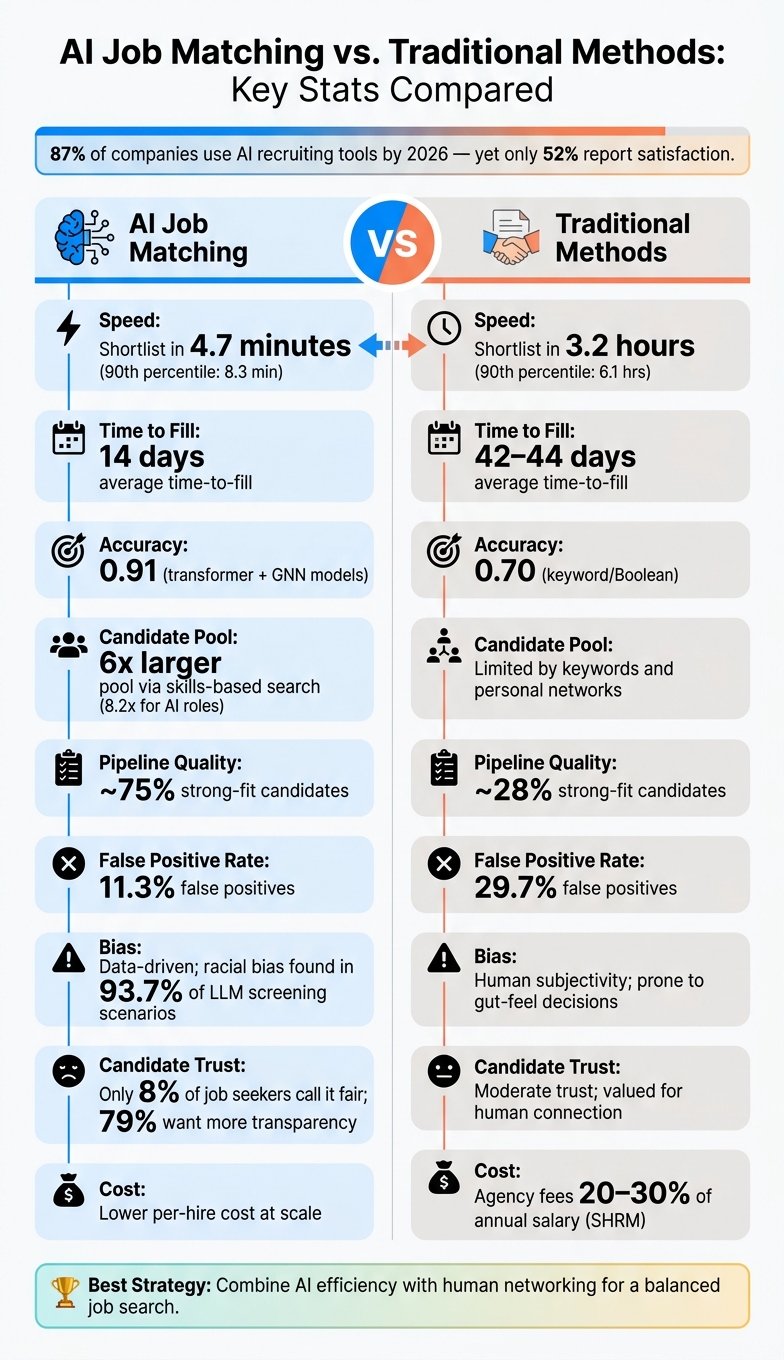
AI Job Matching vs. Traditional Methods: Key Stats Compared
Robots Screening Robots: Inside the AI Hiring Arms Race
How AI Job Matching Works
AI job matching takes résumés and job descriptions and turns them into numerical data for comparison. Unlike older methods that focused on exact word matches, this process prioritizes context and intent. For example, it won’t dismiss a candidate for saying "revenue growth" instead of "sales performance." This makes the system smarter and more inclusive.
Core Features of AI Job Matching
Modern AI job matching tools rely on transformer models paired with graph neural networks (GNNs). This combination has achieved an impressive F1 accuracy score of 0.91, significantly outperforming traditional keyword-based systems, which only reach 0.70. This leap in accuracy leads to better candidate recommendations and fewer missed matches.
The secret sauce here is natural language processing (NLP). NLP allows the system to grasp the meaning behind words, not just the words themselves. On top of that, reinforcement learning ensures the system improves over time. Essentially, every hiring decision helps refine the algorithm, making it even more accurate. This approach represents a clear break from outdated keyword filtering methods.
"AI job matching has evolved from keyword filters to transformer + GNN hybrid models that achieve 0.91 F1 accuracy versus 0.70 for cosine similarity." - Pin
These advancements directly help candidates by expanding the criteria for matches, making results more relevant and inclusive.
What AI Job Matching Offers Job Seekers
For job seekers, one of the biggest perks is skills-based matching. AI systems focus on what you can do rather than just your job title. LinkedIn reports that skills-based searches can expand the pool of eligible candidates by 6x compared to title-based searches, and for AI-related roles, this number jumps to 8.2x. This is especially beneficial for candidates with diverse experience or non-linear career paths.
Take LinkedIn’s example: In April 2026, they introduced a large language model called JUDE to power their job recommendations. This led to a 2.07% increase in qualified applications and a 5.13% drop in the dismiss-to-apply ratio, meaning users were finding jobs that fit their skills better and skipping fewer irrelevant listings.
Drawbacks and Limitations
AI job matching isn’t without its flaws. Algorithmic bias is a major concern. If the system is trained on biased historical data, it can unintentionally replicate those same biases on a larger scale. Compounding this issue is the "black box" nature of AI - users often don’t know how decisions are made, making it hard to challenge or correct errors. Over-reliance on these systems is another issue. When hiring teams treat AI scores as definitive, candidates who don’t fit a standard mold may be unfairly overlooked. This can lead to missed opportunities for both job seekers and employers.
How Traditional Job Matching Works
Before algorithms entered the picture, job hunting was a much more hands-on process. It revolved around job boards, personal connections, recruiters, and referrals. Each of these methods had its own rhythm, and together they formed the backbone of how millions of Americans found work for decades.
What Traditional Job Search Looks Like
Job boards have long been a go-to starting point. Job seekers upload their résumés, enter a few keywords, and sift through listings. On the flip side, recruiters and hiring managers post openings and manually sort through applications. Beyond job boards, networking plays a huge role. This involves attending industry events, staying active on LinkedIn, reconnecting with former colleagues, and asking for introductions. Another major piece of the puzzle is referrals, where current employees recommend candidates. Companies often favor these candidates because they come with built-in trust.
"The job board model is older than the internet you're reading this on. Take a stack of resumes, file them by keyword, charge employers to dig through the stack." - HiredAI
Recruiters add another layer to the process. Staffing agencies and headhunters use their expertise and connections to match candidates with open roles, especially for niche or senior-level positions.
While these methods bring valuable human insight, they also have limitations that modern technology aims to address.
Where Traditional Methods Hold Up
Traditional methods have one undeniable strength: human judgment. A seasoned recruiter who has spent years placing engineers in fintech, for example, can pick up on nuances that algorithms might miss - like how someone presents themselves, whether their communication style meshes with a team's vibe, or if their unconventional career path tells a compelling story.
"Traditional recruitment has long been valued for its ability to assess soft skills, cultural fit, and leadership potential, qualities that are not always easily measured by automated systems." - SmartHCM
This strength is especially critical for leadership roles and highly specialized positions, where culture fit and interpersonal dynamics can make or break a hire. Plus, personal connections add a layer of accountability - recruiters risk their reputation if they place the wrong candidate, so they’re incentivized to make thoughtful matches.
Where Traditional Methods Fall Short
Despite their strengths, traditional methods show their weaknesses when you dig into the data. For starters, the average time to fill a position using traditional recruitment is 44 days. That’s a long wait in a competitive market, where top candidates often get snapped up by quicker employers.
Cost is another sticking point. According to the Society for Human Resource Management (SHRM), agency fees for traditional recruiting typically range from 20–30% of a candidate's annual salary. And that’s before you factor in the time and resources spent by internal recruiters.
Another major limitation is network reach. Traditional methods often rely on existing networks, which can unintentionally exclude people outside certain demographics or locations. If you don’t know the right people - or live in the right city - your opportunities can shrink fast. Job boards add to the problem with keyword-based filtering, which can overlook qualified candidates simply because their résumés don’t use the “right” phrasing. These gaps highlight areas where AI-driven systems can step in and make a difference.
sbb-itb-20a3bee
AI Job Matching vs. Traditional Methods: A Direct Comparison
Looking at these two approaches side by side highlights their distinct advantages and challenges.
Speed and Efficiency
When it comes to speed, AI is in a league of its own. The median time to create a qualified shortlist with AI is just 4.7 minutes, compared to 3.2 hours for manual methods. AI-driven systems can also shrink the average time-to-fill to as little as 14 days, whereas traditional methods typically take around 42 days.
| Metric | AI-Powered Matching | Traditional Methods |
|---|---|---|
| Median Time to Shortlist | 4.7 minutes | 3.2 hours |
| 90th Percentile Time | 8.3 minutes | 6.1 hours |
| Average Shortlist Size | 18.4 candidates | 12.7 candidates |
| Average Fit Score | 83.6% | 71.2% |
| False Positive Rate | 11.3% | 29.7% |
This data highlights how AI not only speeds up the process but also generates larger and more accurate shortlists.
However, efficiency is just one piece of the puzzle. The quality of matches and how well they align with job requirements also play a critical role.
Match Quality and Personalization
While AI outpaces traditional methods in speed, its ability to deliver high-quality matches is equally impressive. Unlike traditional keyword-based searches, AI uses contextual understanding to identify candidates, even if their resumes don’t include exact phrasing. For example, semantic AI search identifies 3.2x more qualified candidates than keyword or Boolean searches. Skills-based AI searches also improve candidate-job fit by 67% compared to title-based searches.
That said, traditional methods still hold an edge in evaluating aspects like cultural fit, leadership style, and interpersonal traits - areas where human judgment excels.
"Job boards sort resumes; matching engines interpret them." - HiredAi
| Dimension | AI Job Matching | Traditional Methods |
|---|---|---|
| Search Logic | Contextual (meaning-based) | Keyword/Boolean (string-based) |
| Accuracy (F1 Score) | 0.91 | 0.70 |
| Candidate Pool | 6x larger via skills-based expansion | Limited by specific titles/keywords |
| Fit Focus | Technical skills and competencies | Cultural fit and soft skills |
| Personalization | Algorithmic learning from recruiter feedback | Human intuition and relationship-based |
These differences show that while AI excels in technical precision, human recruiters still bring unmatched expertise in evaluating softer, more nuanced qualities.
Bias and Transparency
Bias is a challenge for both methods, though it manifests differently. Traditional methods often rely on subjective judgment, which can inadvertently favor certain groups. On the other hand, AI systems may inherit biases from historical hiring data. For instance, a 2025 Brookings Institution study revealed racial bias in 93.7% of LLM-based screening scenarios. In one test involving 40,000 resumes, AI systems preferred white-associated names 85.1% of the time, compared to just 8.6% for Black-associated names.
Transparency remains another shared concern. Both methods provide limited feedback to candidates, leaving many in the dark about their application status. However, regulations like New York City's Local Law 144 and California's AI-related hiring rules are beginning to address these gaps.
| Feature | Traditional Methods | AI Job Matching |
|---|---|---|
| Bias Source | Human subjectivity and "gut feel" | Historical data patterns and proxy variables |
| Transparency | Low; rarely any feedback provided | Low; improving via regulation |
| Candidate Trust | Moderate (valued human connection) | Very low (only 8% call it fair) |
| Match Basis | Keywords and job titles | Semantic meaning and skills graphs |
These challenges highlight the ongoing need to balance efficiency with fairness and clarity.
Candidate Experience
For job seekers, each method offers unique challenges. Traditional job boards often leave candidates frustrated with the "black hole" effect, where applications seem to disappear without a trace. AI platforms, while faster and more consistent in communication, can come across as impersonal. Surveys show that only 8% of job seekers believe AI hiring is fair, and 79% want transparency about how AI evaluates their applications.
| Metric | Traditional Job Boards | AI Matching |
|---|---|---|
| Time to First Hire | ~42 days | Significantly reduced |
| Pipeline Quality (%) | ~28% | ~75% |
| Candidate Perception | Frustrating "black hole" | Efficient but potentially alienating |
This contrast shows that while AI offers speed and efficiency, it still has a long way to go in building trust and creating a more human-centered experience for candidates.
Getting the Most Out of Both Approaches
As AI continues to reshape job matching, combining automated tools with traditional networking can give you a stronger edge.
Using AI Tools Alongside Older Job Search Methods
Job seekers in 2026 are finding success by blending AI-powered tools with tried-and-true strategies. AI is great for handling repetitive tasks like scanning job descriptions or tailoring resumes. Meanwhile, personal networking remains invaluable. With over 72% of U.S. hiring managers relying on AI-driven applicant tracking systems (ATS) to screen resumes before they even reach a human reviewer, getting past these filters is a critical first step. By pairing AI with personal connections, you can clear automated hurdles while leveraging the human element that technology can’t replace.
"AI isn't replacing job seekers. But it is replacing job seekers who don't use AI." - George, Jobed.ai
This combination doesn’t just improve your job search - it also helps you prepare more effectively for interviews.
Getting Ready for Interviews and Applications
Whether your opportunity comes through AI tools or a personal referral, strong interview preparation is non-negotiable. Start by documenting your measurable achievements - things like percentage improvements, revenue growth, or time saved - and the tools or methods you used to achieve them. These details make it easier to craft compelling cover letters and answer behavioral questions confidently. AI can assist in organizing your experiences into STAR (Situation, Task, Action, Result) stories tailored to specific job descriptions.
For interview preparation, tools like Acedit can be a game-changer. This AI-powered Chrome extension offers real-time coaching, generates personalized Q&A sessions, and provides interview simulations that boost confidence by 98%. Acedit’s free plan includes four practice Q&As per job listing and two simulated interviews. For $75, the Premium Plus plan unlocks unlimited sessions and LinkedIn profile integration.
Once you’ve nailed your preparation, a few practical tips can further sharpen your approach.
Practical Tips for U.S. Job Seekers
Adopting smart habits can help you stand out in today’s competitive job market.
- Resume Tips: Stick to a single-column layout using standard fonts like Calibri at 11pt. Avoid tables, graphics, or unusual formatting that might confuse ATS software. It’s estimated that up to 75% of resumes are filtered out by these systems due to formatting issues or missing keywords. Tools like Jobscan (which offers a free tier) can compare your resume against job descriptions, aiming for a match score between 65% and 75%.
- LinkedIn Optimization: Craft a headline using the formula "Role | Skill | Result", and ensure the first 275 characters of your About section highlight your top strengths. Profiles that include quantified achievements see a 27% higher match confidence score, and "All-Star" profiles are 40 times more likely to receive opportunities on LinkedIn.
- Interview Integrity: Avoid using live AI assistance during interviews. Most employers consider it dishonest, and it could lead to immediate disqualification. Instead, focus on using AI during your preparation phase so you can confidently handle the interview on your own.
Conclusion
AI job matching and traditional methods each bring their own strengths to the table. AI systems excel in speed and scalability, generating ranked shortlists in as little as 12 seconds. Meanwhile, traditional methods remain valuable for high-volume hiring, local opportunities, and the personal connections that only human networks can provide.
That said, both approaches have their limitations. Traditional job boards often struggle with match quality - only 28% of candidates found through these platforms are a strong fit. On the other hand, even the most advanced AI solutions can’t fully evaluate factors like team dynamics or build the trust that comes from personal interaction. The smartest strategy in 2026? Combine the best of both worlds. Let AI handle the time-consuming tasks like sifting through listings and identifying potential matches, while you focus on the human side: networking, telling your story effectively, and preparing for interviews.
This hybrid approach addresses the challenges outlined earlier: AI’s efficiency and precision fill the gaps left by traditional methods, while human judgment mitigates AI’s weaknesses in areas like bias and transparency. Tools like Acedit exemplify this synergy. Whether your interview is the result of an AI-matched platform or a personal referral, Acedit ensures you're prepared with features like personalized Q&A practice, STAR-structured response guidance, and role-specific interview simulations. While the free plan covers the basics, the $75 Premium Plus plan offers unlimited access to these resources across every step of your job search.
"The AI doesn't make the hiring decision - it surfaces the right 47 people for the manager to interview instead of the wrong 400." - HiredAi
The job market may evolve, but the core principle remains timeless: connect with the right people and make the most of the opportunity when you do.
FAQs
How can I make my resume ATS-friendly without losing a human touch?
To create a resume that works well with ATS (Applicant Tracking Systems) and still feels natural, stick to a straightforward, single-column layout. Use standard headings like Experience and Skills, steering clear of tables or graphics, as these can trip up the software. Focus on showcasing measurable achievements rather than relying on vague buzzwords. Use action verbs and include metrics to describe your accomplishments. This approach ensures your resume effectively highlights your abilities while staying clear and accessible for both AI systems and human reviewers.
How can I tell if an AI screening decision was biased or wrong?
Detecting bias in AI screening tools can feel tricky, but there are key signs to watch for. One red flag is a lack of transparency - if the criteria used to evaluate candidates aren’t clear, it could be hiding biased practices. Another issue arises when AI relies on limited or skewed training data, which might reinforce outdated or unfair hiring patterns.
For example, bias might surface if the system excludes qualified candidates based on factors like their zip code or even the way they use language. These seemingly small details can lead to unfair outcomes.
What can you do? Look for tools that have undergone independent bias audits or those that prioritize transparency in their processes. And don't forget - you always have the right to request a human review of decisions made by automated systems. This extra step can help ensure fairness in the hiring process.
What’s the best way to combine AI matching with networking in my job search?
To make the most of AI in your job search, start by using tools like Acedit to fine-tune your resume and LinkedIn profile. These tools can help highlight the specific skills and experiences needed for your target roles, ensuring your profile stands out in applicant tracking systems.
Next, let AI assist you in identifying networking opportunities. AI-powered platforms can locate relevant events and even help you craft tailored outreach messages. These personalized messages can open doors to meaningful connections, increasing your chances of getting warm introductions. Such introductions often allow you to skip the crowded public application process.
Finally, use AI tools to prepare thoroughly for interviews. Whether it’s practicing responses or researching the company, AI can give you the edge you need to impress and secure that role.