
If I wanted a career with better odds through 2030 and beyond, I’d look at three things first: job growth, total openings, and how much the work still needs human judgment. The data in this guide points to a clear pattern: healthcare, cybersecurity, cloud work, green trades, and people-heavy roles look stronger than routine office jobs that AI can take over.
Here’s the short version:
- Healthcare leads job growth, with nurse practitioners projected to grow by 40% through 2034
- Cybersecurity stays hot, with 514,000+ open U.S. roles and projected growth of 29% to 33%
- Green trades stand out, with wind turbine technicians at 60% growth and solar installers at 48%
- AI is changing tasks more than whole jobs, with about 22% of current roles expected to shift by 2030
- Skills matter more than titles, especially clusters like AI/ML, cloud, cybersecurity, product thinking, communication, and leadership
- About 40% of job skills are expected to change by 2030, so I’d build around a skill set, not one title
- Skills-based hiring is now common, with 70% of employers using it in 2026
What this means for me is simple: I shouldn’t pick a path based on hype or one big growth percentage alone. I’d compare openings, pay, training time, and automation risk, then test fit with AI job search tools and a small project before spending money on a degree or certification.
A fast way to use this guide is:
- Check whether demand comes from a long-term force like aging, infrastructure, or security needs
- Review 15–20 job postings for skill patterns and generate tailored cover letters for each
- Try a low-cost project or short course
- Compare training cost with likely pay after 3–5 years
| Career area | Demand signal | AI risk | Main reason it holds up |
|---|---|---|---|
| Healthcare | Very high | Very low | Licensed care, patient trust, in-person work |
| Cybersecurity | High | Low | Threat response, judgment, fast hiring need |
| Cloud/Data infrastructure | High | Moderate | Core business systems still need skilled people |
| Green trades | High | Low | Physical on-site work is hard to automate |
| Human-centered roles | Steady to high | Very low to moderate | Trust, judgment, communication |
If I were making a career move today, I’d use AI forecasts as a filter - not a promise - and focus on fields where demand, wages, and human work still line up.
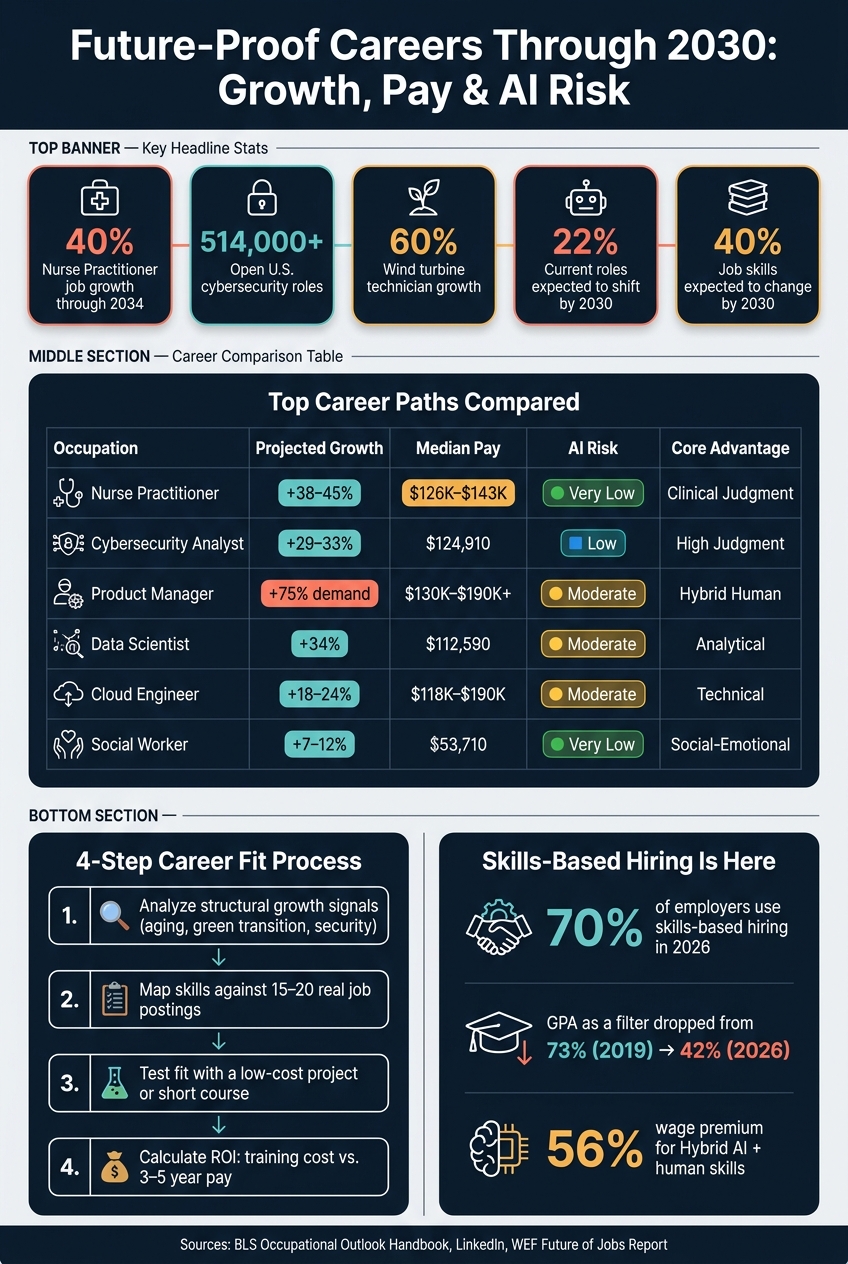
Future-Proof Careers 2030: Growth, Pay & AI Risk at a Glance
How AI Forecasts Career Demand in the U.S.
The Main Data Sources Behind Career Forecasts
The starting point is official government data. The Bureau of Labor Statistics (BLS) publishes 10-year employment projections for more than 800 occupations and 300 industries, with annual updates to keep up with changes in tech and research. The Occupational Outlook Handbook (OOH) then turns that raw data into plain-English career profiles that cover most jobs in the United States.
Two other tools help fill in the picture. The National Employment Matrix shows how occupations are spread across industries, while the O*NET-SOC Taxonomy links jobs to the skills, education, and training they need. Put together, these sources connect jobs, skills, and industry demand.
There’s one catch: BLS projections use a full-employment assumption, and they treat AI’s impact with care, only adding it when there’s evidence of lasting change. That makes the data strong for long-range trends, but it can be slower to pick up sudden shifts in the private sector.
These sources give you the baseline. After that, the job is to read the signals that matter most for career decisions.
The Metrics That Matter Most
Not every forecast number tells you the same thing. Projected employment growth shows where a role is headed, but percentage growth on its own can be misleading. Wind turbine service technicians are projected to grow by 49.9% through 2034, but registered nurses start from a much bigger base, so they create more total openings even with a lower growth rate.
That’s why annual occupational openings matter so much. They show not just new jobs, but also replacement openings when workers retire or leave the field. Add in median annual wage, and you get a better sense of pay. For example, nurse practitioners earn a median of $129,210 per year, while home health aides, another fast-growing job, earn about $34,900.
Skill demand and automation risk add one more layer. They help show whether AI is likely to support a role or cut into it.
So the point isn’t just to watch labor data like a scoreboard. It’s to use these numbers as a filter when you compare career paths.
How Forecasting Models Turn Data Into Career Signals
BLS-style models look at past links between industry output and employment, then use those patterns to estimate future demand. The BLS treats occupations as “bundles of tasks,” not fixed job titles, which matters a lot when AI enters the picture. Instead of asking whether a whole job disappears, forecasters look at which tasks a tool can copy and then adjust their assumptions carefully.
That’s why forecasts work best as a guide to direction and scale, not as a promise. If a forecast shows 17.9% growth in software developer employment from 2023 to 2033, driven by demand for AI-based business solutions, that’s a strong signal about where attention may pay off - even if the exact figure changes later.
Next comes the side-by-side comparison: which career fields look most likely to hold up over time.
sbb-itb-20a3bee
Career Areas Most Likely to Stay Strong as AI Changes Work
High-Demand Domains with Strong Long-Term Signals
Once you have the main metrics in view, the next move is to compare fields that still look steady as AI changes work. A few areas still bring together growth, pay, and lower AI exposure.
Healthcare and social assistance stands out most. This sector makes up 72% of total projected U.S. job growth, pushed by an aging population and a deep worker shortage. Nurse practitioners are projected to grow by 40% through 2034, and registered nurses score 94 out of 100 on AI stability. That lines up with the kind of work they do every day: clinical judgment, patient trust, and in-person care.
Technology and data infrastructure is a bit more mixed. Some entry-level coding work is under pressure, but fields like cybersecurity, AI safety, and data engineering are growing fast. In the U.S., cybersecurity has more than 514,000 open roles and projected growth of 29% to 33%. AI job postings have jumped 257% since 2015, and demand for AI/ML engineering is far above supply.
Green infrastructure and skilled trades offer another lane with staying power. Federal infrastructure spending and net-zero goals are pushing demand for hands-on work. Wind turbine service technicians are projected to grow by 60%, and solar photovoltaic installers by 48%. These jobs are tough to offshore or automate because the work happens in changing physical settings and still needs people on site.
Human-centered, high-judgment roles also hold up well. Product managers, mental health counselors, and social workers stay in demand because the work depends on trust, judgment, and relationships. AI can help with parts of the job, but it can't replace human presence or accountability.
Why Skill Clusters Matter More Than Job Titles
These fields matter less as job titles and more as skill clusters. AI changes tasks faster than it changes labels. About 22% of current roles are changing - meaning they will disappear, shift, or show up in a new form by 2030. A title like data analyst can cover very different kinds of work depending on the tasks involved. Some of those tasks are easy to automate. Others aren't.
That's why tracking skill clusters gives you a better read on where work is heading. For example, a cluster like data analysis can help someone move from a routine data-entry job into a growing strategic analysis role. Same base skill, very different path.
Right now, the clearest signals point to clusters like AI and machine learning, cloud infrastructure, cybersecurity, and product thinking. Alongside those are core human skills: communication, leadership, and collaboration. Workers who pair a technical base with strong human skills are often called hybrid profiles, and they earn a 56% wage premium over workers without AI skills.
Build toward a cluster, not a title.
Comparing Roles by Growth, Pay, and Automation Risk
Use these roles as starting points, not final answers.
| Occupation | Projected Growth | Median Pay (USD) | Automation Risk | Core Advantage |
|---|---|---|---|---|
| Nurse Practitioner | +38% to +45% | $126,260–$143,183 | Very Low | Social-Emotional / Clinical |
| Data Scientist | +34% | $112,590 | Moderate | Technical / Analytical |
| Cloud Engineer | +18% to +24% | $118,500–$190,750 | Moderate | Technical |
| Cybersecurity Analyst | +29% to +33% | $124,910 | Low | Technical / High Judgment |
| Product Manager | +75% (Demand Increase) | $130,000–$190,000+ (Est.) | Moderate | Hybrid / Heavy Human Interaction |
| Social Worker | +7% to +12% | $53,710 | Very Low | Social-Emotional / Regulatory |
Data scientists sit in a moderate-risk zone not because the job is fading, but because AI is changing which parts of the work matter most. The center of value is shifting away from routine modeling and toward interpretation, communication, and strategic framing. Cloud engineers are seeing a similar change. The role is shifting, not shrinking. Social workers and nurse practitioners stay in the very low-risk group because their work depends on licensed judgment, physical presence, and human trust.
Use growth, pay, and automation risk to test fit in the next step, then compare AI interview preparation vs traditional methods to refine your approach.
AI Is Killing the Career Ladder. A Stanford Economist Explains What Comes Next | Bharat Chandar
How to Evaluate and Prepare for a Career Path Using AI Tools
The previous table points to the paths with the strongest outlook. This section turns those signals into a personal decision process. The goal is simple: use the forecasts above to see whether a path fits your skills, your budget, and your timeline.
A 4-Step Process to Test Career Fit and Demand
1. Analyze structural growth signals
Start with the force behind the demand. Is it tied to something likely to stick around, or could it fade fast?
Fields tied to the green transition, supply chain resilience, and demographic shifts tend to hold up through economic cycles. The main test is durability. If the force behind demand would still matter during a recession or after a policy change, that's a signal worth taking seriously.
2. Map your skills against real job postings
Pull 15–20 current job postings for the role you want. Then look for patterns.
- Skills that appear in most listings are the baseline requirements.
- Skills that show up in 20%–40% of listings can help you stand out after you meet the basics.
This step also shows you the exact wording hiring teams use. That matters if you want to get through AI-driven applicant tracking systems (ATS). If the language in the posting lines up with your background, test that fit with a short project before you spend money on training.
3. Test before you commit
Before paying for a full certification or degree program, do a low-cost trial run. Use an affordable platform for a quick aptitude check. Then try a short project, a freelance contract, or a volunteer role to find out whether the day-to-day work actually suits you.
That small test can save you time and money. It can also help with hiring. Workers with micro-credentials or online certificates are 45% more likely to be hired for skills-based roles, so even a short course can make a difference.
4. Calculate the return
Look at starting pay, then compare it with mid-career pay - what the role tends to pay after 3–5 years. Add in the cost of upskilling.
For example, cloud and cybersecurity certifications often add 15%–25% to pay. If the numbers make sense and the work feels like a fit, you may have a path worth pursuing.
Professional skills now age fast, so continuous learning is part of the job.
Comparing Career Pathways by Entry Barriers and Expected Return
Use this lens to compare paths before you commit to a program or certification.
| Career Path | Entry Barrier | Expected Payoff | Key Requirement |
|---|---|---|---|
| AI/ML Engineer | Heavy training burden | High mid-career ceiling | Strong technical foundation |
| Cybersecurity | Specific certifications required | 15–25% pay bump from certs | Persistent demand; near-zero unemployment |
| Nurse Practitioner | Licensing and physical presence | Stability and long-term impact | High entry barrier; clinical training |
| Construction Manager | Digital project management certification | AI-resilient; infrastructure-driven | On-site coordination skills |
| Data Analyst | Strong communication skills | Remote flexibility | Ability to turn technical work into business decisions |
The strongest openings tend to cluster in two places: deep technical specialization and licensed clinical training.
Paths with lower barriers often reward a different mix - certifications, project work, and strong communication. You can already see that in hiring. In 2026, 70% of employers use skills-based hiring, and GPA as a filter has dropped from 73% in 2019 to 42% in 2026. In plain English, a clear project or a known certification can carry real weight.
Using Acedit to Build Interview Readiness for Growth Roles
Once a path looks viable, the interview becomes the last hurdle. Acedit helps candidates practice role-specific questions, simulate interviews, and get real-time response suggestions during live interviews. For someone moving into a forecast-backed growth role, that's a practical next step.
Conclusion: Turn Forecast Data Into a Career Plan
After you compare growth, pay, and automation risk, pick one clear path and move on it.
AI demand forecasting cuts down the guesswork. It pulls together job growth, pay, skill frequency, and automation risk in one view. The best way to use it is side by side with BLS occupational data and live job postings. When all three point in the same direction, treat that as a strong signal. If both postings and pay keep climbing over time, that usually points to solid demand and can give you more leverage when it’s time to negotiate.
From there, shift from reading the market to building skills for it. Use demand forecasts to choose the skill cluster with the best long-term odds. A mix like cloud + DevOps + security usually holds up better than any single skill on its own. And that matters, because nearly 40% of skills required for jobs today are expected to change by 2030. So don’t build your plan around one job title. Build it around a set of related skills that work well together. Once that skill cluster is clear, interview prep is the next step.
When you know where you’re headed, use Acedit to practice role-specific questions, simulate interviews, and get live response suggestions. Acedit helps you show that fit clearly in interviews.
FAQs
How do I choose between growth and pay?
Balance your long-term career path with what you need to earn right now. AI tools can help by matching your skills, experience, and goals with live market data, including job openings, industry shifts, and salary benchmarks.
That gives you a clearer view of where your skills pay off the most and which roles offer strong growth and earning potential. Acedit can then help you get ready for those roles with interview prep and coaching.
Which future-proof careers require the least training?
Careers that are more likely to last often lean on people skills and specialized know-how that AI can't copy with ease. Healthcare and skilled trades stand out here because the work depends on human judgment, hands-on problem-solving, and direct interaction with other people.
Instead of aiming for entry-level jobs that are more exposed to automation, you can use Acedit to spot paths that build on the experience you already have and help you show those transferable skills to employers.
How can I test a career path before committing?
Use AI-driven tools to check your direction with less risk. Start with a skills gap analysis. That means comparing what you can do now with the skills your target role is likely to need in the future.
Next, build a 3–5 year career map with key milestones, such as certifications and in-demand skills. Think of it like a road map: you don’t need every turn planned out, but you do need clear markers along the way. Acedit can help here with interview simulations and personalized coaching.