
Struggling with interviews? Real-time feedback tools may be the answer.
These AI-powered systems provide instant guidance during interviews, helping you refine your answers, reduce stress, and boost confidence. Unlike traditional interview preparation methods like mock interviews or delayed feedback, real-time feedback offers immediate corrections and suggestions, ensuring you stay on track when it matters most.
Key Benefits:
- Improved Answer Quality: Tools like Acedit use AI to analyze your responses and suggest structured improvements, such as following the STAR method.
- Reduced Anxiety: Instant support helps you stay composed and confident, even under pressure.
- Faster Learning: Immediate corrections allow you to refine your skills more quickly than traditional feedback methods.
- Higher Success Rates: 76% of users reported better interview outcomes after using these tools.
How It Works:
- AI Analysis: Tracks your tone, structure, and clarity in real time.
- Live Prompts: Offers instant tips to improve your responses as you speak.
- Practice Features: Simulate interviews with AI-generated questions and detailed feedback reports.
Tools like Acedit integrate seamlessly with video platforms (Zoom, Microsoft Teams, Google Meet) and offer flexible plans, including a free option. With real-time feedback, you can walk into your next interview prepared and confident.
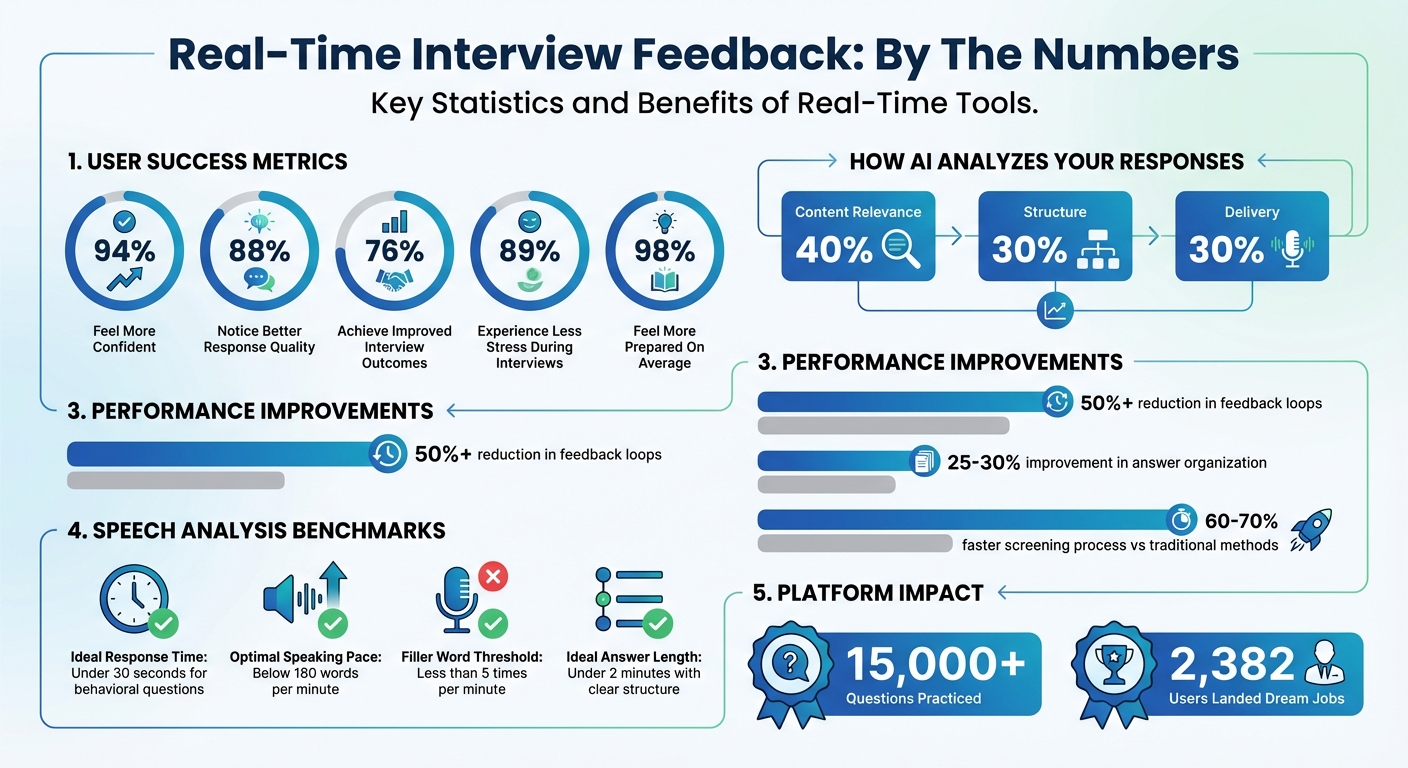
Real-Time Interview Feedback Tools: Key Statistics and Success Metrics
Top FREE AI Mock Interview Tools You Must Try in 2025 🚀
Explore more resources for free AI interview practice to sharpen your skills.
sbb-itb-20a3bee
How Real-Time Feedback Technology Works
Real-time feedback tools rely on artificial intelligence to instantly analyze your responses. By combining natural language processing (NLP), speech recognition, and sentiment analysis, these tools provide immediate insights into your speech, tone, and clarity.
AI Technology That Powers Real-Time Feedback
At the heart of real-time feedback lies NLP, which examines the structure, meaning, and relevance of your responses. It processes audio in milliseconds and flags deviations from interview best practices, such as the STAR method (Situation, Task, Action, Result). For example, if your response exceeds two minutes without a clear structure, the AI identifies this and suggests ways to make it more concise and focused.
Sentiment analysis adds another layer by assessing your emotional tone. AI models evaluate your delivery and identify signs of anxiety, like speaking faster than 180 words per minute or overusing filler words. If you say "um" or "like" more than five times per minute, the tool might advise, "Reduce filler words by 20% for a more confident tone".
These tools continuously monitor your responses in real time, offering actionable feedback as you speak.
How Tools Monitor and Analyze Your Responses
During live or practice interviews, these tools use speech-to-text transcription and audio analysis to track your responses through your microphone. Metrics such as response time (ideally under 30 seconds for behavioral questions) and keyword density are analyzed to provide a detailed evaluation.
Responses are scored based on three key elements: 40% content relevance, 30% structure, and 30% delivery. AI algorithms compare your answers to high-performing interview benchmarks, addressing common challenges like nervousness and disorganized interview prep questions. For instance, platforms like Acedit use this technology to provide live prompts that refine your responses on the spot. You might see suggestions like, "Organize with STAR: Elaborate on results." This approach aligns with proven interview strategies designed to build rapport and leave a lasting impression. This real-time coaching reduces feedback loops by over 50% and improves answer organization by 25–30%, speeding up the screening process by 60–70% compared to traditional methods.
Main Benefits of Real-Time Feedback for Interviews
Real-time feedback transforms how you approach interviews by addressing problems as they happen. It tackles common challenges like disorganized answers, nervousness, and delayed feedback. Instead of waiting days - or even weeks - for insights, you get immediate guidance that helps you adjust and improve during your practice session.
Better Answer Organization and Clarity
One of the standout benefits of real-time feedback is its ability to sharpen your responses. If you start rambling, it might suggest using the STAR method (Situation, Task, Action, Result) to make your answer more structured. For instance, a prompt like "Start by describing the situation before moving to your actions" can help you craft a response that's clear and concise. According to user data, 88% of candidates reported better-quality answers when using real-time AI coaching. This not only improves the clarity of your answers but also helps reduce the jitters that come with feeling unprepared.
Less Anxiety and More Confidence
A lot of interview anxiety comes from not knowing if you're on the right track. Real-time feedback changes that by offering instant support. It provides positive reinforcement when you’re doing well and gently corrects you when needed. This kind of immediate guidance feels more like a conversation than a critique, which helps you build confidence while keeping stress levels in check. By knowing exactly where you stand during practice, you can go into the actual interview feeling more prepared and self-assured.
Faster Learning Through Instant Corrections
Real-time feedback also speeds up the learning process. Traditional interview prep often leaves you waiting for feedback long after your session is over. With instant feedback, you can make corrections right away. For example, if you’re overusing filler words, the system will flag it immediately, helping you break the habit faster. Tools like Acedit allow candidates to practice as much as they need, without the time constraints of traditional coaching. Over 15,000 questions have been practiced using the platform, with 76% of users reporting better interview success rates after incorporating real-time corrections into their prep routine. The ability to tweak and retry answers on the spot builds the kind of muscle memory that leads to a polished and confident performance.
How to Use Real-Time Feedback Tools Effectively
To get the most out of real-time feedback tools, you need a clear, structured approach that transitions from preparation to execution. Think of it as a two-step process: the Practice Phase, where you refine your skills through mock interviews, and the Performance Phase, where the tool provides live support during your actual interview.
What to Look for in Real-Time Feedback Tools
The most effective tools offer features designed to enhance both preparation and live performance. Look for tools with live question detection, which use AI to transcribe and analyze interview questions in real time. This feature provides immediate coaching prompts, helping you organize your responses before speaking. Additionally, AI-generated response suggestions tailored to your resume, LinkedIn profile, and the job description ensure that the advice aligns with your specific background, avoiding generic recommendations. Tools with AI-powered mock interview system allow you to practice in a safe, controlled environment, helping you become more comfortable with the interview process.
Other key features to consider include real-time performance analytics to measure factors like clarity and structure, seamless integration with popular video platforms like Zoom, Microsoft Teams, and Google Meet (often via a Chrome extension), and post-session reports to track your progress. Research shows that candidates who receive clear feedback are 30–50% more likely to recommend the process to others, with 70% saying it leaves a positive impression.
Once you've identified a tool with these features, the next step is to incorporate it into a structured preparation routine.
Adding Real-Time Feedback to Your Preparation Routine
To make the most of these tools, start by uploading your resume, syncing your LinkedIn profile, and entering STAR (Situation, Task, Action, Result) examples. This allows the AI to generate context-specific suggestions that align with your experience. Begin practicing 1–2 weeks before your interview with 20–30 minute daily sessions. These short, focused simulations help you familiarize yourself with the tool and establish a baseline for improvement.
During practice, focus on one aspect at a time. For example, dedicate one session to refining your answer structure and another to working on tone and pacing. After each session, review the AI analytics to spot patterns, such as areas where you might feel anxious or where your responses lack clarity. As the interview date approaches, transition to full mock interviews that simulate real conditions. On the day of the interview, activate the tool's live features, like question detection and on-screen suggestions, to help organize your thoughts without breaking your flow. Afterward, review the session transcripts and scores to identify actionable takeaways for future opportunities.
How Acedit Provides Real-Time Interview Coaching
Acedit is a Chrome extension that combines all the key features of real-time feedback tools into one platform. It includes real-time question detection, offering instant, tailored response suggestions, as well as personalized Q&A generation and interview simulations to build confidence. By integrating your LinkedIn profile, Acedit ensures that its guidance aligns with your professional background. It even offers AI-driven cover letter creation to keep your application materials consistent.
What makes Acedit stand out is its ability to work invisibly during live interviews. It integrates seamlessly with browser-based video conferencing tools like Zoom, Microsoft Teams, and Google Meet, without being detected. Over 15,000 questions have been practiced on the platform, with 94% of users reporting increased confidence and 76% achieving better interview outcomes after using the tool. As one user, Sophia Lang, shared:
"Assisted with preparing me and then on the day, the live prompts during the interview helped me nail it".
Acedit offers flexible pricing: a free plan with basic features, a $45 Premium plan for limited interviews and simulations, and a $75 Premium Plus plan with unlimited access to all features. All plans are one-time purchases with lifetime access - no recurring fees.
Conclusion: Improve Your Interviews With Real-Time Feedback
Main Benefits Summary
Real-time feedback can completely change the way you handle interviews. By instantly identifying questions and guiding responses with the STAR method, it helps you stay composed, even when faced with unexpected topics. This approach ensures your answers are well-structured and engaging while boosting your confidence without interrupting your flow.
The results speak for themselves: 94% of users feel more confident, 88% notice better response quality, 76% achieve improved interview outcomes, and 89% experience less stress during interviews. Incorporating real-time feedback into your preparation not only sharpens your delivery but also builds the confidence to tackle any interview with ease.
Get Started With Acedit
If you're ready to take your interview skills to the next level, Acedit offers everything you need in one simple Chrome extension. It integrates effortlessly with platforms like Zoom, Microsoft Teams, and Google Meet. With over 2,382 users successfully landing their dream jobs, Acedit has proven its effectiveness across various fields.
You can try the free plan to explore alternatives to mock interview apps and basic AI-assisted features, or upgrade to the Premium plan for $45 (one-time) or the Premium Plus plan for $75 (one-time) for unlimited access with no recurring fees. Users report feeling 98% more prepared on average. With Acedit’s real-time support, you'll walk into your next interview feeling confident and ready to succeed.
FAQs
Is real-time interview feedback ethical to use?
The ethics surrounding real-time interview feedback, especially when AI tools are involved, hinge on two key principles: transparency and fairness. On one hand, critics worry that such tools might give certain candidates an unfair edge or obscure their genuine abilities. On the other hand, supporters view these tools as a way to boost confidence and help candidates perform better. For these tools to be used ethically, employers must clearly communicate their purpose and ensure they serve as a way to help candidates prepare without undermining the fairness of the hiring process.
Will the tool be visible during my interview?
The tool works quietly behind the scenes, staying entirely out of sight from interviewers while offering real-time assistance.
How can I avoid sounding scripted with live prompts?
To keep your interview responses from sounding overly rehearsed, aim for a natural flow rather than memorizing exact answers. A good way to prepare is by thinking of relevant stories or examples you can draw from during the conversation. Tools like Acedit can also be a game-changer - they can pick up on unexpected questions and provide tailored suggestions in real-time, helping you stay composed and genuine. Focus on truly understanding each question and sharing your honest thoughts to create a more engaging and authentic impression.