
The STAR method is a structured approach to refining your interview responses by breaking them into four parts: Situation, Task, Action, and Result. This framework not only helps you prepare better answers but also makes it easier to identify areas for improvement during post-simulation reviews. Here's how it works:
- Focus on Actions: Spend 60% of your response detailing the steps you took to solve the problem.
- Keep Context Brief: Limit the Situation and Task sections to 30% combined, avoiding unnecessary details.
- Quantify Results: Use measurable outcomes to make your answers stand out and demonstrate impact.
- Document Quickly: Write down your interview responses immediately after practice to retain key details.
- Leverage Tools: Platforms like Acedit simplify the process by recording simulations, breaking down answers into STAR components, and offering AI-driven feedback.
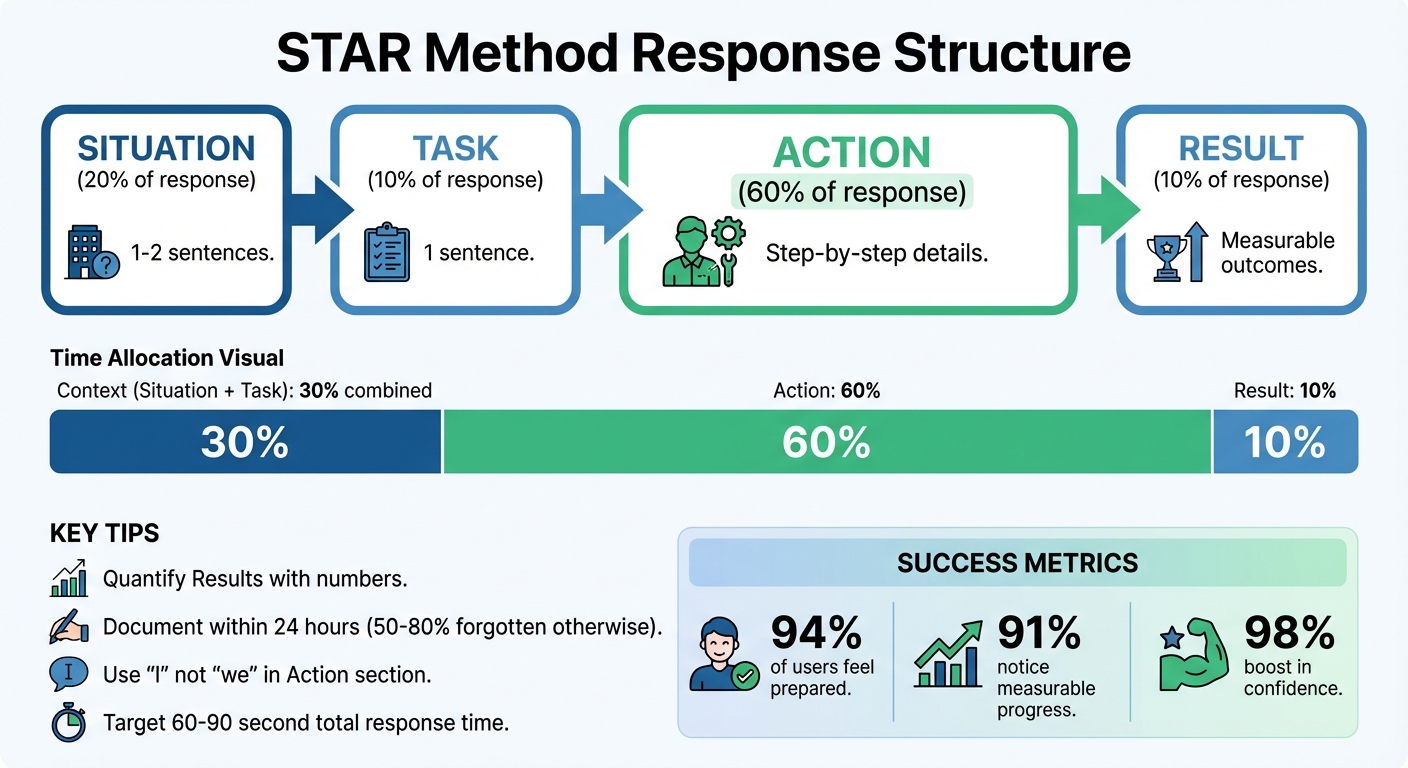
STAR Method Response Structure and Time Allocation Guide
Getting Ready for Your STAR Review
Documenting Your Responses Right Away
Did you know that 50-80% of new information slips away within just 24 hours? This phenomenon, called the Ebbinghaus forgetting curve, emphasizes the importance of documenting your responses immediately to avoid losing critical details.
When jotting down your answers, don’t settle for vague notes. Capture the exact questions, the context, and your full responses. Let’s say you tackled a question like, "Tell me about a time you handled conflict." Your notes might look something like this:
- Situation: "Coworker missed deadlines on a shared project."
- Task: "Ensure the team met its overall goal."
- Action: "Scheduled a one-on-one meeting, set checkpoints for progress."
- Result: "Project finished two days ahead of schedule, team collaboration improved significantly".
Be sure to also reflect on your strengths and areas for improvement right after the review. Did you struggle to articulate your specific role? Did you forget to mention measurable outcomes? Capturing these insights while they’re fresh will make your STAR analysis much more effective. And if keeping track manually feels overwhelming, there’s a tech solution for AI-driven interview prep that can lend a hand.
Using Acedit to Save and Sort Your Feedback
While manual notes are helpful, tools like Acedit can make the process much smoother. Acedit’s Chrome extension automatically records your entire simulation, so you don’t have to rely solely on memory. Its real-time question detection feature logs each question as it’s asked, and the built-in AI provides instant feedback on your responses.
What makes Acedit particularly useful is how it organizes your answers. It automatically breaks down your responses into STAR components. For example, it will pull the Situation from the context you shared, pinpoint the Actions you took, and even highlight areas where your response might be lacking - like spending too much time on background details and not enough on your contributions. Plus, its Custom STAR Examples feature creates structured worksheets that clearly show which parts of your answers need refining.
sbb-itb-20a3bee
Analyzing Your Answers with STAR
Reviewing Your Situation and Task
When crafting your STAR response, keep the Situation and Task sections concise - together, they should take up only about 30% of your answer: 20% for the Situation and 10% for the Task. If these sections drag on, you risk losing the interviewer’s interest before you get to the core of your answer, which highlights your skills and accomplishments.
Stick to 1–2 sentences for the Situation and 1 sentence for the Task. Marlo Lyons from Harvard Business Review puts it clearly:
Situation describes the circumstance or challenge you faced (one to two sentences). Task explains the objective you were responsible for achieving (one sentence).
If you find your setup is longer than this, it’s likely you’re including unnecessary details that dilute your message. Be selective and focused.
To refine your Task, use the "So What" test. This means ensuring your Task clearly communicates your goal and emphasizes your personal contribution by using "I" rather than vague terms. Additionally, compare your Situation and Task to the job description. If they don’t align with the skills or keywords the role requires, your response might miss the mark in demonstrating your fit for the position.
Once your Situation and Task are clear and concise, shift your energy toward perfecting the Action and Result sections.
Assessing Your Action and Result
The Action section should dominate your answer, taking up about 60% of your response. During your review, pay attention to how often you use "we" versus "I." While teamwork is valuable, this is your opportunity to highlight your individual contributions - limit the use of "we" and focus on what you did.
Break down your actions step by step and explain the reasoning behind each one. Madeline Laguaite, Editorial Content Strategist at Yoodli, explains:
The action element of the STAR method is also a good place to emphasize your skills and abilities you were able to leverage during the situation.
Avoid vague statements like "I did research." Instead, be specific - mention the tools or software you used, the number of stakeholders involved, or the methodologies you applied. Specificity not only adds credibility but also makes your response more engaging.
Finally, the Result is where you tie everything together. This part should include measurable outcomes. Lydia Bowers, a Human Resources Professional, stresses its importance:
Too many job candidates skip over this crucial step [Result]. But... That's the most important part of the answer!
Quantify your achievements whenever possible. For example, instead of saying, "I improved SEO rankings", specify the impact: "I improved SEO rankings by 89%." Numbers like revenue growth, cost savings, or time reductions make your results more compelling and tangible. If your Result feels vague or lacks data, revisit it and add specifics to clearly demonstrate the impact of your actions. To practice these refinements, consider using an AI interview simulation to test your delivery.
Improving and Rehearsing Your STAR Answers
Rewriting Answers That Need Work
Take a close look at your STAR responses and pinpoint areas that need improvement. Start by trimming your Situation section down to 2-3 essential details that provide just enough context without unnecessary backstory. For example, instead of saying, "I did research", be specific: "I developed a detailed study guide, created practice problems, and demonstrated problem-solving techniques to students". This level of specificity makes your Action section stand out and adds credibility.
Focus on measurable outcomes to refine your Results section. The MIT CAPD STAR Method Guide offers a great example: a tutor addressed low math exam scores by creating targeted study materials and demonstrating strategies. The result? "The class average for the national exam was the highest in over 10 years". Including a clear timeline or numerical result makes achievements more concrete and impactful.
If you're struggling to restructure your responses, try using Acedit's Custom STAR Examples feature. This tool analyzes your LinkedIn profile and suggests tailored responses based on your career history. Once you've polished your answers, move on to practicing them in a realistic setting.
Practicing Your Improved Answers with Acedit
Once your responses are fine-tuned, it’s time to rehearse for a confident delivery. Practice saying your answers out loud, and use Acedit's AI-Simulated Practice Interviews to refine your tone and timing. Avoid memorizing responses word-for-word; instead, aim for a conversational tone that sticks to the STAR framework while sounding natural.
Acedit users have practiced over 15,000 questions on the platform, with many reporting a 98% boost in confidence. After each simulation, you'll receive detailed AI feedback that identifies any missing elements in your STAR structure. This feedback helps you adjust and perfect your delivery. One user, William Johnson, shared:
Being able to prepare for interviews with real-time AI feedback was a game changer and made me feel confident for my interview.
Pay attention to timing - allocate about 60% of your response to the Action section. During practice, note which answers prompt follow-up questions, as this could indicate either strong interest or areas needing more clarity. Acedit’s Premium Plus plan ($75 one-time) offers unlimited practice, so you can rehearse until your delivery feels effortless and self-assured.
Answering Behavioral Interview Questions Using the STAR Method
Conclusion
The STAR method transforms post-simulation reviews into a powerful tool for honing your interview responses. By breaking down each answer into Situation, Task, Action, and Result, it becomes easier to pinpoint where adjustments are needed. Are you diving too deep into context? Overlooking your specific contributions? Forgetting to quantify your results? This structured approach turns vague feedback into practical steps for improvement.
Consistent practice also helps build the confidence and muscle memory needed for a smooth, conversational delivery. In fact, 94% of users report feeling prepared, 91% notice measurable progress, and 88% feel comfortable using AI-generated suggestions to refine their answers.
Acedit’s unlimited practice simulations, included with the Premium Plus plan for a one-time fee of $75, offer the repetition necessary to make your STAR responses second nature. The platform’s AI feedback helps bridge the "Preparation Confidence Gap", enabling you to tailor your answers to specific job descriptions while keeping your delivery authentic.
To get the most out of your practice, document your STAR examples. This not only enhances the personalized feedback provided by AI but also ensures your responses naturally fit into the ideal 60-90 second range. As career coach Sarah Robinson wisely puts it:
Interviews are a verbal skill. Get used to practicing aloud to refine both content and delivery.
FAQs
How can the STAR method help improve your interview answers?
The STAR method is a practical way to refine your interview answers by offering a clear framework to present your skills and accomplishments. It divides your response into four essential components: Situation, Task, Action, and Result, ensuring your answers are organized and impactful.
By using this method, you can effectively emphasize your qualifications and showcase measurable successes, making your responses more memorable and appealing to interviewers. This approach helps you stand out and leaves a strong, positive impression.
How does Acedit enhance STAR method practice?
Acedit takes your STAR method practice to the next level with real-time feedback, customized coaching, and questions tailored to specific roles. These tools help you fine-tune your responses, ensuring they’re well-structured, clear, and aligned with the job you’re aiming for. The result? Greater confidence and improved performance during interviews.
By leveraging AI-powered tools, Acedit streamlines the process of mastering the STAR method, making it simpler to create responses that truly stand out and leave a memorable impact.
Why should I include measurable results when using the STAR method?
Including measurable results when using the STAR method is essential because it clearly demonstrates the outcomes of your efforts. It proves to interviewers that you not only recognize the significance of your contributions but can also back them up with concrete data.
For instance, rather than saying you "enhanced team efficiency", you might say you "boosted team productivity by 20% within three months." This way, your accomplishments become more specific and easier for interviewers to grasp, showcasing the direct benefits of your work.