
AI is reshaping jobs, not eliminating them. To stay relevant, focus on building skills that complement AI tools. Here's what you need to know:
- 50%-55% of U.S. jobs will change due to AI by 2028, but many tasks - not entire jobs - are being automated.
- Employers increasingly seek AI literacy; job postings requiring it rose 70% in 2026 compared to 2025.
- AI is projected to create 78 million net new jobs globally by 2030, despite displacing 92 million roles.
Key Takeaways:
- Start with AI Basics: Learn terms, ethical considerations, and what AI can/can’t do (e.g., Google AI Essentials course, $49).
- Focus on Practical Skills: Master tools like ChatGPT for writing, data analysis, and coding. Prompt engineering is highly valued.
- Specialize by Industry: Tailor AI skills to your field (e.g., marketers: SEO briefs; developers: debugging; managers: talent development).
- Assess Job Risk: Audit tasks you perform regularly. Automate repetitive work and strengthen skills requiring human judgment.
- Use Tools to Prepare: Platforms like Acedit help practice AI-related interview questions and showcase your expertise.
AI is a tool, not a threat. Use it to automate routine tasks and focus on areas where human creativity and decision-making shine. Start building your AI skills today to future-proof your career.
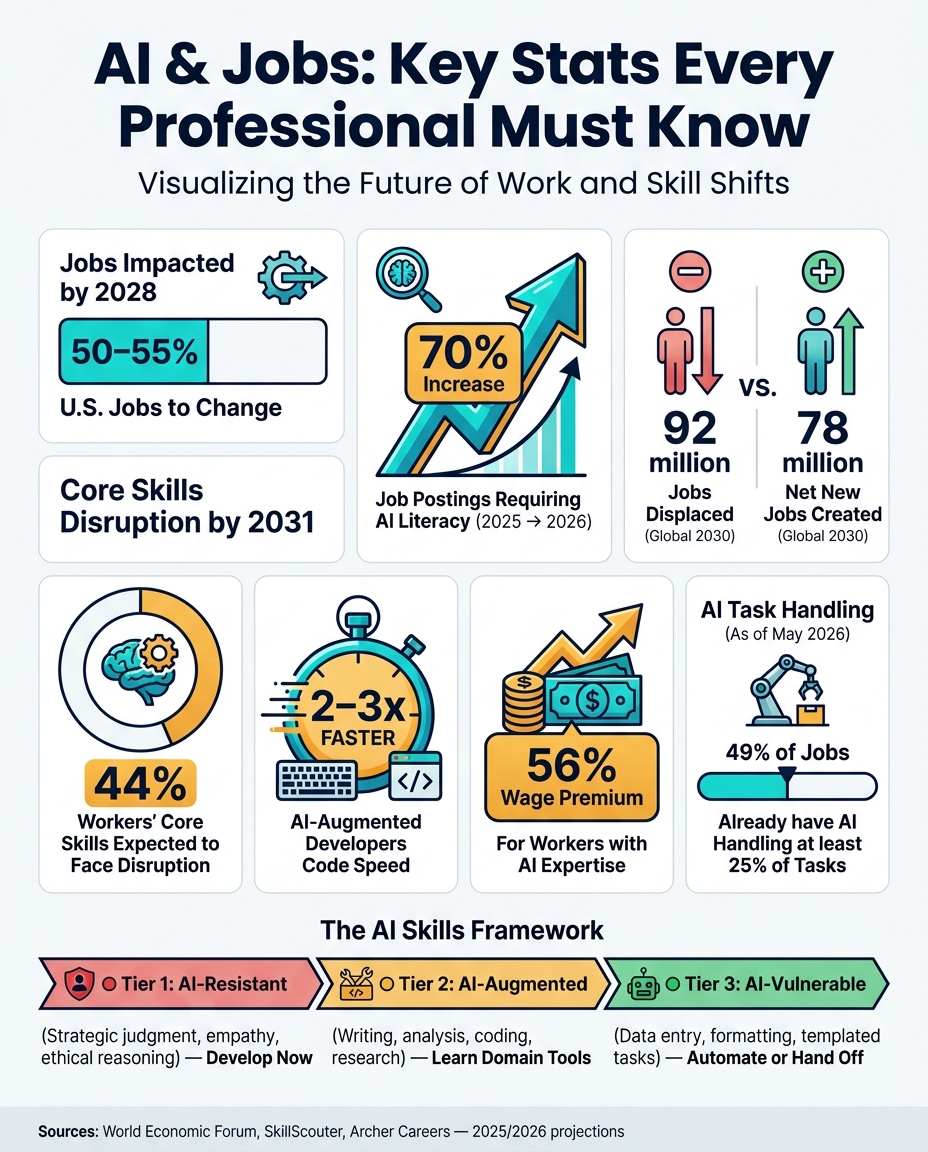
AI & Jobs 2024–2030: Key Stats Every Professional Must Know
The AI Skills You Need to Stay Relevant
Basic AI Literacy
Start by building a strong foundation in AI literacy. This means understanding what AI can and cannot do, becoming familiar with basic terms, and being aware of the ethical considerations surrounding AI use in the workplace.
You don’t need to become a data scientist; instead, focus on being informed enough to make smart decisions about integrating AI into your work. For instance, knowing the difference between large language models and traditional algorithms helps you set realistic expectations and avoid costly missteps. A good starting point is Google’s AI Essentials course on Coursera, which costs about $49 and provides an accessible introduction.
Ethics is another critical aspect. Topics like bias, data privacy, and accountability are now central to professional discussions. Being knowledgeable in these areas shows employers that you’re not just tech-savvy but also responsible and thoughtful.
Practical AI Skills for Daily Work
Once you’ve mastered the basics, it’s time to apply AI to your day-to-day tasks. One of the most in-demand skills right now is prompt engineering, or the ability to craft precise queries that get the best results from AI tools.
"AI handles the computational heavy lifting; human judgment determines what questions are worth asking." - SkillScouter
AI tools can enhance productivity in tasks like writing emails, summarizing meetings, analyzing data, and drafting reports. Research shows that AI-augmented software developers produce code 2–3 times faster than those who don’t use AI tools. This kind of efficiency boost is relevant across industries.
To help prioritize your efforts, consider the three-tier framework for tasks:
| Skill Tier | Examples | Your Priority |
|---|---|---|
| AI-Resistant | Strategic judgment, stakeholder influence, empathy, ethical reasoning | 🔴 Develop now |
| AI-Augmented | Writing, data analysis, research, coding | 🟡 Learn domain tools |
| AI-Vulnerable | Data entry, basic formatting, template reporting | 🟢 Automate or hand off |
This framework encourages focusing on tasks that require human creativity and judgment while automating repetitive work. It’s a practical way to align your skills with long-term career growth.
Industry-Specific AI Skills
After you’ve developed general AI skills, it’s time to specialize based on your industry. Tailoring AI tools to your profession gives you a distinct edge. The goal is to integrate AI into your workflow seamlessly, rather than treating it as a separate skill.
| Job Category | AI-Augmented Skills to Learn | AI-Resistant Skills to Strengthen |
|---|---|---|
| Marketing | Content drafting, persona research, SEO briefs, ad copy variants | Brand strategy, audience psychology, campaign architecture |
| Data & Analytics | SQL generation, automated EDA, report summarization | Experimental design, data storytelling, business strategy |
| Software Dev | Boilerplate generation, debugging, test writing | System architecture, code review, security principles |
| Finance | Variance analysis, forecast automation, financial modeling | Scenario planning, risk frameworks, M&A judgment |
| Management | Meeting summaries, AI interview preparation vs traditional methods and performance review drafting | Coaching, talent development, change management |
Across these fields, the trend is clear: AI is automating routine tasks, allowing professionals to focus on strategic thinking, judgment, and creativity. For example, in marketing, AI can handle content production, but the real value lies in crafting a brand strategy and understanding audience behavior. Similarly, in software development, AI can generate boilerplate code, but professionals are now more valuable when focusing on system design and architecture.
"The question isn't whether AI will change your job: it already has. The question is whether you'll be on the right side of that change by the end of 2026." - Dave Kline, Editorial Lead, SkillScouter
sbb-itb-20a3bee
How to Assess Your Risk of Job Obsolescence
Using AI to Read Job Market Trends
If your role involves routine tasks or rule-based processes, you might be at higher risk of automation. It's a good idea to evaluate your position now. AI tools can help you navigate job market trends by analyzing job postings and tracking the skills that employers are prioritizing. For instance, tools like ChatGPT or Claude can quickly summarize patterns from multiple job listings, highlighting which skills are gaining traction and which are becoming less relevant. According to the World Economic Forum, 44% of workers' core skills are expected to face disruption by 2031. This projection suggests that significant shifts could happen within just a few years, making it crucial to assess your vulnerability sooner rather than later. Start by documenting the tasks you perform regularly to understand where you fit into this evolving landscape.
Building a Personal Skills Inventory
Creating a skills inventory is simpler than you might think. Begin with a task audit: write down all the key tasks you handle in a typical week. Use the table below as a tool to organize and evaluate your tasks, focusing on how they align with AI's capabilities. Keep in mind, this is meant to help you assess your own situation, not as a universal guide.
| Skill Tier | Characteristics | Your Tasks |
|---|---|---|
| Tier 1: AI-Resistant | Relies on human judgment and empathy | List tasks involving strategic thinking, leadership, or ethical decision-making |
| Tier 2: AI-Augmented | Enhanced by AI tools | List tasks like writing, analysis, coding, or modeling |
| Tier 3: AI-Vulnerable | Routine and rule-based | List tasks such as data entry, scheduling, or templated work |
Once you've categorized your tasks, focus on Tier 2. This is where you have the most opportunity to improve your value by incorporating AI tools. Identify your top three skill gaps in this category and work on addressing them.
To start closing these gaps, try using an AI assistant daily for a week. Pay attention to where it excels and where it struggles - this will help you identify areas where you might need to refine your approach, such as improving prompt engineering. With a clear understanding of your skill gaps, you can take targeted steps to address them.
How Acedit Helps You Align Your Skills
After pinpointing your skill gaps and prioritizing them, it's essential to demonstrate your progress effectively. This is where Acedit can be a game-changer. Identifying areas for improvement is one thing, but showcasing them to potential employers is another. Acedit helps bridge this gap by transforming your learning into interview-ready responses through customized Q&A generation tailored to specific job postings.
For example, if you've worked on improving your AI-driven data analysis skills, Acedit can create targeted practice questions that reflect how interviewers evaluate candidates for data-focused roles. Its real-time coaching and AI-simulated mock interviews let you practice until you're confident, ensuring you can clearly articulate your abilities when it counts. Workers who take the initiative to reskill in AI-related areas often experience growth in their earnings rather than a decline.
How to Build and Keep Up Your AI Skills
Ways to Learn AI Skills
Once you've assessed your current abilities, the next step is to strengthen and expand them with a clear, hands-on approach. The good news? You don’t need a computer science degree to dive into AI. A great starting point is the 90-Day Reskilling Framework, which breaks the process into manageable phases:
| Learning Phase | Focus Area |
|---|---|
| Days 1–30 | Task Audit & Foundational Literacy |
| Days 31–60 | Domain-Specific Skill Application |
| Days 61–90 | Integration & Career Demonstration |
To begin, take a foundational course like Google AI Essentials on Coursera or explore free resources such as fast.ai and Kaggle. These will give you a structured understanding of AI basics. Once you're comfortable, dive into specialized AI interview tools and apply your knowledge by working on three real-world projects. This hands-on experience is key to truly mastering the concepts.
"The professionals who thrive are those who identify which of their current tasks are being automated, double down on the tasks that require human judgment, and layer AI tools on top of both." - Dave Kline, Editorial Lead, SkillScouter
Putting AI to Work Every Day
Building a foundation is just the start - what matters is how you apply AI in your daily life. Completing a course isn’t enough; you need to incorporate AI into your everyday tasks. Start small: use an AI tool like ChatGPT to handle one meaningful task each day. This could be drafting an email, summarizing a meeting, or brainstorming ideas for a project. Daily practice will help you build confidence and practical skills.
As you begin to see results, take the time to quantify them. For instance, if using AI tools reduces reporting time, document it: "Used AI tools to reduce reporting time by 40%." Specific metrics like this can make a big impression on a resume or during interviews. The goal? Make AI an effortless part of your workflow, not just an occasional add-on.
Using Acedit to Prepare for AI-Focused Interviews
As AI becomes a bigger part of your skill set, you’ll need to articulate your expertise during job interviews. That’s where Acedit can help. This platform supports your career growth by tailoring interview preparation to specific roles. Acedit generates role-specific practice questions based on actual job postings, giving you a realistic sense of what hiring managers will ask about your AI experience.
The platform’s interactive interview simulator goes a step further by adapting its follow-up questions based on your answers, simulating the dynamics of a real interview. You can also build a personalized STAR example library using Acedit’s LinkedIn integration, ensuring your responses are detailed and relevant. According to user feedback, the platform boosts confidence by an average of 98%, and over 15,000 questions have been practiced on it as of mid-2026.
"Being able to prepare for interviews with real-time AI feedback was a game changer and made me feel confident for my interview." - William Johnson
Acedit offers a free plan with 4 AI-generated Q&As per job listing and 2 simulated practice interviews, giving you a chance to explore its features. For those actively job searching, the Premium Plus plan ($75, one-time) unlocks unlimited live and simulated interviews, making it a worthwhile investment in today’s AI-driven job market.
Conclusion: How to Keep Your Career Relevant as AI Grows
Why Lifelong Learning Matters
As AI continues to reshape industries, making learning a regular part of your routine is more important than ever. The best professionals don’t just reskill once - they treat it as an ongoing process. A great way to stay ahead is by adopting a 90-day cycle: assess your skills, learn something new, apply it, and repeat. This approach ensures you stay relevant and valuable in the job market. And the effort pays off - workers with AI expertise currently enjoy a 56% wage premium compared to their peers.
"The professionals who act on this now, while the premium is highest and the competition is still thin at the senior level, will be setting the compensation benchmarks that everyone else tries to catch up to in 2028." - Archer Careers
Seeing AI as a Career Tool, Not a Threat
Ongoing education helps you see AI as an opportunity rather than a problem. Despite alarming headlines, AI hasn’t caused mass unemployment. By May 2026, 49% of jobs had AI handling at least 25% of their tasks, but this hasn’t led to widespread job losses for those in highly exposed roles. What’s changing isn’t the demand for human workers - it’s the value placed on skills that only humans can provide.
"AI elevates entry-level tasks but cannot replace high-level human judgment. AI-proofing your career means deliberately shifting your time, energy, and identity toward the ceiling and letting AI take over the floor." - Will Tygart, AI Strategist
Instead of fearing AI, take a step back, evaluate your strengths, and map out your next steps to stay competitive. Shifting your mindset from worry to action can make the difference between thriving in your career or falling behind.
Most People Will Be Unemployable in 5 Years. Here’s Why.
FAQs
Which parts of my job should I learn to automate with AI first?
Focusing on automating routine and repetitive tasks - like data entry, document processing, or managing basic text-based queries - frees up your time for more meaningful work. This shift allows you to dedicate energy to problem-solving and making strategic decisions that require deeper thought.
To get started, consider using tools like Acedit. These can help you assess your skills in comparison to market demands, guiding you in pinpointing which tasks to automate. At the same time, prioritize developing skills that technology can't replace, such as leadership and ethical reasoning, ensuring you remain essential in any professional environment.
What AI skills matter most if I’m not a technical person?
To stay ahead in the game without a technical background, focus on building AI literacy and learning how to integrate AI tools effectively into your work. You don’t need to know how to code, but understanding how to manage and use AI tools is key.
Here are some important skills to develop:
- Prompt engineering: Learn to create clear, detailed instructions that help AI deliver the results you need.
- Verification: Always review AI-generated outputs to ensure they are accurate and free from bias.
- Workflow design: Organize tasks so that AI handles repetitive work while you maintain overall control and direction.
- Communication: Use empathy and ethical judgment to address areas where AI might fall short or miss the human touch.
How can I prove my AI skills in interviews and on my resume?
When presenting your AI skills, focus on specific achievements and measurable outcomes. Instead of generic statements like "familiar with AI", provide clear examples. For instance, mention the AI model you used, the context of its application, and the results it delivered - such as reducing processing time by 20% or increasing revenue by $50,000.
For interviews, the STAR method (Situation, Task, Action, Result) is your best friend. Use it to explain how you strategically applied AI to solve problems. Highlight your critical thinking process, how you ensured the AI outputs were accurate and unbiased, and the impact of your work. This approach demonstrates not just technical skills but also your ability to think holistically about AI's role in achieving business goals.