
I use titles for context and skills to check fit - not match scores alone. Compare the job’s required skills with proof from your work, then check credentials and gaps before judging a match.
Why look beyond titles? The OECD, citing LinkedIn’s 2023 analysis, reports that skills-first criteria found more than nine times as many eligible candidates as title-only matching. That means more people to consider - not proof of better hires.
Here’s what I check:
- Same title, different work: Do duties and responsibility levels line up?
- Different titles, shared work: Do tasks overlap, and who owns the results?
- Industry changes: Which skills transfer, and which rules, tools, or credentials still need checking?
Quick Comparison
| What I compare | Job-title matching | Skill-based matching |
|---|---|---|
| Starting point | Role names and seniority | Skills, duties, and work history |
| Data needed | Titles, dates, and employer context | Resume text, tools, credentials, results, and recency |
| Fit and missed matches | May favor familiar titles or miss related work | May find shared skills or mistake keywords for ability |
| Explanation | Title, synonym, or role-family match | Skill, source text, inference, and requirement weight |
| Main checks | Actual duties and responsibility level | Skill accuracy, recent use, and required versus preferred qualifications |
I test both methods with the same profile and job description, then read the reasons behind each result. <u>Required qualifications come before ranking.</u>
For interview prep, I connect three to five required skills to verified STAR examples. Acedit can help me rehearse those answers, but it does not verify my achievements or decide whether I fit the job.
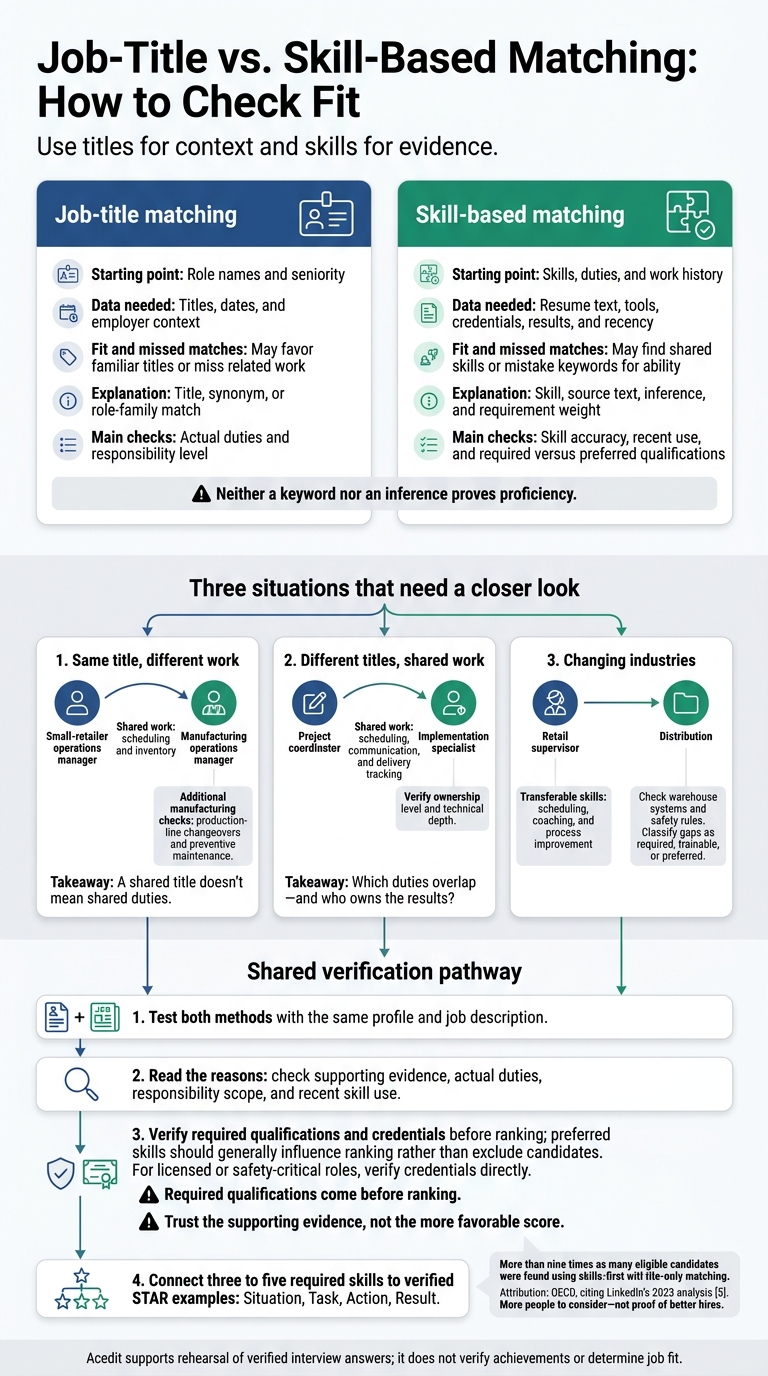
Job-Title vs. Skill-Based Matching: How to Check Fit
How the Matching Methods Work
The main difference is what each tool uses as its starting point: role titles or evidence of skills.
Job-Title Matching: Role Names and Seniority
Tools compare a candidate’s current and past titles with the open role’s title. They may map titles to standard role names, recognize synonyms, and read seniority markers such as “lead” or “director.” Some also factor in employer history and dates. O*NET links occupational titles to tasks, skills, and preparation requirements, helping searches look beyond exact wording.
Not every tool handles title variants or seniority the same way. Check whether its explanation shows an exact title match, a synonym, or a broader occupation, rather than just a label that looks similar.
Skill-Based Matching: Skills and Work Evidence
Skill matching starts with evidence of work, not role labels. Tools extract skills from resumes, profiles, job descriptions, and work history. Semantic matching links related meanings, while skill taxonomies group capabilities under consistent labels. ESCO supplies a shared vocabulary for occupations and skills to support this process.
Explanations should separate keyword matches from inferred capabilities, show the source text supporting actual use, and label confidence or evidence type. Neither a keyword nor an inference proves proficiency.
Check extracted skills for errors, missing evidence, and recency. Older experience still counts, but experience with fast-changing tools needs a recency check. Requirements that candidates must meet should act as eligibility gates. Preferred skills should generally affect ranking - not exclude candidates. The explanation should make that distinction clear.
Precision and recall depend on the tool, its rules, and the quality of its evidence. The table shows how these differences affect results and explanations.
| Comparison factor | Job-title matching | Skill-based matching |
|---|---|---|
| Title dependence | High; exact or normalized labels strongly influence results | Lower; titles add context but are not the main signal |
| Data needs | Current and past titles, standard labels, synonyms, seniority, and employer context | Resume or profile text, job duties, skills, tools, credentials, outcomes, and recency |
| Precision | Can be strong for standardized roles, but broad or inflated titles may return irrelevant results | Can be strong when specific skills have supporting evidence; broad skills can create false positives |
| Recall | May miss qualified people with unfamiliar or different titles | Can find related roles and candidates with transferable skills, but may miss skills that are omitted or described indirectly |
| Explanations | Usually straightforward: title, synonym, family, or seniority match | More detailed: extracted skill, relationship, evidence, and requirement weight |
| Common errors | Identical titles with different duties; unfamiliar titles; incorrect seniority assumptions; title inflation | Keyword stuffing; mistaken skill inference; confusing exposure with proficiency; outdated experience; missing context; giving preferred skills too much weight |
sbb-itb-20a3bee
How the Methods Compare Across Roles and Industries
Similar Titles, Different Duties
A small-retailer operations manager may share scheduling and inventory work with a manufacturing operations manager, but not production-line changeovers or preventive maintenance.
A shared title doesn’t mean shared duties. Compare the work, transferable skills, and hiring risks - not just the label.
| Evaluation criterion | Job-title matching | Skill-based matching | Human check |
|---|---|---|---|
| Title similarity | High: both roles use “operations manager” | Compares duties behind the shared title | Confirm whether employers use the titles the same way |
| Required skills | May miss differences in production work | Separates leadership and scheduling from production, safety, and technical skills | Identify day-one requirements |
| Seniority | “Manager” suggests a similar level | Reviews team size, budget, decision authority, and responsibility scope | Verify that responsibility levels match |
| False-match risk | The same title can hide different work | Can still miss safety or technical gaps | Assess gaps in safety, quality, equipment, and compliance |
The reverse happens, too: different titles can describe the same work.
Different Titles, Shared Duties
A project coordinator may overlap with an implementation specialist on scheduling, communication, and delivery tracking, but title differences do not show ownership level or technical depth.
Look beyond the titles to see which duties overlap - and who owns the results.
| Evaluation criterion | Job-title matching | Skill-based matching | Human check |
|---|---|---|---|
| Title recognition | May miss overlap because titles differ | Identifies shared tasks, tools, and skills | Confirm that resume language reflects actual work |
| Responsibility overlap | Finds little overlap from labels alone | Compares scheduling, communication, tracking, documentation, and escalation | Separate delivery ownership from support |
| Evidence of ability | Relies on title and employer context | Looks for on-time launches, reduced delays, adoption rates, or completed deliverables | Verify the candidate’s contribution |
| Potential missed match | High when equivalent duties have different titles | Lower, though generic skills can create false positives | Review domain complexity, customer exposure, and technical responsibilities |
Changing Industries
When titles and tasks cross industries, industry-specific rules can decide whether a match holds up.
A retail supervisor may transfer scheduling, coaching, and process improvement skills to distribution, but warehouse systems and safety rules still need review.
Compare transferable skills with industry requirements, then check which gaps affect hiring.
| Evaluation criterion | Job-title matching | Skill-based matching | Human check |
|---|---|---|---|
| Transferable skills | “Supervisor” suggests related seniority | Highlights scheduling, coaching, and workflow coordination | Compare the scale and pace of operations |
| Industry requirements | Offers little evidence of industry knowledge | Flags systems, safety, and domain knowledge | Verify mandatory qualifications |
| Training needs | Reveals little about specific gaps | Identifies missing or unverified abilities | Assess training time and supervision needs |
| Method limits | Can put too much weight on the shared title | Can put too much weight on broad skills | Classify gaps as required, trainable, or preferred |
Treat a gap as blocking only if the skill is required on day one and can’t be learned quickly.
Check Matching Results and Support Your Fit
Test Match Quality With the Same Criteria
Test both methods using the same profiles, job descriptions, and criteria. Record how each handles title synonyms, seniority, extracted skills, duty overlap, required versus preferred qualifications, and explanations. Also check whether updated profile details change the result. Treat this as a qualitative audit, not a score ranking.
| Candidate situation | Job-title matching | Skill-based matching | Human review trigger |
|---|---|---|---|
| Standard title and conventional career path | Check title recognition and seniority | Check evidence of required tools and duties | Verify responsibility scope and qualifications |
| Equivalent duties under different titles | Check whether title synonyms are recognized | Check whether shared responsibilities are extracted | Review differences in authority and accountability |
| Industry change | Check whether the former industry limits results | Check whether transferable capabilities are recognized | Assess industry knowledge separately from shared skills |
| Trainable software gap | Check whether the title masks the missing tool | Check whether the tool gap is separated from core capability | Confirm whether the tool is required or preferred |
For licensed or safety-critical roles, verify credentials directly. A strong match does not establish eligibility.
Save the first explanations, then add a verified accomplishment, certification, or project and rerun both methods. Does the new evidence appear in the reasoning? If the results conflict, trace the disagreement to missing information, title interpretation, seniority, or qualifications. Trust the supporting evidence, not the more favorable score.
Use the strongest match signals to choose the evidence you'll prepare for the interview.
Practice Skills-Based Interview Answers With Acedit
Use the match explanation to identify which skills you'll need to prove in the interview. Connect each important requirement to a truthful STAR answer: Situation, Task, Action, Result. Spell out your contribution, the tools or methods you used, and the outcome. Include figures and timeframes only when you can support them. If you're changing industries, separate the capability you already have from the domain knowledge or tool familiarity you still need to develop.
Acedit is an interview-prep tool, not a matching engine. Use it to rehearse verified STAR answers and follow-up questions.
Correct outdated LinkedIn details before practicing, and check every claim against your experience. Acedit does not verify ability, authenticate achievements, or determine job fit.
Conclusion: Use Titles and Skills Together
Use titles for context and skills for evidence. Job-title matching works best when role names and seniority line up. Skill-based matching can show relevant experience across titles and industries. Neither tells the whole story. Verify skills, credentials, and role requirements before judging fit, then use that comparison to support what you present next.
Choose a target role and list its three to five required skills. For each skill, document one verified achievement with measurable results. Separate strengths you can carry into the role from gaps in industry knowledge or required credentials.
Then practice explaining how your responsibilities - not just your title - connect to the work. Be clear about what you can do now and what you still need to learn.
FAQs
Should I change my resume title to match a job posting?
Keep the facts on your resume consistent with your application materials, LinkedIn profile, and interview notes. When hiring teams compare these documents, a matching employment history helps prevent confusion and builds trust.
If your official job title is unusual, keep it and add a standard industry title in parentheses rather than replacing it. This helps applicant tracking systems and recruiters understand your experience.
How can I prove transferable skills without industry experience?
Lead with measurable achievements, not job titles. Use STAR (Situation, Task, Action, Result) to explain what you accomplished, backed by numbers such as revenue growth, percentage improvements, or time saved. Replace industry jargon with clear descriptions of skills like executing plans or managing stakeholders.
Use Acedit to compare your background with target job descriptions, spot strengths you can bring to a new role, and match your resume and cover letter to the role’s language and requirements.
How do I spot keyword-driven false matches?
Use AI recommendations as suggestions, not final answers. Be cautious of high match scores that lack clear explanations. If a role doesn’t feel like a good fit despite a high score, compare it with your research and ask mentors for their input. Check the listed skills, too, to make sure they reflect your experience. AI can misread vague terms or company names.