
AI-powered tools are reshaping how we navigate the job market. They analyze massive datasets - like job postings, salaries, and hiring trends - to help you make smarter career decisions. From identifying high-demand skills to providing real-time salary benchmarks, these platforms simplify the job search and career planning process. Here's what they offer:
- Personalized Insights: Tools like PayScope tailor salary and job data to your profile, using up-to-date market conditions.
- Hidden Opportunities: AI uncovers roles often missed on public job boards by scraping internal systems.
- Skill Analysis: Platforms identify gaps in your resume and suggest areas to improve for better hiring chances.
- Employer Trends: Tools track hiring velocity and company growth, helping you focus on active, transparent employers.
- Interview Prep: Acedit turns insights into tailored strategies, offering AI-driven interview coaching compared to traditional methods.
These tools don't just provide data - they help you act on it, ensuring you're prepared for every step of your career journey.
Key Data Sources and Metrics in Career Analytics
Primary Data Sources for Career Analytics
AI-powered career tools pull together a variety of data sources to give a well-rounded view of the job market. The most trusted platforms combine government datasets, real-time job postings, and employer sentiment data to create insights that are both timely and actionable.
Government data plays a foundational role. Tools access resources like the Bureau of Labor Statistics (BLS) for employment stats and job openings (JOLTS), the Federal Reserve Economic Data (FRED) for broader economic indicators like unemployment rates and inflation, and the O*NET database, which provides detailed information on job classifications and required skills. These sources offer a rock-solid baseline for career analytics.
Real-time job postings add another layer of insight. Platforms like Lightcast collect data from over 220,000 websites globally, including company career pages and job boards. They use a two-step process to remove 80% of duplicate listings, ensuring cleaner data. Similarly, LinkUp indexes an impressive 315 million job postings daily from 80,000 employer websites. This direct-sourcing approach typically yields more reliable and accurate information compared to data aggregated from third-party job boards.
Here’s a breakdown of how different sources contribute to specific insights:
| Data Source Type | Key Metrics Provided |
|---|---|
| Government | Unemployment rates, SOC codes, macroeconomic trends, demographics |
| Job Boards | Posting volumes, advertised salaries, sponsored job rates |
| Direct Sourcing | Job listings directly from employer websites |
| Social/Sentiment | CEO approval ratings, business outlook, workforce skills |
By aggregating these diverse data points, AI tools convert raw information into insights that reflect both current conditions and emerging trends.
Key Metrics for Job Market Insights
These metrics form the backbone of AI-driven career insights, helping individuals and organizations make smarter decisions. Several stand out for their impact.
Skill frequency tracks how often specific skills appear in job postings. For example, as of April 2026, AI-related skills were listed in 71% of U.S. tech job postings - a 181% increase compared to the previous year. Across all industries, 13.5% of active job postings required AI skills, up from just 4.5% in April 2025. This trend highlights the growing demand for AI expertise. As noted by the Indeed Hiring Lab:
"The low-hire, low-fire dynamic persists, but it may now be better understood as a new steady state rather than an ongoing deterioration." - Indeed Hiring Lab
Salary benchmarks provide a nuanced look at compensation trends. Instead of relying on a single figure, these tools compare salary ranges from job boards with official data from the BLS Occupational Employment and Wage Statistics (OEWS). This comparison helps address discrepancies, especially since only 64.7% of job postings include salary details.
Other valuable metrics include fill days, which measure how long job postings remain active before being filled. In March 2026, the average was 48 days. Another critical measure is automation risk scores, which assess jobs on a 0–10 scale for their exposure to AI. The average score across 342 U.S. occupations is 5.3/10, though roles like medical transcriptionists hit the maximum score of 10.
Together, these metrics not only provide a snapshot of the current job market but also offer clues about its future direction. Up next, we’ll dive into how AI tools use this data to identify trends and spotlight skills that stand the test of time.
sbb-itb-20a3bee
AI For Data Analysis In 21 Minutes
AI Tools for Job Market and Skills Trend Analysis
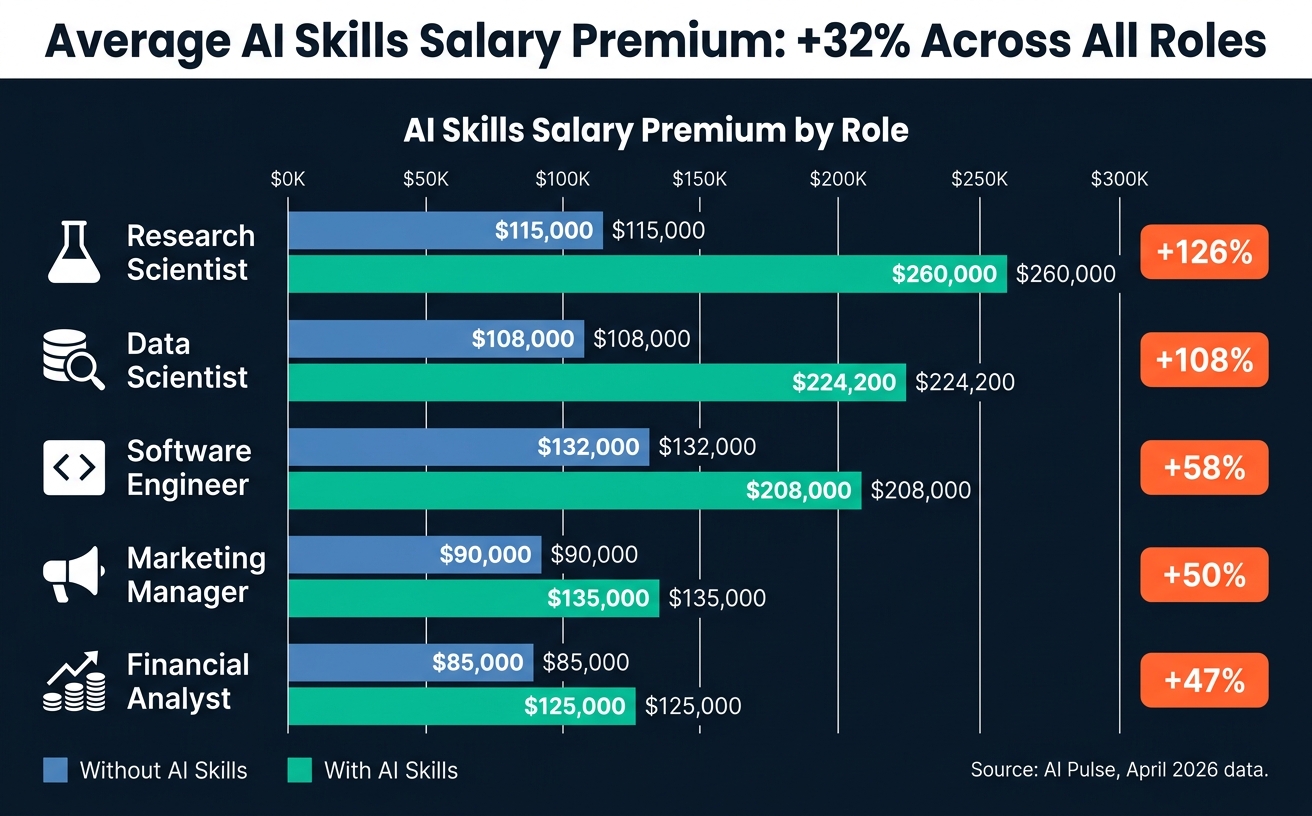
AI Skills Salary Premium by Role: With vs. Without AI Expertise
Tracking Job Trends and Emerging Roles
Numbers alone don’t tell the full story - that’s where AI tools step in, transforming raw data into actionable insights. Platforms like JobSpace AI analyze millions of job postings daily, creating regional hiring heatmaps that show exactly where demand is rising and in which industries.
The job market is shifting quickly. In the U.S., tech job postings were up 21% year-over-year as of May 2026, signaling a steady recovery and growth following the pandemic. The Philadelphia metro area saw a massive 69% year-over-year increase in tech job listings in April 2026, with healthcare IT, financial services technology, and applied AI leading the charge. These insights came from analyzing over 7 million tech job postings in the Dice US Tech Job Market Report. New Jersey (+73% YoY) and Maryland (+45% YoY) also experienced notable growth, while traditional tech hubs along the coasts saw slower increases.
AI tools don’t just track where jobs are booming; they also monitor how roles are evolving. For instance, they can identify when Python starts to replace Excel as a key skill for financial analysts or when "AI Agent Developer" emerges as a distinct title separate from "AI Engineer." This kind of granular analysis helps professionals stay ahead of changing job requirements.
"AI fluency is no longer a differentiating credential in most tech roles and instead has become a baseline expectation." - Dice Staff, Dice
AI-driven forecasting tools also provide demand projections for the next 12–24 months. This allows professionals to pivot toward high-growth roles before the market becomes oversaturated. For example, defense and aerospace industries are experiencing a surge in demand for Radar Systems Engineers and Signal Processing Engineers, fueled by increasing federal budgets - a trend uncovered through AI analysis.
These shifting job trends naturally prompt a reevaluation of the skills that professionals need to remain competitive.
Identifying Future-Proof Skills
AI tools now assess skill levels on a scale from L1 (basic awareness) to L5 (expert-level mastery). This matters because employers are prioritizing candidates with practical, working proficiency rather than basic familiarity.
"Skills sitting at L3 or higher are where candidates get separated from the pack." - ShouldApply
Take this example: in April 2026, ShouldApply’s scoring engine reviewed 1,220 job postings and found a 100% gap rate for skills like Snowflake and SAP - meaning no applicants met the required proficiency level. For job seekers, this is a clear signal to focus on building these high-demand skills.
In the AI field, Retrieval-Augmented Generation (RAG) has become one of the fastest-growing skills, appearing in 64.1% of AI-related job postings during the week of February 24, 2026. This data came from AI Pulse, which tracked 22,351 active AI roles that week. Jobs requiring AI expertise offer a significant salary boost, with a 32% premium on average across all roles. At the higher end, the difference is even more striking:
| Role | Without AI Skills | With AI Skills | Premium |
|---|---|---|---|
| Research Scientist | $115,000 | $260,000 | +126% |
| Data Scientist | $108,000 | $224,200 | +108% |
| Software Engineer | $132,000 | $208,000 | +58% |
| Marketing Manager | $90,000 | $135,000 | +50% |
| Financial Analyst | $85,000 | $125,000 | +47% |
For professionals outside of tech, the advice is clear: focus on how AI applies to your specific industry. AI Pulse suggests targeting tools like AI-assisted contract reviews in law, AI valuation models in real estate, or predictive analytics in healthcare, rather than chasing generic AI certifications.
"The question isn't whether AI reaches your role. It's whether you're ready when it does." - AI Pulse
AI Tools for Salary Benchmarks and Employer Insights
Salary Benchmarking with AI
Understanding your market value is one of the standout advantages of using AI tools. Instead of relying on broad averages, these platforms take a closer look at your individual profile - factoring in your skills, experience, and location - to provide a more accurate assessment of where you stand in the job market.
Take PayScope, for instance. This tool allows you to upload your resume or a job description. From there, it identifies key skills, such as expertise in Product Strategy or AI/Data, and calculates your personalized market value using a massive dataset updated daily with 10 million data points. Unlike traditional salary sites, which often rely on crowd-sourced averages, PayScope offers a more tailored approach:
"Glassdoor and Levels.fyi show crowd-sourced averages – useful as reference points, but not about you. PayScope analyzes your specific profile and tells you where you personally stand." - PayScope
Another example is Pave, which connects directly to companies' HCM (Human Capital Management) and equity APIs. This allows it to benchmark total compensation packages - including base salary, equity, and vesting schedules - across data from more than 8,700 companies.
"The half-life of compensation data is weeks, not years. When top AI researchers and ML engineers are moving between frontier labs and hyperscalers every quarter, data from last year is a history lesson." - Pave
While having precise salary insights is crucial, understanding a company's hiring trends and growth patterns can be just as valuable.
Analyzing Employer Performance and Growth
AI tools go beyond salary data to offer a window into a company's growth trajectory and hiring strategies.
For example, platforms like TalNexis monitor hiring velocity, which tracks how quickly and frequently a company posts new job openings. This can reveal strategic shifts well before they become public knowledge. A striking case occurred in May 2026, when SpaceX's hardware division showed a rapid hiring acceleration - job postings jumped from 4 to 13 and then to 33 over three consecutive weeks. Similarly, Salesforce saw a surge in AI/ML job postings in April 2026, increasing from 5 roles one week to 28 the next - a 5.6× jump.
"Hiring patterns reveal strategy. Track which teams are expanding... weeks before it makes the news." - TalNexis
AI tools also help you avoid wasting time on "ghost jobs" - listings that have been up for more than 45 days without salary details or clear hiring intent. On the flip side, tools like OpteroAI can track employer responsiveness. For example, as of May 26, 2026, Netflix had an average response time of 14 days and a 0% ghost job rate across its active listings. Companies like Anduril Industries and Mudrex also maintained a 0% ghost rate, signaling genuine hiring intent. These insights enable you to align your job search with companies that are actively hiring and transparent about their processes.
Here's a quick comparison of how AI-powered salary benchmarking stands up against traditional methods:
| Feature | Legacy Surveys | AI-Powered Benchmarking |
|---|---|---|
| Data Source | Manual submissions | Direct HCM/API integrations |
| Update Frequency | Annual or bi-annual | Daily or real-time |
| Granularity | Broad industry averages | Skill-based & peer-group precision |
| Compensation Scope | Mostly base salary | Total rewards (equity, refresh cadences, vesting) |
| Personalization | Low | High (based on individual profile) |
Using Acedit for Interview Readiness
Understanding market trends is important, but being fully prepared for interviews is what truly makes the difference. That’s where Acedit steps in - it bridges the gap between career insights and interview success. Here’s how Acedit turns data-driven insights into standout interview performance.
Tailored Interview Preparation with Acedit
Acedit takes a deep dive into your resume, the job description, the company’s background, and even your LinkedIn profile to create customized STAR examples tailored to the role you're aiming for. It also builds a unique question bank based on your experiences. With over 15,000 questions practiced on the platform, users report feeling a 98% boost in confidence after using Acedit.
But it’s not just about practice. Acedit transforms market insights into powerful narratives that resonate during interviews.
Using Career Insights for Stronger Interview Responses
With Acedit, your career insights become the foundation for impactful responses. Its real-time, context-aware personalized answer suggestions help you craft answers that stand out. During live interviews on platforms like Zoom, Microsoft Teams, or Google Meet, Acedit’s Chrome extension detects questions as they’re asked and provides discreet, tailored response suggestions visible only to you.
One user shared their experience:
"Assisted with preparing me and then on the day, the live prompts during the interview helped me nail it." - Sophia Lang
Building Better Interview Skills Over Time with Acedit
Acedit isn’t just a one-and-done tool - it helps you improve over time. Its Interactive Interview Simulator recreates the pressure of real interviews with a virtual interviewer that adjusts follow-up questions based on your responses. This allows for risk-free practice while also refining your strategy. Plus, during live interviews, the AI continues to provide subtle, real-time guidance to help you adjust your tone, cut down on filler words, and communicate more clearly.
"The preparation modules made me ready for any interview scenario. Highly effective!" - Michael Roberts
Acedit is available as a free Chrome extension, with one-time paid plans starting at $45 (Premium) and $75 (Premium Plus). The Premium plan includes features like AI-assisted live interviews, simulated practice sessions, and custom STAR examples. The Premium Plus plan goes further, offering unlimited sessions and advanced AI models - all without recurring subscriptions. By combining tailored preparation with live coaching, Acedit ensures you're ready to excel in any interview.
Conclusion: Making Better Career Decisions with AI Tools
Navigating today’s fast-moving job market without a solid strategy can cost you valuable time, money, and opportunities. That’s where AI-powered career tools come into play. They bring together various metrics to create a clearer picture of the market. For example, job-trend analyzers highlight areas of growing demand, skills-analysis tools point out the expertise employers are seeking, salary benchmarks offer realistic local figures, and employer-insight tools track hiring activity.
However, AI insights are meant to guide, not dictate, your decisions. Salary estimates and trend predictions can differ depending on the data source, how recent the data is, and geographic factors. Always cross-check AI findings with reliable primary sources, like official job postings, company websites, or data from the U.S. Bureau of Labor Statistics, before making significant career moves. Your unique priorities - whether it’s location, work-life balance, or long-term goals - are just as important as the data.
Once you’ve gathered insights, tools like Acedit help you turn that research into actionable preparation. Acedit uses the data to provide targeted STAR responses and real-time coaching, helping you confidently communicate why you’re the best fit for a role. With over 15,000 questions practiced on the platform and a 98% average confidence boost reported by users, Acedit bridges the gap between being informed and being interview-ready.
A good way to start? Choose one target role, identify one skill gap from job postings, and run an interview simulation with Acedit. As new market data emerges, you can refine this process. This data-driven, iterative approach helps you stand out as a proactive candidate who consistently lands better offers.
AI won’t make decisions for you, but it ensures you walk into every interview equipped and ready.
FAQs
How accurate are AI job-market trends?
AI-driven job market forecasts boast an impressive 80% accuracy rate for short-term projections (1–2 years). These predictions leverage a combination of historical data, real-time job postings, economic signals, and industry trends to pinpoint patterns and highlight emerging roles. However, the reliability of these insights can fluctuate based on the depth and quality of the data being analyzed.
What skills should I learn next?
To stay ahead in 2026, it's crucial to develop digital fluency and get comfortable using AI-powered tools. Focus on mastering areas like AI applications, data analysis, and digital communication. You can also give your career a boost by honing skills such as crafting personalized resumes, fine-tuning your LinkedIn profile, and using AI to practice for interviews. Embracing these AI-driven hiring trends will help you stand out as a forward-thinking professional prepared for a tech-focused workplace.
How can I use Acedit in live interviews?
With Acedit's real-time AI features, you can seamlessly use it during live interviews. Once you've installed the Acedit Chrome extension, it automatically identifies questions during online interviews on platforms such as Zoom, Microsoft Teams, or Google Meet. It then offers instant, personalized response suggestions that remain completely hidden from interviewers. This tool helps you maintain confidence, deliver well-crafted answers, and perform better - all without interrupting the natural flow of the conversation.