
AI is reshaping FinTech hiring by replacing outdated, manual processes with faster, data-driven systems. Companies now rely on AI to screen resumes, schedule interviews, and reduce unconscious bias. Tools like Acedit even help candidates prepare for interviews with real-time coaching. Candidates can also benefit from AI interview simulation to practice in a low-stakes environment.
Key takeaways:
- Efficiency: AI reduces hiring cycles by up to 40% and automates 70% of screening tasks.
- Bias: Anonymized applications and standardized assessments improve fairness.
- Candidate Experience: Chatbots and AI interview preparation vs traditional methods enhance engagement.
- Compliance: Automated audit trails and regulatory checks ensure adherence to laws.
While AI improves speed and precision, human oversight remains essential to assess qualities like leadership and motivation.
AI in Fintech Hiring: Compliance Talent Crisis | Owen Dearn
sbb-itb-20a3bee
1. Traditional FinTech Hiring Methods
Before AI entered the picture, hiring in FinTech was a labor-intensive process that often fell short of meeting industry demands. Recruiters spent countless hours manually reviewing resumes, juggling interview schedules through endless email chains, and tracking candidates in basic spreadsheets. Job postings were largely passive, relying on applicants to come forward rather than proactively seeking out top talent. These traditional methods struggled with issues like inefficiency, bias, poor candidate experience, and challenges in regulatory compliance.
Efficiency
The inefficiency of traditional hiring methods is staggering. On average, recruiters spent 23 hours per hire handling administrative tasks, leaving only 30% of their time for meaningful interactions with candidates.
"I spend 90 minutes coordinating interview schedules among candidates, hiring managers, and panel members... By 5 PM, I'll have moved maybe three candidates forward", shared Marcus Thompson, a recruiter.
This time-consuming process resulted in an average time-to-hire of 43 days, with specialized roles like compliance officers or machine learning engineers often taking over 60 days. Costs were another issue - while the average cost-per-hire stood at $4,700, executive roles could push that figure past $28,000.
Bias Reduction
Traditional hiring methods were prone to unconscious bias, with decisions often based on "gut feelings" rather than measurable data. Manual resume reviews sometimes allowed irrelevant factors - like a candidate's name or employment gaps - to influence decisions unfairly. The consequences were significant: 74% of managers admitted to making at least one bad hire using these methods, and 41% reported that such mistakes cost their company over $25,000. Gender disparities further highlighted the issue, as only 21% of Heads of AI in the US are women.
Candidate Experience
For job seekers, the process was often frustrating and opaque. Lengthy hiring cycles meant that top candidates frequently accepted other offers before a decision was made. This delay often left candidates seeking ways to master their online interviews independently while waiting for feedback. Without automation, response times lagged, and many applicants experienced "ghosting", submitting resumes only to hear nothing back for weeks.
"Traditional hiring can also make it harder to predict whether a candidate will thrive in a fast-paced fintech environment".
Sahm Capital noted that the lack of transparency and personal engagement left candidates feeling disconnected and undervalued.
Regulatory Compliance
Verifying a candidate's knowledge of complex financial regulations was another hurdle. Traditional methods relied heavily on costly recruitment consultants to assess candidates' understanding of compliance frameworks. Background checks and database cross-referencing were slow, increasing the risk of non-compliance and potential fines.
"Recruitment is more than merely matching keywords on a CV to a job description - it requires an understanding of a candidate's soft skills, motivations, and cultural fit", as AP Executive pointed out.
However, traditional approaches often struggled to evaluate these qualities effectively, leaving gaps in the hiring process.
2. AI-Driven Recruitment Tools (e.g., Acedit)
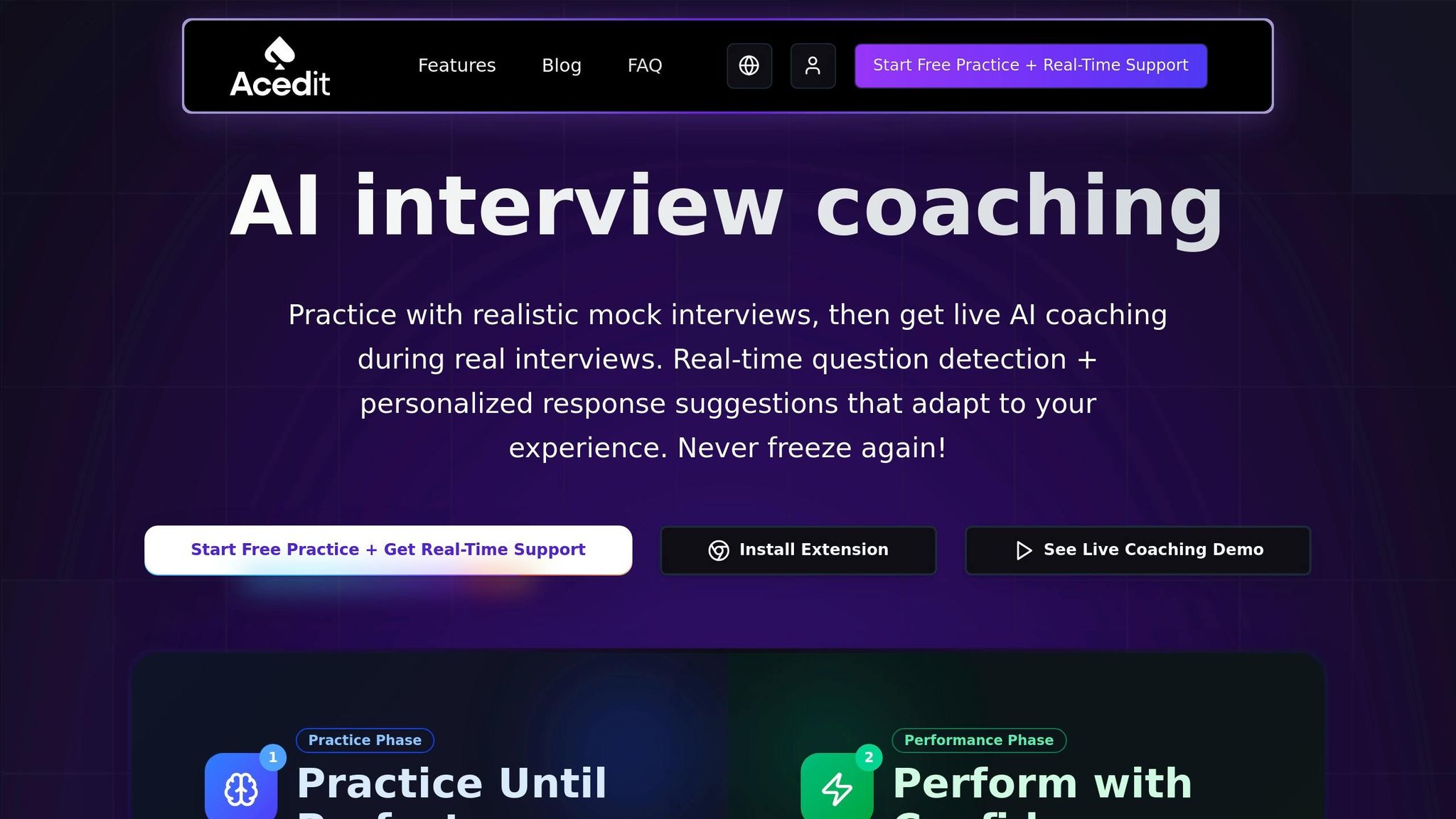
AI is reshaping how FinTech companies approach hiring by replacing time-consuming manual methods with streamlined, automated processes. These tools not only speed up recruitment but also redefine how businesses identify, assess, and connect with potential candidates.
Efficiency
AI-powered recruitment platforms eliminate the bottlenecks of traditional hiring. Instead of manually reviewing resumes, AI leverages natural language processing to quickly identify skills, certifications (like AML and KYC), and relevant experience. It then ranks candidates against job requirements in mere seconds. Scheduling bots further simplify the process by syncing with hiring managers' calendars to automatically arrange interviews, cutting out back-and-forth emails. These tools reduce routine HR tasks by 40–50% and can shrink sourcing time by up to 70%.
"My best recruiter used to spend 60% of her time on admin. Now she spends 60% of her time talking to candidates and hiring managers", Sarah Chen shared.
A mid-sized FinTech company in Southeast Asia reported a 40% drop in time-to-hire and a 25% boost in offer acceptance rates after implementing an AI hiring platform. Beyond saving time, these systems also help minimize biases in candidate evaluations.
Bias Reduction
AI tackles unconscious bias by anonymizing applications, concealing details like names, gender, and age so candidates are judged solely on their qualifications and experience. Standardized assessment modules ensure every applicant is evaluated consistently, removing the variability of subjective impressions or uneven questioning. AI can even detect patterns where certain demographics are being unfairly excluded, prompting corrective measures.
The numbers back this up: companies with diverse teams are 25% more likely to outperform their competitors financially. While 93% of hiring managers acknowledge AI as a valuable tool, they agree it complements rather than replaces human judgment. To ensure fairness, regular audits are essential to prevent AI from unintentionally reinforcing past biases. By reducing bias, companies not only promote fairness but also improve the overall experience for candidates.
Candidate Experience
For job seekers, AI tools like Acedit bring precision to interview preparation. Acedit's Chrome extension, for example, offers real-time coaching during interviews, listening to questions and suggesting optimized answers on-screen. It also evaluates resumes against specific job descriptions to generate personalized mock interviews. Using advanced language models, it predicts likely technical and behavioral questions, giving candidates a tailored practice experience.
AI also analyzes delivery, focusing on clarity, structure, and tone, while offering feedback on body language, eye contact, and facial expressions through audio and video simulations. These features are especially helpful for individuals transitioning into FinTech or those with limited interview experience, helping to ease anxiety and build confidence.
On the employer side, AI chatbots engage passive candidates around the clock, answering FAQs and providing updates. Asynchronous video interviews allow candidates to record their responses at their convenience, while AI transcribes and evaluates key technical details.
Regulatory Compliance
FinTech firms operate under strict regulatory oversight, and AI tools support compliance by maintaining standardized audit trails for every hiring decision. These logs help companies adhere to regulations like New York City's AI hiring law and the Illinois AI Video Interview Act. Such systems not only ensure fairness but also improve overall efficiency.
AI platforms can also administer coding tests and financial simulations - like risk management exercises - to accurately assess candidates' knowledge of complex compliance frameworks, surpassing the capabilities of traditional interviews.
With 86% of financial firms believing AI in recruitment will be critical to their success over the next two years, it's clear that these tools must also align with strict data security standards, such as GDPR and CCPA, to maintain trust and reliability.
Pros and Cons
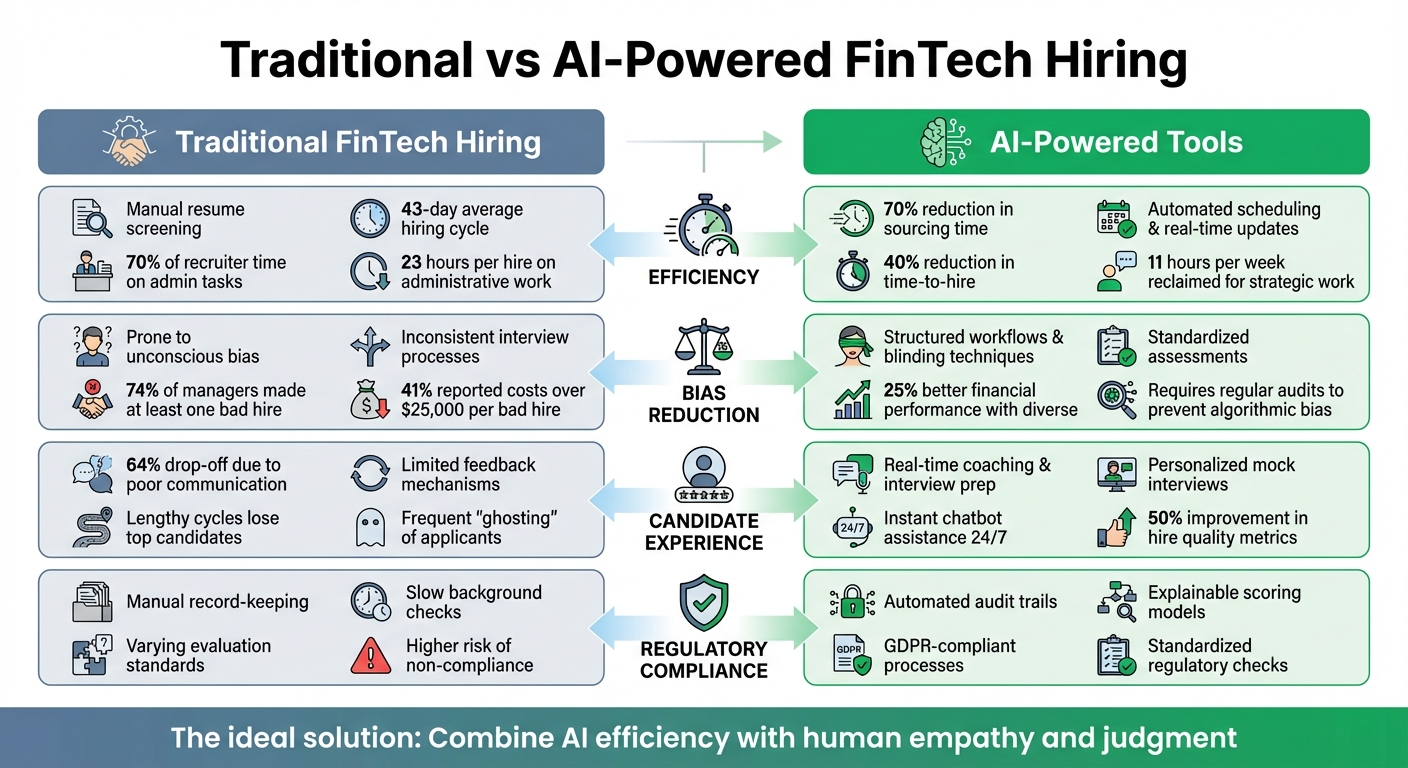
Traditional vs AI-Powered FinTech Hiring: Efficiency, Bias, and Compliance Comparison
Traditional and AI-powered hiring methods each bring distinct strengths and challenges to the table. Traditional approaches offer a personal touch that 74% of candidates still value highly, allowing recruiters to gauge interpersonal dynamics and build meaningful connections. However, these methods often consume substantial administrative time, with hiring cycles for specialized FinTech roles, such as compliance officers, stretching beyond 60 days. Additionally, unconscious bias frequently creeps into decision-making, shaped by subjective impressions.
On the other hand, AI-powered hiring tools tackle many of these inefficiencies through automation and data-driven precision. Platforms like Acedit streamline repetitive tasks, reducing screening times by up to 80%. Companies leveraging AI report a 31% boost in hiring speed and a 50% improvement in hire quality metrics. Features like real-time coaching offer candidates tailored interview simulations, while standardized assessments help mitigate bias. However, 67% of job seekers express discomfort with algorithms making final hiring decisions without human involvement, and AI systems can perpetuate biases if trained on flawed datasets.
Here’s a quick comparison of the two approaches:
| Dimension | Traditional FinTech Hiring | AI-Powered Tools (e.g., Acedit) |
|---|---|---|
| Efficiency | Manual resume screening; average hiring cycle of 43 days; 70% of recruiter time spent on admin tasks | 70% reduction in sourcing time; automated scheduling; real-time updates for candidates |
| Bias Reduction | Prone to unconscious bias; inconsistent interview processes | Structured workflows and blinding techniques; potential algorithmic bias if data is flawed |
| Candidate Experience | 64% drop-off due to poor communication; limited feedback mechanisms | Real-time coaching; instant chatbot assistance; personalized interview prep |
| Regulatory Compliance | Manual record-keeping; varying evaluation standards across global teams | Automated audit trails; explainable scoring models; GDPR-compliant processes |
These differences highlight how AI is reshaping FinTech hiring by shifting from manual, labor-intensive methods to more precise and efficient recruitment practices.
"AI tools don't operate in a vacuum. They learn from existing data - which can be incomplete, poorly coded, or shaped by decades of exclusion and inequality." – Emilio J. Castilla, Professor at MIT Sloan.
The ideal solution lies in combining the speed and accuracy of AI with the empathy and intuition of human judgment. This balanced approach ensures that FinTech recruitment remains both efficient and fair.
Conclusion
AI has reshaped FinTech recruitment, shifting it from tedious, manual processes to a more strategic and efficient approach. Companies leveraging AI report impressive results: screening times cut by up to 75%, a 40% reduction in time-to-hire, and recruiters reclaiming as much as 11 hours per week for higher-value tasks. For example, in March 2026, FinanceFlow showcased this shift by handling 40% more candidates while significantly boosting recruitment efficiency.
The key to success lies in treating AI as a co-pilot rather than a replacement. Tools like Acedit automate up to 80% of transactional tasks - such as resume parsing, scheduling interviews, and initial screenings. This allows human recruiters to focus on areas where AI falls short, like assessing leadership potential, understanding cultural fit, and exploring the deeper motivations behind career choices. As Sarah Chen, CEO of FinanceFlow, highlighted, her top recruiter now spends 60% of her time engaging with candidates and hiring managers rather than being bogged down by administrative tasks.
That said, implementing AI effectively requires careful planning and safeguards. Regular bias audits are essential to ensure algorithms don’t exclude unconventional candidates, and maintaining human oversight in final hiring decisions preserves the interpersonal nuances of recruitment. These practices align with the growing emphasis on transparent, data-informed hiring processes that address the shortcomings of traditional methods.
The future of FinTech recruitment blends speed with empathy. AI can handle repetitive tasks and provide actionable insights, but human judgment remains critical for high-stakes decisions. By training recruiters to interpret AI-driven analytics and being upfront with candidates about the role of AI in the process, companies can ensure that personal connections remain central to hiring. This balanced approach not only resolves inefficiencies and biases but also helps FinTech firms build robust talent pipelines that meet the demands of 2026 and beyond.
FAQs
What should humans still decide in AI-driven hiring?
Humans play a crucial role in making nuanced decisions and managing the interpersonal dynamics of hiring. AI, while helpful in automating parts of the recruitment process, cannot fully replicate the depth of human expertise, contextual awareness, or the ability to ensure fairness. While these tools can simplify certain tasks, critical judgment and ethical decision-making are responsibilities that remain firmly in human hands.
How can companies prove AI hiring is fair and compliant?
Companies can show they’re committed to transparency and compliance in AI-driven hiring by adopting systems designed to be audit-ready. Regularly reviewing algorithms for potential bias and adhering to regulatory guidelines are essential practices. These efforts not only enhance trust in the recruitment process but also promote accountability.
How can I prepare for AI-based FinTech interviews with Acedit?
Getting ready for an AI-based FinTech interview? Acedit offers tools to help you stand out. Start by uploading your resume and specifying the role you're aiming for. From there, dive into AI-driven mock interviews that adjust based on your responses. These sessions provide real-time feedback, helping you fine-tune your answers.
Acedit also includes features like interview simulations, personalized Q&A, and progress tracking. These tools are designed to boost your confidence and sharpen your skills. By practicing regularly with Acedit, you'll be well-prepared to tackle your next interview with ease.