
AI tools are changing how professionals approach LinkedIn content. These tools analyze data like engagement levels, hashtag performance, and content formats to identify what works best. They also predict trends, helping users create timely, relevant posts. Key factors like relevance, expertise, and meaningful engagement heavily influence LinkedIn's algorithm, determining which posts get wider visibility. AI also highlights optimal posting times, formats, and strategies to maximize reach and interaction.
Key Takeaways:
- AI analyzes engagement, hashtags, and content formats to predict trends.
- LinkedIn's algorithm favors relevance, expertise, and quality engagement.
- Posts perform best during the first 60 minutes ("golden hour").
- Native formats (e.g., carousels, videos) outperform posts with external links.
- AI tools like CoSchedule and LigoSocial refine strategies by tracking metrics, identifying content gaps, and optimizing schedules.
The Ultimate AI LinkedIn Content Creation Tool Stack for 2026 (My entire content workflow)
How LinkedIn's AI Algorithm Analyzes and Ranks Content
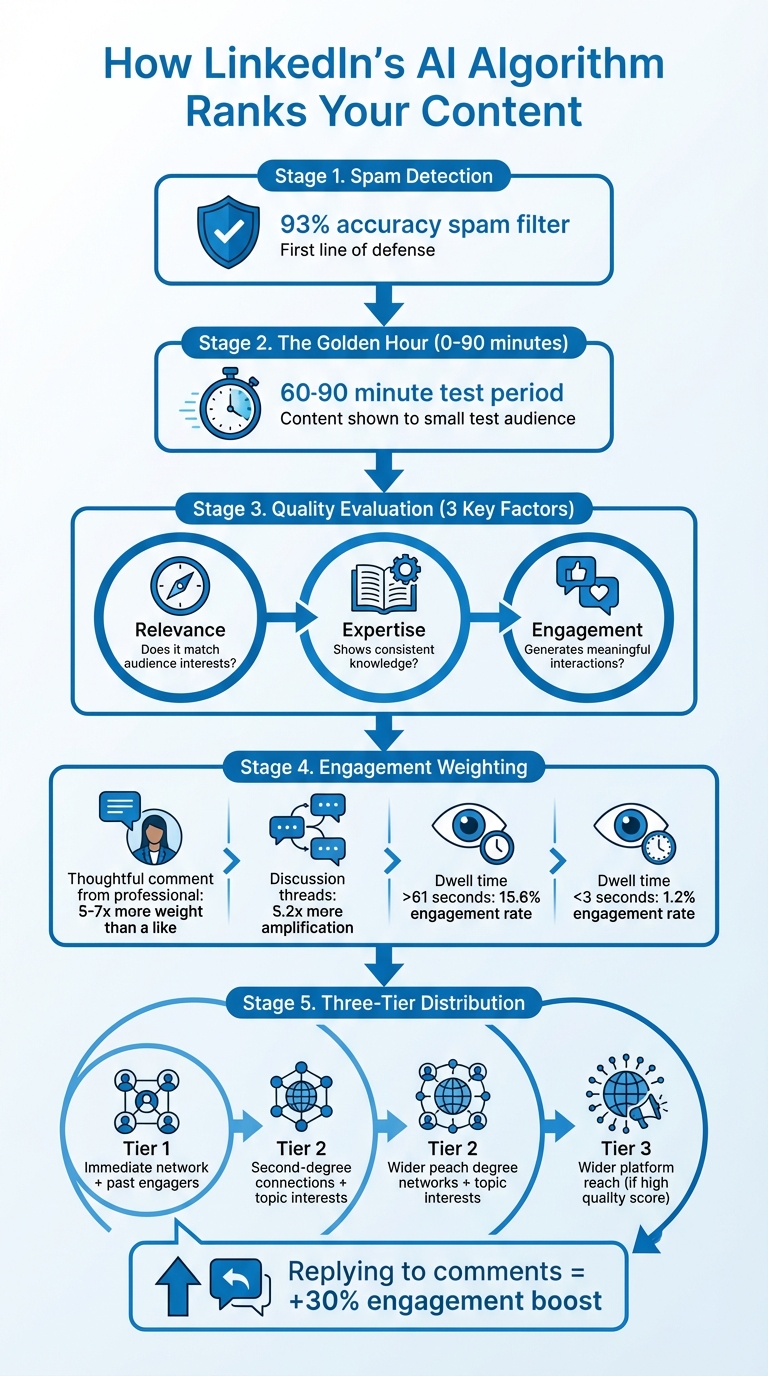
How LinkedIn's AI Algorithm Ranks and Distributes Content
LinkedIn's AI follows a detailed process to decide whether your content will be seen by just a handful of people or go viral across the platform. This starts with a strict spam filter and moves into a deeper evaluation of your post’s quality and appeal.
The first step is spam detection, which LinkedIn’s system handles with impressive 93% accuracy. If your post clears this hurdle, it enters what’s known as the "golden hour" - the first 60 to 90 minutes after publishing. During this time, LinkedIn shows your content to a small test audience and measures how they engage with it. Posts with strong engagement are pushed to a wider audience, while those with little interaction see their visibility shrink.
Key Factors in LinkedIn's Content Algorithm
LinkedIn’s algorithm evaluates posts based on three main criteria: Relevance, Expertise, and Engagement.
- Relevance: Does your post match the interests of your audience?
- Expertise: Does your content showcase consistent knowledge in a specific area?
- Engagement: How meaningful are the interactions your post generates?
Not all engagement is created equal. A thoughtful comment from a respected professional can carry 5–7 times more weight than a simple like. Posts that spark genuine discussions - where people reply to each other - receive 5.2 times more amplification. Another key metric is dwell time. Posts that hold attention for over 61 seconds tend to have a 15.6% engagement rate, compared to just 1.2% for posts with less than 3 seconds of attention.
"Think about what kind of knowledge you have to offer to help people. That is the kind of thing that will likely get you to reach the right audience as well." - Alice Xiong, Director of Product Management, LinkedIn
The algorithm also filters out low-value tactics like engagement bait (e.g., "Comment YES if you agree") and repetitive, generic content. It uses semantic analysis to understand the topics in your post, making 1–3 targeted hashtags more impactful than overloading your post with them.
Once your post is evaluated, it moves into a structured distribution process designed to amplify content that performs well.
The Content Distribution Process
If your post passes the initial spam and relevance checks, it enters a three-stage distribution process. At the first stage, the algorithm tests your content with your immediate network and people who’ve engaged with your posts in the past. It closely monitors how quickly and deeply this group interacts with your post.
Strong performance during the golden hour earns your post a higher quality score. This allows the algorithm to expand its reach to second-degree connections and others who share an interest in your topic. Posts that generate significant engagement remain visible for longer, as LinkedIn now prioritizes professional value over how recently the content was posted. Interestingly, replying to comments on your post can increase engagement by as much as 30%.
The platform also favors content formats that keep users engaged without leaving LinkedIn. For example, multi-image posts typically see a 6.60% engagement rate, while PDF carousels average around 5.85%. On the other hand, posts with external links often experience a 40–50% drop in reach. This is why native formats like document carousels and videos tend to outperform simple text posts with outbound links - they encourage users to spend more time on the platform.
Using AI Tools to Track LinkedIn Trends
While LinkedIn's built-in analytics provide basic metrics, they fall short when it comes to identifying performance drivers. This is where AI tools step in, offering deeper insights by analyzing historical trends, benchmarking against industry standards, and delivering actionable strategies. These tools help uncover which topics resonate most, boosting profile visits and sparking meaningful engagement by highlighting performance patterns over time.
For example, in 2025, a custom software development firm leveraged LigoSocial's AI analytics and discovered that posts detailing their development process generated 3.4 times more engagement than posts showcasing completed projects. By shifting their content strategy based on this insight, they achieved a 215% increase in engagement and secured 7 qualified leads in just one quarter. Similarly, a UX/UI design agency found that "before-and-after" comparisons drove 2.8 times more engagement, resulting in a 170% increase in profile views and 5 direct project inquiries.
Choosing the Right AI Tools for LinkedIn Trend Analysis
These examples highlight the value of AI tools that go beyond basic analytics to refine your content strategy. Look for platforms with built-in Insights Assistants that can answer specific queries like, "Which post format generates the most connection requests?". Tools such as CoSchedule, LigoSocial, and Taplio specialize in LinkedIn optimization, offering features like theme analysis and format tracking.
Businesses that adopt AI analytics with predictive forecasting report 2–3 times better results compared to manual tracking. When selecting a tool, prioritize features like competitor benchmarking, sentiment analysis, and real-time dashboards that allow for quick adjustments. For instance, CoSchedule includes an AI-powered Insights Assistant in all its paid plans, while LigoSocial offers $15 in free credits for new users - no credit card required.
Setting Up AI Tools for LinkedIn Integration
Once you've chosen your AI tool, the next step is integrating it with LinkedIn. Start by linking your LinkedIn account through the tool's Analytics or Settings tab. If you're managing a company page, ensure you have admin permissions to access and export detailed analytics.
Set up tracking by choosing specific date ranges - 90-day intervals are ideal to avoid timeouts - and focus on key metrics like engagement rate, reach, and click-through rate. Tag posts by topic, format, and time to identify high-performing categories. Many tools also offer Chrome extensions for real-time engagement tracking, helping you pinpoint interactions that drive the most profile views. Enable automated alerts to stay ahead of emerging trends or sudden engagement spikes.
"LiGo is a sparring partner for me, and she knows better than me how to format the posts, what the audience likes etc or in other words, what has chances to go viral." - Anna, Founder of a B2B Marketing Agency
sbb-itb-20a3bee
Finding and Using Trending Topics with AI
Once you've set up your AI tools, the next step is to uncover topics that spark engagement. AI can analyze data like engagement rates, hashtag performance, and content virality to identify what resonates with your audience. By building on these analytics, you can fine-tune your LinkedIn strategy to focus on topics that matter most. Tools powered by Natural Language Processing (NLP) can even dive into sentiment analysis, helping you measure not just how much engagement a topic gets, but the quality of that engagement.
Tracking Hashtag Usage and Topic Discussions
AI tools can be your eyes and ears, monitoring brand mentions, industry chatter, and trending hashtags. When crafting your posts, a mix of broad hashtags (e.g., #Marketing) and more focused ones (e.g., #B2BContentStrategy) can help you reach both larger and niche audiences. Since LinkedIn's algorithm favors posts with 3 to 5 hashtags, AI can determine the combinations that boost profile visits and connection requests.
But hashtags are just the beginning. AI can track second-degree reach - how often your content is shared by your network with their connections. A high second-degree reach means your topic is hitting the mark, encouraging people to amplify your message and opening doors to new leads. Additionally, AI can analyze competitors' wins and missteps to uncover content gaps. These gaps represent opportunities for you to address overlooked topics and position yourself as a thought leader.
Once you've nailed down your topics, timing becomes the next crucial element.
Timing Your Content for Maximum Engagement
AI takes the guesswork out of scheduling by identifying the best times to post. While Tuesday through Thursday between 9 a.m. and 12 p.m. tends to work well for most industries, AI can pinpoint the exact times when your audience is most active. Certain sectors, like healthcare or finance, may have their own unique peak times.
The format of your content matters just as much as when you post it. AI can help you figure out what works best for your audience - whether it's carousel posts (which often outperform single images), native videos, or long-form text posts in the sweet spot of 1,200 to 1,400 characters. It can even run A/B tests to see whether starting with a question or a surprising fact makes your posts more engaging before users hit "see more". Plus, since LinkedIn's algorithm rewards posts where creators actively engage in the comments, AI can send you real-time alerts when your post starts gaining traction, so you can jump in and keep the conversation going.
Improving Your LinkedIn Content Strategy with AI Insights
AI does more than just highlight trending topics - it digs deeper to show why certain content performs well and how you can replicate that success. By analyzing patterns across your posts, AI uncovers strategies that consistently deliver results. This level of insight allows you to fine-tune your approach to engagement.
Monitoring Engagement Metrics to Adjust Your Strategy
AI takes you beyond basic metrics like likes and views, helping you focus on what really matters. For instance, while an engagement rate of 2% or higher is considered "influencer status" on LinkedIn, the true game-changers are metrics like comment depth from decision-makers and second-degree reach. Tools like Julius AI can analyze your LinkedIn data to reveal how factors such as post timing, length, and viewer retention affect performance.
"Follower count is vanity. Pipeline is sanity." - Chris Cozzolino, Co-Founder/CEO, Uptown.com
To refine your strategy, test different content formats and headlines systematically. AI can run "Format Effectiveness Tests" (e.g., comparing carousels with text-only posts) and "Headline Style Tests" (e.g., questions versus surprising facts) to see what resonates best with your audience. Regularly export LinkedIn analytics - such as Profile Views, Post Impressions, and Search Appearances - and upload them to AI tools to uncover daily engagement trends.
Using AI to Find Content Gaps and Opportunities
AI doesn’t just track what works - it also reveals what’s missing. Tools like CoSchedule's Insights Assistant can identify trends in tone, format, and topic, helping you understand what drives the most engagement. Even more valuable, AI highlights content gaps, pointing out underexplored topics that are relevant to your audience but missing from your current content mix. Addressing these gaps can position you as a go-to expert in your field.
AI also measures how long your posts maintain traction, helping you determine the ideal posting frequency to keep your audience engaged without overwhelming them. Advanced tools allow you to tailor content for specific audience segments, such as C-suite executives versus entry-level professionals. By tracking the "ICP Engagement Share", you can ensure your content reaches the professionals who matter most to your goals, rather than just casting a wide net.
Conclusion
AI is reshaping how professionals craft LinkedIn content, turning guesswork into strategy backed by data.
Today, professionals can leverage AI to pinpoint what truly resonates with their audience. In fact, data shows that 30-40% of professional LinkedIn content now incorporates AI in some form, with adoption rates nearing 50% in industries like tech, marketing, and sales.
The real game-changer? Speed and accuracy. Dylan Hey, a LinkedIn strategy expert at Postdrips, proved this in February 2025 when he adopted an AI-powered workflow. The results were impressive: his profile views skyrocketed by 78% in just one month, engagement increased by 40% within three months, and his content creation time dropped from two hours to just 20 minutes per post.
"The professionals seeing the greatest success aren't those with the most advanced AI tools - they're the ones who effectively combine AI efficiency with authentic human connection." - Dylan Hey, LinkedIn Strategy Expert, Postdrips
The secret lies in balance. AI can analyze trends, identify content gaps, and optimize posting schedules, but it’s your personal voice and unique experiences that truly connect with others. This blend of data-driven insights and genuine storytelling is what sets exceptional LinkedIn content apart.
As LinkedIn continues to reward meaningful engagement over surface-level metrics, AI tools offer a smart way to stay ahead. They help you post consistently, adapt to trends, and save time - without losing that personal touch. The only question left is: when will you start using AI to transform your LinkedIn strategy?
FAQs
How does AI help improve my LinkedIn content strategy?
AI has the potential to supercharge your LinkedIn content strategy by spotting trends, identifying hot topics, and uncovering what drives engagement. This means you can craft content that resonates with your audience while staying relevant in your field.
On top of that, AI tools simplify time-consuming tasks like creating, fine-tuning, and scheduling posts. This not only keeps your content consistent but also increases its visibility. By analyzing metrics such as likes, comments, and shares, AI offers clear insights to help you adjust and improve your strategy over time.
Take tools like Acedit, for instance. When paired with LinkedIn, they provide personalized insights and custom responses, making it easier to strengthen your professional presence and connect with your audience on a deeper level. With AI, you can build a smarter, more effective LinkedIn approach.
What does LinkedIn’s algorithm consider when ranking posts?
LinkedIn’s algorithm determines how posts appear in users’ feeds by analyzing several key factors: relevance, engagement quality, relationship strength, and content value. It begins by categorizing posts as spam, low quality, or high quality. This classification depends on elements like proper formatting, appropriate use of hashtags, and compliance with LinkedIn’s platform guidelines.
When a post is identified as high quality, it’s initially shown to a small group of users to measure their reactions. If the post generates meaningful engagement - like comments, shares, or in-depth conversations - it gets shared with a larger audience. The algorithm also tailors content to match a user’s professional interests, industry, and network, ensuring the feed feels personalized and relevant. LinkedIn’s ultimate goal is to highlight professional, engaging content that fosters authentic interactions.
Why do certain types of posts perform better on LinkedIn?
Certain types of posts - like PDFs, carousels, and polls - often stand out on LinkedIn. Why? The platform's algorithm leans toward content that sparks genuine interaction. These formats naturally invite comments, discussions, and other forms of engagement, which increases their visibility.
LinkedIn also favors posts that align with its professional vibe. Content that delivers value, encourages conversations, or shares helpful insights tends to resonate more with its audience. Additionally, native formats, like PDFs and carousels, are designed to keep users on the platform longer, which aligns with LinkedIn's priorities and further boosts their performance.