
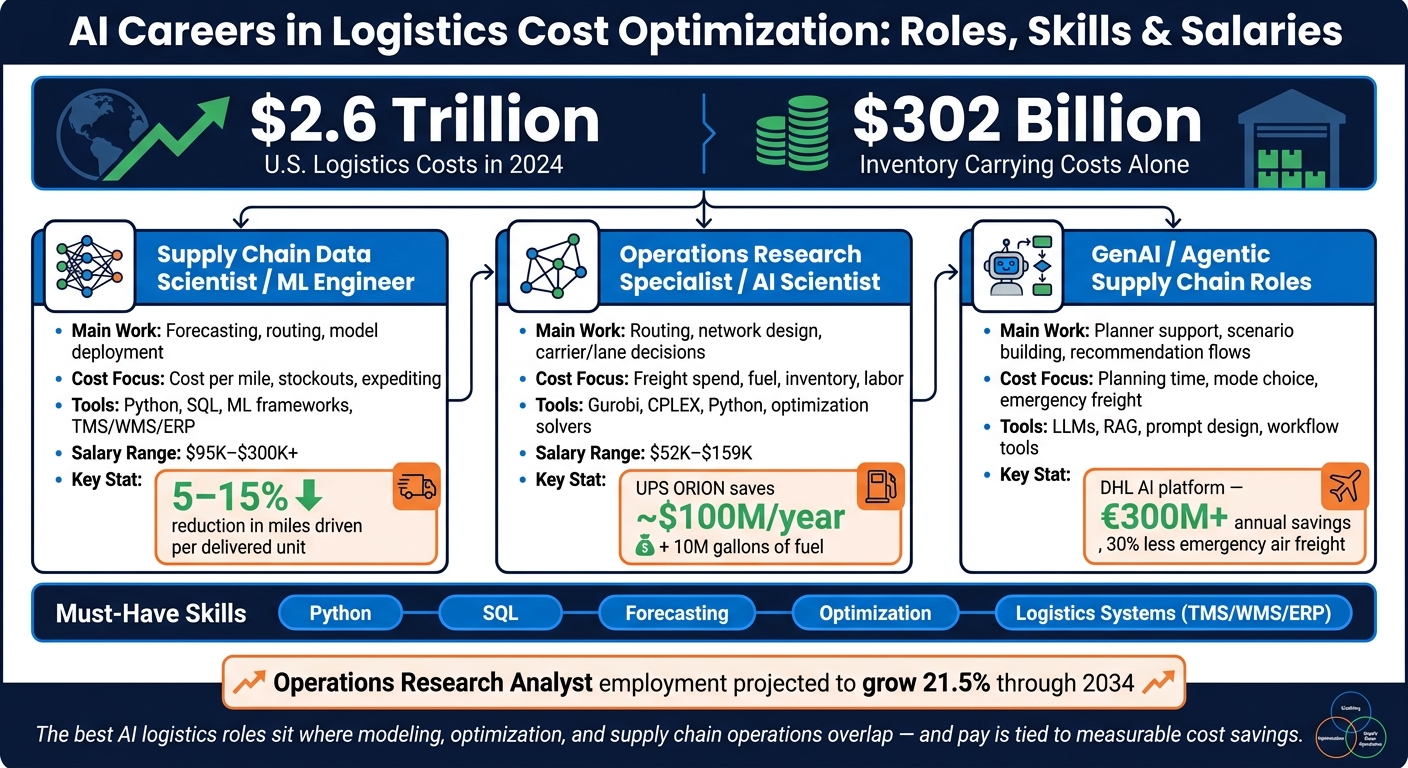
AI jobs in logistics pay well because they help cut big costs. In the U.S., logistics costs hit about $2.6 trillion in 2024, and inventory carrying costs alone reached $302 billion. If you want to work in this space, the jobs with the most pull are the ones tied to routing, forecasting, inventory, carrier choice, and network planning.
Here’s the short version:
- I’d group the top roles into three buckets:
- Supply chain data scientists and ML engineers
- Operations research specialists and AI scientists
- GenAI and AI agent roles for planning workflows
- The main skills are Python, SQL, forecasting, optimization, and logistics systems
- Employers want people who can connect model output to lower freight spend, fewer empty miles, lower inventory, and less expediting
- Interviews focus on cost impact, not just model accuracy
- U.S. pay can range from about $95,000 in early-career data science roles to $300,000+ in senior ML roles
If I were entering this field, I’d focus on one simple question: can I show that my work saves money? That is the thread running through the whole article.
Quick comparison
| Role group | Main work | Cost focus | Common tools |
|---|---|---|---|
| Supply chain data scientist / ML engineer | Forecasting, routing, model deployment | Cost per mile, stockouts, overtime, expediting | Python, SQL, ML frameworks, TMS/WMS/ERP |
| OR specialist / AI scientist | Routing, network design, carrier and lane decisions | Freight spend, fuel, inventory, labor, service penalties | Gurobi, CPLEX, Python, optimization solvers |
| GenAI / agent workflow roles | Planner support, scenario building, recommendation flows | Planning time, mode choice, emergency freight, planner output | LLMs, RAG, prompt design, workflow tools |
So if you’re reading this to find the best path, the answer is simple: go after the roles that sit closest to measured cost savings.
AI Logistics Jobs: Roles, Skills & Salary Ranges at a Glance
Practical AI for Logistics & Supply Chain: How to Start and Succeed
sbb-itb-20a3bee
Top AI Roles in Logistics Cost Optimization
These roles line up with the biggest cost drivers in logistics. Companies bring them in to cut freight spend, reduce empty miles, and lower inventory carrying costs. The strongest hiring demand tends to show up in jobs that can turn models into measurable savings.
Supply Chain Data Scientist and Machine Learning Engineer
Supply chain data scientists build forecasting and routing models. Machine learning engineers put those models into live systems such as transportation management systems, warehouse management systems, and ERP platforms.
The payoff is clear. ML-based dynamic routing has helped U.S. carriers report 5–15% reductions in miles driven per delivered unit. Better demand forecasting reduces the need for emergency replenishment loads, which cuts expedited freight spend. Better inventory positioning also lowers carrying costs and helps teams avoid expensive last-minute fixes.
This is where the role shifts from analysis to accountability. Unlike analysts, these teams usually need to show direct cost results: lower cost per mile, fewer stockouts, and less overtime caused by late dispatch changes.
Operations Research Specialist and AI Scientist
Data scientists predict. OR specialists decide.
These roles use mathematical optimization - linear programming, mixed-integer models, and network flow algorithms - to make network-level decisions. That includes where to place distribution centers, which carriers to assign to which lanes, and how to combine shipments across modes.
AI scientists push this a step further by feeding machine learning outputs - forecasts, risk scores, and transit-time predictions - into optimization models. The result is prescriptive analytics that point planners toward the lowest-cost way to serve demand. UPS's ORION routing system shows what this looks like at scale: it reportedly saves 10 million gallons of fuel and approximately $100 million per year, with expected operating cost reductions of $300–$400 million annually.
The impact spreads across several cost buckets:
- Transportation spend
- Inventory carrying costs
- Warehouse labor
- Service penalties such as on-time, in-full charges
These roles handle large routing and network problems with tools like Gurobi, CPLEX, and open-source solvers.
The next step is already taking shape: AI agents that turn optimization output into planner-ready actions.
Generative AI and Agentic Supply Chain Roles
New job titles are starting to appear, including Agentic Supply Chain Engineer and AI Workflow Engineer for Planning. These roles place LLMs and AI agents right inside planning workflows.
Picture the day-to-day use case. An AI agent can pull shipment data from a TMS, build several routing or mode-shift scenarios, estimate the cost and service effect of each option, and give a planner a short recommendation. That can happen in minutes instead of days. DHL's AI logistics platform, which combines demand forecasting with dynamic route optimization, reports €300M+ in annual savings and a 30% reduction in emergency air freight costs, with forecast accuracy improving from 60–70% to 85–90% at the hub level.
To do this well, these roles need both deep technical skill and sharp logistics judgment. That includes LLM tuning, prompt design, retrieval-augmented generation, and multi-agent workflows, along with a working grasp of how freight, planning, and service tradeoffs play out in practice. The cost effect shows up in planner output, faster decisions, and better use of lower-cost options.
What ties all of these roles together is simple: they need fluency in logistics data, systems, and cost metrics.
Skills, Tools, and Data These Jobs Require
Technical Skills That Show Direct Cost Impact
These roles revolve around Python, SQL, and optimization.
Python is used to build forecasting, routing, and consolidation models. SQL helps teams pull apart cost drivers inside TMS and WMS data. Optimization methods handle lane, load, and network choices while still meeting service constraints.
Machine learning methods like gradient boosting and time-series models can improve demand forecasting accuracy. That leads to fewer stockouts and fewer emergency shipments. But models don't stay right on their own. You need to watch for model drift as fuel prices, carrier behavior, and demand shift over time.
These are the main signals employers look for when they want to know if a candidate can turn models into cost savings, often evaluated through AI interview preparation vs traditional methods to test technical depth.
Logistics Systems, Metrics, and Domain Knowledge
Employers expect strong working knowledge of TMS, WMS, ERP, and telematics because those systems hold the data used to cut cost.
Here’s how they usually break down:
- TMS supports carrier selection, tendering, and freight audit
- WMS tracks pick paths, labor utilization, and order cycle time
- ERP manages inventory balances and carrying cost calculations
- Telematics gives GPS-based fuel consumption, dwell time, and driver behavior data
The metrics matter just as much as the systems. Teams often track OTIF, cost per shipment, freight cost per unit, vehicle utilization, route deviation, and accessorial charges.
In the U.S., cost drivers also have to be understood line by line. That includes fuel surcharges, detention and layover fees, warehouse labor rates, and inventory carrying costs. Domain knowledge matters here. If you don't understand dwell time, appointment timing, or facility constraints, it's hard to connect a model's output to dollars saved.
AI and Supply Chain Platforms Used in the Field
U.S. logistics teams often rely on planning, transportation, and visibility platforms. These tools support common AI workflows across logistics operations.
| Platform | Primary Cost Problem Solved | Typical Measurable Savings | Target User Role |
|---|---|---|---|
| SAP IBP | Inventory carrying cost, stockouts, expediting | 10–30% inventory reduction | Supply chain planners, analysts |
| Blue Yonder | Demand–supply mismatch, transportation inefficiency | 5–15% transportation cost reduction | Demand planners, logistics managers, data scientists |
| Oracle Transportation Management | High freight spend, accessorial leakage, routing | 3–10% transportation cost reduction | Transportation planners, carrier managers |
| Kinaxis | Slow planning cycles, high buffers and expediting | 10–20% inventory reduction; lower expediting | Supply chain planners, S&OP teams |
| project44 | Poor visibility causing detention and expediting | Lower detention and expediting spend | Logistics operations, customer service |
A common workflow looks like this: teams export demand forecasts from SAP IBP or Blue Yonder, add external signals, and push that data back into the planning platform to improve replenishment decisions.
project44 data can also feed Python-based decision engines. When delays are predicted, those engines can trigger dynamic re-routing.
These tools connect model output to day-to-day logistics choices.
Career Paths, U.S. Hiring Trends, and Salary Ranges
Common Entry Points and Career Progression
People break into this field from a few familiar starting points: supply chain analyst, operations analyst, data analyst, software engineer, and operations research analyst.
A common route starts in supply chain or logistics analysis. Someone might spend their early years working in Excel and SQL, tracking metrics like cost per delivery, dollars per mile, and inventory carrying cost. Then, after building up Python, statistics, and machine learning skills, they move into data science.
Another path starts in software engineering, often in logistics tech or e-commerce. From there, people shift into ML engineer roles tied to forecasting, routing, or pricing once they can show that their work cuts costs.
There’s also the operations research track. People in that lane often begin with network design, routing, and capacity planning, then move into AI work and real-time decision systems as the scope gets broader.
Hands-on exposure to trucking, parcel delivery, warehousing, or retail fulfillment can speed things up too. It helps candidates connect model output to day-to-day operations, actual cost savings, and the trade-offs teams deal with on the ground.
What U.S. Employers Are Hiring for Now
Right now, U.S. employers are hiring heavily in forecasting, routing optimization, inventory optimization, and automation and real-time decision systems. The reason is pretty simple: each of these areas targets a big cost bucket.
That’s also why pay tends to climb faster for people who can point to measured savings in freight, inventory, or planning cycles. If you can show that your work saved money or cut time, that tends to matter a lot.
Those priorities shape compensation, and they show up in interviews too. Case studies often focus on savings, trade-offs, and model impact, which is why many candidates use AI for interview answers to prepare for these technical discussions.
Salary ranges depend on role, level, and specialization. The table below shows sample U.S. pay bands, not fixed career stages.
| Role | Early-Career | Mid-Level | Senior/Lead |
|---|---|---|---|
| Supply Chain Data Scientist | ~$95,000–$132,000 | ~$133,500–$170,000 | ~$165,000–$243,000 |
| ML Engineer (Logistics) | ~$112,500 | ~$150,000 | ~$200,000–$300,000+ |
| Operations Research Analyst | ~$52,930–$66,250 | ~$83,640–$115,190 | ~$140,000–$159,000 |
The same cost-first mindset keeps showing up in interviews. Practicing an interview with AI can help candidates refine how they communicate these complex financial impacts. Employers want to know what you saved, what trade-offs you made, and whether your model changed the business in a clear way.
Operations research analyst employment is projected to grow about 21.5% through 2034, pushed by broader use of analytics and AI in transportation and supply chains.
Preparing for Interviews in AI Logistics Roles
What Interviewers Test in Cost-Focused AI Roles
That cost-first hiring logic shows up in interviews too. At the center of these interviews is one simple test: can you tie your technical work to actual cost savings? Employers aren't just checking whether you can build a model. They want to know what that model changed in the business.
A big part of that starts with problem framing. If someone says, “our transportation costs are too high,” can you turn that into a clear optimization problem with defined goals and limits? That's what interviewers look for. From there, they usually dig into model selection. Why use gradient boosting for demand forecasting? Why mixed-integer linear programming for vehicle routing? The point isn't to name a method you know. It's to explain why that method fits the data volume, latency needs, and day-to-day operating limits.
Data quality gets a lot of attention too. Missing shipment records or noisy demand data can throw off model output and, in turn, drive up costs. Strong candidates show that they understand that chain reaction. They talk through how they used historical shipment data, carrier contracts, fuel prices, and SLAs to build features they could trust.
Experiment design matters just as much. Employers want proof that you can test an idea before rolling it out at scale. For example, you might run a pilot for a new routing algorithm on 10% of lanes and track what happens to cost per stop, detention fees, or expedited freight spend. It's not enough to say the numbers moved in the right direction. Interviewers tend to notice candidates who can back results with basic statistical checks.
Then comes the part many hiring teams care about most: ROI in dollars. Be ready to explain the baseline, the model change, the operating result, and the annual savings. Quantified impact is the signal that matters.
| Interview Area | What Interviewers Want | How to Answer Well |
|---|---|---|
| Problem framing | Business-first definition of the logistics pain point | State the cost driver, impacted process, and success metric |
| Model selection | Justification for forecasting, optimization, or hybrid approach | Explain why the method fits the data, constraints, and operational goal |
| Data quality | Awareness of missing or inconsistent logistics data | Describe validation, cleaning, and monitoring steps |
| Experiment design | Evidence the idea works before scale-up | Mention pilot design, baseline comparison, and KPI tracking |
| ROI communication | Dollar-denominated impact tied to model improvement | Translate metric gains into freight, inventory, or labor savings |
How Acedit Can Help You Prepare
Once you know what interviewers test, your practice needs to center on structured, cost-based answers. You should be able to walk through a routing optimization case, explain a forecasting project, or describe a cost-per-delivery improvement to a non-technical operations director without getting lost in jargon. That's where Acedit comes in.
Acedit is a Chrome extension that creates tailored practice questions from the role details you provide. Paste in a logistics AI job description, and it generates questions tied to that role's focus areas, whether that's demand forecasting, inventory optimization, or network design. You can rehearse your answers and get AI-generated response suggestions for both technical choices and business results.
It also helps with cover letters based on your LinkedIn profile and the job description. On top of that, it offers real-time coaching during live interview simulations, so you can practice under conditions that feel much closer to the real thing.
| Skill Area | Typical Interview Focus | How Acedit Helps |
|---|---|---|
| Demand forecasting | Explain model choice, accuracy metrics, and impact on expedited freight | Generates role-specific Q&A; simulates follow-up questions on trade-offs |
| Route optimization | Walk through problem formulation, constraints, and cost-per-delivery results | Helps rehearse end-to-end project narratives with quantified outcomes |
| ROI communication | Translate model improvements into dollar savings for non-technical stakeholders | AI response suggestions for framing results in plain business language |
| Cover letter writing | Highlight relevant logistics AI experience for specific job postings | Cover letters tailored to your LinkedIn profile and the job description |
| Live interview pressure | Respond clearly under real-time questioning | Real-time coaching and interview simulations to build confidence |
Conclusion: The AI Logistics Careers Tied to Real Savings
These roles matter because they connect AI work to measurable savings. The best openings tend to sit where modeling, optimization, and supply chain operations overlap. And in interviews, employers want proof that you can make that link clear in dollar terms.
FAQs
Which AI role in logistics best fits my background?
The best AI logistics role depends on two things: what you’ve done before and the kind of work you like doing.
If you come from a data or engineering background, machine learning and data science roles will often make the most sense. If your strengths are in communication or user experience, design-focused AI roles may be a better fit. And if you’ve spent time in operations or working with complex systems, you may line up well with logistics strategy, AI integration, or autonomous systems work.
Acedit can help you figure out where your experience fits among in-demand logistics roles. It can also help you practice explaining your strengths through targeted interview simulations, so you’re not stuck trying to improvise when it counts.
How can I prove cost savings on my resume?
Focus on specific, measurable results instead of vague claims. Numbers do a lot of the heavy lifting. For example, say you increased revenue by $50,000 or cut processing time by 20%.
A simple way to structure each example is the STAR method:
- Situation: What was going on?
- Task: What were you responsible for?
- Action: What did you do?
- Result: What changed, in numbers if possible?
Acedit can help refine your resume and cover letters so those measurable outcomes stand out.
Do I need logistics experience to get started?
Not always. Some specialized roles, like Transportation Systems Engineer, may call for deep experience. But many employers now lean toward skills-based hiring.
That means your background may fit better than you think.
Focus on transferable skills such as leadership, process improvement, and cross-functional collaboration. Acedit can help you see how your experience lines up with the roles you want and point out any skill gaps you may need to work on.