
AI can cut some tasks and still add jobs. The short answer is this: new hiring usually shows up in system build-out, human review, risk control, training, and customer-facing support. And the shift is often uneven. Some roles shrink first, while other roles grow over the next 12 months to 3+ years.
Here’s the big picture in plain English:
- The article says AI usually changes tasks before whole careers
- Most exposed jobs are more likely to be changed than fully removed
- The ILO says only 3.3% of global employment is in the highest-exposure group
- The World Economic Forum projects 170 million jobs created and 92 million displaced by 2030, for a net gain of 78 million
- AI-related hiring tends to start in tech, finance, professional services, healthcare, and training
- For workers, the best path is often a mix of AI tool use, human judgment, communication, and domain knowledge
- In interviews, the article recommends a short SCAR story: Situation, Change, Action, Result
If I boil the article down to one idea, it’s this: AI job loss does not usually mean the end of work. It often means the work moves - to new tasks, new teams, and new job types.
A fast way to view the article:
| Topic | Main takeaway |
|---|---|
| Where jobs come from | Build AI systems, check outputs, manage risk, support growth |
| Who hires first | Tech, finance, services, healthcare, education |
| When change happens | Now, next 12 months, 1–2 years, and 3+ years |
| What workers should do | Show judgment, oversight, tool fluency, and results |
| What to say in interviews | Explain the shift clearly and show what you did next |
So if you’re asking, “How does AI create jobs after displacement?” the article’s answer is simple: by shifting work into new technical, review, and business roles that still need people.
Where does AI-driven job growth come from?
When AI takes over part of a task, it doesn't just remove work. It also creates new demand elsewhere.
In practice, AI-driven job growth tends to come from three channels: technical build-out, oversight, and business expansion. Some of these jobs are brand new. But most show up as existing roles with added duties.
Building and maintaining AI systems
The most direct source of new demand is technical work.
When companies adopt AI, they need people to build systems, keep them running, and connect them to the software they already use. That includes software developers, systems integrators, data analysts, cybersecurity staff, and technical support. In many cases, these roles become more tied to AI adoption even if the job title doesn't change.
Checking AI output, managing risk, and changing workflows
Not all of the new work is technical.
As organizations roll out AI, teams still need to verify outputs, manage model risk, document new processes, and retrain staff. This kind of work depends much more on domain knowledge, judgment, and communication than on coding.
These are often existing roles with a new layer of responsibility. They're part of the same displacement response, not side notes.
More products and services at lower cost
Lower costs can let companies serve more customers and take on work they couldn't support before.
That creates demand in customer success, implementation, and sales support. So AI-driven growth doesn't stay limited to technical teams. It often shows up in nontechnical roles too.
The next section shows which industries hire first.
sbb-itb-20a3bee
Which industries and job groups hire first?
AI hiring tends to show up first in places with money to spend, rules to follow, and work that can be reshaped without too much chaos. That usually means firms with clear cost savings, compliance needs, or strong pressure to get more done with the same team.
Technology, finance, and professional services
Technology is moving first. Data-center construction is running above $75 billion per year, up 60% from the prior year, and that is pulling in electrical engineers, HVAC technicians, and grid specialists. AI-focused roles make up about 1% of all professional jobs in the U.S., but that share jumps to 4% to 5% in tech and life sciences.
Finance is right behind it. AI cuts the cost of routine data work and risk modeling, which opens up more roles in fintech, compliance, and model-risk work. In professional services, firms are hiring people who can help clients put AI into day-to-day work, reshape processes, and guide teams through change.
Healthcare, education, and training
Healthcare is also hiring early, especially in clinical technology, health-data analysis, and care coordination. These are areas where rules matter and human judgment still carries a lot of weight. AI can help, but it doesn't replace the need for people who understand care, context, and risk.
Education and training are seeing demand too. Companies need instructional designers and curriculum developers who can teach workers how to use AI tools for job preparation and daily tasks. That's one of the clearest ways job loss in one area can turn into job growth in another.
The pattern is easier to see at a glance:
| Sector | Source of New Demand | Likely Entry Skills |
|---|---|---|
| Technology | AI model development, cybersecurity, data center infrastructure | ML engineering, Python, systems thinking |
| Finance | Fintech engineering, model-risk assessment, compliance | Quantitative analysis, regulatory knowledge |
| Professional Services | Client implementation, workflow redesign, change management | Project management, domain expertise |
| Healthcare & Life Sciences | Clinical technology, health-data analysis, care coordination | Data literacy, clinical awareness, human judgment |
| Education & Training | Workforce AI literacy, instructional design | Communication, curriculum development, AI tool fluency |
How long do AI-related job changes take?
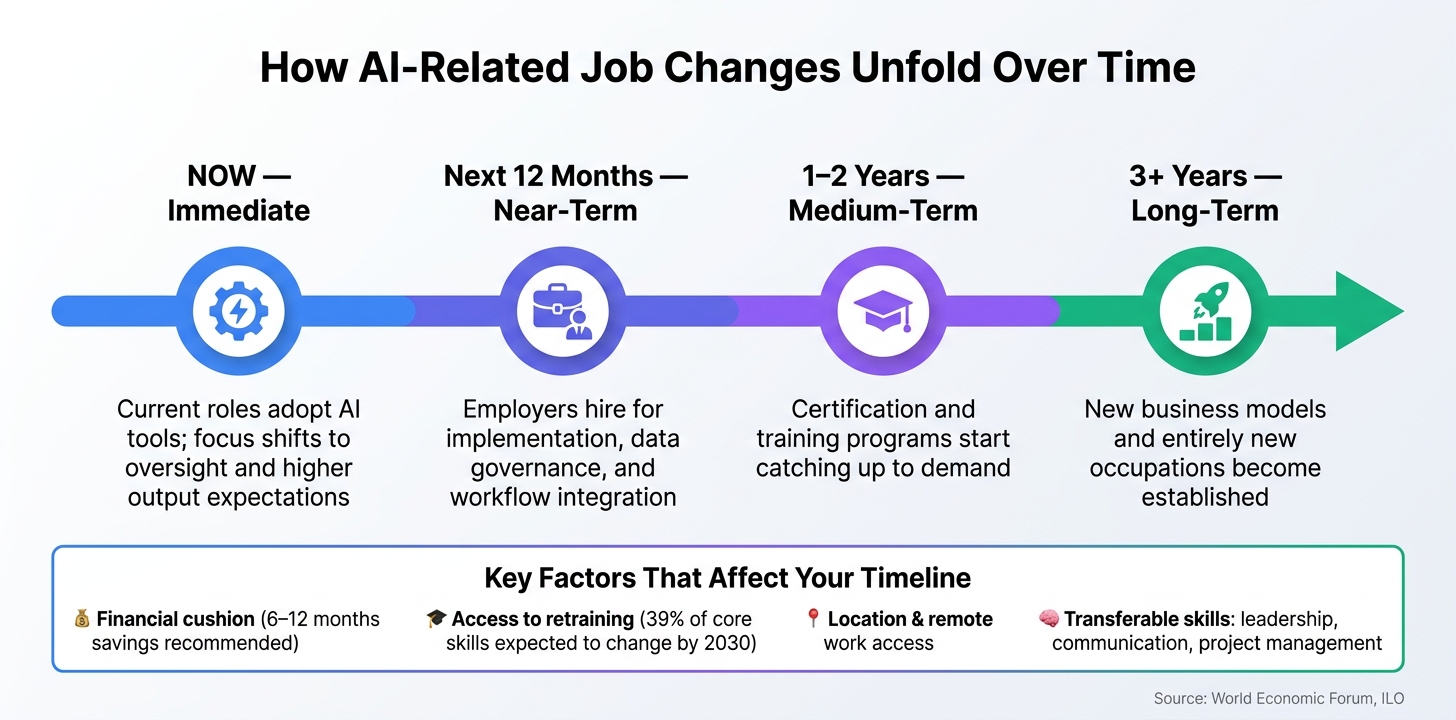
AI Job Change Timeline: From Displacement to New Roles (Now–3+ Years)
Once AI starts creating demand, the next issue is timing. And there isn't one neat answer. AI-related job change happens on different schedules based on the industry, the role, and the worker.
4 timelines: immediate, near-term, medium-term, and long-term
These shifts tend to happen in stages.
| Timeline | What changes | Typical timing |
|---|---|---|
| Immediate | Current roles take on AI tools; the focus moves toward oversight and higher output expectations | Now |
| Near-term | Employers hire for implementation, data governance, and workflow integration | Next 12 months |
| Medium-term | Certification and training programs start catching up to demand | 1–2 years |
| Long-term | New business models and entirely new occupations become more established | 3+ years |
The speed varies by worker, industry, and access to retraining. In the near term, hiring is clustered around implementation, governance, and workflow integration. In the medium term, the big shift is on the training side as programs work to catch up.
What affects the timeline for each worker
For individual workers, timing often comes down to transferable skills, savings, location, and access to retraining. Leadership, communication, project management, and stakeholder relationships carry weight across industries and can speed up a transition.
Money matters too. Financial pressure can slow a move, and 56% of workers cite financial security as the main barrier to moving. A 6- to 12-month savings cushion can give someone more room to wait for the right role instead of grabbing the first one available.
Age can shape the timeline as well. Workers over 45 may face longer job searches because age bias still shows up, especially in technology. At the same time, remote and hybrid work have lowered geographic barriers, making it easier to go after roles that once required relocation.
Then there's the skills piece. By 2030, 39% of core skills are expected to change. That's why upskilling can't be a one-time thing. For those in tech, this includes mastering technical interview preparation to stay competitive as roles evolve.
What should candidates say in interviews about AI job change?
Once the timeline is clear, turn the change into a short pivot story employers can trust. Then focus on the message: explain the shift in a way that shows you responded well, not that things fell apart.
A simple way to explain displacement at work
Keep your answer short and specific. A Situation, Change, Action, Result (SCAR) structure works well: state the role, name the change, show what you did, and end with a measurable result.
The point is simple. You want to show a move from displacement to new value. That means pointing to skills AI can't replace, like domain knowledge, judgment, and accountability.
Questions employers may ask and how to prepare
Be ready to explain how AI changed your role, how you check AI output, and which tasks still need human review.
Acedit can help with that. It can generate role-specific questions, simulate interviews, and tailor STAR examples to your background so you walk into the interview ready.
Main points for job seekers dealing with AI change
AI is creating demand in oversight, implementation, and risk-focused roles.
The strongest answers connect AI literacy with communication, judgment, and results.
FAQs
Will AI replace most jobs or just change them?
AI isn’t replacing most jobs. For the most part, it’s changing them.
What’s happening is simpler than a lot of headlines make it sound: AI is taking over routine tasks, not whole roles. Yes, some jobs may be pushed out. But the bigger shift is toward hybrid work, where people use AI as part of their day-to-day job.
That matters because AI is best at repetitive, rule-based work. It can handle the stuff that follows a set pattern, which frees people up to spend more time on judgment, empathy, and complex problem-solving.
For workers, the message is pretty clear. If you want to stay competitive, build AI fluency and strengthen the human skills machines can’t match so easily.
What skills help people move into AI-related roles?
Focus on a hybrid skill set: AI fluency paired with human strengths.
Employers want people who can manage, prompt, and check AI tools while also bringing critical thinking, emotional intelligence, and ethical judgment to the table. That mix matters because AI can produce output fast, but people still need to ask the right questions, spot weak answers, and make sound calls.
You don’t need a computer science degree to do this work. What matters more is building skills in prompt engineering, workflow design, and reading AI-driven insights with a clear head. Then show proof. Walk employers through how you’ve used AI to solve business problems, improve a process, or support a decision where human judgment still made the difference.
How can I explain AI-driven job loss in an interview?
AI-driven job loss is best framed as a change in how work gets done, not as a reflection of your worth or performance. That shift matters. It shows you understand what employers already see: some routine tasks are being handed off to AI, while work that calls for human judgment, ownership, and complex problem-solving is becoming more important.
When you talk about your experience, focus on how your role changed. Maybe AI took over first drafts, data sorting, scheduling, or other repeatable work. That gave you more room to handle the parts of the job that still need a person in the loop, like making judgment calls, checking for errors, weighing tradeoffs, and speaking with stakeholders when the stakes were high. That’s the story you want to tell.
A good way to make that concrete is with the STAR method:
- Situation: Briefly explain the shift in your team or company. For example, AI tools were introduced to handle routine tasks that used to take up a chunk of your time.
- Task: Describe what you were still responsible for. This could include decision-making, quality control, client communication, exception handling, or solving problems that didn’t fit a simple pattern.
- Action: Show how you used AI on purpose, not passively. Maybe you used it to speed up research, summarize information, draft basic materials, or process repeat work, while you focused on reviewing outputs, fixing weak spots, and handling cases that needed context and judgment.
- Result: Point to what changed. You may have improved turnaround time, reduced manual workload, caught errors before they reached customers, or helped your team shift toward better use of time and talent.
That kind of example sends a strong message: you weren’t replaced because you fell behind. You worked in a setting where the task mix changed, and you responded by leaning into the work that people do best.
It also helps to spell out that you don’t treat AI output as final. Employers want people who can use these tools without handing over their judgment. You can say that you verify AI-generated work by checking facts, reviewing logic, testing outputs against business goals, and watching for gaps, edge cases, or plain old weird mistakes. In a lot of roles, that human review step is where the real value sits.
You should also highlight your hybrid skill set. In plain English, that means you can work with AI tools and bring the human strengths that tools can’t own: judgment, accountability, communication, prioritization, and problem-solving under messy conditions. That mix matters because most jobs aren’t becoming fully automated. They’re becoming more blended.
A simple way to phrase it in an interview or networking conversation is:
In my last role, AI changed how routine work was handled, but it also made human oversight more important. I used AI to speed up repeatable tasks, then focused my time on reviewing outputs, solving exceptions, and making decisions that needed context and accountability. That experience pushed me to build a stronger hybrid skill set, where I’m comfortable using AI tools while staying responsible for quality and outcomes.
If you want, I can also turn this into a resume bullet, interview answer, or LinkedIn summary.