
AI is reshaping how industries analyze growth. Companies using AI tools have seen faster decision-making, higher efficiency, and better scalability compared to older methods. For example, AI-driven systems can process data 24/7, automate repetitive tasks, and deliver insights in real-time. This has resulted in a 3% annual growth boost for businesses with strong AI adoption since 2022. By 2025, AI investments are expected to contribute between $2.6 trillion and $4.4 trillion annually to the global economy.
However, AI isn’t perfect. Its reliance on high-quality, real-time data can lead to issues when data is unreliable or outdated. Traditional methods, while slower and less scalable, offer transparency and control, making them suitable for regulated industries or scenarios where human oversight is critical.
Key Takeaways:
- AI Strengths: Real-time insights, automation, cost savings, and scalability.
- AI Challenges: Data quality issues, high initial costs, and "black box" decision-making.
- Traditional Methods Strengths: Transparency, reliability, and suitability for manual processes.
- Traditional Methods Challenges: Labor-intensive, slower, and limited scalability.
The best approach? Combine AI's speed and efficiency with the reliability and control of manual methods to achieve balanced results.
1. AI-Driven Industry Growth Analysis Tools
Automation and Efficiency
AI tools never clock out - they work around the clock, analyzing market trends and delivering insights without the limitations of human schedules. This constant availability gives businesses the edge they need to respond quickly to emerging opportunities. Whether it’s automating repetitive tasks like data entry and report generation or verifying information, AI streamlines processes. For instance, it eliminates the 20% of time workers usually spend hunting for information by instantly scanning massive amounts of corporate data.
And AI is evolving. By 2025, "agentic AI" will take automation to another level, tackling complex challenges with planning and reasoning capabilities. For example, in 2024, a European insurer used AI to centralize over 1,000 policy documents and boost sales call reviews from a mere 3% to an impressive 95%. The payoff? Conversion rates shot up 2 to 3 times, and customer service call durations dropped by 25%. Similarly, between 2023 and 2025, a top U.S. homebuilder trained AI sales agents with data from 500,000 sales conversations. The result? Conversion-to-appointment rates tripled, and weekly appointments doubled. These examples show how AI-driven automation isn’t just saving time - it’s reshaping how industries operate.
Data Requirements and Reliability
While AI can supercharge efficiency, its effectiveness depends heavily on the quality and timeliness of the data it processes. Forget quarterly reports - today's AI thrives on real-time data feeds like search trends, satellite images, transaction logs, and even telecom metadata. Take the OECD Weekly Tracker, which from 2020 to 2024 used machine learning to predict weekly GDP changes across 46 countries by analyzing Google searches for terms like "unemployment" and "crisis". Similarly, the UK Office for National Statistics has been publishing high-frequency data, such as weekly Pret A Manger transactions, categorized credit/debit card spending, and traffic flow levels.
But here’s the catch: data quality remains a major hurdle. A global survey revealed that only 45% of developers found government data reliable, and just 35% considered it well-documented. To tackle this, organizations are building governance frameworks and "agent factories" to standardize reusable data products. The emergence of "reasoning AI" is another game-changer - it not only delivers forecasts but also provides logical explanations, improving trust in its outputs. These advancements are helping businesses act faster and more accurately, opening doors to untapped opportunities.
"Analytics models are only as good as the data they are based on, and working with unintegrated or scattered data can bog down projects and increase costs." - McKinsey Public Sector Practice
Cost and Scalability
AI doesn’t just save time - it also saves money. By automating processes, AI can cut operational costs by up to 30%. Even better, it allows companies to scale their expertise without needing to hire more people. The financial impact is massive: generative AI is projected to contribute between $2.6 trillion and $4.4 trillion annually to the global economy. In the U.S. alone, AI-related investments are expected to boost GDP growth by 1 percentage point in the second quarter of 2025.
The scalability of AI becomes even more apparent when you compare traditional methods like field research - which involves physical site visits and manual asset counting - to AI-driven analysis. For example, satellite imagery and mobile network data can achieve similar accuracy at a fraction of the cost. Between 2019 and 2023, REDI Cincinnati implemented a predictive analytics model that combined business intelligence with real-time data on mergers, acquisitions, and earnings. This approach helped attract more than $6 billion in capital investments.
"Competitive advantage will depend not on how many agents a company launches but on how effectively they are designed, managed, and scaled." - Greg Kelly, Senior Partner, McKinsey & Company
Where AI Is Right Now: 15 Charts in 15 Minutes
2. Traditional Growth Analysis Methods
Traditional growth analysis operates quite differently from AI-driven approaches, relying heavily on manual processes and fixed schedules. Human analysts typically work 8-hour days, and every step - from identifying relevant data to compiling reports - depends on their effort. This reliance on manual labor introduces the possibility of repetitive errors, making tasks like data entry, report generation, and verification prone to mistakes that can compromise the overall quality of the analysis.
The methodology used in traditional systems is deterministic, meaning analysts follow explicit, step-by-step instructions to address clearly defined problems. While this approach offers predictability and stability, it lacks flexibility. These systems struggle to handle unstructured data, such as images or natural language, and cannot adapt to unexpected changes without direct human intervention. These inherent limitations also restrict how effectively data can be gathered and utilized.
Data Requirements and Reliability
Traditional analysis methods require highly structured data and rely on manual synthesis. Analysts must painstakingly identify, review, and integrate data to uncover trends or gaps. This process is not only slow but often hindered by "bureaucratic silos" and fragmented data, as McKinsey points out, leading to higher costs and project delays. It’s worth noting that over 50% of developers report dealing with inconsistent or inaccurate data from traditional government sources, and fewer than 35% find such data to be well-documented.
A case in point is the World Bank’s 2023 Afghanistan study, which highlighted the inefficiency of traditional methods. Field visits to survey household assets, a cornerstone of traditional data collection, proved far more expensive than using machine learning models with mobile service data. Yet, both approaches delivered similar accuracy in identifying the poorest households. This example underscores how traditional methods often fall short in terms of cost-efficiency compared to modern analytics.
Cost and Scalability
While AI systems demand a significant upfront investment - ranging from $20,000 to several million dollars - traditional methods carry substantial ongoing labor costs. Expanding operations or addressing new scenarios with traditional systems often requires additional manual coding or hiring more personnel. Although traditional programming offers stability, it struggles with scalability. Scaling operations becomes a daunting task because programmers must write extensive new code to accommodate growth.
One notable upside of traditional methods is their transparency. Developers can trace the codebase to pinpoint exactly why a particular decision was made, which is especially crucial in regulated industries like healthcare and finance. However, this level of control comes at a steep cost. Manual reviews typically cover only 3% of interactions, compared to automated systems that can handle 95%. This stark difference in scalability highlights why industries are increasingly favoring AI-driven analysis to keep pace with today’s fast-changing market demands. Traditional methods, while reliable in certain contexts, simply cannot match the efficiency and scalability required in modern industries.
sbb-itb-20a3bee
Pros and Cons
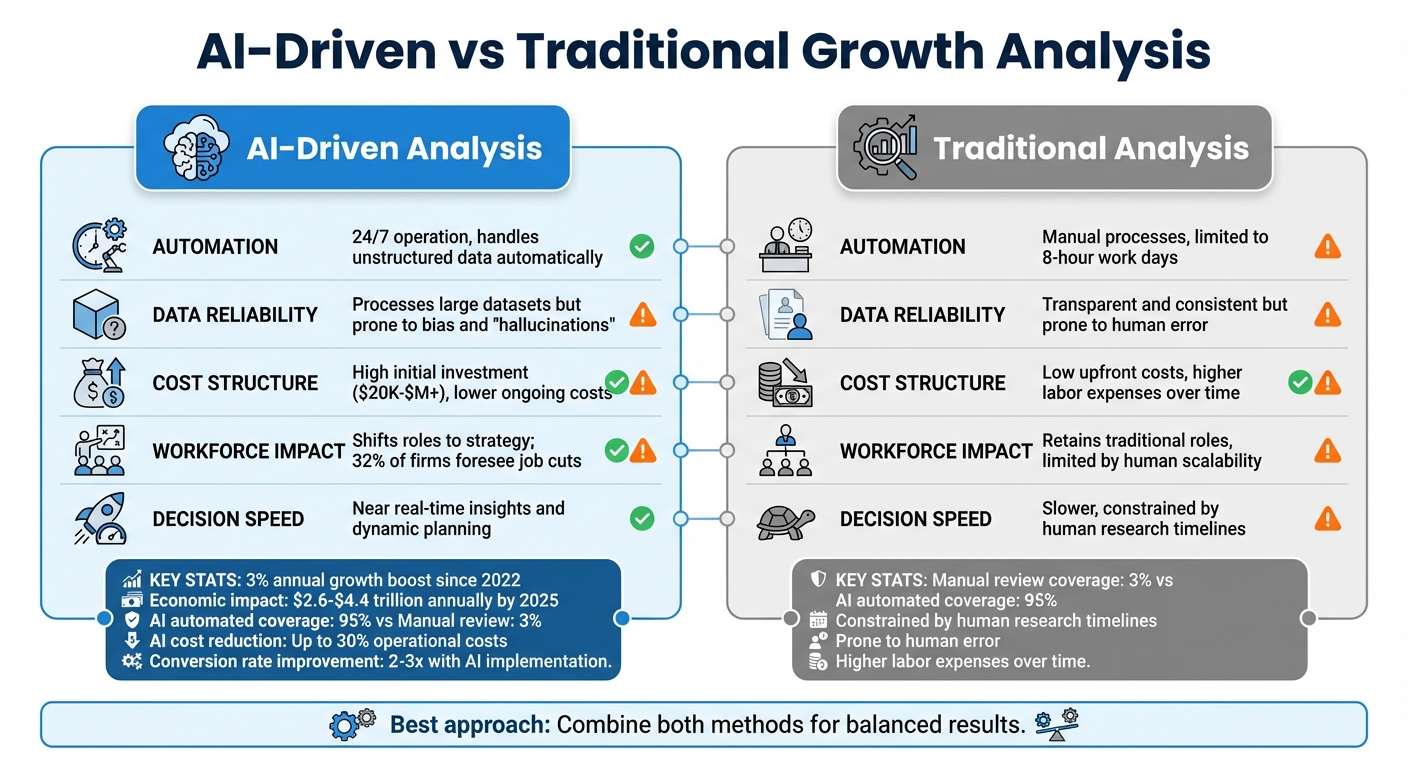
AI-Driven vs Traditional Growth Analysis: Key Differences and Performance Metrics
Let’s break down the strengths and weaknesses of AI-driven and traditional methods, highlighting how each performs in key areas.
AI-driven methods shine when it comes to speed and automation. These systems work round the clock, processing immense datasets without pause. While the initial investment can range anywhere from $20,000 to several million dollars, the long-term operational costs drop substantially once the system is up and running. However, AI isn't without its challenges. One of the biggest hurdles is the "black box" nature of many AI models, which makes their decision-making processes hard to interpret. Additionally, there's the issue of model drift - where accuracy declines as the data it was trained on becomes outdated.
Traditional methods, by contrast, offer clarity and control. Every decision can be traced back to a clear, logical process, which is especially important in regulated sectors like healthcare and finance. These methods also tend to have lower upfront costs and deliver steady, predictable results. The downside? Scaling these systems can be tricky. Growing operations often requires hiring more staff or writing new code, which increases labor expenses over time.
The impact on the workforce further sets these two approaches apart. AI often replaces repetitive roles while creating opportunities for specialized jobs in AI management and personalized answer suggestions for strategy. Traditional methods, on the other hand, preserve existing analyst roles but are inherently limited by human capacity. As Daron Acemoglu, a Nobel Laureate at MIT, put it:
"There are indeed much bigger gains to be had from generative AI... but these gains will remain elusive unless there is a fundamental reorientation of the industry... to focus on reliable information".
Here’s a quick comparison of the two approaches:
| Criterion | AI-Driven Analysis | Traditional Analysis |
|---|---|---|
| Automation | Operates 24/7 and handles unstructured data | Manual processes, limited to work hours |
| Data Reliability | Handles large datasets but can suffer from bias and errors like "hallucinations" | Transparent and consistent but prone to human error |
| Cost Structure | High initial costs ($20k–$M+), with lower ongoing expenses | Low upfront costs but higher labor expenses over time |
| Workforce Impact | Shifts roles to focus on strategy; 32% of firms foresee job cuts | Retains traditional roles but limited by human scalability |
| Decision Speed | Offers near real-time insights and dynamic planning | Slower, constrained by human research timelines |
This comparison highlights the trade-offs between the two approaches, showing how they align with different needs and priorities.
Conclusion
Deciding between AI-driven and traditional growth analysis depends on selecting the right tool for the job. Businesses with advanced AI capabilities often see a significant boost in growth. In data-heavy industries like finance, e-commerce, or software, AI can uncover opportunities that traditional methods might miss entirely.
However, in fields where physical workflows dominate, traditional methods still hold their ground by offering essential clarity. For businesses operating in data-scarce environments, dealing with complex regulations, or making high-stakes decisions that require ethical oversight, sticking with traditional analysis often proves more dependable.
The best strategy? Combine the strengths of both approaches. As Greg Kelly and Steve Reis, Senior Partners at McKinsey, explain:
"Growth won't come from tools alone but from how leaders choose to build and deploy them".
Identify specific growth challenges - whether it's pricing, conversion rates, or market expansion - and use AI to drive measurable results. For instance, a European insurance company managed to double its conversion rates and reduce service call times by 25% through AI adoption.
But success doesn’t come from technology alone. To truly integrate AI, businesses must ensure data quality, establish strong governance, and invest in workforce training. Many companies - nearly 80% - report no significant financial gains from AI, often because of fragmented programs or unreliable data. Instead of simply layering AI onto existing processes, redesign workflows to maximize its potential while keeping human oversight for areas that require empathy, creativity, or contextual understanding.
AI isn’t here to replace traditional analysis - it’s changing how and where we use it. Companies that thoughtfully blend both methods, focusing on high-impact use cases and building a solid digital foundation, will be best equipped to tap into the $2.6 trillion to $4.4 trillion in annual value generative AI could contribute to the global economy.
FAQs
What challenges come with using AI for analyzing industry growth?
AI brings incredible capabilities for analyzing growth trends, but it's not without its hurdles. One major limitation lies in its struggle to grasp complex or abstract ideas, which can sometimes lead to insights that are either incomplete or off the mark. Plus, the quality of AI's output is only as good as the data it's trained on. If that data is biased or incomplete, the results can end up skewed.
Another obstacle is the hefty investment needed to get AI systems up and running - not just financially, but also in terms of the technical expertise required to maintain them. Then there are the concerns around privacy, security, and ethics, especially when dealing with sensitive business or consumer data.
The best way to navigate these challenges? Pair AI-driven insights with human judgment. This combination can lead to more accurate, balanced, and dependable growth analysis.
How can businesses successfully integrate AI with traditional methods?
Businesses can integrate AI with traditional methods effectively by finding the right balance between the two. AI brings automation, predictive analytics, and real-time insights to the table, while traditional methods contribute strategic planning, human judgment, and specialized expertise. When combined, these strengths lead to smarter and more effective decision-making.
The key is to weave AI into existing processes rather than treating it as a standalone addition. This could involve reworking workflows to leverage AI for tasks like automating repetitive processes or generating data-backed recommendations. At the same time, human oversight remains crucial to ensure AI-generated insights are relevant and aligned with broader business objectives. By encouraging collaboration between AI tools and human expertise, companies can unlock new opportunities for growth and innovation.
How can companies ensure high-quality data for AI systems?
To maintain top-notch data for AI systems, businesses should prioritize a few essential practices. First, they need to adopt continuous monitoring and validation. This helps catch problems like missing or inconsistent data early, preventing them from derailing AI performance. Another critical step is setting up clear data governance frameworks. Assigning ownership and responsibilities ensures accountability and helps keep complex datasets accurate and well-organized.
Upgrading data infrastructure is another must. Modern systems that enable real-time data collection, integration, and cleaning can address the shortcomings of older technologies, making AI systems more effective. By blending strong governance, cutting-edge infrastructure, and regular quality checks, companies can build a solid foundation for dependable AI results.