
Understanding system requirements is the cornerstone of excelling in system design interviews, especially for senior engineering roles. The ability to clearly define functional requirements (what the system does) and non-functional requirements (NFRs) (how the system behaves) can significantly impact your interview performance. Here’s why it matters:
- Functional Requirements: Focus on the system's features, like APIs or user actions. Example: A URL shortener must generate short links and redirect users.
- Non-Functional Requirements (NFRs): Define measurable benchmarks like latency, availability, and scalability. Example: "p95 latency under 200ms" shows depth versus saying "make it fast."
Key Insights:
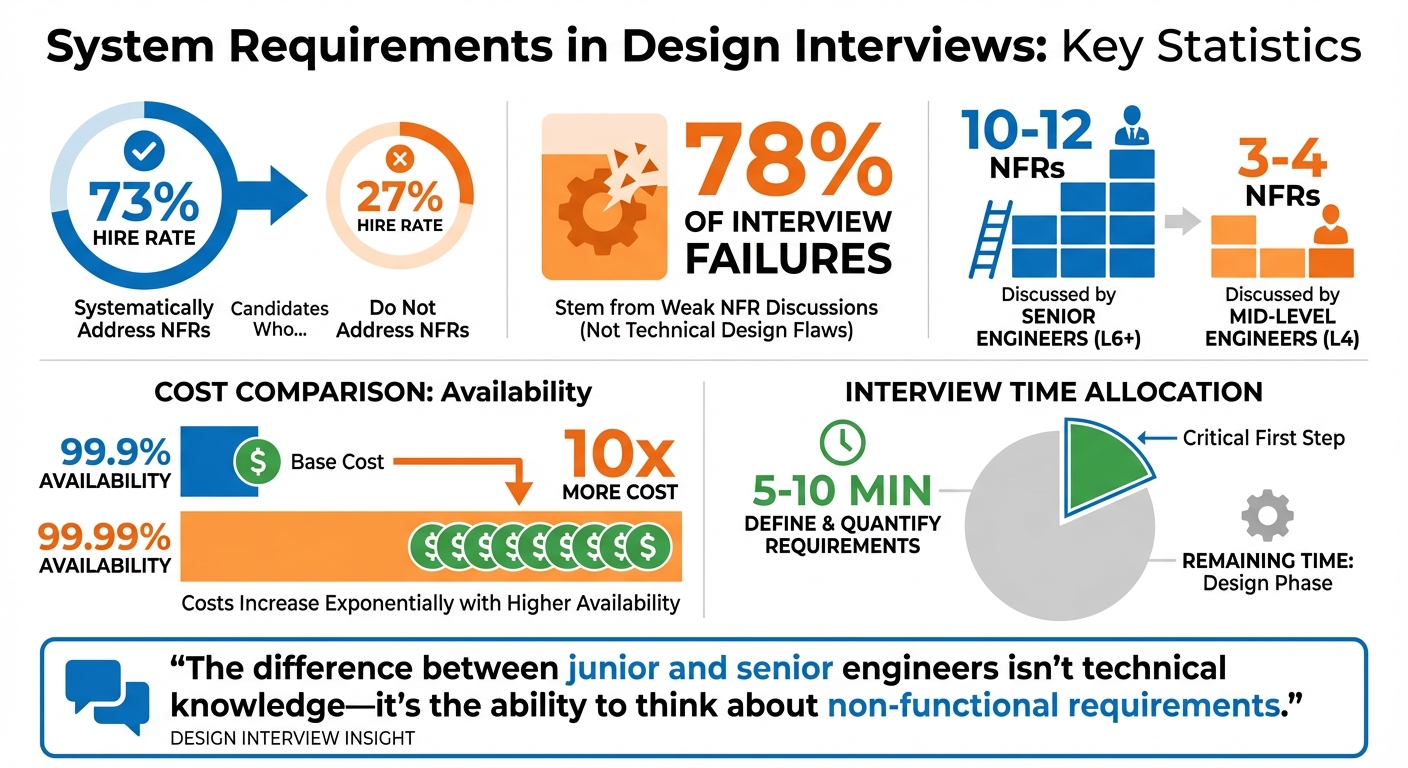
- 73% of candidates who systematically address NFRs receive offers.
- Senior engineers (L6+) discuss 10–12 NFRs, while mid-level engineers (L4) address only 3–4.
- 78% of interview failures stem from weak NFR discussions rather than technical design flaws.
The best candidates tie every architectural decision to clear requirements. For example, justifying a cache layer to meet specific latency goals or using multi-region setups for 99.99% availability.
If you’re preparing for system design interviews, tools like Acedit can help. It offers AI-driven simulations, NFR benchmarks, and scenario-based exercises to refine your ability to define and defend system requirements effectively.
System Design Interview Requirements: Key Statistics and Success Metrics
1. Functional vs. Non-Functional Requirements
Evaluation Methods
When it comes to functional requirements, interviewers are looking for how well you can define the system's scope and connect user actions to specific features. For example, in designing a URL shortener, the core functional requirements would include generating a short link and redirecting users to the original URL. Can you identify the necessary APIs and outline these features clearly? That’s what matters.
On the other hand, non-functional requirements (NFRs) often reveal your level of experience. Senior candidates stand out by turning vague goals into measurable benchmarks. For instance, saying a system should be "fast" is too abstract. Instead, specifying something like "p95 latency under 200 milliseconds" demonstrates a deeper understanding. Interestingly, an analysis of over 1,000 system design interview transcripts found that 78% of failures were due to poor NFR discussions rather than technical design issues.
"Requirements are the difference between a coherent design and a pile of boxes." - Sumit Mehrotra, System Design Handbook
This clarity in defining requirements is essential, especially when you need to navigate conflicting priorities.
Trade-Offs
The toughest part of system design is managing conflicting requirements. For example, if a database goes down, should you prioritize consistency or availability? Strong candidates explain the trade-offs involved. Achieving 99.99% availability can cost up to 10 times more than 99.9% availability because of the added complexity of multi-region failover setups. Interviewers want to see you make a firm architectural decision based on constraints, rather than resorting to "it depends."
This is why turning vague goals into concrete metrics is so critical. For instance, if users abandon your site due to slow load times, you can translate "make it fast" into a clear latency budget. That budget might justify adding a cache layer to improve speed. Every architectural choice should tie directly back to a specific requirement.
Understanding these trade-offs is key to excelling in system design interviews.
Practical Applications in Interviews
Dedicate 5–10 minutes of your interview to defining and quantifying requirements. If the interviewer is unclear, propose reasonable assumptions: "Let’s assume 1 million daily active users and 10,000 requests per second." This keeps the discussion on track and ensures you're working with concrete numbers.
Junior candidates typically focus on 3–4 NFRs, but senior engineers tackle 10–12, mapping each one to specific design elements. For example, you might say, "I'm adding Redis caching to meet the p95 latency requirement" or "I'll use Kafka queues to handle traffic spikes and ensure availability." This approach demonstrates that you're not just sketching out boxes but solving real problems with measurable results.
sbb-itb-20a3bee
Requirements Gathering | System Design Primer Part 1
2. Using Acedit for Requirements Practice
Acedit emphasizes the importance of clear requirements in design interviews by offering focused practice modules that sharpen your skills.
Evaluation Methods
Instead of relying on pre-made templates, Acedit turns interview prep into an interactive learning experience. Acting as a thinking partner, it asks thought-provoking questions like, "What happens if traffic increases 10x?" These questions help you identify gaps in your reasoning and understand the logic behind your architectural choices. For example, when designing an online multiplayer game, Acedit might challenge you to refine a vague requirement like "minimize lag" into a measurable constraint such as "p99 latency under 50 milliseconds for player actions." This process ensures you can translate business needs into specific, actionable metrics. These targeted prompts not only clarify requirements but also lead you to explore the trade-offs inherent in your design decisions.
Trade-Offs
Acedit’s failure mode analysis plays the role of a devil’s advocate, helping you pinpoint and address weaknesses in your design before an actual interview. If your design reveals a single point of failure, the AI encourages you to think critically about how load distribution impacts both consistency and availability. This forces you to articulate trade-offs clearly, simulating the dynamic discussions you'd encounter in real-world system design. Additionally, Acedit guides you through scaling exercises, illustrating how user demand growth - from small numbers to millions - can expose the importance of non-functional requirements like reliability and scalability.
Practical Applications in Interviews
Acedit doesn’t stop at exploring trade-offs - it also prepares you for real-world stakeholder interactions. Its simulation mode helps you practice defending your design decisions against varied perspectives. For instance, if the AI takes on the role of a cost-conscious product manager, you’ll need to justify your choices in terms of both performance and cost. This kind of preparation ensures you’re ready for the business-driven questions that can often catch candidates by surprise.
"AI becomes your secret weapon - not as a crutch for memorization, but as a thinking partner that helps you develop authentic expertise." - Aceround/Acedit
To further solidify your understanding, Acedit offers quizzes on components like load balancers or message queues. These exercises reinforce the link between system requirements and technical solutions, ensuring you can confidently explain the reasoning and trade-offs behind your design decisions.
Pros and Cons
Balancing functional and non-functional requirements is key to creating a product that’s both well-defined and ready for production. Functional requirements focus on the core features and APIs, helping you build the right product while defining a clear MVP. Think of them as the "steering wheel" that keeps you from veering into unnecessary features or components. But there’s a downside - if you concentrate too much on features and overlook quality attributes, it can signal a lack of production-level insight.
Meanwhile, non-functional requirements (NFRs) like scalability, latency, and availability shape the architectural decisions that make systems reliable in real-world use. Discussing these systematically has a measurable impact: candidates who do so have a 73% hire rate compared to 27% for those who don’t. A Google interviewer shared this example:
"I interviewed two candidates with identical technical designs for a payment system. Candidate A spent 40 minutes on the technical architecture. Candidate B spent 20 minutes on architecture and 20 minutes discussing security, compliance, and failure handling. Guess who got the L6 offer?"
The difference is stark: senior engineers (L6+) typically address 10–12 NFRs, while mid-level engineers (L4) mention only 3–4.
| Requirement Type | Benefits in Interviews | Drawbacks in Interviews | Real Scenario |
|---|---|---|---|
| Functional | Helps define clear scope and avoids building the wrong product | Can seem junior-level; misses production concerns like scaling and failure handling | Example: A URL shortener focusing on create and redirect endpoints without planning for cache invalidation |
| Non-Functional | Highlights seniority and production experience | Risks "architecture theater" if not tied to functional needs | Example: A chat system targeting 99.99% availability before deciding if group chat is needed |
This comparison shows why integrating both types of requirements is essential for a strong design. The trick is to find the right balance: start by nailing down functional requirements to set the scope, then define measurable non-functional goals, like "p95 latency < 200ms" or "99.9% monthly uptime", to back up your architectural choices. Without clear targets for latency or availability, decisions around caching, replication, or queues lack justification - they’re just guesswork. Balancing both types ensures your design is grounded in both practicality and production readiness. Practicing these scenarios through an interview with AI can help you master the balance between functional and non-functional requirements.
Using Acedit for Requirements Practice
Acedit’s AI-powered simulator is designed to help you master system requirements under the pressure of an interview. By simulating real design interviews, it offers a virtual interviewer that adjusts its follow-up questions based on your answers. Instead of relying on memorized responses, you’ll develop a structured way to break down complex problems. Plus, the simulator integrates with platforms like Google Meet, Zoom, and Microsoft Teams, allowing you to practice in a setting that feels just like an actual interview. This setup transitions smoothly into interactive questioning, challenging your thought process and design rationale.
The platform’s Socratic questioning method helps you uncover blind spots, such as missing scalability considerations or trade-offs. You can even have the AI take on roles, like a cost-conscious Product Manager, to push you into defending your system requirements from different business angles. This mirrors the real-world interview experience, where interviewers often test how well you can justify your design decisions under pressure. It’s a great way to sharpen your ability to define and defend system requirements effectively.
Acedit also includes Scale Progression Exercises, which guide you through how a system’s architecture should adapt as it scales - from 100 users to 100 million. These exercises help you identify potential bottlenecks and prepare for "what if" scenarios, such as, "What changes would you make if write traffic increased tenfold?". The failure mode analysis feature takes it a step further by playing devil’s advocate, challenging your design to expose potential failure points. This ensures you address critical non-functional requirements like reliability and availability. To maximize your practice, the platform encourages time-boxing your requirements-gathering phase to 5–10 minutes, leaving enough time for the design phase. It also emphasizes stating assumptions - like "I’m assuming 1 million daily active users" - to test whether your targets align with the scenario. These exercises help refine your approach to scaling and scenario planning.
Acedit offers a free tier that includes essential tools for practice interviews and Q&A sessions. With a 4.2/5 rating on the Chrome Web Store, users highlight its realistic simulations as a confidence booster. By early 2026, more than 2,000 job seekers had used the platform to prepare for design interviews.
Conclusion
Understanding functional and non-functional requirements is what turns a scattered design into a well-structured solution. Interestingly, 78% of system design interview failures are linked to weak discussions around non-functional requirements rather than technical design mistakes. Practicing with an AI interview answer generator can help you refine these responses. On the flip side, candidates who address these requirements systematically land job offers 73% of the time.
"The difference between junior and senior engineers isn't technical knowledge - it's the ability to think about non-functional requirements." - Neothi
What sets junior engineers apart from senior ones is their depth of focus on non-functional requirements. Senior-level candidates - and especially staff-level engineers - demonstrate architectural maturity by tying every decision to specific requirements. Whether it's choosing a NoSQL database for scalability or adding a cache to reduce latency, each choice reflects a clear understanding of the system's needs.
FAQs
What NFRs should I prioritize first in a system design interview?
In a system design interview, it's essential to emphasize non-functional requirements such as performance, availability, and scalability. These factors play a crucial role in ensuring the system can handle real-world challenges effectively. Highlighting these areas shows that you understand how to create systems that are not only functional but also reliable and efficient under varying conditions.
How do I turn vague goals like “fast” into concrete metrics on the spot?
To make ambiguous goals like "fast" more concrete during a system design interview, ask focused questions that establish clear, measurable metrics. For instance:
- "What is the desired response time?"
- "What percentage of requests should meet this latency?"
- "Are there specific benchmarks or SLAs we need to adhere to?"
By doing this, you show you can turn vague terms into specific, actionable targets - an essential skill in system design.
How can I justify trade-offs (like consistency vs. availability) without saying “it depends”?
When designing systems, every trade-off has ripple effects on users, operations, and business goals. Let's break it down:
Prioritizing consistency ensures that data remains accurate and up-to-date across the system. This is essential for industries like finance, where even a minor discrepancy in transaction records could lead to serious consequences. However, achieving this level of accuracy often comes at the expense of availability. For instance, during system failures or maintenance, users might experience downtime, which could frustrate customers and disrupt operations.
On the flip side, emphasizing availability ensures that users can access the system even during failures or network issues. This is particularly important for platforms like social media, where immediate access is more critical than perfect data accuracy. In such cases, users might tolerate slightly outdated or "stale" data as long as they can continue interacting with the platform. For businesses, this approach can enhance user satisfaction and engagement but might lead to challenges if incorrect data impacts decision-making or analytics.
The choice between consistency and availability depends heavily on the system's purpose and the expectations of its users. For example:
- Consistency-first systems: Ideal for scenarios where accuracy is non-negotiable, such as banking, healthcare, or inventory management.
- Availability-first systems: Better suited for applications where real-time access is key, like social platforms, streaming services, or customer support tools.
Ultimately, these trade-offs reflect the delicate balance between meeting user needs, ensuring smooth operations, and achieving broader business goals. Every decision should align with the system's real-world application and the priorities it serves.