
I use AI voice feedback to check my delivery - not to judge my confidence or answer quality, unlike traditional interview preparation. Before acting on a pace or tone flag, I check the transcript and listen to the recording.
Here’s my approach:
- Review 4 delivery signals: pitch, volume, pauses, and speaking pace.
- Check audio quality before using the feedback.
- Judge my answer separately: Did I answer the question and explain my reasoning?
- Change one habit at a time and record again.
- Use Acedit’s practice prompts as cues, not a script. If real-time coaching disrupts my rhythm, I review it afterward.
My goal is <u>clear speech backed by solid answers</u> - not a perfect-sounding performance.
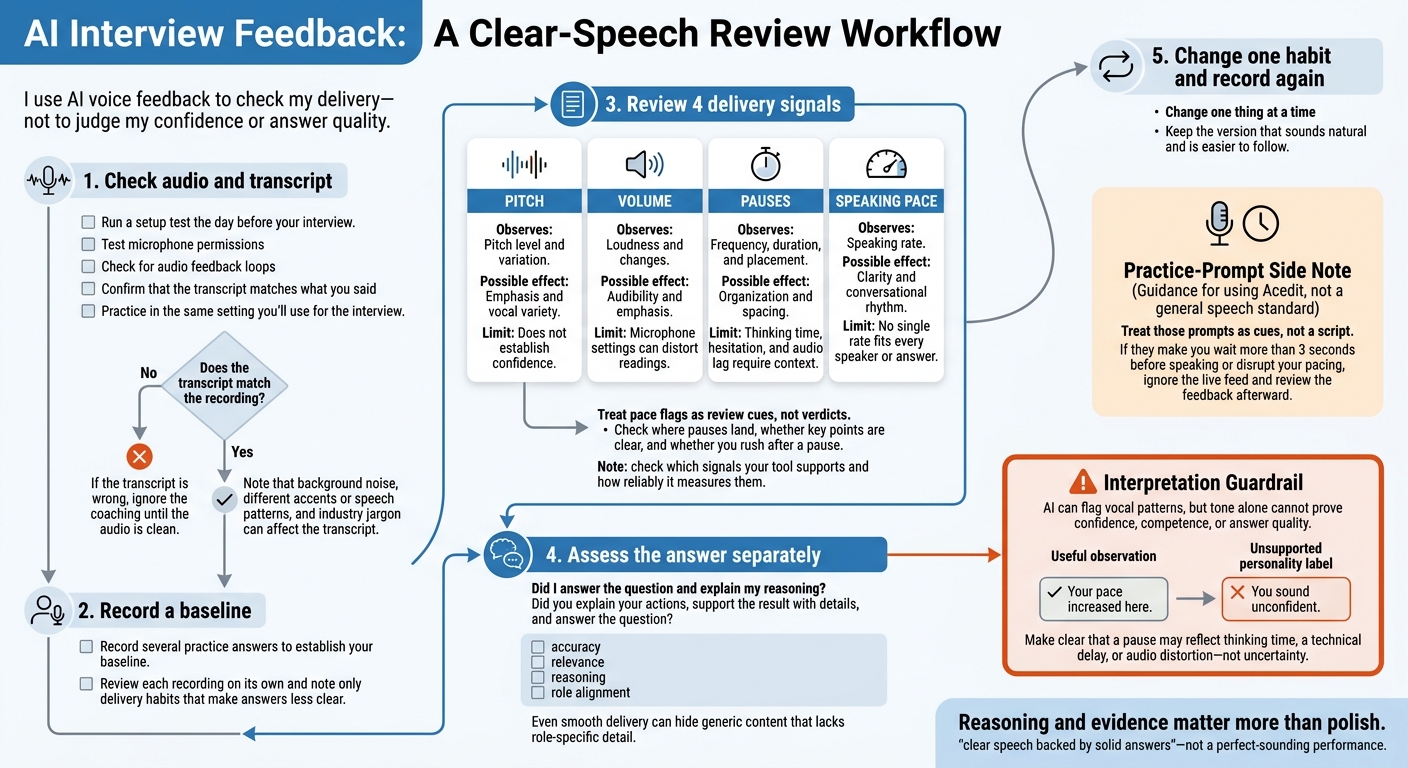
AI Interview Feedback: A Clear-Speech Review Workflow
What Live Voice Feedback Can Measure
AI can track parts of your delivery, but not every signal tells the whole story. Check which signals your tool supports and how reliably it measures them.
| Signal | What AI can observe | Possible delivery effect | Interpretation limit |
|---|---|---|---|
| Pitch | Pitch level and variation | Emphasis and vocal variety | Does not establish confidence |
| Volume | Loudness and changes | Audibility and emphasis | Microphone settings can distort readings |
| Pauses | Frequency, duration, and placement | Organization and spacing | Thinking time, hesitation, and audio lag require context |
| Speaking pace | Speaking rate | Clarity and conversational rhythm | No single rate fits every speaker or answer |
Checking Audio Quality Before You Trust the Feedback
Check the transcript before trusting the coaching. Live feedback only helps when the transcript is accurate.
Run a setup test the day before your interview. Test microphone permissions, check for audio feedback loops, and confirm that the transcript matches what you said. Practice in the same setting you'll use for the interview. This helps you spot problems caused by background noise, different accents or speech patterns, and industry jargon. If the transcript is wrong, ignore the coaching until the audio is clean.
How Pauses and Pace Affect Clarity
Look at where your pauses land. A pause between ideas can make your answer easier to follow. A pause inside a sentence needs context. Treat pace flags as review cues, not verdicts.
Check whether your key points are clear and whether you rush after a pause. The goal is clearer delivery - not a fixed speaking rate. This is a key part of using AI for interview preparation effectively. Work with your natural rhythm.
sbb-itb-20a3bee
What Tone Cannot Tell You
Pitch, volume, pauses, and pace can guide interview with AI coaching, but they have limits. AI can flag vocal patterns, but tone alone cannot prove confidence, competence, or answer quality.
Delivery Feedback vs. Content Feedback
Keep what the voice shows separate from what the answer proves.
Hypothetical scenario Delivery feedback Content feedback Soft-spoken answer Check volume, pauses, and pace Assess whether the answer is clear and supported by detail Smooth delivery Review clarity and pacing Check accuracy, relevance, reasoning, and role alignment
Review the content on its own. Did you explain your actions, support the result with details, and answer the question? Then ask why you chose that approach. Even smooth delivery can hide generic content that lacks role-specific detail.
Why Tone Does Not Prove Confidence
A pause may reflect thinking time, a technical delay, or audio distortion - not uncertainty. Audio quality, background noise, or an interviewer’s accent can make a response sound out of sync with the question. Describe what you hear instead of assigning personality labels:
“Your pace increased here” is useful; “You sound unconfident” is not.
Using Voice Feedback in Practice
Once you understand what voice feedback can and can’t show, use it to test small changes in your delivery.
Record and Review Your Answers
Record several practice answers to establish your baseline as part of your interview preparation. Review each recording on its own, noting only the delivery habits that make your answers less clear.
Change one thing at a time, then record again. Keep the version that sounds natural and is easier to follow.
Practicing Interviews With Acedit
Use Acedit to rehearse your delivery and check whether your changes improve clarity. Its interview simulations and real-time coaching let you practice with live prompts.
Treat those prompts as cues, not a script. If they make you wait more than 3 seconds before speaking or disrupt your pacing, ignore the live feed and review the feedback afterward.
Conclusion: Use Voice Feedback as a Guide
Voice feedback describes delivery - not confidence or qualifications. Focus on clear speech, audible volume, well-placed pauses, and a pace that helps listeners follow your reasoning. Use that feedback to adjust how you speak, then assess the answer itself.
Reasoning and evidence matter more than polish, but combining strong content with effective delivery is the key to success.
FAQs
How do I separate delivery issues from weak answers?
Separate how you speak from what you say. Delivery issues include your speaking pace, filler words, tone, and pauses. Content issues include unclear structure, missing metrics, and confusing jargon.
Acedit gives you separate feedback on delivery and content. Check your post-session reports for recurring patterns, such as a nervous pause or a missing result in a STAR (Situation, Task, Action, Result) example. This helps you work on each area independently.
How can I check whether a tone flag is reliable?
Compare results across multiple tools, but rely on human judgment. AI can misread regional accents, communication styles across cultures, or gender-specific patterns. Its feedback may also reflect biases in its training data.
Record and review your practice sessions to spot recurring patterns the AI flags, like nervous pauses or unintended inflections [2]. Track steady improvement over time rather than focusing on a single data point.
When should I review live feedback afterward?
Review live feedback after every session, whether it’s a practice simulation or a live interview. Performance reports can show recurring patterns, like filler words, nervous pauses, or weak use of the STAR method.
Watch your practice recordings, too. You may spot habits you missed, such as drifting mid-sentence or leaving out key details. Practice, review, and refine to build lasting speaking habits and track your progress.