
If I had to sum up the article in one line: AI is cutting routine tasks, but it is still leaving strong job demand in roles built on judgment, care, hands-on work, oversight, and model-building.
I see a clear pattern in the data. U.S. employment is projected to grow 3.1% from 2024 to 2034, and the jobs with the best staying power are not random. They cluster around 10 role groups: nurses and nurse practitioners, mental health counselors and social workers, K-12 and special education teachers, electricians/plumbers/HVAC techs, medical and health services managers, training and talent development managers, product and marketing managers, machine learning engineers and data scientists, coaches and personal trainers, and trial lawyers/senior auditors/financial advisors.
Here’s the short version of what matters most:
- Routine admin work is at more risk than whole jobs
- Human judgment still matters most in care, education, law, finance, and leadership
- Hands-on trade work stays in demand because the work is physical, local, and code-based
- AI-building roles are growing fast, especially data scientists and ML engineers
- Licenses, certifications, and proof of results matter across almost every role
- Interview stories need numbers: lower wait times, fewer errors, better retention, more revenue, safer installs, or stronger client outcomes
- AI fluency helps, but employers still want people who can check outputs and make the final call
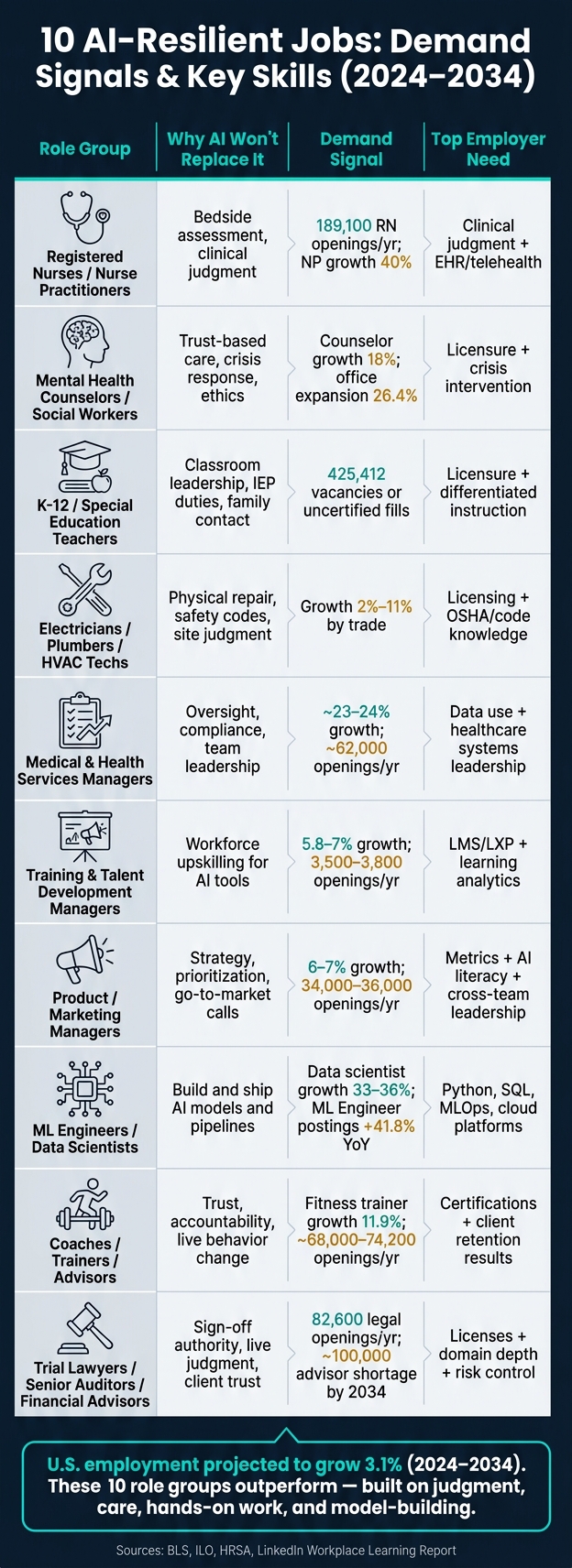
10 AI-Resilient Jobs: Demand Signals & Key Skills (2024–2034)
5 Jobs AI Can't Replace in 2026 (And What They Pay)
sbb-itb-20a3bee
Quick Comparison
| Role group | Why demand holds up | Demand signal from article | What employers want most |
|---|---|---|---|
| Registered nurses / nurse practitioners | Bedside care, assessment, clinical calls | 189,100 RN openings/year; NP growth 40% | Clinical judgment, care coordination, EHR/telehealth |
| Mental health counselors / social workers | Trust-based care, crisis work, ethics | Counselor growth 18% | Listening, crisis response, licensure, documentation |
| K-12 / special education teachers | Classroom control, family contact, IEP duties | 425,412 posts vacant or filled by uncertified staff | Licensure, classroom management, family communication |
| Electricians / plumbers / HVAC techs | Physical repair, safety, code work | Growth ranges from 2% to 11% by trade | Licensing, troubleshooting, OSHA/code knowledge |
| Medical and health services managers | Oversight, compliance, team leadership | Growth about 23% to 24% | Data use, healthcare systems, leadership |
| Training and talent development managers | Workforce training for AI tools | Growth about 5.8% to 7% | LMS/LXP, change management, learning analytics |
| Product / marketing managers | Prioritization, tradeoffs, go-to-market calls | Marketing manager growth 6% to 7% | Metrics, AI literacy, cross-team leadership |
| ML engineers / data scientists | They build and ship AI systems | Data scientist growth 33% to 36% | Python, SQL, stats, cloud, MLOps |
| Coaches / trainers / advisors | Trust, accountability, live guidance | Fitness trainer growth about 11.9% | Certifications, retention, adherence, client results |
| Trial lawyers / senior auditors / financial advisors | Sign-off, live judgment, client trust | 82,600 legal openings/year; advisor shortage by 2034 | Licenses, domain depth, risk control |
My takeaway: this article is not just a list of jobs. It is a guide to what employers still pay for when AI gets better - judgment, responsibility, people skills, and proof that your work changed an outcome.
If I were using this article for job search prep, I would focus on two things first: which roles still depend on human calls, and how to turn past work into short STAR stories with numbers.
What Makes a Role Hold Up in the AI Economy
AI changes work at the task level, not the whole-job level. In plain English: most jobs don’t vanish overnight. They shift, split, and get reshaped instead. That pattern shows up clearly in the 10 roles covered below.
The roles on this list tend to depend on work that’s harder to automate, such as human judgment, licensing, physical problem-solving, or the building and oversight of AI systems. The ILO found that clerical support workers have 24% of their tasks at high automation exposure - one of the highest shares across occupational groups. Jobs centered on hands-on care, physical settings, and high-stakes decision-making rank much lower on those same measures. That difference is the backbone of this list.
This framework also gives job seekers a better way to answer interview questions and answers. For each of the 10 roles, this article looks at four things: why the role remains resilient in the AI economy, which skills employers are hiring for, where demand is strongest across the United States, and how to build tailored STAR interview examples that link your experience to what hiring managers want to see. Acedit can help you turn those examples into STAR stories, spot questions in real time, and practice your responses.
When you understand why a role holds up, you can talk about your experience with more precision. Instead of just listing skills, you can show that your work involves regulatory accountability, physical problem-solving, or direct AI oversight. That makes your judgment easier for an interviewer to see.
1. Registered Nurses and Nurse Practitioners
Nursing is still one of the steadier career paths in healthcare. AI can help with charting and risk flags, but it can't step into bedside assessment, care coordination, or clinical judgment. Mercy pilot units saw ambient documentation software cut flowsheet documentation time per shift by 22%. At Stanford Hospital, a system pulls patient data every 15 minutes and sends risk alerts to the nursing care team. Useful? Absolutely. A substitute for a nurse? Not even close.
That shows up in the job numbers too.
The BLS projects 189,100 RN openings each year and 5% growth from 2024 to 2034. Nurse practitioners are set to grow much faster at 40%, adding about 128,400 jobs, with a median annual wage of $129,210.
A few forces are behind that demand:
- An aging RN workforce
- More chronic disease
- Broader NP scope-of-practice laws in many states
Those pressures also shape what employers want.
For RNs, hiring teams tend to focus on patient assessment, medication management, care coordination, and comfort with EHR and telehealth workflows. For NPs, the bar is higher on clinical depth: advanced assessment, diagnostic reasoning, treatment planning, and chronic disease management. Employers also want people who know SBAR and ICD-10/CPT coding. Most hiring sits in hospitals, outpatient care centers, home health, and primary care clinics. NP demand is especially strong in rural and underserved communities. General medical and surgical hospitals employ about 1.75 million RNs.
When it comes to interviews, the best stories usually center on patient outcomes and sound judgment under pressure. Think about moments like catching a medication discrepancy before it reached the patient, managing a patient who was getting worse while coordinating with a physician, or fixing a handoff workflow that cut down on errors. NP candidates should also bring in examples that show diagnostic reasoning, handling comorbidities, and knowing when to escalate treatment.
Numbers help here. A story lands harder when you can point to reduced readmissions, faster triage times, or better patient satisfaction scores. Acedit can help you rehearse those examples and tighten up your STAR answers.
2. Mental Health Counselors and Social Workers
Demand in behavioral health stays high for a simple reason: AI can help with paperwork, but it can't take over trust-based care. About 137 million Americans live in federally designated mental health professional shortage areas, and HRSA's 2025 behavioral health workforce brief points to major shortages in addiction counselors, mental health counselors, and behavioral health social workers through 2038. Tools can speed up notes, intake, and other admin tasks. But therapy still depends on the human side of the job: building rapport, handling crises, and making judgment calls around mandatory reporting. That's a big part of why hiring stays strong across counseling and social work.
The labor data backs that up. The BLS projects 18% growth for substance abuse, behavioral disorder, and mental health counselors from 2025 to 2035, and 6% growth for social workers overall, with mental health and substance use social workers at about 8% to 10%. Offices of mental health practitioners (except physicians) are also set to expand fast, with projected growth of 26.4% from 2024 to 2034. Median pay is $59,350 for counselors and $61,330 for social workers, though earnings vary by setting and license level. Hiring stretches across outpatient clinics, hospitals, schools, community mental health centers, and telehealth services. Telehealth has opened up more roles, and behavioral health remains one of the top telehealth use categories in U.S. care delivery.
Because this work is both relationship-based and tightly regulated, employers look for people who can connect with clients and handle documentation with care. The main things they screen for usually include:
- Active listening
- Crisis intervention
- Cultural competence
- Ethical judgment
- Comfort with EHRs and telehealth tools
Most counseling roles call for a master's degree plus state licensure, such as LPC, LMHC, or LMFT; nearly 97% of positions do. Supervised clinical hours are also part of the path. For social workers, clinical roles often require a CSWE-accredited MSW and the ASWB exam. In other words, the same things pushing demand up - licensure, ethics, documentation, and telehealth use - also shape how employers hire.
In interviews, it helps to lead with examples that show warmth and structure at the same time. You might talk about a crisis intervention where you followed a safety plan and coordinated with emergency services. Or a case with co-occurring depression and substance use where you worked across disciplines to build a care team. A telehealth example can also land well, especially if you explain how you adjusted your risk assessment for a virtual setting.
If you use AI-assisted documentation or EHR prompts, be clear about your process. Employers don't just want to hear that you used the tool. They want to know you reviewed the output, edited it, and checked that it matched your own clinical judgment. That's the line they care about: using tech without letting it steer the care. Acedit can surface counseling and social work interview prompts, including ethics, multicultural practice, and integrated care.
3. K-12 Teachers and Special Education Teachers
K-12 teaching runs on in-the-moment judgment, classroom leadership, and clear communication with families. Those are not side tasks. They’re core parts of the job, and they require a licensed human educator in the room. During the 2025–26 school year, about 425,412 teaching positions across the country were either vacant or filled by uncertified teachers. Paragraph 2 already shows the shortage.
Special education is the toughest area to staff. For the 2024–25 school year, 45 states reported shortages in this field. On top of that, more than half of U.S. school districts said they were short on special education teachers and substitutes. That keeps openings steady and helps support pay. The BLS reports mean annual wages of $71,770 for elementary special education teachers, with about 212,850 people employed in that category alone. Even though the BLS projects little or no net growth for kindergarten and elementary school teachers through 2035, it still expects about 99,400 openings per year because of retirements and turnover. For job seekers, that means steady demand, especially if you can point to student growth and strong family communication.
Public school districts are still the main employer. After that come charter school networks, private and parochial schools, and online or hybrid K-12 programs. Most employers look for:
- State licensure
- Classroom management
- Differentiated instruction
- Assessment literacy
- Family communication
For special education roles, the bar is even more specific. Schools want people who can write IEPs, track progress, and work closely with general education teachers and related service providers. Since IEPs are legally required, those duties stay tied to credentialed educators.
In interviews, don’t just describe what you did. Show what changed. A strong answer might focus on a student who improved after you adjusted instruction and updated an IEP goal. Or maybe you helped build a behavior plan that cut classroom incidents by a clear, measurable amount. If you’re applying in a high-need district, it also helps to talk about trauma-informed practices and family engagement. Acedit can help you rehearse teacher interview questions and tighten your STAR answers.
4. Electricians, Plumbers, and HVAC Technicians
For hands-on work, AI is changing the tools more than the job itself. These trades hold up well because they rely on jobsite judgment, hands-on repair, and safety-first work. Electricians, plumbers, and HVAC technicians are often ranked among the jobs least exposed to AI-led automation for a simple reason: the work is physical, site-specific, and tied to code requirements.
Job growth stays steady across all three fields. Electricians are projected to grow 9%–11%, HVAC technicians 6%–11%, and plumbers 2%–7%. Openings keep coming from retirements, new construction, and day-to-day maintenance. On top of that, too few people are finishing apprenticeships, which is pushing pay upward and giving skilled technicians more leverage. The push toward electrification - EV chargers, solar integration, and AI data center buildout - is adding even more demand for electricians.
That puts these jobs in a strong spot for candidates who can show reliability, sharp diagnostic skill, and comfort with newer tools.
AI is also becoming part of the workflow. Electricians use AI-driven design tools for circuit planning and load calculations. HVAC technicians work with IoT-connected systems and predictive maintenance platforms that spot failing parts before a full breakdown. Plumbers use camera diagnostics and connected sensors to find hidden leaks behind walls or under floors. The main hiring sectors include:
- Construction
- Home-services franchise networks
- Facilities management
- Utilities
- Manufacturing
When employers hire, they usually start with credentials. Electricians need a state license, apprenticeship completion, OSHA training, and NEC knowledge. Plumbers need a state plumbing license plus knowledge of local code and water-efficiency systems. HVAC technicians must have EPA Section 608 certification, and many employers also want NATE credentials to show higher-level skill.
After that, the differentiators are still very human: troubleshooting, reliability, and clear customer communication. AI tools can help spot patterns, but they can't step into a home, size up a messy situation, and make a safe call under pressure. In interviews, credentials matter most when they're backed by examples of safe, fast, code-compliant work.
The strongest interview answers show both trade skill and comfort with tech. An electrician might talk through an EV charging station install in an older building, including the load calculations, code issues, and final result. An HVAC technician could explain how a predictive maintenance alert helped catch a refrigerant problem before the equipment failed. A plumber might describe using camera diagnostics to find a leak that a visual check missed.
A simple formula works well here:
- State the problem
- Explain what you did
- Share the result
- Point out the safety or quality outcome
That kind of answer lands because it shows how you think on the job. Acedit can help you practice interview prep questions for your trade and tighten your STAR answers. Across skilled trades, the pattern stays the same: show code knowledge, troubleshooting skill, and measurable results.
5. Medical and Health Services Managers
Healthcare is growing fast, and it needs people who can keep the whole system running. Medical and health services managers - also called healthcare administrators or healthcare executives - plan, coordinate, and oversee care delivery across hospitals, clinics, group practices, home health agencies, and public health agencies.
The Bureau of Labor Statistics lists this as the fastest-growing management job in the U.S., with projected employment growth of about 23% to 24% from 2024 to 2034, versus roughly 3% for all occupations. That works out to about 62,000 job openings each year over the decade, including both growth and turnover. In plain English, this is a role with staying power. AI may speed up parts of the work, but it doesn't take ownership, make judgment calls, or carry responsibility.
Automation can handle back-office work like billing, scheduling, and documentation. But managers still need to read the data, guide teams through change, keep the organization in line with regulations, and make sure new tools support care instead of getting in the way. One analysis put automation risk at around 39%, but said most of the effect would come from augmentation, not job loss.
Because the job sits at the crossroads of operations and compliance, employers want people who can do both. That usually means:
- A bachelor's degree in health administration or a related field
- For senior roles, an MHA, MBA, or MPH
- Experience with EHR systems, population health platforms, and health informatics
- Proof that you've used data in projects to improve outcomes
- In some cases, FACHE to strengthen a leadership profile
Hiring remains strong across hospitals, outpatient care centers, home health, and physician group practices. These are the places where AI-based tools like remote monitoring, telehealth, and predictive risk scoring are showing up more often. Employers aren't just looking for someone who understands healthcare administration in the old sense. They want managers who can oversee AI-supported operations in day-to-day practice.
In interviews, the best examples usually do two things at once: they show you can work with data and lead people. For example, maybe you used dashboard metrics to cut emergency department wait times by 15%. Or maybe you led a team through an EHR rollout, dealt with staff resistance, and tracked results after launch. Readmission-reduction work with measurable gains also stands out, because it shows the kind of judgment hiring managers want to see.
Acedit can help you turn those wins into tighter STAR answers.
6. Training and Talent Development Managers
As companies roll out more AI tools, they also need people who can teach employees how to use them well. That’s where training and talent development managers come in. And in the U.S., employers aren’t pulling back on this role - they’re hiring for it.
The Bureau of Labor Statistics projects employment in this role to grow about 5.8%–7% between 2024 and 2034, which is faster than average. The field is also expected to see roughly 3,500–3,800 job openings per year from both new roles and replacement needs. On top of that, LinkedIn's Workplace Learning Report found that 9 out of 10 global executives plan to maintain or increase spending on learning and development, with a strong focus on upskilling and reskilling.
AI is taking over routine content creation, so the job is changing. Employers now need managers who can build training programs, read learning data, and connect skill growth to business results. In plain terms, this role is moving beyond managing courses. It’s now much more about helping the workforce build new skills at the right time.
That need is showing up clearly in the data. One survey found that 67% of employees want training on new AI tools, yet many organizations say they still haven’t prepared their people well enough. That gap is exactly why this role matters.
Hiring teams are also getting more specific about what they want. Employers usually look for a bachelor’s degree in HR, organizational development, education, or business. For senior roles, a master’s degree is often preferred. They also screen for skills like:
- learning data and analytics
- LMS/LXP tools
- change management
- proving business impact in dollar terms
Demand is especially strong in information, professional services, health care, and finance and insurance.
In interviews, don’t just say you managed training. Show what changed because of your work. A strong example might be leading an AI-augmented upskilling initiative that improved adoption and reduced time to competence. Or maybe you used learning analytics to spot a drop-off point in compliance training, then redesigned that module and improved completion rates. That kind of story gives employers something concrete to latch onto.
Acedit can help you turn those wins into tight STAR answers.
7. Product Managers and Marketing Managers
AI can handle a lot of the doing. It can draft specs, sum up feedback, study usage patterns, and sort audiences into segments. But these roles still carry the harder part: deciding what to build, who to target, which tradeoffs to make, and how to get different teams moving in the same direction. In practice, strategy, prioritization, and team alignment still sit with the manager.
The job outlook backs that up. The BLS projects 6% to 7% growth for advertising, promotions, and marketing managers from 2024 to 2034, with 34,000 to 36,000 openings per year. Product manager job counts also climbed from 34,729 in 2017 to 43,603 in 2021, with more growth expected through 2028. The strongest hiring is showing up in AI product roles and senior jobs that own strategy and launch calls.
At the same time, employers are asking for more. Product managers now need AI and machine learning literacy, comfort with metrics, and the ability to work closely with data scientists and machine learning engineers to ship AI-enabled features. That shift makes judgment matter even more. The tools help, but the hard calls still belong to people.
Marketing managers are seeing a similar change. Companies want people who can use AI-powered campaign and analytics tools day to day, while still owning brand positioning, budget choices, and go-to-market plans. AI may run much of the execution, but someone still has to decide what the brand stands for and where the money goes. Demand is strongest in:
- technology
- AI-native startups
- vertical SaaS
- financial services
- healthcare
- retail/e-commerce
Hiring managers also care less about motion and more about results. For both roles, interviews need proof that your work changed something that mattered.
A strong PM story should show:
- discovery
- tradeoffs
- execution
- a metric shift, such as stronger retention, conversion, or revenue
For marketing managers, the best examples usually center on campaign results with clear numbers, like more qualified leads, lower acquisition costs, or revenue impact. It also helps to show one clear example of using AI tools responsibly without losing brand voice.
Acedit can help you rehearse those outcome-based stories and answer follow-up questions with more precision.
8. Machine Learning Engineers and Data Scientists
Unlike the strategy roles above, these jobs build the models and get them into production. They sit right in the middle of AI adoption. Companies need people who can turn raw data into working models, and then turn those models into systems teams can use every day.
That need is growing fast. Data scientist roles are projected to grow about 33%–36% from 2024 to 2034, compared with roughly 3% to 5% for all occupations, adding more than 80,000 jobs and 23,000–25,000 openings per year. Machine learning engineer roles are also gaining ground. In Q1 2025, AI/Machine Learning Engineer was the fastest-growing AI job title, with 41.8% year-over-year growth in job postings.
The difference between these roles matters. Data scientists focus on the analysis side: exploring data, building models, and turning results into decisions that stakeholders can use. ML engineers focus on what happens after that: building pipelines, deploying APIs, and keeping models accurate over time in production. At large companies, those jobs are often split. On smaller teams, one person may do both. That split shapes what employers look for.
Across both roles, employers tend to screen for the same core skills:
- Python, SQL, statistics, and machine learning fundamentals show up as baseline requirements in many postings.
- ML engineers are also expected to know cloud platforms like AWS, GCP, or Azure, plus Docker, CI/CD, and MLOps tools such as MLflow for experiment tracking and model monitoring.
Technical skill isn't the whole story. In one review of 283,789 job postings, communication appeared in 43% of postings, ahead of data analysis at 38% and problem solving at 22%. That says a lot. It's not enough to build a model that works. You also need to explain what it does, why it matters, and where it can fail.
Hiring spans a pretty broad mix of industries. Tech and cloud companies use ML engineers for recommendation systems and developer tools. Finance and insurance firms rely on predictive models for fraud detection, risk, algorithmic trading, and personalization. Healthcare groups hire data scientists for clinical analytics and diagnostic support. Retail and e-commerce teams use both roles for demand forecasting, pricing, and personalization. Manufacturing and logistics apply them to predictive maintenance and supply chain optimization.
In interviews, don't just walk through the model. Walk through the full chain: the business problem, the modeling choice, the production step, and the result. Show what changed. Did your work move a metric, cut risk, or fix a process that was leaking money? For instance, reducing churn by 5% can mean about $2.5 million in annual retained revenue in the U.S. market.
For ML engineer roles, be ready to talk about the messy parts too. Model drift. Bad data. Broken pipelines. System failures. Employers want to hear how you spotted the issue, how you debugged it, and what you changed to make the system hold up better over time. Acedit can help you rehearse those stories and handle technical follow-up questions.
The next roles are less technical, but they still depend just as much on human trust and expert judgment.
9. Coaches, Personal Trainers, and High-Touch Advisors
These roles tend to hold up well because clients aren’t just paying for information. They’re paying for trust, accountability, and in-the-moment judgment. When someone is burned out, stuck, resistant, or needs a live adjustment, that’s where coaches and trainers still matter most. So even as AI takes over more back-office tasks, this group stays in a strong spot.
The labor data supports that. In the U.S., fitness trainers and instructors are projected to grow by about 11.9% from 2024 to 2034, which is faster than average. The field had roughly 370,100 jobs in 2024, with about 68,000–74,200 openings per year. Within the broader coaching market, health and wellness coaching is the fastest-growing segment.
AI is most likely to take over the admin side first: scheduling, progress tracking, and repeatable templates. But it doesn’t replace the part clients are actually hiring for: the relationship. That leaves human coaches doing more of the hard stuff - emotion-heavy conversations, pushback from clients, and behavior change that calls for sound judgment. Coaches with a niche, like executive transitions, trauma-informed health coaching, or chronic disease management, are usually better protected than people offering broad, general coaching.
Hiring is spread across a few settings, including fitness companies, hospitals, corporate wellness programs, insurance firms, and digital health startups. Credentials matter here. Personal trainers usually need certifications from NASM, ACE, NSCA, or ISSA, and many employers also want CPR/AED certification. Health and wellness coaches working in clinical or insurance settings often need training tied to the National Board for Health & Wellness Coaching, along with backgrounds in nursing, nutrition, psychology, or exercise science.
In interviews, show that you turned trust into results people can measure. Use STAR-format examples that focus on things like:
- client retention
- adherence
- benchmark progress
- injury reduction
If you’ve used wearables or digital health platforms to track adherence and then changed your approach based on that data, that’s a strong signal. It shows you can use AI tools without giving up human judgment. Acedit can help you shape and practice those stories.
10. Trial Lawyers, Senior Auditors, and Financial Advisors
These roles hold up well because they depend on live judgment, regulatory sign-off, and client trust. AI can help with the work. It can't own the call.
A trial lawyer has to read the room in real time and shift when a jury reacts in an unexpected way. A senior auditor signs off on findings and may have to defend them to regulators. A financial advisor often does something less flashy but just as hard: helping a client stay calm and avoid panic selling during a market drop. That makes these three of the clearest cases where demand can last even as AI use grows.
The labor data supports that view. BLS projects 82,600 annual openings in legal occupations from 2025 to 2035, with lawyers earning a median pay of $159,670. For accountants and auditors, BLS projects 5% growth from 2024 to 2034, with about 72,800 jobs added and 124,200 openings per year across the broader field, plus an unemployment rate of just 1.0% in May 2026. In wealth management, the field faces a projected shortage of roughly 100,000 financial advisors by 2034, and more than 44% of advisors are already over age 50.
AI is already part of day-to-day work in all three fields. In 2026, 94% of lawyers reported using AI for legal work, most often for legal research, document summarization, and drafting. In financial advice, 85% of advisors had adopted AI tools, and one survey estimated that AI saves advisors the equivalent of more than 200 hours per year. In audit and accounting, a 2026 IDC study found that 66% of respondents said AI is already embedded in firm strategy or in active pilot projects.
That helps explain why credentials still carry so much weight. Trial lawyers need a J.D. from an accredited law school and must pass a state bar exam. Trial advocacy work through moot court or clinics can set one candidate apart from another. Senior auditors are often expected to hold a CPA license, sometimes paired with a CIA or CISA for internal audit or IT-heavy settings, along with strong knowledge of U.S. GAAP, PCAOB standards, and SOX requirements. Financial advisors generally need FINRA Series 7/65/66 licenses, and many employers favor the CFP® designation for planning-focused roles. What employers want now is simple: domain depth, AI fluency, and tight risk control.
In interviews, the strongest move is to show how you used AI, then show where your judgment changed the outcome. That's the part hiring teams care about.
- A trial lawyer might explain how an AI research tool surfaced key precedents, then show how they built the courtroom argument around what the jury responded to.
- A senior auditor could describe using analytics to flag an anomaly, then digging deeper and confirming a real control weakness.
- A financial advisor might share how AI-generated planning scenarios helped a client understand volatility, while the advisor provided the calm, human guidance that kept them from making a costly mistake.
Acedit can help you build and rehearse these kinds of STAR-format stories. These roles fit STAR especially well because they put judgment, accountability, and trust under pressure front and center.
How to Turn Labor-Market Trends Into Stronger Interview Stories
Knowing which roles hold up is only the starting point. The next move is to turn those patterns into interview stories that sound clear, sharp, and grounded in what employers want.
Across the roles covered here - care, skilled trades, education, leadership, and high-trust decision-making - hiring teams are looking for the same signal: can this person get results and work well as tools change?
A simple way to prep is to build 2 to 3 STAR stories per role:
- one with a measurable result
- one that shows adaptation
- one that shows collaboration or judgment
Start with the result. Put the outcome up front, then explain what you did. If you have numbers, use them. If you don't have exact figures, show the direction of change instead - faster turnaround, fewer errors, higher retention, better response rates, smoother handoffs.
And don't stop at the metric. Add a short note about how you kept accuracy, quality, or accountability in place. That's the signal AI-era hiring teams want to hear: efficiency plus judgment, not speed alone.
For the AI-heavy roles above - especially product, marketing, and data work - at least one story should show responsible AI use paired with human judgment. Demand for AI literacy rose sharply from 2024 to 2025, and most organizations now plan to hire for AI-related skills.
The key is simple: treat AI as a tool, not the headline. A marketer who used AI to draft first-pass copy, then improved conversion through testing and editing, tells a much stronger story than someone who just says they used AI at work.
Acedit can generate role-specific practice questions, run mock interviews, and help you sharpen STAR answers for live interviews - so you're ready for follow-up questions without drifting off-message.
Job Search Takeaways for U.S. Candidates
Across care, skilled trades, education, management, and other high-trust roles, the same rule keeps coming up: show proof, not labels. Go after roles where domain knowledge and judgment still count, and build your application around measurable results.
On your resume, list the tools, frameworks, and outcomes. Don’t hide behind a vague label like AI tools. Saying you’re “AI-savvy” or “good with technology” doesn’t tell an employer much. Workers who can show AI skills earn 56% more than peers in the same role who don’t have those skills. That’s why it helps to name the tool, explain how you used it, and show what changed.
Another shift is worth noting: across the ten roles covered above, entry-level hiring now checks for judgment, communication, and strategic thinking much earlier than it used to. Skills that once showed up after one or two promotions are now part of the first screen.
For non-degree roles, shipped work can matter a lot. If you’ve built it, fixed it, installed it, taught it, or improved it, show that. For everyone else, industry-specific credentials can signal fit more clearly than a resume by itself. Those signals carry through the rest of the article’s final takeaway.
Acedit can help you turn those examples into practice questions, simulations, and sharper STAR answers.
Conclusion
These 10 roles hold up because they depend on human judgment, trust, hands-on problem-solving, coordination, and technical expertise. AI tends to support those skills more than replace them. And that lines up with the role-by-role data: demand is strongest where care, instruction, leadership, and technical judgment still matter most.
For job seekers, that changes the game a bit. The story you tell can matter just as much as the role you go after.
Employers are looking for communication, problem-solving, and flexibility earlier in the hiring process. So your examples need to show results, teamwork, and tool fluency. Clear, measurable examples beat vague claims every time.
Keep building your domain skills, learn the AI tools used in your field, and update your interview stories with measurable outcomes. Acedit can help you practice role-specific questions and sharpen STAR-format answers. That’s the practical edge in an AI-shaped job market.
The strongest candidates will pair human-centered expertise with AI fluency and clear proof of results.
FAQs
Why are tasks more at risk than entire jobs?
AI affects jobs as a bundle of tasks, not just a job title. It works best on specific, rule-based work like data entry, documentation, and routine queries.
Most roles mix routine tasks with harder, less predictable work. So in many cases, AI handles only the repetitive parts. That tends to augment a job instead of replacing it, which leaves people to focus on judgment, creativity, and relationships.
Which of these roles require licenses or certifications?
- Nurse Practitioners need formal licensing and clinical training.
- Cybersecurity roles often call for industry-standard certifications.
- Construction Managers can benefit from digital project management certifications.
For many other roles, employers often put more weight on hands-on experience, portfolios, or skills-based assessments.
How can I prove AI fluency in interviews?
Show that you can use AI tools well, make sense of what they give you, and check whether the results hold up. Talk about how you frame the right prompts, test the output, and use technical judgment to solve problems that come up on the job.
Acedit can help you practice with real-time coaching, AI-driven simulations, and role-specific Q&A. It’s also handy for shaping answers with the STAR method, so you can explain your technical skills and business thinking in a clear, sharp way.