
I’d use 2026–2030 as a career-planning window - not a schedule of AI layoffs. Start by checking which tasks in your role AI can handle, then compare local openings, skill requirements, and pay every three to six months.
The 2025 ILO–NASK study estimates that one in four workers globally has some generative-AI exposure. That means tasks could change - not that one in four jobs will disappear. WEF projects 170 million jobs created and 92 million displaced globally by 2030 across multiple drivers, not AI alone.
Here’s how I’d use the timeline:
- 2026: Compare current hiring and workflows with a 2025 baseline.
- 2027: Watch for fewer junior openings or combined duties.
- 2028: Check demand for AI oversight and human review.
- 2029: Match training costs to skills employers request.
- 2030: Compare forecasts with actual employment results.
<u>These are checkpoints, not promised milestones.</u> I’d focus on proof that I can check AI output, handle decisions, and deliver results - and use tools like Acedit to rehearse those examples for interviews.
AI Job Displacement Timeline: 2025–2030
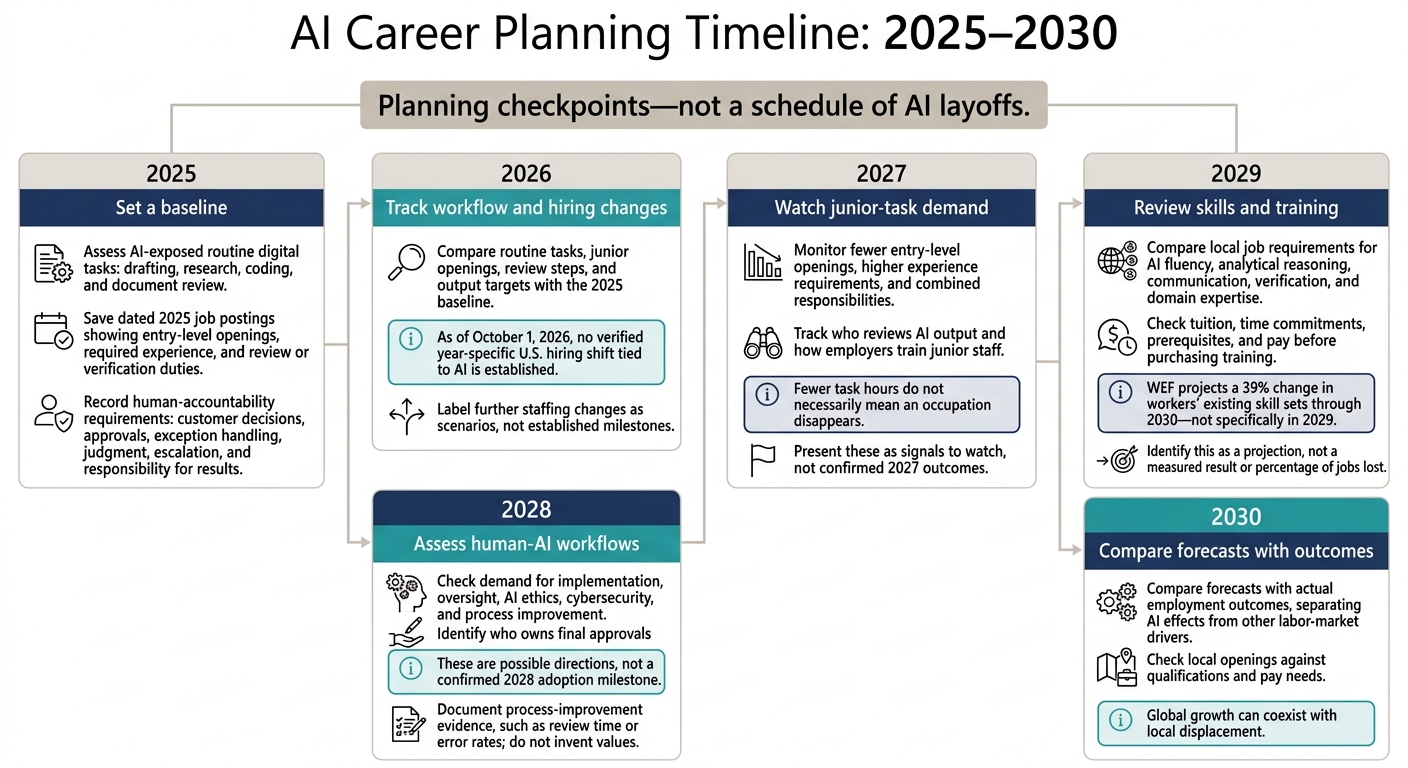
AI Career Planning Timeline: 2025–2030
2025: Set a Baseline for Job Tasks and Hiring
Save a baseline so you can track which tasks change first.
| Task category | Tasks to assess in your target role | Baseline to save |
|---|---|---|
| AI-exposed | Routine digital tasks, including drafting, research, coding, and document review | Dated 2025 job postings showing entry-level openings, required experience, and review or verification duties |
| Human accountability | Customer decisions, approvals, and exception handling | Requirements for judgment, escalation, and responsibility for results |
Compare these records with 2026 postings to see whether hiring signals start to shift.
2026: Track Workflow and Hiring Changes
As of October 1, 2026, no verified year-specific U.S. hiring shift tied to AI is established. Compare routine tasks, junior openings, review steps, and output targets with your 2025 baseline.
Treat further staffing changes in 2026 as scenarios, not established milestones. In interviews and applications, stick to skills and results you can prove. Watch next for signs that employers need less junior-level task work.
2027: Watch for Lower Demand for Junior Tasks
As workflow automation spreads, drafting, research, routine coding, and document review may take fewer staff hours without eliminating the occupation.
Watch for fewer entry-level openings, higher experience requirements, or combined responsibilities. Also track who reviews AI output and how employers train junior staff. For interviews, prepare evidence of how you verified information, handled an exception, or took responsibility for a result - not just how fast you produced a draft.
2028: Assess Shared Human-AI Workflows
Following task-level changes, more use of human-AI workflows could shift hiring toward implementation, oversight, AI ethics, cybersecurity, and process improvement. These are possible directions, not a confirmed 2028 adoption milestone.
Check who owns final approvals and whether employers offer training. Prepare a process-improvement example that explains the task, your checks, and the result. Use measurements from your work, such as review time or error rates. If these hiring shifts occur, watch which skills employers value most.
2029: Review Skills and Training Needs
Those workflow shifts may lead employers to place more weight on AI fluency, analytical reasoning, communication, verification, and domain expertise. The World Economic Forum’s projected 39% change in workers’ existing skill sets applies through 2030, not specifically to 2029.
Before paying for training, compare requirements across current local job openings. Check tuition, time commitments, prerequisites, and pay. Favor training that gives you evidence of what you can do, and explain how your existing experience connects to the new role.
2030: Compare Forecasts With Employment Outcomes
In 2030, compare forecasts with actual employment outcomes, separating AI effects from other labor-market drivers. Global growth can coexist with local displacement.
Before treating expanding occupations as realistic job options, check whether they match current local openings, your qualifications, and your pay needs. Use that comparison to assess which roles still fit current hiring patterns.
sbb-itb-20a3bee
Which Job Tasks May Change First?
The 2025–2030 timeline shows when changes may arrive. This section helps you spot which tasks are likely to change first.
Routine Digital Tasks and Human Responsibility
Start with the task, not the title. People remain central when work involves judgment, safety, trust, or budget ownership.
The table below outlines the tasks most likely to shift first.
| Task category | Task change | Human responsibility | Skills to develop | Exposure | Displacement risk |
|---|---|---|---|---|---|
| Clerical processing and basic reporting | Automate routine inputs and summaries | Audit records and resolve exceptions | Data auditing, tool management | High | Higher where routine processing dominates |
| Scripted customer support | Automate standard questions | Resolve disputes and preserve customer trust | Conflict resolution, interpersonal judgment | High for scripted tasks | Higher where escalation and empathy needs are low |
| Marketing first drafts | Generate content drafts, SEO basics, and image concepts | Own brand voice, planning, and ethics | AI ethics, storytelling tied to business goals | Medium | Moderate where work is mostly drafting |
| Entry-level technical work | Assist with coding and repeatable analysis | Check outputs and assumptions | Technical oversight, problem-solving | Moderate to high | Moderate; technical skills can age quickly |
| Regulated decisions | Assist with analysis and documentation | Own decisions and ethical obligations | Domain knowledge, accountable judgment | Moderate | Low to moderate |
| Physical and in-person work | Limited ability to automate physical tasks | Protect safety and respond to individual needs | Specialized technical or manual skills, communication | Low | Lower, not zero |
In small businesses, administrative, service, and marketing duties often change before the core role does. Those shifts tend to appear first in hiring language, staffing plans, and training budgets.
Hiring, Staffing, and Training Signals to Watch
As tasks shift, hiring language changes next. Watch for postings that combine previously separate duties, set higher productivity targets, or add AI governance skills. Also look for fewer junior openings focused on first drafts or basic reporting.
Growth in AI ethics, data analysis, cybersecurity, or AI oversight roles points to AI integration. Training spending may suggest plans to help current workers adjust, but it doesn't, on its own, prove that AI will support workers or replace them.
Most jobs are filled through networks and referrals, so treat job ads as just one signal.
Use the Timeline for Interviews and Career Planning
Use the timeline above to turn job-shift signals into interview examples. Pick completed projects with measurable results that match the tasks most likely to change. This gives you concrete ways to connect labor-market trends to your work.
Prepare Interview Examples for Changing Roles
Build a short transition story that links your past work to the target role. Highlight transferable strengths such as leadership, stakeholder management, budget ownership, and project management. Use informational interviews to learn what the company looks for when hiring and how AI has changed specific tasks.
Prepare examples that show how you checked work, made decisions, or reviewed outputs in areas such as drafting, research, or routine analysis. Explain how that experience fits a role whose tasks are changing with AI.
Practice Role-Specific Interviews With Acedit
Acedit is an AI-powered Chrome extension for interview prep. It offers tailored questions, simulations, STAR prompts, and LinkedIn or cover-letter support to help you prepare for a specific role. Use the STAR prompts to organize examples from your own experience.
Check every generated answer and cover letter for accuracy. Remove invented experience or unsupported metrics, and explain your decisions in your own words. If you use real-time interview assistance, follow employer policy and get permission when required. Use it to rehearse how you explain changing tasks - not to replace your own answers.
Conclusion: Plan for Task Changes, Not Fixed Dates
Treat 2025–2030 as a planning window, not a countdown. AI exposure changes tasks before it eliminates roles. Employer forecasts and hiring signals already point to this shift. AI may handle more drafting, analysis, classification, scheduling, and customer support, while people handle judgment, exceptions, verification, and relationship management.
The World Economic Forum projects 170 million jobs created and 92 million displaced globally by 2030 across multiple drivers. But global net growth doesn't prevent local disruption. New openings may call for different skills, credentials, locations, or experience levels than the jobs affected.
Use the 2025 research baseline as a starting point, not a fixed schedule. Timing will vary by industry, company size, region, occupation, regulation, adoption costs, labor shortages, training capacity, and management readiness.
Turn the timeline into a screening tool:
- Sort your target role’s tasks into four buckets: automatable, AI-assisted, human-led, or newly created.
- Track local hiring signals: job-posting volume, entry-level openings, required AI skills, staffing patterns, and wage changes.
- Update your evidence every three to six months: revise résumé examples and interview stories with concrete proof that you used AI responsibly, checked its outputs, protected confidential information, improved a process, or delivered a measurable outcome.
Use Acedit to rehearse those examples with role-specific questions, real-time coaching, and interview simulations.
FAQs
How can I distinguish AI-related hiring changes from a slowdown?
Fewer job openings don’t tell the whole story. AI-related shifts include less entry-level hiring, more AI-hybrid roles, higher AI literacy requirements, and automation focused on routine, rule-based tasks.
A general hiring slowdown, by contrast, tends to affect unrelated tasks and skill categories through layoffs or hiring pauses. Forecasts and Bureau of Labor Statistics–style models may lag sudden private-sector shifts, so track live job postings and pay trends over time.
When should I reskill rather than switch careers?
Reskill when your role is still needed but the work is changing. AI may automate routine tasks, while employers still need your judgment, people skills, and accountability.
Review your tasks, build AI literacy now, and look into nearby roles with growing demand before a job loss turns into long-term unemployment. Use a skills gap analysis and a 3–5-year plan to check whether those roles fit. Test a small project and set training milestones instead of jumping straight into a different career.
How can I prove responsible AI use in an interview?
Show how you combine AI efficiency with human judgment. Explain how you frame prompts, check outputs against your expertise, and edit the results for accuracy and quality.
Use the STAR method - Situation, Task, Action, Result - to describe how you reduced turnaround time or errors. Include the steps you took to stay accountable for the final work. Acedit’s interview simulations and personalized Q&A can help you practice explaining how your judgment improves AI-generated results.