
If your interview answers are fine but your delivery slips, these 7 drills help fix that. I’d focus on the signals that shape first impressions fast: pace, tone, filler words, eye contact, answer flow, follow-up handling, and full-session consistency.
Here’s the short version:
- Pace drill: aim for about 140–160 WPM
- Tone drill: sound steady and warm, not flat or tense
- Word choice drill: cut filler words and vague language
- Eye contact drill: keep camera focus around 60%–70%
- STAR flow drill: keep answers clear, with most time on your actions
- Follow-up drill: answer direct follow-ups in 30–45 seconds
- Full mock review: track patterns across a full 25–40 minute session
The core idea is simple: one-off practice shows mistakes; repeated practice with feedback shows patterns. And those patterns matter. The article points to research showing mock interview prep can improve performance by 55%–60%, increase confidence by 30%+, and lower anxiety for 79% of people.
What I like here is the focus on measurable delivery, not guesswork. Instead of asking, “Did that sound okay?” you track things like:
- Words per minute
- Filler words per answer
- Answer length
- Eye contact
- STAR completeness
That makes it easier to pick the right drill for the next session instead of trying to fix everything at once.
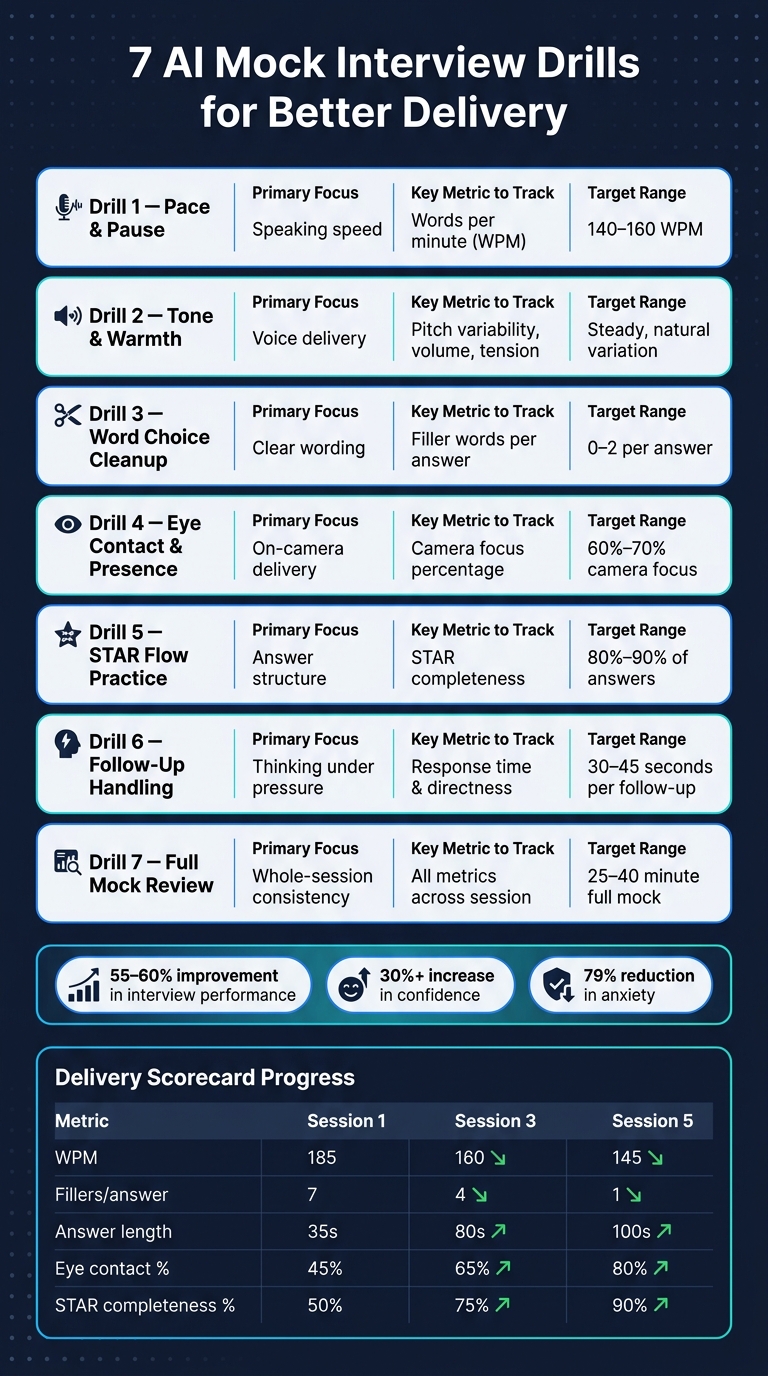
7 AI Mock Interview Drills: Key Metrics & Targets at a Glance
How to Practice Mock Interviews with AI
sbb-itb-20a3bee
Quick Comparison
| Drill | Main focus | What to track | Best for |
|---|---|---|---|
| Pace and pause | Speaking speed | WPM, pause length | Video interviews, phone screens |
| Tone and warmth | Voice delivery | Pitch change, volume, tension | Client-facing and leadership roles |
| Word choice cleanup | Clear wording | Fillers, jargon | Behavioral and panel interviews |
| Eye contact and presence | On-camera delivery | Gaze, posture, camera focus | Video interviews |
| STAR flow practice | Answer structure | Section balance, ownership, results | Structured behavioral interviews |
| Follow-up handling | Thinking under pressure | Response delay, directness | Manager and panel interviews |
| Full mock review | Whole-session consistency | Trends across all metrics | Long interview rounds |
My takeaway: this article is less about “what to say” and more about how to say it well under pressure. If I were using it, I’d take the weekly approach it lays out: two short drill sessions during the week, one full mock interview on the weekend, then review the numbers and repeat.
Why AI Mock Interview Drills Outperform One-Off Practice
One practice session can show you what's off. Repeated sessions, with feedback each time, show you the pattern.
That's the big difference.
Delivery issues like rushing your opening line or falling back on "um" when the pressure kicks in aren't random. They're habits. And those habits are tied to pace, tone, word choice, eye contact, and how your answer moves from one point to the next. Habits change through repetition, not through a single run.
Research backs this up. Studies on interview preparation show that higher levels of practice, combined with feedback, lead to a clear pattern of better interview performance ratings. Separate research on asynchronous video interviews found that candidates who had more prep time and could re-record answers scored much higher in evaluator ratings than those who had just one chance. That's why the drills below focus on one delivery skill at a time.
AI also beats casual practice for a simple reason: it gives objective, precise feedback. It can point to the exact moment your opening sounds rushed or show where your pace slows down later in the answer. That's a lot more useful than a vague reaction like, "something felt off."
It can also spot patterns that are easy to miss on your own. Say you answer the same behavioral question samples a few times. The system might flag that your filler words jump during transitions, or that your eye contact drops right as you start to wrap up. Small details like that shape how calm and sure you sound. Data makes them easier to see.
The first drill starts with the easiest signal to control: pace and pause.
That loop - answer, review, adjust, repeat - is what turns rough answers into cleaner, more confident delivery.
1. Pace And Pause Rehearsal With Timed AI Prompts
The Primary Delivery Skill
This drill helps you build a steady pace and use pauses on purpose, so your answers sound clear, organized, and confident. When your pace stays even, you sound prepared instead of rushed.
Research suggests that interview speech works best at around 150–160 words per minute (WPM). If you go above 180 WPM, you may sound anxious or less credible. If you fall below 120 WPM, you risk sounding checked out.
The AI Feedback Signal To Track
Use AI to measure your pacing, not just give a vague opinion. Good tools can break down your audio or video into numbers you can track: average WPM for each answer, how often you pause, and how long those pauses last. In one mock interview study, candidates who paused 1–2 seconds before answering hard questions received 20% higher ratings on intelligence and trustworthiness than candidates who answered right away, even when the content of their answers was identical.
Acedit can add context-aware feedback on top of those numbers. For example, it can flag when your WPM jumps on behavioral questions or when your pace slows and trails off at the end of an answer.
Recommended Practice Format
A focused 30–45 minute weekly session works well. Start with a simple prompt like “tell me about yourself,” and focus only on breathing and a comfortable speaking rate. Then move into a pace drill aimed at 150–160 WPM, with at least one deliberate 1–2 second pause every 20–30 seconds.
After that, run a pause-before-speaking drill. Wait 2–3 seconds in silence before answering each question. It may feel awkward at first, but that’s usually a sign the habit is changing.
Best Use Case In U.S. Interviews
This drill is especially useful for roles where calm, measured delivery signals executive presence. In video interviews, keep steady eye contact with the camera during a 1–2 second pause so the silence reads as confidence, not hesitation. In phone screens, where the interviewer only has your voice to go on, aim for the lower end of the range - around 135–150 WPM - so they can follow your answer without losing the thread.
Once your pace feels under control, the next drill sharpens tone and warmth.
2. Tone And Warmth Calibration Using AI Voice Feedback
The Primary Delivery Skill
This drill helps you work on vocal tone and warmth. Those are the signals that make you sound confident, easy to talk to, and professional. A warm voice with some natural variation tends to come across as more likable and more hireable than one that sounds flat or creaky.
Treat tone the same way you treated pace: track one metric at a time.
The AI Feedback Signal To Track
The main signals to watch are:
- Pitch variability: Do you sound monotone, or do you have natural expression?
- Volume consistency: Does your voice get too quiet or suddenly too loud?
- Warmth or tension: Do you come across as warm, or do you sound tight and strained?
There’s one small but important catch here. A higher pitch can make someone seem warmer, but it can also make them sound more anxious, which can hurt perceived suitability. So don’t try to make your voice higher. Go for steady, natural pitch variation instead.
Acedit’s interview simulations are useful here because they let you answer the same question more than once and compare each try, especially when you pair them with voice-analysis feedback.
Recommended Practice Format
A focused 15–20 minute session works well. Use one or two common questions, such as "Tell me about yourself" or "Why are you interested in this role?"
Start by recording a baseline answer. Then review the AI’s tone and sentiment scores. From there, fix just one thing. Maybe your energy fades in the second half. Maybe your pitch stays flat the whole time. Make that one adjustment, answer the same question again, and see whether the metrics changed.
Doing this two or three times per week helps build muscle memory. Log the question and the key scores after each session.
Once your tone sounds steady, the next step is to clean up the words that carry it.
Best Use Case In U.S. Interviews
This drill tends to matter most in client-facing roles, leadership interviews, and video interviews, where your voice shapes a big part of the first impression. In phone screens and video calls, you have fewer visual cues to lean on, so your voice does a lot of the heavy lifting.
With tone and warmth in better shape, the next drill moves to the specific words you choose.
3. Word Choice Cleanup To Cut Filler Words And Jargon
The Primary Delivery Skill
This drill helps you cut filler words and jargon so your answers sound clear and confident. Words like "um", "uh", "like", "you know", and "basically" don't add meaning. Under pressure, they tend to show up fast, which makes them one of the clearest signs of shaky delivery. Once your voice sounds steady, the next step is to tighten the words you use.
The goal is simple: say less, mean more. Swap filler words for short pauses.
The AI Feedback Signal To Track
Once tone is under control, filler words are much easier to catch and fix. The main signals to watch are filler word frequency per minute and jargon per answer.
AI can track filler-word frequency, show jargon density, and flag progress from one session to the next. Pay close attention to filler spikes at openings, transitions, and moments of recall. That's usually where they bunch up most.
Acedit can transcribe your answers and flag filler and jargon terms automatically, then suggest cleaner alternatives. Over repeated sessions, you can track a clear drop - say, from 10 fillers per minute down to 3 - and watch your clarity score improve along with it.
Recommended Practice Format
A focused 15–20 minute session works well here. Review the AI transcript, spot your filler spikes, and replace them with pauses or tighter phrasing. Then record the same answer again until the filler count drops.
Also check for empty intensifiers. Words like "really", "very", "basically", and "I guess" can weaken an answer without adding much. Instead of vague phrasing, get specific.
"We improved performance by 18%."
That kind of wording lands better because it gives the listener something concrete. Try this drill 3–4 times per week and log your filler count after each session so you can see the change over time.
Best Use Case In U.S. Interviews
This drill helps most in behavioral interviews, panel interviews, and executive-level conversations - situations where a U.S. interviewer is listening closely for clear communication.
Once your wording sounds clean, the next drill moves to on-camera presence.
4. Eye Contact And On-Camera Presence For Video Interviews
The Primary Delivery Skill
After pacing, tone, and word choice, the next thing an interviewer notices is your on-camera presence. In U.S. video interviews, eye contact and framing shape that first impression fast. Around 86% of U.S. organizations use virtual interview technology, so what you look like on camera is often one of the first signals a recruiter gets.
Look at the camera lens, not the interviewer's face on your screen. A small sticky note just below the lens can help keep your gaze in the right spot. Aim for about 60% to 70% camera focus - engaged, but not locked in place. Sit upright, keep your shoulders relaxed, center your face and upper torso in the frame, and place your light source in front of you.
The AI Feedback Signal To Track
On-camera presence gets better when you can track it. Focus on eye-contact percentage, gaze shifts, and posture stability.
Meta-analytic research covering more than 70 years found that eye contact had one of the strongest links to interview performance of any nonverbal cue, with a correlation of ρ = .45. That’s a big deal. AI tools can show these metrics after each session, which makes it easier to spot patterns and see progress over time.
Acedit supports this through its interview with AI simulation feature. You can run repeated video mock sessions and review your delivery patterns across attempts. After each simulation, check your gaze, posture, and eye-contact percentage.
With eye contact and posture in a steady place, move to answer flow so delivery and content stay in sync.
Recommended Practice Format
A 15–25 minute session, 2–3 times per week works well for this drill. Start with the setup:
- Put your camera at eye level
- Hide self-view so your eyes don't drift
- Check that your lighting is in front of you
Then run 4–6 behavioral questions. Focus on anchoring your gaze to the lens at the start and end of every answer. Those moments tend to stick with interviewers the most.
After each session, review one thing to keep and one thing to fix. For example:
"Posture stayed solid - next session, reduce off-screen glances during recall."
That kind of narrow review keeps progress concrete. It also helps you avoid trying to fix everything at once.
Best Use Case In U.S. Interviews
This drill matters most in first-round video screens, remote or hybrid panel interviews, and client-facing or sales roles.
Once your on-camera presence is steady, the next drill tightens answer structure and flow.
5. Answer Flow Practice With STAR-Based AI Repetitions
The Primary Delivery Skill
Once your on-camera presence feels steady, the next thing to tighten is answer flow.
In behavioral interviews, flow matters because STAR gives your answer a clear path: Situation, Task, Action, Result. That structure helps interviewers follow your story as you speak and judge it in the moment.
A lot of candidates make the same mistake. They spend too much time on background and not enough time on what they actually did. Keep the Situation and Task short, put most of your time into the Action, and finish with a clear, specific Result.
The AI Feedback Signal To Track
AI repetitions make STAR flow easier to measure. Across practice sessions, focus on three signals:
- Section balance
- Ownership language - how often you say I instead of we
- Result specificity - whether you end with a number instead of a vague wrap-up
STAR-style answers are far more predictive of performance than AI interview preparation vs traditional methods. That’s why AI feedback on these signals matters. Small shifts in flow and specificity can make your answers easier to follow and much stronger in the room.
Acedit supports this with interview simulations and real-time question detection, so you can practice STAR answers in a setting that feels closer to an actual interview. Its Custom STAR Examples feature is especially helpful when you’re building and sharpening your story bank over time.
Recommended Practice Format
Build 5–7 reusable STAR stories, practice them 2–3 times per week, review the AI feedback after each run, and then answer the same prompt again with one fix.
Best Use Case In U.S. Interviews
Once your core stories are stable, start testing them under interruption.
This drill matters most in structured behavioral interviews at large U.S. tech, finance, consulting, and Fortune 500 interviews. When STAR flow starts to feel natural, move to follow-up questions that throw off your prepared rhythm.
6. Real-Time Follow-Up Handling With AI Question Detection
The Primary Delivery Skill
Once your STAR answers feel steady, the next thing to test is what happens after them. Follow-up handling is about hearing an unexpected question, sorting your thoughts fast, and giving a direct answer without freezing, rambling, or starting the whole story over.
Most weak follow-up answers break down because of delivery, not because the person lacks the right idea.
A simple way to answer works well here: give the answer in one sentence, add one concrete detail, then share the result or lesson, and stop.
The AI Feedback Signal To Track
Pay attention to response latency and relevance. In plain English, that means how fast you answer and whether you answer the follow-up directly.
AI can also spot patterns that are easy to miss in the moment, like:
- restarting the original answer
- getting vague after a direct probe
- leaving out ownership detail
Try to keep follow-up answers under 30–45 seconds. The goal is to add one new layer of depth, not launch into a new story.
Recommended Practice Format
In practice, this works best as a fast two-step loop. Answer a base question in 60–90 seconds, let AI generate 1–3 follow-ups, respond under time pressure, review what happened, and repeat.
Acedit supports this with real-time question detection and AI-generated response suggestions during interview simulations, so the pressure feels closer to an actual conversation.
Best Use Case In U.S. Interviews
This drill matters most in behavioral, manager, and panel interviews. It shows up a lot at U.S. companies in consulting, product management, sales, and leadership roles, where interviewers often use layered questions to test judgment and consistency.
After follow-up handling starts to feel steady, review the full session and look for the delivery habits that still crack under pressure.
7. Full Mock Interview Review Loop With AI Analytics
This drill is the stress test. It shows whether your pace, tone, and structure stay steady through a full interview.
The Primary Delivery Skill
The earlier drills each work on one piece at a time - pace, tone, word choice, eye contact, STAR structure, or follow-up handling. This one brings those pieces together.
The skill here is staying consistent across the full interview, not just giving one strong answer.
A 25–40 minute mock interview can expose habits that short drills often miss. Maybe your confidence drops near the end. Maybe filler words jump when the questions get tougher. Maybe your STAR structure looks solid at first, then starts to slip once you get tired. That’s the gap this drill is meant to close: keeping your delivery steady under pressure for the whole session.
The AI Feedback Signal To Track
AI analytics can show delivery patterns over time that are tough to spot by yourself. Track:
- Answer length
- Words per minute
- Filler words
- Eye contact
- STAR adherence
The big win here is timing. You can see the exact point where your delivery starts to drift. Over a few sessions, those signals can show patterns tied to harder questions - the kind of consistency data a short drill just won’t give you.
Recommended Practice Format
Use the scorecard to find the two weakest habits, then drill ONLY those before the next full run.
Do one full-length mock interview each week, record it, and have the AI build a delivery scorecard right after. Review the top 2–3 weak metrics, then spend 10–15 minutes working on those spots before your next full session. Log the numbers each week so you can track the trend.
Acedit makes this loop easier by combining full interview simulations with question-by-question feedback.
Best Use Case In U.S. Interviews
Use this drill for video, panel, and onsite interviews where you need to stay steady across a long stretch of questions.
Delivery Metrics To Track Across Practice Sessions
Use the same metrics every session so you can tell if your delivery is getting better. That’s what turns practice from “I think I’m improving” into clear progress you can see.
This scorecard helps you spot what changed after each drill and what to work on next. Think of it like a dashboard for your speaking habits.
Use these ranges as session-to-session targets.
| Metric | Healthy Range | Session 1 | Session 3 | Session 5 |
|---|---|---|---|---|
| Words per minute (WPM) | 140–160 WPM | 185 WPM | 160 WPM | 145 WPM |
| Filler words per answer | 0–2 per answer | 7 per answer | 4 per answer | 1 per answer |
| Answer length (seconds) | 60–120 seconds | 35 seconds | 80 seconds | 100 seconds |
| Eye contact consistency | 70%–90% of speaking time | 45% | 65% | 80% |
| STAR completeness | 80%–90% of answers | 50% | 75% | 90% |
Session 1 is your baseline, not your goal. Session 5 should be moving closer to the target range.
Here’s what to watch as you go from one session to the next:
- WPM should move toward 140–160
- Filler words should drop over time
- Answer length should rise into the 60–120 second range
- Eye contact should keep improving
- STAR completeness should move up with each round
If WPM falls below 110, you’ve probably slowed down too much, and your answers may start to sound hesitant or flat. If filler words stay the same or go up, that usually means you’re still improvising instead of leaning on structure.
Acedit can surface these numbers automatically, which makes it easier to compare sessions and decide what drill to run next.
At that point, the numbers should make the next step pretty obvious: pick the two drills that match your weakest metrics and build those into your weekly routine.
How To Build A Weekly Practice Routine Around These Drills
A simple weekly plan works well here: two 15-minute drill sessions during the week and one 30–45 minute mock interview on the weekend. Use your latest scorecard to decide which two drills earn those weekday spots.
The weekday sessions are for fixing specific weak points. Look at the two lowest delivery metrics from your last round and build your practice around them. For example, if filler words are still high and fewer than 80% of your behavioral answers are complete, use one session for word choice cleanup and the other for STAR practice.
The weekend session is different. This is where you stop isolating pieces and test the full thing together. Treat it like a real interview: camera on, quiet room, no restarts. Run through:
- a short intro
- four to six behavioral questions
- at least one follow-up
- a closing, and questions to ask the employer
This session shows whether pace, tone, word choice, eye contact, and STAR flow stay steady at the same time. It’s also where you check if the week’s fixes still hold up when there’s some pressure. Acedit can detect questions in real time during this session, suggest responses on the fly, and generate post-session analytics so you know exactly what to target the following week.
After that, spend 10 minutes comparing this week’s metrics with last week’s. Then set one or two targets for the next round. If filler words dropped by 30%, move to a new focus area. If eye contact is still below 70%, keep working on it. Bring those targets into next week’s two drill sessions.
On busy days, keep it short with a 5-minute micro-drill: one STAR answer or one tone calibration run.
Conclusion
These seven drills work on the parts of interviewing that often make the biggest difference: pacing, tone, word choice, on-camera presence, STAR structure, follow-up handling, and full-session review. Put together, they turn delivery from something fuzzy into a repeatable system.
And the upside isn't vague. Structured mock interviews and strong eye contact are linked to better interview performance. Nonverbal delivery matters too, with eye contact correlating at ρ = .45 with interview performance. In U.S. hiring, where clear communication and behavioral interviews are a normal part of the process, that can matter a lot.
What sets AI-powered repetition apart from simply doing more practice is the feedback loop. You're not left guessing whether you're getting better. You can track the same signals across each session and see where you're improving, where you're flat, and what still needs work. That's how practice stops feeling random and starts feeling measurable.
If you want one place to run that loop, Acedit can keep the whole process in one browser workflow with real-time question detection, AI-suggested responses, and interview simulations.
Strong delivery won't guarantee an offer. But it can help your qualifications come through clearly, help your answers land the way you mean them to, and help your preparation match how U.S. interviewers assess candidates. That's a real edge.
FAQs
Which drill should I start with first?
Start small. Pick one thing you can manage, like cutting filler words.
Once that starts to feel natural, add tougher drills like tone and pacing.
As you get better, record one STAR response each day and listen back to it. Check for clarity and emotional impact. That kind of steady practice helps you build confidence step by step.
How long does it take to see improvement?
Progress can happen fast with steady practice. Many users say they start to see clear gains after a few sessions, especially when repeated mock drills help sharpen pacing, tone, and the way they structure each answer.
Tools like Acedit give instant feedback, so it’s easier to catch weak delivery habits, build muscle memory, and feel more sure of yourself over time. In one case, 91% of users reported measurable progress through steady training.
Can these drills help with phone and panel interviews too?
Yes. These drills work for both phone and panel interviews because they build core delivery skills like pacing, tone, and word choice across each format.
Practice makes a big difference here. The more you rehearse, the easier it gets to keep your answers clear, natural, and professional - even on phone interviews, where body language disappears, or in panel interviews, where you're speaking to several people at once with different expectations.
Acedit can help with that practice through real-time feedback and mock interview sessions.