
In 2026, AI is reshaping nearly 40% of global jobs, automating repetitive tasks and impacting middle-skill roles the most. Workers now face two key challenges: learning technical skills to work with AI and strengthening human-centric abilities that AI cannot replicate. The good news? Up to 40% of jobs can be retrained for AI-related tasks, but the speed of adaptation is critical.
Key Takeaways:
- Technical Skills in Demand: AI fluency, data literacy, context engineering, and AI governance.
- Human Skills Needed: Emotional intelligence, decision-making, leadership, and adaptability to change.
- Job Market Trends: High-skill and low-skill roles are growing, while middle-skill jobs decline.
- Upskilling Tools: Platforms like Acedit and Degreed offer AI-driven training to close skills gaps.
To stay competitive, focus on building AI fluency, improving soft skills, and leveraging learning tools to align with evolving job demands.
Mind the AI Skills Gap: Findings from DeVry University | The AI+HI Project
Skills Workers Need in 2026
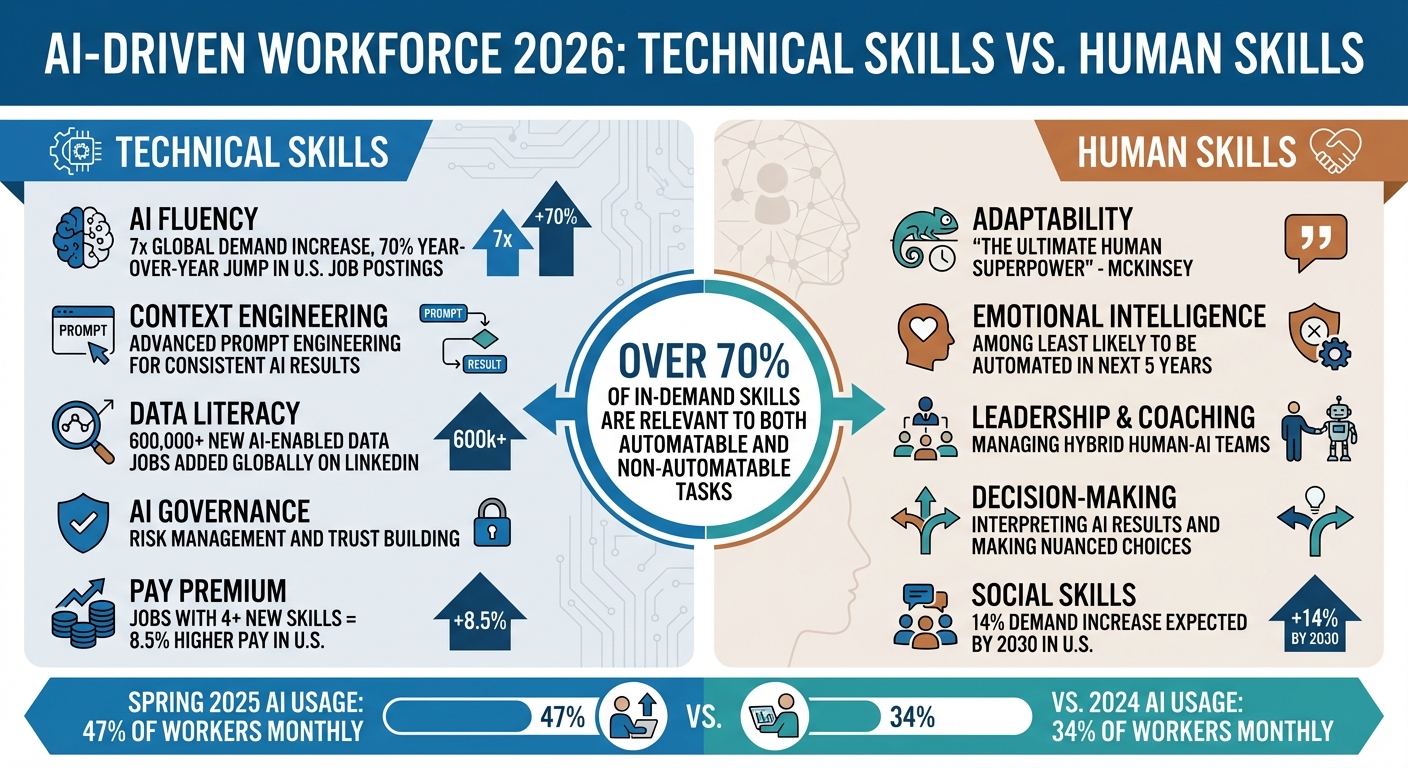
Essential Technical and Human Skills for AI-Driven Workforce in 2026
By 2026, the skills employers are looking for will fall into two main categories: technical abilities that allow seamless collaboration with AI and human-centric skills that AI can't replicate. Interestingly, over 70% of these skills are relevant to both automatable and non-automatable tasks. Understanding how to apply these skills in various contexts is becoming increasingly essential. Let’s break down the technical and human skills that are shaping the workforce of tomorrow.
Technical Skills Employers Want
AI fluency is quickly becoming a must-have for nearly every job. While you don’t need to be a coder, you do need to know how to effectively use and manage AI tools. The demand for this skill is skyrocketing, with a sevenfold increase globally and a 70% year-over-year jump in U.S. job postings.
A step beyond basic AI knowledge is context engineering, a refined version of prompt engineering. This skill involves crafting prompts that produce consistent and reliable results, even as AI models evolve. Another emerging area is supervising autonomous AI agents - where workers oversee digital systems executing complex workflows. Bekir Atahan, Vice President at Experis Services, explains:
"Humans are moving from operators to policy designers. And then the future of work is supervising intelligence, not producing an output".
Data literacy is another major player in the technical skillset. Employers are looking for professionals who can clean, validate, and analyze data using AI tools to generate actionable insights. In fact, over 600,000 new AI-enabled data-related jobs were added globally on LinkedIn in the past year alone. Plus, job postings that list four or more new skills often come with a pay premium of up to 8.5% in the U.S..
| Skill Category | Key Technical Competencies | 2026 Market Status |
|---|---|---|
| AI Literacy | Using GenAI tools (e.g., ChatGPT, Gemini), AI-powered workflows | Baseline Requirement |
| Engineering | AI Integration, Machine Learning Research, Data Annotation | High Growth / "New-Collar" |
| Data Management | Data Cleaning, Quality Assurance, AI Data Analysis | Critical for Decision-Making |
| Governance | AI Sovereignty, Risk Management, Trust Building | Emerging Leadership Priority |
| Prompting | Context Engineering, Predictive Prompt Design | Advanced Specialist Skill |
These technical skills are just one part of the equation. Equally important are the human abilities that complement and enhance AI-driven workflows.
Human Skills That Work With AI
While AI can handle repetitive data tasks and drafting, humans excel at asking the right questions, interpreting results, and making nuanced decisions. Skills that rely on real-time situational awareness - like a teacher gauging a student's engagement or a salesperson picking up on subtle client cues - remain outside AI’s capabilities.
Adaptability has been dubbed "the ultimate human superpower" by McKinsey Global Institute. As technology evolves rapidly, the ability to learn and pivot becomes crucial. Leadership roles are also changing, with managers now focusing more on coaching, influencing, and integrating teams of humans and AI systems.
The adoption of AI tools is accelerating. By Spring 2025, nearly 47% of workers reported using AI tools at least once a month, up from 34% in 2024. This highlights the growing importance of interpersonal skills like empathy, conflict resolution, and relationship-building. These abilities are among the least likely to be automated in the next five years. By 2030, demand for social and emotional skills is expected to rise by 14% in the U.S..
Skills for Specific Job Roles
AI-driven tools are reshaping job roles across industries. For example, the Mayo Clinic reported a 50% increase in its radiology staff since 2016 while deploying hundreds of AI models to assist with image analysis and improve efficiency. Radiologists are now focusing on complex decision-making and direct patient care rather than just reading scans.
In human resources, job postings mentioning AI grew by an astounding 419% between December 2022 and December 2024. HR professionals are shifting from routine administrative tasks to using analytics and managing hybrid teams of humans and AI. In one case, Salesforce’s "Career Connect AI" successfully matched an employee with no sales experience to a sales enablement role based on their change management skills.
Medical assistants saw an incredible 8,350% increase in AI-related job postings between 2018 and 2024. Meanwhile, customer service roles are evolving to focus on complex, emotionally charged issues. The trend is clear: AI handles the repetitive tasks, while humans tackle the nuanced and intricate challenges.
How to Find and Fix Your Skills Gaps
Compare Your Skills to Job Requirements
In today’s AI-driven job market, understanding what employers are looking for is step one. Resources like the Occupational Information Network (O*NET) and the Bureau of Labor Statistics (BLS) provide free databases that evaluate 35 skills and 41 work activities on a scale of 1 to 5 across hundreds of occupations. For instance, you can check BLS Table 6.2 to gauge how critical skills like "Critical thinking" or "Project management" are for your role, and then rate yourself using the same scale. This straightforward comparison helps you pinpoint areas for improvement.
Using AI in your job search and resume tools can simplify this process by scanning job postings, identifying key requirements, and flagging missing keywords. Alternatively, you can manually analyze job ads for your target positions to spot recurring technical and soft skills. This gives you a clearer picture of what’s in demand and where you might need to catch up.
Assess Both Technical and Soft Skills
Once you’ve compared your skills to job requirements, it’s time to dig deeper. Break your evaluation into four categories: Digital Skills (like AI fluency and data analysis), Specialized Professional Skills (specific to your industry), Generalized Professional Skills (such as project management and strategic planning), and Human Skills (like adaptability, leadership, and problem-solving). This comprehensive approach helps you understand your strengths and gaps.
Interestingly, 60% of employers now place more emphasis on soft skills than they did five years ago. As Nick van der Meulen, a research scientist at MIT CISR, notes:
"What makes you successful today won't make you successful three years, five years, or 10 years from now".
Consider which parts of your job could be automated and focus on developing skills that require empathy, judgment, or dexterity - areas where AI still lags behind. By targeting these skills, you’ll position yourself to succeed in a workplace reshaped by AI advancements.
sbb-itb-20a3bee
How to Upskill Using AI Tools
Upskilling Methods for AI-Driven Jobs
Blending learning with daily work is one of the most effective ways to upskill. AI-powered platforms like Degreed make this possible by embedding training into everyday tasks, allowing you to immediately apply what you learn. This hands-on approach often outperforms traditional training sessions because it integrates directly with real-world work scenarios.
Take Ericsson, for example. The company successfully trained 30,000 employees in artificial intelligence within a single year using the Degreed platform. TEKsystems also saw impressive results, cutting the time it takes for new hires to start generating revenue by four weeks while maintaining an 80% weekly engagement rate. Combining initial training with mentorship and hands-on practice is key. CMA CGM, a global shipping firm, exemplified this in 2025 when CEO Rodolphe Saadé joined AI training sessions alongside employees, fostering a culture of learning across departments and regions.
The demand for AI fluency - the ability to effectively use and manage AI tools - has grown sevenfold in just two years. Jobs in the United States requiring four or more new skills often come with an 8.5% pay increase. By leveraging tools and methods like these, professionals can stay ahead in an AI-driven job market.
Build Skills With Acedit
Acedit is another powerful tool for developing AI-related skills. This AI-powered Chrome extension offers real-time interview coaching by detecting questions during live interviews and suggesting tailored responses. It’s designed to sharpen both quick-thinking and communication skills, which are vital in today’s tech-driven workplace.
Acedit also helps you practice with personalized, AI-generated Q&A sessions tailored to specific job listings. This allows you to rehearse in a safe, low-pressure environment before tackling high-stakes interviews. Research shows that personalized learning journeys can increase AI adoption rates by as much as 20 times compared to generic training approaches. The platform’s AI-simulated interviews provide instant feedback, helping users build both confidence and skills faster.
Additional features like LinkedIn profile integration and AI-generated cover letter creation ensure your professional presence reflects your growing expertise. As Allison Bailey, a senior partner at BCG, puts it:
"Workforces are facing a skills gap where they're not using AI tools effectively in ways that both integrate into and transform their workflows".
Acedit also includes a Custom STAR Examples feature, which helps you structure your experiences using the Situation-Task-Action-Result framework. This not only boosts your technical AI fluency but also enhances critical human skills like problem framing and interpreting results.
Acedit Plans Compared
Acedit offers flexible pricing plans to suit different needs and stages of the job search process:
- Free Plan: Perfect for trying the platform, this plan includes 4 AI-generated practice Q&A sessions per job listing, 2 simulated practice interviews, and 2 cover letter generations.
- Premium Plan: For a one-time payment of $45, you get lifetime access with unlimited Q&A sessions, unlimited cover letters, 6 simulated interviews, and 3 AI-assisted live interviews for added preparation.
- Premium Plus Plan: At $75 (one-time), this plan offers unlimited access to all features, including AI-assisted interviews, practice sessions, and cover letter generation - ideal for those needing extensive support.
| Plan | Price | AI-Assisted Interviews | Practice Q&A | Simulated Interviews | Cover Letters |
|---|---|---|---|---|---|
| Free | $0 | Included | 4 per job listing | 2 | 2 |
| Premium | $45 (One-Time) | 3 | Unlimited | 6 | Unlimited |
| Premium Plus | $75 (One-Time) | Unlimited | Unlimited | Unlimited | Unlimited |
All plans include advanced AI response suggestions, LinkedIn profile integration, and the Custom STAR Examples feature. With a one-time payment structure and no recurring fees, Acedit offers an accessible way to bridge the skills gap in an AI-driven world. This is especially relevant as a staggering 98% of employees express interest in learning how to use generative AI effectively.
How to Stay Competitive Long-Term
Make Continuous Learning a Priority
McKinsey Senior Partner Lareina Yee put it perfectly:
"The speed of technological change will make adaptability the ultimate human superpower."
By spring 2025, nearly 47% of workers across all industries reported using AI tools at least once a month - up from 34% the year before. This rapid growth highlights one thing: staying competitive means embracing continuous learning.
But here’s the thing - AI fluency is now more valuable than just technical coding skills. In fact, demand for AI fluency has skyrocketed sevenfold in just two years, far outpacing the need for expertise in AI development. What does AI fluency mean? It’s about understanding how to guide AI systems, interpret their outputs, and apply human judgment where machines fall short. Workers who thrive in this environment are becoming "AI translators", bridging the gap between AI's capabilities and business needs.
At the same time, don’t overlook human skills that AI can’t replicate. While machines excel at routine tasks, employers increasingly value abilities like negotiation, coaching, empathy, and social-emotional insight. Surprisingly, over 70% of in-demand skills remain relevant in an AI-driven economy, though their applications may shift. And here’s a bonus: job postings that require even one new skill tend to offer 3% higher pay, while roles demanding four or more new skills can boost wages by 8.5% in the U.S..
Experimenting with AI tools regularly is another critical step. Nearly a quarter of workers now use these tools weekly to stay ahead. This hands-on experience not only sharpens your skills but also reduces the stress of feeling left behind. Dennis Stolle from the American Psychological Association captured this shift well:
"AI adoption isn't just creeping in, it's accelerating rapidly - and for nearly a quarter of workers, it's gone from an experiment to something that they're doing every single week".
As you build these skills, it’s equally important to think ahead about how evolving roles might impact your career trajectory.
Plan Ahead for Workforce Changes
AI is reshaping jobs across the board, but not all roles are affected in the same way. Start by categorizing your position into one of three types: "frontier" (brand-new AI-driven roles), "retooled" (existing roles that now require AI skills), or "legacy" (traditional roles less impacted by AI but potentially facing labor shortages). Most people won’t need to switch careers entirely but should focus on adapting their current roles to meet new demands.
This isn’t about mass unemployment; it’s about work evolving into a collaboration between humans, AI agents (software automation), and robots (physical automation).
To stay ahead, build a strong professional network - it can help you uncover hidden opportunities and refine your strategy for adapting to change. Earning validated skills certifications is another smart move, as employers increasingly prioritize verified expertise over general experience. For inspiration, look to countries like Finland, Denmark, and Ireland. These nations rank high on the "Skill Readiness Index" thanks to their heavy investment in lifelong learning programs, setting a global example for workforce adaptation.
Conclusion: Closing the Skills Gap
The skills gap is a challenge, but it’s one that can be overcome. AI fluency and human-centered skills aren’t opposites - they work hand in hand. While AI fluency is growing rapidly, over 70% of the skills employers prioritize today remain applicable across both automatable and non-automatable tasks. The key lies in how you apply them.
To bridge your own skills gap, focus on these steps: compare your current abilities to what employers are seeking, commit to continuous learning on the job, and make use of AI tools to enhance your capabilities. Platforms like Acedit can be especially helpful. They offer AI-driven simulations to prepare you for interviews, build confidence, and highlight your evolving skill set to potential employers. The goal is to balance your AI knowledge with human qualities like insight and empathy - this combination is what makes a strong, future-ready profile.
Success in today’s workplace means working alongside AI, using it to amplify your strengths while honing uniquely human abilities like critical thinking, empathy, and strategic decision-making. As Kristalina Georgieva, Managing Director of the IMF, aptly said:
"Success will hinge on bold steps taken now: investing in skills supporting workers through job transitions and keeping markets competitive so innovation benefits everyone".
Take a small step today. Try out one AI tool this week and track a tangible outcome, such as solving a practical business problem. Look for opportunities to practice - whether through an apprenticeship, a project focusing on specific skills, or a using AI for interview preparation on Acedit. Each action builds the adaptability you’ll need to thrive in an evolving workplace.
The future of work isn’t coming - it’s already here. The real question is: will you be ready when AI reshapes your role? These strategies can help you stay ahead and secure your place in an AI-driven world.
FAQs
What key skills should workers develop to thrive in an AI-driven job market?
To thrive in an AI-driven job market, workers need to focus on a blend of technical know-how, interpersonal skills, and a willingness to learn continuously. Having technical proficiency with AI tools is becoming increasingly important - knowing how to prompt, manage, and interpret these systems is now a key skill. At the same time, human-centered abilities like critical thinking, creativity, empathy, and problem-solving remain indispensable, as they enhance what AI can do.
Equally crucial is the ability to adapt and embrace lifelong learning, enabling workers to pick up new skills and collaborate effectively in AI-enabled workplaces. Strengthening communication and emotional intelligence is also vital, as these skills allow individuals to make thoughtful decisions and effectively guide AI systems. Platforms like Acedit can play a valuable role in this process, offering tools such as real-time interview coaching, AI-assisted cover letter writing, and tailored preparation for job seekers. These resources help workers stand out in the areas employers value most.
What steps can workers take to develop the skills needed to thrive in an AI-driven job market?
To thrive in an economy increasingly shaped by AI, it's essential to treat upskilling as a continuous journey rather than a one-off task. Begin by pinpointing the AI-related skills that align with your current job or future career aspirations. These might include prompt engineering, data visualization, or ethical AI. Once you’ve identified the gaps, focus on closing them through a mix of formal education - like online courses or certifications - and hands-on projects that let you apply AI tools in practical settings.
Take advantage of free or budget-friendly resources, such as online learning platforms or AI-powered tools, to speed up your progress. For example, tools like Acedit can support your growth by offering features like real-time interview coaching, customized Q&A prep, and tailored cover letters to showcase your expertise. Studies also highlight that workers who invest in AI-related training often experience tangible rewards, including higher salaries, making this effort a smart investment. By staying proactive and blending learning with real-world application, you can close the skills gap and position yourself for success in an AI-driven workplace.
How can workers balance AI-related technical skills with essential human skills?
Balancing AI expertise with essential human abilities is key to thriving in today’s evolving workplaces. While AI efficiently manages repetitive and data-intensive tasks, employees have the opportunity to shine in areas where machines fall short - like critical thinking, ethical decision-making, and building meaningful relationships. Success in this environment requires interpreting AI outputs, asking thoughtful questions, and clearly communicating insights.
Here are some practical ways to strengthen these skills:
- Practice regularly with AI tools and take time to reflect on how decisions are made and their broader impact.
- Join cross-functional projects to blend technical knowledge with effective communication and collaboration.
- Leverage platforms like Acedit to simulate interview scenarios that challenge both technical expertise and interpersonal skills.
- Embrace a growth mindset by staying open to feedback, updating your skills, and tackling new challenges with confidence.
By combining technical know-how with strong interpersonal abilities, workers can stay competitive and thrive in workplaces shaped by AI.