
In the AI era, success at work means blending technical knowledge with human strengths. AI is reshaping industries, automating tasks, and creating demand for new skills. Here's what you need to know:
- AI Fluency: Learn to use and manage AI tools effectively. Demand for this skill has surged sevenfold in job postings.
- Key Technical Skills: Basics of programming (Python, R), prompt engineering, and data analysis are essential for working with AI systems.
- Human Skills: Critical thinking, problem-solving, and ethical judgment are vital for evaluating AI outputs and addressing bias.
- Communication: Explain AI results clearly to non-technical audiences and collaborate in human-AI teams.
- Continuous Learning: Stay updated with tools like Acedit for skill-building. Employers increasingly value those who take charge of their learning.
AI isn't replacing humans - it’s changing how we work. The future belongs to those who combine technical skills with human insight to create value.
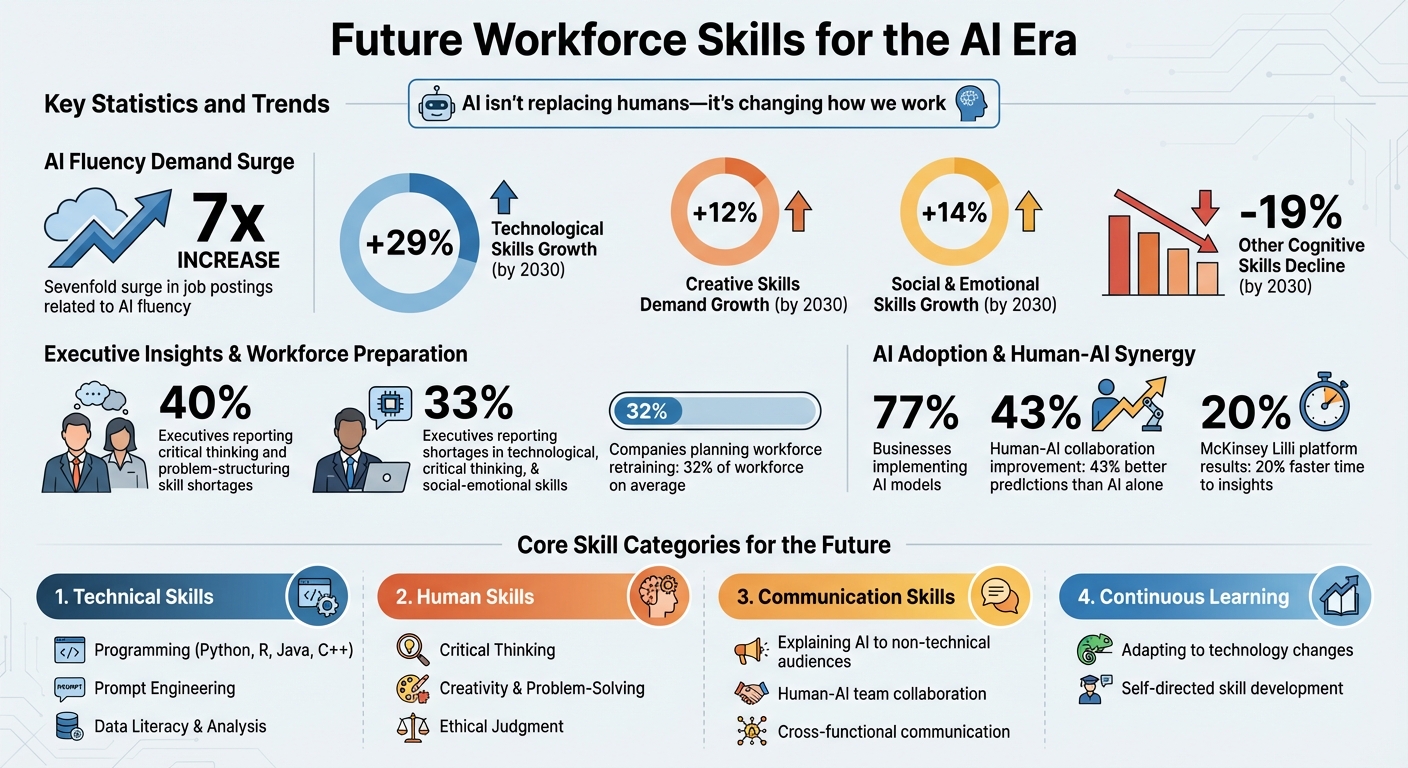
Essential AI Era Workforce Skills: Technical and Human Competencies Growth by 2030
The Skills That Will Keep You Relevant in the Age of AI (5, 10, 15 Year Career Plan)
Core Technical Skills for Working with AI
You don't need to be a computer scientist to thrive in the AI space, but having a solid grasp of some key technical skills is a game-changer. With technological skills in the U.S. expected to grow by 29% by 2030, and with many executives already highlighting shortages in advanced IT, programming, and data analysis skills, there's no better time to start building these abilities. Let’s dive into the essential skills that help you work effectively with AI.
Programming and Automation Basics
At the heart of many AI applications lies a basic understanding of coding. Familiarity with programming languages like Python, R, Java, and C++ can give you a solid foundation for understanding AI systems and automating routine tasks. Python, in particular, stands out for its simplicity and powerful frameworks like PyTorch, making it a go-to choice for many working in AI. While you don’t need to be an expert in every language, knowing how machine learning models work - and the math behind them - can be incredibly helpful.
Prompt Engineering for Generative AI
Prompt engineering is all about crafting clear and precise instructions to get the best results from AI systems. For example, research has shown that guiding AI with instructions like “think step by step” can significantly improve accuracy. This skill is valuable across a wide range of roles, from handling complex customer service issues to tackling advanced scientific problems. A strong grasp of data further enhances your ability to apply these techniques effectively.
Data Literacy and Analysis
Data is the backbone of AI. Being able to understand and analyze it is critical for improving AI outputs. In today’s world, data literacy isn’t optional - it’s essential for providing high-quality inputs to AI systems and making sense of their outputs. This skill allows you to identify trends, interpret results, and detect anomalies, which is vital in industries like healthcare, finance, manufacturing, and marketing. States like California and Michigan are already investing in AI and data literacy training to prepare their workforces for these demands. Building a strong local infrastructure that integrates data systems with digital-skills training is key to ensuring fair and widespread adoption of AI. The takeaway? Developing data literacy is no longer a bonus - it’s a necessity for success in the AI-driven workplace.
Human Skills That Complement AI Tools
AI excels at processing data and automating tasks, but human judgment remains irreplaceable. Knowing which human abilities matter most when collaborating with AI is crucial. These skills help ensure that AI outputs are evaluated effectively and used responsibly.
Critical Thinking and Evaluating AI Outputs
AI isn't perfect - it can make mistakes, produce biased results, or even "hallucinate" entirely false information. This is why critical thinking is indispensable when working with AI tools. As one member of Colorado Succeeds aptly said:
"We need people who know when the AI is hallucinating and how to dig deeper. Discernment is the skill that matters most".
Take the pharmaceuticals industry as an example. Generative AI tools have significantly reduced the time needed to draft clinical reports while improving accuracy. However, this success hinges on medical writers who guide and verify every step of the process.
McKinsey & Company experienced similar outcomes with their internal AI platform, Lilli, launched to 30,000 users in December 2025. By treating AI adoption as a leadership-driven transformation and encouraging critical engagement with AI outputs, they cut the time to insights by 20%. The key wasn’t just using AI - it was questioning, testing, and refining its results.
Experts call this combination of skills "discernment" and "analytical literacy" - the ability to evaluate AI outputs for accuracy, spot errors, and identify bias. However, many organizations face a gap in these skills. Around 40% of executives report a shortage of workers equipped with the critical thinking and problem-structuring abilities needed to work effectively with emerging technologies.
Creativity and Problem-Solving Beyond AI
AI might analyze data and automate tasks, but it struggles with context, ambiguity, and unconventional thinking. That’s where human creativity steps in - bridging the gaps by crafting innovative solutions and addressing complex, undefined problems.
In a study conducted in late 2024, researchers Philipp Schoenegger, Philip Tetlock, and their team paired human forecasters with GPT-4 assistants to predict financial and political events. The humans contributed probabilities, uncertainty ranges, and arguments for and against outcomes. The collaboration improved predictions by 43% compared to AI working alone. The human touch - creative reasoning and judgment - proved indispensable.
The demand for creative skills is on the rise. By 2030, it’s expected to grow by 12%, even as demand for other cognitive skills declines by 19%. Eric Hazan, Managing Partner at McKinsey & Company, emphasizes this point:
"We must get better at everything the computers struggle with, including understanding context, thinking outside the box, and managing relationships with other humans".
Interestingly, creativity doesn’t just complement AI - it can enhance it. In 2021, researchers at Google DeepMind discovered that teaching AI to approach problems step-by-step (a method called "least to most" reasoning) improved its accuracy from 16% to 99%. This breakthrough required human ingenuity to design and implement.
Understanding AI Ethics and Bias
While technical skills are crucial, ethical oversight ensures AI outputs are fair, responsible, and aligned with human values. AI lacks moral judgment, making human involvement essential to address issues like bias and privacy.
AI systems can unintentionally reflect biases from their training data or how they are used. Companies like Microsoft and Google have introduced features to detect harmful prompts and outputs, while Salesforce has designed AI systems to mask sensitive data and assess risks like toxicity and bias. However, technology alone can’t solve these challenges - human judgment is vital.
As regulations evolve, federal and state governments are working to establish frameworks to address bias and ensure output accuracy. Staying informed about these developments allows individuals to make ethical decisions that AI systems, lacking broader social or business context, cannot.
Dov Seidman, CEO of LRN, captures the essence of human responsibility in the AI era:
"Our highest self-conception needs to be redefined from 'I think, therefore I am' to 'I care, therefore I am; I hope, therefore I am; I imagine, therefore I am. I am ethical, therefore I am. I have a purpose, therefore I am. I pause and reflect, therefore I am".
Ultimately, ethical judgment steers AI toward serving humanity’s best interests.
sbb-itb-20a3bee
Communication and Teamwork Skills in an AI Workplace
Beyond technical know-how and human judgment, strong communication and teamwork are crucial to fully tapping into AI's capabilities. AI is reshaping how teams operate, requiring professionals to blend human insight with machine intelligence. As collaboration increasingly involves people, AI agents, and automated systems, communication skills are adapting to meet these new challenges.
Working in Human-AI Teams
Collaborating with AI goes far beyond simply operating software - it requires what experts refer to as "integrative skills" to merge human and machine efforts effectively. Three key abilities are critical here: intelligent interrogation (crafting the right questions for AI), judgment integration (assessing AI outputs), and reciprocal apprenticing (sharing expertise to improve AI performance).
The Mayo Clinic offers a compelling example of this collaboration. Since 2016, it has grown its radiology team by more than 50%, while also deploying hundreds of AI models for image analysis. AI handles routine image processing, freeing radiologists to focus on complex decision-making and patient care. This teamwork works because healthcare professionals clearly communicate what the AI should analyze and then use their expertise to interpret the results.
Even small adjustments in how we interact with AI can have a huge impact. For instance, adding phrases like "Let's think step by step" to instructions has been shown to triple output accuracy. In 2024, a study pairing human forecasters with GPT-4 assistants using detailed prompts found that their predictions about financial and political events were 43% more accurate than AI-generated predictions alone.
As organizations adopt flatter hierarchies and hybrid teams where senior talent collaborates directly with AI, the need for effective cross-functional communication grows. These internal communication skills are also essential for translating AI insights to broader, non-technical audiences.
Explaining AI Results to Non-Technical Audiences
Once internal teams are aligned, the next challenge is presenting AI insights to stakeholders who lack technical expertise. Whether you’re addressing executives, clients, or colleagues, explaining AI outputs requires a different approach than discussing algorithms with data scientists. With about 77% of businesses now implementing AI models, the ability to turn complex outputs into actionable insights is more important than ever.
Start by understanding your audience - their level of knowledge, their priorities, and how they prefer to receive information. For example, a CFO might focus on cost savings and risk mitigation, while a marketing director would be more interested in how AI predictions can improve campaign results.
Simplify without dumbing things down. Trade technical jargon for plain language and break complicated ideas into digestible parts. Instead of saying, "The model achieved 83% accuracy", you could explain, "About 5 out of 6 predictions were correct". Analogies can also help - for instance, compare machine learning to learning how to drive, where practice and feedback gradually improve performance.
Visual aids like charts, graphs, and infographics can make abstract ideas more relatable. Pairing these visuals with well-crafted narratives helps connect data to real-world business outcomes.
Diego Arnone, AI Evangelist and Marketing Specialist for Neodata, highlights the importance of this approach:
"Remember, the goal is not only to convey information but to inspire curiosity, collaboration, and, ultimately, action".
Building trust is another critical element. This means ensuring data accuracy, creating thorough documentation like user guides and FAQs, and establishing feedback loops so non-technical stakeholders can ask questions and deepen their understanding.
As demand for social and emotional skills rises - projected to increase by 14% in the U.S. by 2030 - professionals who can bridge the gap between AI systems and practical challenges will stand out. Translating AI's capabilities into solutions that address real-world problems proves far more valuable than focusing solely on technical details.
Lifelong Learning and Skill Development
In today's AI-driven world, keeping your skills sharp isn't just helpful - it’s essential. The real challenge lies in adapting what you know to fit new and evolving contexts.
Keeping Up with Technology Changes
Your current expertise still matters, but how you apply it is shifting as AI becomes more integrated into the workplace. For example, AI fluency - the ability to effectively use and manage AI tools - has grown sevenfold in just two years. This rapid growth makes one thing clear: knowing how to work alongside AI is no longer optional.
The pace of change has created a pressing need to upgrade skills. In the United States alone, demand for technological skills like advanced IT, programming, and data analysis could increase by 29% by 2030. But here’s the catch - technical know-how isn’t enough. Skills like empathy, interpersonal communication, and leadership are also expected to rise by 14% during the same period.
It’s not just individuals feeling the pressure; companies are too. About one-third of C-suite executives say their teams lack technological, critical thinking, and social-emotional skills. To address this, businesses plan to retrain an average of 32% of their workforce. However, waiting for your employer to step in might leave you behind. Professionals who take charge of their own learning will stand out as roles expand and entry-level expectations climb higher.
In this ever-changing environment, the smartest move is to embrace ongoing learning and actively develop your skill set.
Using Tools Like Acedit for Skill-Building
AI-powered learning tools are stepping up to help professionals build the skills that employers are looking for. Platforms like Acedit (https://acedit.ai) are a great example. This Chrome extension is designed to help you practice and refine your AI fluency, offering features like real-time interview coaching, personalized Q&A sessions, and AI-driven simulations.
Acedit connects with your LinkedIn profile to create tailored preparation materials for interviews. It even provides AI-generated suggestions during practice sessions, making it easier to articulate complex ideas to non-technical audiences. Whether you’re sharpening your communication skills or showcasing your ability to work with AI tools, Acedit provides a low-pressure environment to build confidence.
The platform offers a free plan with AI-assisted interviews and limited practice simulations. For those who want more, the Premium Plus plan costs $75 and includes unlimited access to all features. It’s a worthwhile investment in continuous learning - a necessity in a world where staying ahead means never stopping.
Conclusion: Building Your Skills for the AI Era
Thriving in the AI era requires blending technical know-how with creative and ethical human insight. It’s not a matter of picking between programming skills or emotional intelligence - it’s about combining them. To excel in an AI-driven workplace, you’ll need to pair proficiency with AI tools alongside critical thinking, innovation, and sound ethical judgment.
The future isn’t about competing with AI; it’s about collaborating with it. By leveraging your distinctly human abilities, you can focus on tasks that machines simply cannot replicate - those higher-value activities that require empathy, creativity, and nuanced decision-making.
This blend of skills, often referred to as "fusion skills", is becoming a cornerstone of the modern workforce. While many companies are investing in retraining programs, waiting for employer-led initiatives could leave you playing catch-up. Taking charge of your own learning journey is key.
Start now by building these fusion skills. Dive into online courses on Python or data analysis, and practice explaining technical concepts to non-experts - it’s a great way to sharpen both your communication and technical abilities. Don’t just accept AI outputs at face value; challenge them, verify their accuracy, and refine your understanding. Tools like Acedit can also support you in improving your communication and presentation skills, particularly in interview scenarios, helping you navigate the human-AI collaborative landscape with confidence.
The professionals who will stand out aren’t those with just technical expertise or strong interpersonal skills. Instead, they’ll be the ones who continuously learn, adapt, and blend both skill sets to deliver value that AI alone cannot achieve.
FAQs
What are fusion skills, and why are they essential in today's AI-driven workforce?
Fusion skills represent the ability to merge expertise in a specific domain - like healthcare, finance, or engineering - with a strong grasp of artificial intelligence concepts, tools, and ethical considerations. These skills include working with AI systems, interpreting the outputs of algorithms, and designing workflows that seamlessly blend human input with AI capabilities. Essentially, they act as a bridge between traditional industries and the rapidly evolving world of AI technologies.
As AI reshapes workplaces across the board, fusion skills are becoming more important than ever. They equip professionals to adapt to cutting-edge tools, take the lead on AI-driven projects, and collaborate effectively with intelligent systems. By developing these hybrid abilities, individuals can secure their careers, bring greater value to their roles, and help their organizations leverage AI for innovation and growth.
What are the best ways to build skills for the AI-driven workforce?
To excel in a workforce increasingly shaped by AI, it's crucial to focus on a balanced mix of technical skills, hands-on experience, and flexibility. Start by solidifying your understanding of math and statistics - these are the core building blocks of artificial intelligence. Then, dive into programming languages like Python and explore widely-used AI frameworks such as TensorFlow or PyTorch to build a solid technical base.
Put your skills to the test by working on practical projects. Whether it’s developing machine learning models, creating chatbots, or designing data analysis tools, these projects not only sharpen your abilities but also serve as a portfolio to showcase your expertise. Sharing your work on platforms like GitHub can make your skills visible to potential employers. You might also consider earning certifications or completing specialized AI courses to enhance your qualifications and stand out in a competitive job market.
Equally important are soft skills like critical thinking, teamwork, and adaptability. These human-centered abilities are essential for effectively collaborating with AI systems. Lastly, make it a habit to stay informed about the latest industry trends and advancements to keep your skills aligned with the demands of this fast-changing field.
Why is ethical decision-making important when working with AI systems?
Ethical decision-making plays a crucial role in how AI is developed and used. When done right, it ensures technology is applied responsibly and fairly. This is especially important in areas like hiring, healthcare, and finance, where AI systems can significantly impact people’s lives. If biases go unchecked or privacy is compromised, it can lead to harm and erode trust. Professionals with a strong sense of ethics can spot these risks early and take steps to ensure AI systems promote fairness and positive outcomes.
In today’s workplaces, where AI is increasingly integrated into operations, ethical practices aren’t just a nice-to-have - they’re a collective responsibility. Whether it’s during data collection or the deployment of AI tools, weaving ethical considerations into everyday processes helps organizations stay compliant with regulations, safeguard sensitive data, and maintain trust with both customers and the public. By prioritizing ethical decision-making, professionals are helping lay the groundwork for a future where AI is more transparent and trustworthy.