
A bad post, review spike, or false claim can spread before most teams see it. My take is simple: AI helps most with early warning, triage, and follow-up tracking, but people still need to make the call.
Here’s the article in plain English:
- AI watches for trouble at scale. It scans reviews, social posts, comments, and news far faster than a person can.
- It looks for three things first: tone, what side people are on, and what issue is driving the reaction.
- Spread matters as much as tone. A false story can move about 6x faster than the truth on X, which is why time matters.
- Fast signals matter. A sharp drop in sentiment, a burst of toxic replies, or reposts from large accounts can signal a crisis in 30 to 60 minutes.
- AI can help draft responses, but public replies still need human review. One study found AI-written crisis messages were seen as less fair and less believable than human-written ones.
- Recovery takes longer than detection. Containment may start in minutes. Repair can take weeks, months, or longer.
- This affects hiring too. About 43% of companies use social media to screen applicants, and around 39% to 40% of employers say online content has led them to reject candidates.
- For job seekers, the fix is basic but important: search your name, clean up public posts, keep LinkedIn aligned with your resume, and practice how you explain hard spots during interviews.
The big point: AI is good at spotting patterns and sorting risk. It is not good enough to act alone. I’d use it to flag issues, rank them, and track whether things are getting better or worse - then let a person decide what happens next.
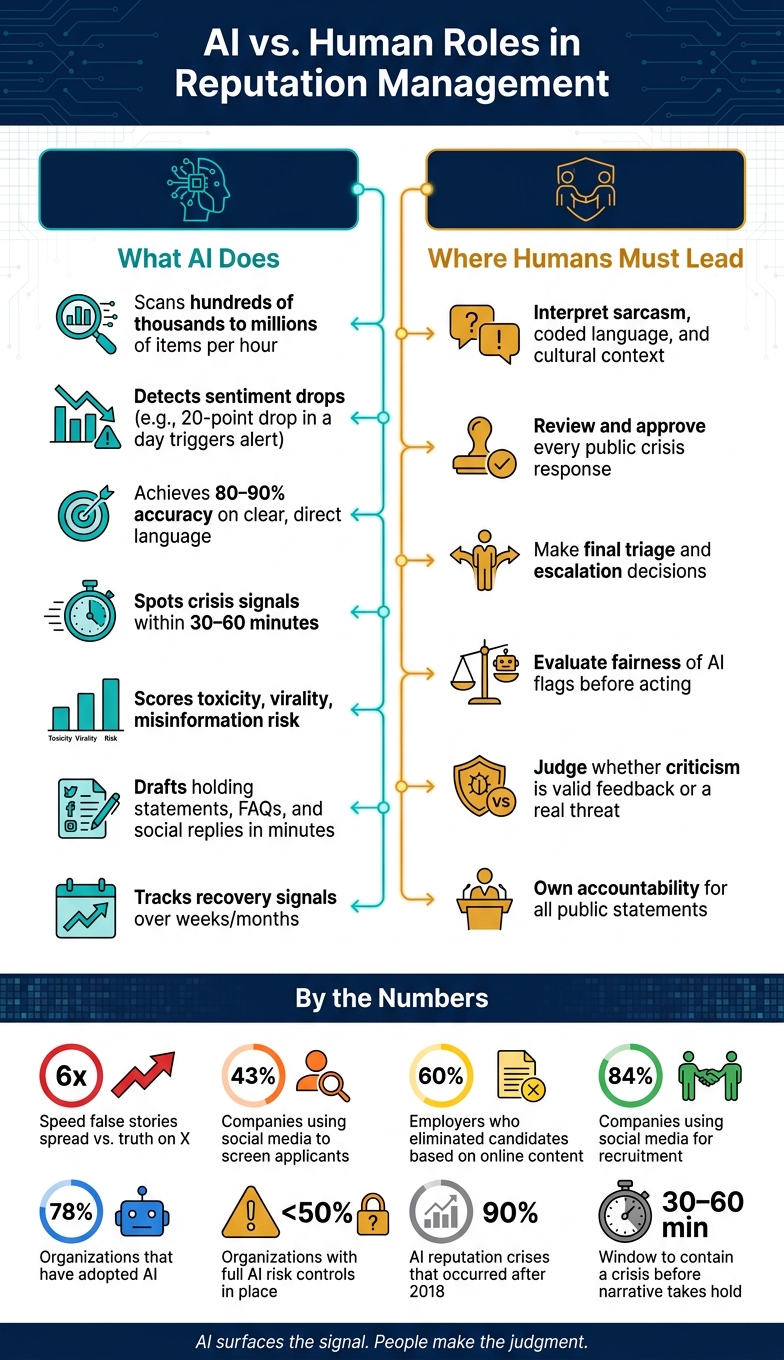
AI vs. Human Roles in Reputation Management: Key Stats & Capabilities
AI Reputation Attacks Are Destroying Businesses (5 Attack Patterns)
sbb-itb-20a3bee
How AI Detects Reputation Damage in Real Time
AI reputation systems can spot the first signs of a reputation shift before most people notice it. They scan posts, reviews, forum threads, news articles, and comments at scale, often processing hundreds of thousands to millions of items per hour. Manual monitoring usually catches only a small slice of that activity, and often not until a complaint or press inquiry shows up. That scale matters because early warning signs are often small, scattered, and easy to miss.
Sentiment, Stance, and Topic Signals
AI reputation monitoring works in three layers: it reads tone, figures out stance and topic, then checks how fast the issue is moving.
Sentiment analysis handles the first layer. It labels text as positive, neutral, or negative, then watches those scores over time. If negative mentions jump fast - for example, a 20-point drop in average sentiment in a single day - the system sends an alert. Transformer-based models trained on domain-specific data, such as product reviews or employer-review platforms, can hit 80% to 90% accuracy on clear, direct language. But there’s a catch: sarcasm, coded language, and mixed-sentiment posts still drag accuracy down.
Stance detection adds context. Instead of asking whether a post sounds negative, it asks whether the post supports, opposes, or stays neutral toward a specific person, brand, or claim. That sounds like a small shift, but it changes a lot. Someone can sound frustrated and still defend a brand. Someone else can sound calm while pushing a boycott. A plain sentiment model may rate both as negative. Stance detection separates loyal critics from active detractors, which helps a communications team decide what kind of response fits the moment.
Topic modeling answers the next question: what’s causing the backlash? Using clustering techniques, it groups incoming text into themes like billing errors, data privacy, or executive behavior. That gives teams a clearer view of the root issue instead of forcing them to react to a vague wave of negativity.
| Method | Data Input | What it catches | Typical Strengths | Key Limitations |
|---|---|---|---|---|
| Sentiment analysis | Reviews, posts, comments, articles | Broad negative tone, dissatisfaction, backlash | Fast, scalable, useful for trend detection | Misses context, sarcasm, and whether criticism is actually about the target |
| Stance detection | Targeted posts/comments about a person, brand, or claim | Support vs. opposition vs. neutrality | Better target specificity; helpful for issue-level reputation analysis | Requires a defined target; more complex than sentiment alone |
| Topic modeling | Large text corpora from social media/news | What issue is driving backlash | Improves interpretability and helps isolate root causes | Can be noisy on short texts; may blur overlapping issues |
| Rumor-propagation analysis | Posts plus replies, reposts, network links, user interaction patterns | False claims, coordinated spread, misinformation cascades | Detects spread dynamics, not just content; useful for crisis escalation | Hard in breaking news due to ambiguity, out-of-vocabulary terms, and overlapping topics |
Put together, these signals show more than the fact that attention is turning negative. They show why it’s happening.
Virality, Misinformation, and Toxicity Alerts
Tone by itself doesn’t tell the whole story. Spread patterns often show whether a problem is turning into a crisis.
Rumor-propagation analysis tracks how information moves through a network, not just what the post says. These models look at repost velocity, the number of unique users sharing a claim, and whether the spread is moving fast from a small cluster of accounts. That pattern often points to coordinated amplification instead of normal conversation. They also flag posts that match known misinformation patterns, such as sensational language, newly created accounts, and content that sharply diverges from verified sources.
Toxicity detectors add another signal by spotting harassment, slurs, and threatening language aimed at a brand or person. Spikes in toxic content often show up before larger pile-ons, which gives communications and safety teams time to step in before things get worse. These tools help, but they are far from perfect. Research keeps finding the same weak spots: they may over-flag reclaimed or in-group language and under-flag coded harassment. That’s why human review still matters for high-stakes calls.
Early-Warning Systems for Sudden Reputation Shifts
The strongest early-warning systems combine mention volume, sentiment drops, influencer reach, and sharing patterns into a composite risk score.
When several signals cross preset thresholds at the same time - like a jump in negative mentions, a steep sentiment drop, and amplification by high-follower accounts within the same hour - the system can trigger a response workflow on its own. Crisis-management research on airlines and consumer brands shows that spotting a surge within the first 30 to 60 minutes gives organizations enough time to issue clarifications or apologies before a negative narrative fully takes hold.
Volume plus worsening tone is a much stronger warning sign than either metric on its own. AI systems that run all the time can catch that mix the moment it forms. That’s what gives teams a window to triage, correct, and respond.
How AI Helps Contain Damage and Rebuild Trust
Once an alert goes off, AI helps teams sort the highest-risk items, send them to the right people, and watch whether the response shifts the conversation. The same setup also works for personal reputation management, where timing and accuracy can make all the difference.
From Monitoring to Triage and Response
AI can turn a flood of incoming mentions into a ranked response queue. It does that by scoring sentiment, toxicity, misinformation risk, and spread. Severity scoring looks at how fast something is spreading, how much reach the source has, the emotional tone, and the type of issue involved. Put together, those signals help teams focus on the conversations most likely to cause lasting reputation harm.
Once the queue is ranked, the next move is drafting the first response.
AI-Supported Crisis Messaging and Corrections
After the triage queue is set, generative AI can draft holding statements, social replies, FAQs, and internal talking points - often within minutes of a crisis being flagged. For misinformation, AI systems that spot false claims can also draft clarifications tied to the exact inaccuracy and point to verified sources. On employer-review platforms, AI can suggest empathetic, tailored replies that acknowledge concerns and invite offline resolution.
There’s a catch, though: human review is mandatory. A Syracuse University study found that AI-generated crisis messages were seen as less credible and less fair than human-authored ones. So yes, AI can help teams move fast. But every public response still needs human review, ownership, and approval.
Tracking Recovery After a Crisis
Containment happens right away. Recovery usually takes weeks or months.
After the first response goes live, AI tracks whether it’s helping by watching longer-term signals such as application volumes, offer acceptance rates, and employer review trends. Consulting analyses suggest that major corporate crises can take months or even years to fully repair, and only some affected organizations make it back to pre-crisis trust levels. That’s why monitoring can’t stop after the first wave passes.
The table below shows how AI methods, timelines, and expected results differ across these two phases.
| Tactic Type | AI Techniques Used | Response Time Horizon | Reported Outcomes |
|---|---|---|---|
| Damage containment | Real-time social listening, sentiment and toxicity detection, virality scoring, misinformation classifiers, automated triage dashboards, generative AI for drafts | Minutes to first alert; hours to initial public statement; 1–7 days of intensive monitoring | Faster crisis detection, reduced reach of false or toxic content, more timely first responses across channels. |
| Trust rebuilding | Longitudinal sentiment and topic modeling, employer review trends, AI-assisted content planning, engagement and trust-indicator tracking | Weeks to multi-month campaigns; sometimes 1–2 years for full recovery | Measurable sentiment improvement, stabilized review scores and application rates, improved brand favorability when actions match communicated commitments. |
For individuals, these same signals shape how employers and recruiters judge online credibility.
What the Research Means for Personal and Professional Reputation
The same AI signals now shape how recruiters read a candidate's digital footprint. In plain terms, you need to watch the same signals recruiters see first - often before an interview is set up, and sometimes before you even know you're being reviewed.
How Recruiters and Employers Read Digital Signals
SHRM data show that 84% of companies use social media for recruitment and 43% use it specifically to screen applicants. A Penn State-cited survey found that 60% of employers have eliminated candidates based on negative content they found online. That’s a big deal.
Recruiters aren’t just scanning for obvious warning signs. They also use posts and profiles to judge reliability, values, and fit - not just technical skills. An incomplete or outdated LinkedIn profile can work against you. So can posts that clash with claims on your resume. The same goes for content that points to poor judgment, like complaints about former employers, discriminatory remarks, or sharing confidential information. Even having no online presence at all can be a problem, since some recruiters may read that as limited transparency.
These signals matter a lot, even though they are not strong predictors of job performance. That gap matters. It means job seekers often have to manage digital signals that may be unfair, incomplete, or read too heavily. That’s why regular self-audits belong in interview prep.
Using AI to Align Online Presence With Interview Readiness
Once the public footprint is cleaned up, your interview answers need to line up with it. That’s where AI-powered tools like Acedit can help.
Acedit is a Chrome extension that connects with a candidate's LinkedIn profile. It reviews roles, skills, and accomplishments, then generates tailored interview questions and suggested responses based on that work history. The goal is simple: keep LinkedIn and interview answers in sync, including around gaps or past issues.
That can help with tricky moments. Instead of sounding defensive, candidates can practice talking about those parts of their history in terms of lessons learned and measurable improvement. Acedit’s real-time coaching and interview simulations also give feedback on tone, clarity, and structure, which can help users avoid vague or evasive wording.
A Simple Monitoring Process for Job Seekers
Managing personal reputation doesn’t require special tools. It does require consistency. A simple routine looks like this:
- Search your name. Run your name and common variations through major search engines to see what recruiters may find, including news mentions, social profiles, old blogs, and cached images.
- Audit public social content. Review public settings and content on Facebook, X, Instagram, and TikTok for posts, comments, or photos that suggest disrespect, discrimination, or poor judgment.
- Check LinkedIn for consistency. Make sure your work history, skills, summary, and featured work are current and match your resume and application materials.
- Decide what to fix versus what to explain. When possible, update privacy settings, delete or edit problematic content, and replace it with constructive, professional material. If something can’t be removed - like news articles or public threads - prepare a clear, accountable explanation for interviews.
- Use AI tools to rehearse sensitive topics. Acedit can generate practice questions based on your background, including prompts about gaps or past issues, so your spoken explanations match your online footprint.
Repeat this each month during an active job search. Even then, AI can still get context wrong, which is why the next section looks at its limits.
Limits, Risks, and Key Takeaways
Where AI Detection Can Misread the Situation
Those gains only matter if the system gets the call right. The biggest risk is simple: a false alarm or a missed signal.
AI reputation tools help, but they also have blind spots. Sarcasm is a big one. A post can sound harsh while defending someone. Or it can hide real abuse behind a joke. That means a tool might flag support as hostility while letting coded harassment slide by.
Cultural gaps make this harder. Most models are trained on English-language data from Western platforms, so they often miss regional slang, multilingual posts, and local context. Accuracy can drop even more when posts mix text with images or video, because models often miss what the visual piece adds.
The most costly mistake is treating fair criticism like a real threat. If a system leans too much on negative wording or charged terms, it can flag useful feedback about a product failure, a diversity issue, or an ethics complaint as a crisis event. That can push teams into public responses they didn't need to make. The safer move is to treat AI output as an alert for review, not as the final call.
How to Use AI Responsibly in Reputation Work
Once AI flags a risk, the next step is checking it before doing anything in public.
The clearest safeguard is keeping people in the loop. AI can flag and sort possible issues. Humans should decide whether action is needed and what that action should be. That's even more important for high-stakes moves, like issuing a public statement, sending a matter to legal, or rejecting a job candidate based on social content or AI-generated interview answers.
| Risk | Mitigation |
|---|---|
| Bias (skewed training data penalizing certain groups or viewpoints) | Periodic fairness audits, diverse training data, and human equity review before decisions |
| False positives (benign content flagged as a threat) | Calibrated alert thresholds, multi-signal scoring, and mandatory human confirmation before public action |
| Privacy concerns (over-collection of personal data) | Data minimization, strict access controls, and transparent notice about what is monitored and why |
| Lack of context (cultural norms, platform rules, relationship dynamics) | Human-in-the-loop review, documented escalation playbooks, and domain-specific guidelines |
A recent survey found that 78% of organizations have adopted AI, yet fewer than 50% have risk controls in place that cover the full picture. Governance doesn't have to be complex. It just has to be written down, clear, and followed.
Conclusion: What Recent Studies Consistently Show
Research on sentiment analysis, misinformation detection, crisis communication, and hiring keeps landing in the same place. AI spots emerging reputation threats faster than human teams working on their own. It also helps teams sort alerts by reach and severity, which makes crisis response more structured. And it can track whether recovery is holding over time.
At the same time, no model removes bias, false positives, or context gaps. An analysis of 106 AI failure cases found that privacy issues made up about 50% of AI-related reputation crises, while algorithmic bias accounted for around 30%. About 90% of those cases happened after 2018, as AI adoption sped up. That's a clear warning sign.
Use AI to monitor, prepare, and align your presence - but keep control of the response. Tools can show you what's surfacing and help you rehearse how to deal with it. The judgment still belongs to you.
AI surfaces the signal. People make the judgment.
FAQs
How accurate is AI at spotting reputation threats?
AI is very good at spotting reputation threats and behavior signals. In many cases, it does better than human reviewers. Studies show that advanced models can explain up to 91% of honest impression management and 84% of deceptive tactics.
It also performs well in emotion classification, reaching 96.78% accuracy on benchmark datasets. When you combine that with sentiment analysis and multimodal data processing, you get a precise, data-driven way to monitor and manage professional reputation.
When should humans step in during a reputation crisis?
People should step in when a reputation crisis needs high-stakes judgment, emotional nuance, or a personal touch that AI can't match.
AI can track negative sentiment and handle routine interactions. But people should take over sensitive communication, where tone, trust, and long-term professional relationships are on the line.
How can job seekers check their online reputation?
Search your full name in quotes, like "John Smith," on Google, Bing, and DuckDuckGo to find exact matches. After that, check image results, social media profiles, and niche sites tied to your field, such as GitHub or Google Scholar.
Put everything you find into a spreadsheet and tag each result as positive, neutral, or problematic. That gives you a simple way to see what’s helping, what’s harmless, and what may need attention.
You can also use AI-driven tools to monitor mentions, track sentiment trends, and see how your content performs over time.