
In 2026, switching careers is faster and more precise thanks to AI. By analyzing your work history, AI identifies transferable skills, highlights gaps, and creates a clear roadmap for transitions. Forget trial-and-error; today, AI tools map your abilities, match them with job requirements, and even guide you on upskilling.
Here’s what AI can do for your career shift:
- Analyze resumes, LinkedIn profiles, and performance reviews to extract detailed skills.
- Categorize skills into core, adjacent, and emerging for targeted growth.
- Compare your skillset with job descriptions to pinpoint missing qualifications.
- Recommend learning paths and estimate effort to close skill gaps (e.g., 30, 60, or 90 days).
- Help practice interviews using [AI-driven tools like Acedit for structured feedback](https://www.acedit.ai/features/ai-interview-simulation).
AI transforms career transitions into a data-driven process. It’s not just about identifying skills - it helps you plan, prepare, and present yourself confidently.
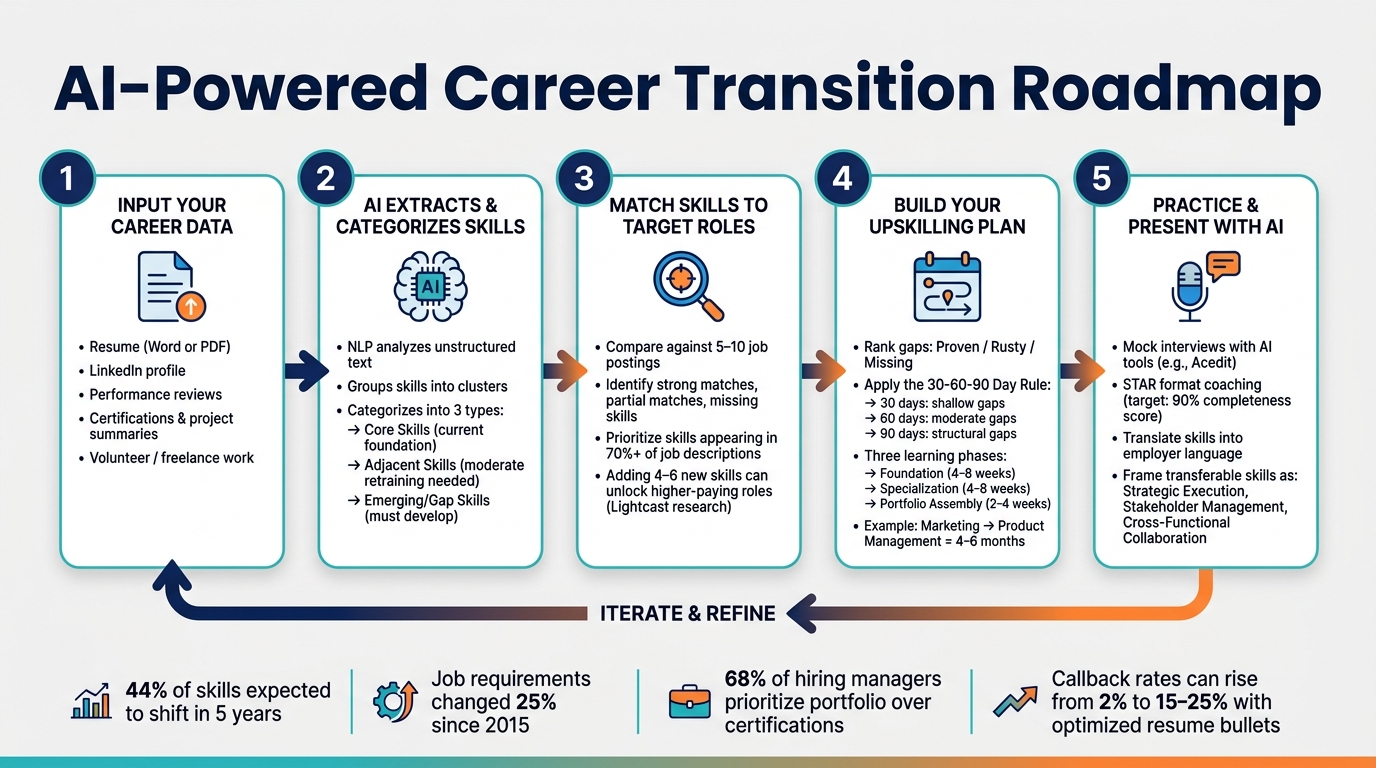
AI-Powered Career Transition Roadmap: From Skills Audit to Job Offer
The Simplest AI Career Pivot That Actually Works in 2026
This approach is a cornerstone of how to leverage AI for your job search effectively.
sbb-itb-20a3bee
How AI Reads and Evaluates Your Skills
Understanding how AI interprets your professional background can be a game-changer when planning your career. Instead of just scanning for keywords, AI dives deeper into your work history to uncover patterns of capabilities.
How AI Processes Your Career Data
AI relies on Natural Language Processing (NLP) to analyze unstructured text - like resumes, LinkedIn profiles, or performance reviews - and turns it into a structured inventory of skills. Essentially, it transforms your career story into a detailed skillset.
But it doesn’t stop at surface-level terms. AI refines broad skills into more specific ones. For instance, instead of simply noting "communication", it might identify "cross-functional alignment" or "strategic communication" - the kind of nuanced abilities employers value today.
"Employers... hire for patterns of capability. AI helps translate experience into those patterns." - WorkWithAI.expert
This process doesn’t just list your skills; it organizes them into clusters, revealing related abilities that might not be immediately obvious.
How AI Groups Skills From Job Titles
Rather than focusing solely on job titles, AI identifies clusters of related skills - like project coordination, stakeholder management, or data analysis. This is especially helpful because people with different titles often share overlapping abilities. For example, a healthcare project manager and a retail operations lead might both excel in workflow design, cross-functional coordination, and resource planning. This insight can make career moves across industries more accessible than they might initially seem.
Once these clusters are mapped, AI categorizes your abilities into core, adjacent, and emerging skills, creating a clearer roadmap for career transitions.
Core, Adjacent, and Emerging Skills: What AI Looks For
AI organizes your skills into three categories, each offering insights into your career potential and guiding your next steps for upskilling or transitioning: This data-driven approach is a core advantage when comparing AI interview preparation vs traditional methods.
| Skill Category | How AI Identifies It | What It Tells You |
|---|---|---|
| Core Skills | Skills consistently visible in your work history | Your current professional foundation |
| Adjacent Skills | Skills linked to roles you aspire to | Areas where moderate retraining can help |
| Emerging/Gap Skills | Skills missing for target roles | What you need to develop and how long it might take |
The gap analysis is especially useful. AI doesn’t just highlight missing skills - it ranks them by the effort required to close the gap. Some gaps are shallow, meaning they can be bridged in weeks with targeted learning. Others are structural, requiring months of experience or formal training. This breakdown helps you focus on the skills that will have the most impact.
How to Organize Your Career Information for AI Analysis
To make the most of AI's ability to analyze your skills and career trajectory, start by gathering well-structured and detailed inputs.
Documents and Inputs to Collect Before You Start
Begin by collecting key documents like your resume, LinkedIn profile, certifications, performance reviews, and summaries of past projects. These materials provide the foundation for AI to deliver accurate insights. Don’t overlook volunteer work, freelance projects, or completed courses that align with your career goals - these can add depth to your profile. Consider adding an "Evidence of Transition" section to your resume. This section might include side projects, online courses, or relevant volunteer roles, helping the AI understand your commitment to a new field.
Once you’ve assembled your documents, focus on presenting your achievements in a way that AI tools can easily interpret and quantify.
Rewrite Job Duties as Measurable Results
Avoid generic job descriptions that fail to highlight your contributions. Instead, reframe your duties to emphasize measurable outcomes.
Use industry-specific language to describe your achievements in terms of results. For instance, instead of saying, "managed a classroom of 30 students", try, "designed and delivered training programs to 30 learners, achieving an 85% success rate." This shift not only makes your work more compelling but can also boost callback rates from 2% to as high as 15–25%. A practical tip: use an AI tool to compare your current job bullets with a target job description. Ask it to rewrite your experience using the target industry’s language while preserving the original facts and figures.
Next, focus on accomplishments that demonstrate your ability to thrive across various industries.
Highlight Accomplishments That Cross Industry Lines
Prioritize achievements that showcase skills transferable to multiple fields. Focus on leadership, process improvement, collaboration across teams, or measurable results - these qualities resonate across industries. For example, a retail manager might say, "led a cross-functional team of 15, managing inventory across a 3-tier supply chain and achieving customer experience KPIs." This example highlights skills relevant to operations, logistics, or supply chain management.
Avoid vague buzzwords like "leveraged" or "spearheaded", as they can dilute the impact of your accomplishments and confuse AI tools. Keep your bullet points concise - ideally under 22 words - to ensure they’re easily processed by AI systems.
Using AI to Find Transferable Skills and Skill Gaps
Once your career information is neatly organized, AI can help you uncover both your transferable skills and the areas where you might need improvement.
Extract Skills From Your Resume and Online Profiles
Start by uploading your resume (in Word or PDF format) to an AI tool designed to extract skills. These tools don't just look at the "Skills" section of your resume - they analyze the entire document, including your job descriptions. For example, a bullet point like "Implemented automated reporting in Excel, reducing weekly report prep time by 30%" highlights skills in automation, process improvement, and data reporting, even if you didn’t explicitly list them.
After the AI generates your skills list, organize it into categories like technical skills, tools/software, soft skills, industry knowledge, and certifications. Then, compare your list with O*NET's occupation profiles (a free resource from the U.S. Department of Labor) to identify any important skills for your target role that might be missing. This comparison often uncovers gaps you weren’t aware of.
Match Your Skills to Target Job Descriptions
Gather 5–10 job postings for roles you’re aiming for, using major U.S. job boards. Upload these postings into an AI tool to compare them against your skills inventory. Try using a prompt like: "Compare my skills inventory to this job description. Identify strong matches, partial matches, and missing skills."
Ask the AI to sort skills into categories like required, preferred, or nice-to-have based on the language used in the job descriptions. Then, analyze all the postings together. Skills that frequently appear as "required" should be your priority. Research from Lightcast shows that adding just 4–6 new skills can help workers qualify for higher-paying roles, so identifying these patterns is worth the effort.
Fine-Tune AI-Generated Results
AI tools aren’t perfect, so it’s important to review the skills they pull. Sometimes, the tool might misinterpret a company name or use vague terms like "strategic thinker" that aren’t easy to back up in an interview. Remove anything you can’t confidently support with examples. This is especially critical when preparing for technical interviews where specific skill validation is required.
Additionally, make sure your skills are phrased in terms that U.S. employers use. For instance, if the AI lists "people leadership", check if job postings in your target field use terms like "team leadership" or "people management" instead. Adjust your skills inventory to match the language employers are likely to search for. This small tweak can make a big difference when your resume goes through an applicant tracking system (ATS). Use your refined skills list as the starting point for planning additional training or generating AI interview answers to practice your new career narrative.
Turning AI Findings Into an Upskilling Plan
Once you've built a clear skills inventory and identified your gaps, it's time to translate that insight into a practical plan.
Rank Skills by Impact and Effort
Not all skill gaps carry the same weight. Start by categorizing them into three groups: Proven, Rusty, and Missing. This helps you gauge how much effort and time might be needed to close each gap.
Focus on the skills that show up in more than 70% of job descriptions for your target role. These are often non-negotiable for hiring managers. Skills that appear less frequently can be addressed later. A handy guideline is the 30-60-90 day rule: use AI to estimate which gaps you can realistically fill in 30 days, and which might require 90 days or more of structured effort. For example, transitioning from Marketing to Product Management might take 4–6 months with an AI-driven roadmap.
Build a Personalized Learning Path
Divide your plan into three stages: Foundation, Specialization, and Portfolio Assembly.
- Foundation: Focus on closing key skill gaps within 4–8 weeks.
- Specialization: Tackle secondary or less urgent skills over the next 4–8 weeks.
- Portfolio Assembly: Spend 2–4 weeks creating polished work samples that showcase your abilities.
According to Glassdoor, 68% of hiring managers for entry-level technical roles prioritize portfolio projects over certifications for career changers. For every new skill you pick up, aim to create something tangible - like a dashboard, process doc, or case study - rather than just completing a course. Before investing time in any learning resource, check labor-market data to confirm the skill is in high demand. If it’s not among the top 10 skills for your target job, it might not be worth focusing on right now.
Once your learning path is in place, use AI tools to practice these skills and refine your interview techniques.
Use AI Tools to Practice and Get Feedback
Put your skills to the test in mock interviews. AI-powered tools like Acedit can help you practice role-specific interview questions and answers and provide real-time feedback. They even assess how well you structure your answers using the STAR format (Situation, Task, Action, Result). Aim for a STAR completeness score of 90% or higher before stepping into an actual interview.
If you're asked about a skill you're still working on, your AI-driven learning plan can become a strength. Explaining your 30-day strategy to close that gap shows hiring managers that you're proactive and self-aware. This kind of preparation doesn’t just keep your upskilling plan in the background - it transforms it into a key part of your career narrative.
How to Prepare for Skill-Based Interviews Using AI
Turn Your AI Skill Map Into a Career Story
Your AI skill map is more than just a list of abilities - it's the backbone of a career story that resonates with hiring managers. The trick is to move beyond job titles like "I was a teacher" and focus instead on transferable skills that employers value across industries. AI can help you translate industry-specific jargon into universally recognized competencies like Strategic Execution, Stakeholder Management, or Cross-Functional Collaboration.
For instance, instead of saying "handled angry parents", you might frame it as "managed complex stakeholder relationships and de-escalated high-stress conflicts." With AI, you can identify 15–20 key phrases from your target job descriptions and weave them seamlessly into your narrative. This isn't about cramming in keywords - it’s about aligning your language with the hiring team’s expectations.
If an interviewer points out a skill gap, briefly acknowledge it, pivot to a related strength you already excel in, and share a clear 30-day plan to address the gap. This approach highlights both your self-awareness and your proactive mindset - qualities that stand out to hiring managers. A well-constructed career story gives you the confidence to tackle skill-based interviews head-on. After crafting your story, use AI-powered tools to practice delivering it in realistic interview scenarios.
Practice Interviews With Acedit's AI Coaching
Having a polished career story is one thing. Delivering it effectively in an interview is where the real challenge lies. That’s where Acedit comes in. This AI-driven tool offers interview simulations tailored to specific roles, providing not only realistic questions but also real-time feedback on your responses. Its STAR coaching feature evaluates how well you structure your answers and even syncs with your LinkedIn profile to personalize questions based on your experience. This combination of targeted practice and STAR method scoring helps you refine your responses and track your progress toward a 90% STAR completeness score.
Start with a full mock interview to establish a baseline, then focus on daily practice with STAR-based answers. The goal? Consistently hit that 90% STAR completeness score before the actual interview.
Frame Your Skills to Match How Employers Hire Today
Once you've sharpened your interview delivery, the next step is to align your experience with modern hiring trends.
"In the 2026 economy, employers care less about your previous job title and more about your core competencies." - Anutio
Skills-based hiring is on the rise, with companies prioritizing demonstrated abilities over traditional career paths. This shift is a win for career changers - if you position your strengths the right way.
Instead of walking interviewers through your resume chronologically, kick off with a concise value statement. Highlight your top transferable skills and map them directly to the role’s key requirements. AI tools can help fine-tune this statement by analyzing your skill set against the job description, ensuring you emphasize the abilities that matter most. Even if your past industry doesn’t align perfectly, this approach shows employers how your skills fit their needs from the get-go.
Conclusion: Using AI to Move Your Career Forward
Changing careers used to feel like starting from scratch. Now, AI can turn your existing skills into a clear roadmap for what's next. It identifies your transferable skills, matches them to potential roles, and helps you bridge any gaps. The process works best as a cycle: input your career data, extract key skills, compare them to job descriptions, work on closing gaps, and practice interview prep questions until you're ready to shine.
Consider this: 44% of skills are expected to shift within the next five years, and job requirements have already changed by 25% since 2015. The pace of change is only accelerating. Having an AI-generated view of your current skills - and knowing where to grow - is no longer optional. It’s a practical edge.
AI acts as your co-pilot by spotting patterns, prioritizing what to focus on, and creating a 3–6 month upskilling plan. But the magic happens when you add your own judgment, context, and personal stories. Use AI’s insights as a foundation, then refine them to reflect your unique perspective and voice.
Once you have a clear skills map and an actionable learning plan, the next step is presenting yourself effectively. This means being able to talk about your skills as well as you’ve developed them. That’s where tools like Acedit come in. Acedit transforms your AI-generated skill map into tailored interview practice, STAR-structured responses, and customized cover letters that align with your goals. Its LinkedIn integration ensures your online presence tells the same story as your career shift.
Your career story is already written in your work history - AI just helps you refine and share it.
FAQs
What info should I provide an AI tool to map my skills accurately?
To get a precise assessment of your skills, provide details about your professional background. This includes your resume, LinkedIn profile, and a summary of your past work experience. For the best results, include job descriptions for the roles you're aiming for, so the AI can align your expertise with industry requirements.
Additionally, sharing your career goals, preferences, and specific details about companies you're interested in will enhance the analysis. Use Acedit to compile this information, helping you identify transferable skills and areas where you can grow.
How can I tell if a “missing skill” is quick to learn or a long-term gap?
AI tools help evaluate how well you can pick up new skills by analyzing your professional experience and how effectively you put knowledge into action. These tools monitor your progress, pinpoint areas where your proficiency is lacking, and offer constructive feedback. This makes it easier to distinguish between skills you can acquire quickly through upskilling and those that need more time and effort to develop - providing a clearer picture before making a career shift.
How do I turn an AI skills map into a strong interview story?
To build a compelling interview story using an AI-generated skills map, try frameworks like STAR (Situation, Task, Action, Result) or CAR (Challenge, Action, Result). Focus on showcasing transferable skills identified by the AI, and pair each skill with a measurable achievement - for example, cutting costs or successfully managing a team. Tools like Acedit can assist by offering personalized response templates, real-time coaching, and interview simulations to help you practice and deliver your answers confidently.