
AI tools are transforming how we understand hiring trends, helping job seekers time their applications more effectively. Here's what you need to know:
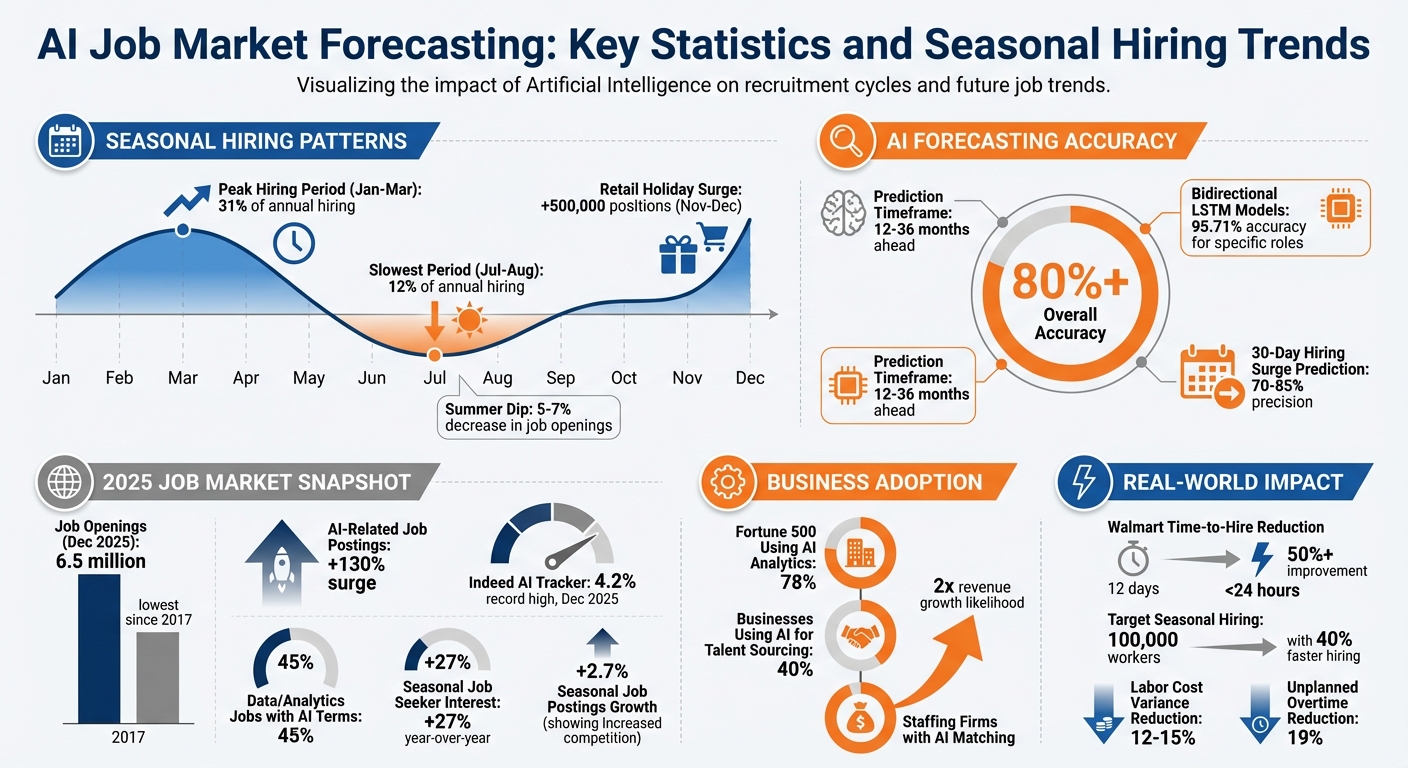
- Hiring Peaks: 31% of hiring happens from January to March, driven by new budgets and planning cycles. July and August see just 12%.
- AI Forecasting: By analyzing job postings, historical data, and economic indicators, AI predicts hiring volumes 12–36 months ahead with over 80% accuracy.
- Key Trends: In December 2025, job openings dropped to 6.5 million, the lowest since 2017, while AI-related job postings surged by 130%.
- Tools like Acedit: AI-powered platforms streamline job searches, create tailored cover letters, and improve interview prep with real-time coaching.
Timing matters. Focus on peak hiring periods and leverage AI insights to gain an edge in a competitive job market.
AI Job Market Forecasting: Key Statistics and Seasonal Hiring Trends
Data Sources AI Uses for Seasonal Forecasting
AI pulls together information from various sources to create a well-rounded picture for seasonal forecasting. By integrating historical employment data, real-time job postings, and broader economic indicators, these models can identify patterns and trends that shape the hiring landscape.
Historical Employment Data
One of the key elements AI relies on is historical data, often analyzing at least two years' worth of hiring records from Applicant Tracking Systems (ATS). This includes metrics like past staffing levels, time-to-fill rates, and hiring volumes. To put this into context, government labor data - such as statistics from the Bureau of Labor Statistics (BLS) - helps confirm broader trends. For example, retail jobs typically see a spike of 500,000 new positions during the holiday season in November and December. On the flip side, job openings often dip by 5–7% during the summer months.
AI also factors in industry-specific cycles, like academic calendars, agricultural seasons, and fiscal planning periods. The hiring rush in January, for instance, often follows end-of-year planning in Q4. Additionally, some platforms take anonymized ATS data from multiple companies to create detailed industry-level heat maps, offering a clearer view of hiring trends.
While historical data highlights long-term patterns, real-time job postings provide insight into current market dynamics.
Real-Time Job Posting Analysis
AI scans millions of job listings on platforms like Indeed, LinkedIn, and Glassdoor to monitor activity in real time. One metric it tracks is job posting velocity - the rate at which new listings appear. A sudden surge in postings can be a telltale sign of an upcoming hiring wave, often within the next 30–90 days.
Natural Language Processing (NLP) tools play a big role here, identifying trending keywords and certifications in job descriptions. For instance, by the end of 2025, there was a 130% jump in AI-related job postings, with Indeed’s AI Tracker hitting a record 4.2% in December 2025. Nearly 45% of all data and analytics job listings included AI-related terms.
"Hiring activity remains subdued... However, jobs with AI mentions are bucking the overall trend and are growing across many knowledge work occupations."
- Cory Stahle, Economist, Indeed Hiring Lab
Real-time data also uncovers sector-specific trends. In late 2025, job seeker interest in seasonal work rose by 27% year-over-year, but seasonal job postings only grew by 2.7%. This mismatch suggests increased competition for job seekers in seasonal roles. To stand out, many candidates are turning to AI interview simulations to refine their performance.
Economic and Industry-Specific Indicators
To refine its forecasts, AI incorporates broader economic and industry-specific signals. Metrics like GDP growth, unemployment rates, and changes in monetary policy help establish baseline hiring expectations. For instance, the Blue Chip consensus forecast predicts a 1.8% annual GDP growth for 2026, a figure AI uses to estimate overall hiring trends.
Policy changes also play a role. A $100,000 fee for new H-1B visa recipients, announced in September 2025, has impacted hiring in STEM fields. AI even taps into social listening, tracking phrases like "expanding team" or "opening new office" on platforms such as Reddit to anticipate regional hiring trends.
"78% of Fortune 500 companies now use AI-driven talent analytics to anticipate hiring needs before posting a single job ad."
sbb-itb-20a3bee
AI Algorithms Used in Job Market Prediction
After collecting data from various sources, AI leverages specific algorithms to transform that raw information into meaningful forecasts. These algorithms work together to uncover patterns, interpret text, and predict hiring trends with impressive accuracy.
Machine Learning Models
Machine learning algorithms are particularly effective at identifying patterns in hiring data that would be difficult - if not impossible - for humans to detect. For example, Bidirectional LSTM models analyze 24 months of historical job listings using auto-regressive prediction techniques, achieving up to 95.71% accuracy in forecasting trends for specific roles and technologies.
When it comes to time-series forecasting, algorithms like ARIMA (AutoRegressive Integrated Moving Average) and Prophet are used to predict job posting volumes over periods ranging from 12 to 36 months. These tools are especially useful for industries with seasonal hiring patterns, as they calculate a "seasonal coefficient" - a ratio of average monthly hiring volume to the annual average - to adjust forecasts for subtle month-to-month fluctuations, improving accuracy.
Unsupervised learning methods like clustering algorithms group similar job roles and skill sets, highlighting emerging career pathways and industry clusters. This approach helps job seekers identify transferable skills and potential career pivots. Additionally, real-time signal integration pulls in live data from job boards, social media, and funding announcements to predict hiring surges with 70–85% precision within a 30-day window.
Natural Language Processing (NLP)
NLP goes beyond simple keyword matching, capturing the nuances of language in job descriptions and market analyses. These algorithms extract details such as required skills, education, and professional experience, then categorize positions by title, seniority, and technical requirements. This reduces data complexity and enhances the accuracy of predictive models.
Advanced NLP models even analyze traits like cultural alignment and soft skills by examining the language used in candidate profiles and company descriptions. They also work to eliminate biased language in job postings, supporting more inclusive hiring practices. Tools like the Indeed Wage Tracker rely on NLP to monitor salary trends and determine which skills are gaining or losing value in the job market. For instance, as of September 2025, advertised wage growth had slowed to 2.5% year-over-year.
"NLP ensures the system understands the nuances of human language, making the matching process more accurate."
- Ross Geller, MokaHR
NLP also uncovers industry-specific insights. For example, healthcare accounted for 47.5% of all U.S. job growth during the first eight months of 2025. Additionally, 40% of businesses now use AI to source and engage talent, and staffing firms employing AI-driven matching are twice as likely to see revenue growth.
Predictive Analytics
Predictive analytics combines the pattern recognition of machine learning with the linguistic depth of NLP to forecast trends. By analyzing at least 24 months of hiring data, these models identify recurring cycles, enabling job seekers to strategically time their applications based on industry patterns.
AI also generates "heat maps" and probability scores for companies likely to start hiring within the next 30–90 days, giving job seekers a head start on opportunities before they are publicly advertised. These models track emerging versus declining skills, helping candidates focus on competencies that will be in demand during upcoming market shifts. For instance, while overall job postings were only 6% higher than 2020 levels by the end of 2025, postings mentioning AI skills had surged by more than 130%.
Additionally, predictive models incorporate non-traditional data sources like Google Trends, venture capital funding rounds, quarterly earnings, and social media activity to forecast hiring booms.
How to Build AI-Driven Seasonal Hiring Forecasts
Creating AI-driven hiring forecasts isn't just reserved for massive corporations. In fact, 78% of Fortune 500 companies already rely on AI-powered talent analytics to predict their hiring needs. By following a structured approach, organizations can better prepare for market changes and fine-tune their hiring strategies. The process involves three key phases: data collection and preparation, model training, and ongoing monitoring.
Data Collection and Preparation
Start by gathering 24–36 months of historical hiring data from your Applicant Tracking System (ATS). This timeframe helps identify true seasonal trends instead of one-off anomalies.
Next, combine this internal data with external sources like real-time job board feeds, government reports, and economic indicators. For instance, one case study showed a 40% improvement in forecast accuracy when external data, such as weather patterns, was included.
Cleaning your data is critical, especially if you're working with large datasets - think 100,000 samples or more. Address missing values, outliers, and inconsistencies, then use feature engineering to add seasonal markers. These markers might include fiscal calendars, graduation periods, or major holidays. You can also calculate a seasonal index by dividing the average hiring volume for a given month by the overall monthly average. For example, if January's index is 1.25, it indicates a 25% increase over the baseline forecast.
Once your data is clean and enriched, it's time to select the right algorithms to capture these trends.
Model Selection and Training
Your choice of algorithm depends on the complexity of your data. For steady seasonal patterns or holiday effects, traditional models like ARIMA or tools like Facebook Prophet work well. On the other hand, Random Forest handles outliers effectively, while LSTM Networks excel at tracking long-term dependencies.
Real-world examples show how impactful these models can be. A major retailer, for instance, used ensemble models to boost forecast accuracy and cut down on waste.
Interestingly, Boston Consulting Group found that the success of these initiatives depends 70% on people and processes, 20% on technology, and just 10% on algorithms. Starting small - say, with a pilot program in one department - can help build confidence before scaling up. Many companies now combine multiple AI techniques (ensemble modeling) to create more reliable forecasts.
Once your model is trained and tested, the next challenge is keeping it accurate over time.
Continuous Monitoring and Refinement
AI models need regular updates to stay relevant. Perform quarterly updates to account for emerging trends, such as the rise of remote work or economic shifts. Back-test your model against the previous year’s hiring data to fine-tune its accuracy. You can also validate forecasts by comparing them against external benchmarks, such as reports from the Bureau of Labor Statistics or SHRM.
In rapidly changing markets, consider refreshing forecasts weekly - or even daily - to react to sudden changes, like spikes in job postings or new funding announcements. Companies that invest in continuous updates have seen significant reductions in operational variances.
This ongoing refinement ensures your predictions stay aligned with market dynamics, helping you time your hiring efforts more effectively. It’s a process that ties directly back to the broader goal of staying ahead in the competitive hiring landscape.
Examples of Seasonal Job Market Predictions
AI-powered forecasting is already reshaping how businesses manage seasonal hiring spikes, and these examples showcase its real-world impact.
In 2023, Walmart revolutionized its hiring process by deploying AI recruiting tools across 4,600 U.S. stores. Thanks to automation, the company reduced the average time-to-hire for hourly roles from 12 days to under 24 hours for many candidates, cutting hiring times by more than 50%. Donna Morris, Walmart's Chief People Officer, highlighted the benefits:
"Automation helps us meet candidates where they are - on their phones - and move faster without sacrificing fairness or quality".
Similarly, Target adopted AI to handle its seasonal hiring surge that same year. Using Paradox's conversational AI assistant, the company successfully recruited 100,000 seasonal workers while reducing its time-to-hire by 40%. The AI system took care of repetitive tasks like verifying availability and work authorization, freeing recruiters to focus on interviews and evaluating candidates for team fit.
In the logistics sector, Amazon applied machine learning in 2025 to optimize warehouse staffing in key hubs such as Texas, Ohio, and Pennsylvania. By predicting shipping demands, the company balanced staffing levels to ensure on-time deliveries while avoiding the expense of overstaffing. Companies leveraging AI for forecasting achieved measurable benefits, including a 12–15% reduction in labor cost variance and a 19% decrease in unplanned overtime. These efficiencies highlight how AI can fine-tune staffing strategies in real time.
The demand for seasonal workers reflects these changes. Retail alone employed over 500,000 additional workers during the November–December holiday rush. Logistics roles, however, saw the sharpest growth in late 2025, with job postings for driving positions increasing by 153% and loading/stocking roles rising 49% year-over-year. This surge underscores the expanding influence of e-commerce and the heightened need for adaptable, short-term staffing solutions.
These examples reveal how AI is transforming seasonal labor planning from guesswork into precise, data-driven strategies. The result? Faster hiring, reduced costs, and smoother operations across industries like retail, logistics, and hospitality. For job seekers, recognizing these AI-driven trends can help in timing applications by staying informed on AI interview trends and preparing for technical interviews more effectively.
Using Acedit to Prepare for Seasonal Job Market Changes
Seasonal hiring can be a whirlwind, but Acedit steps in with AI-driven tools designed to help job seekers navigate these busy periods.
Acedit Features for Job Seekers
Acedit's Chrome extension connects effortlessly with platforms like LinkedIn, Indeed, Prosple, and Seek. It automatically identifies seasonal job openings, saving you hours of manual searching. Beyond that, the AI analyzes your resume and LinkedIn profile to create mock interview questions tailored to the industry and role you're pursuing.
When it’s time for virtual interviews on platforms like Zoom, Microsoft Teams, or Google Meet, Acedit listens in and provides real-time, on-screen response suggestions. This feature has earned a 92% relevance score, with 84% of users reporting improved interview performance. You can also upload your STAR (Situation, Task, Action, Result) examples, which the AI incorporates into customized responses, helping you articulate your achievements effectively. For high-volume application periods, the automated cover letter generator produces tailored cover letters in minutes, keeping you ahead of the competition.
How to Use Acedit for Seasonal Job Trends
To make the most of Acedit during peak hiring seasons, start by downloading the Chrome extension and syncing it with your preferred job boards. Timing matters - landscaping companies often recruit between February and March, while construction firms typically start hiring from March through early April for their busy season spanning April to October. Retail and logistics companies, on the other hand, begin their holiday season hiring as early as August. By inputting your STAR examples ahead of time, you can ensure Acedit fine-tunes these for specific roles.
Use the "Meeting" tab to practice mock interviews that align with the types of questions seasonal employers are likely to ask. Since 64% of seasonal workers apply outside standard business hours, Acedit’s flexibility lets you prepare whenever it suits your schedule. During actual interviews, the tool’s real-time coaching keeps you confident by suggesting optimal responses on-screen. With over 15,000 questions practiced on the platform and a 94% success rate, Acedit helps you stay sharp under pressure.
Acedit Pricing Plans Comparison
| Plan Name | Price | Features | Limitations |
|---|---|---|---|
| Free Plan | $0 | AI-Assisted Interviews, AI-Generated Practice Q&A (4 per job listing), AI-Simulated Practice Interview (2), AI Cover Letter Generation (2), Advanced Response Suggestions, LinkedIn Profile Integration, Custom STAR Examples | Limited Q&A and interview simulations |
| Premium | $45 (One-Time) | AI-Assisted Interviews (3), Unlimited AI-Generated Practice Q&A, AI-Simulated Practice Interview (6), Unlimited AI Cover Letter Generation, Advanced Response Suggestions, LinkedIn Profile Integration, Custom STAR Examples | Limited interviews and simulations |
| Premium Plus | $75 (One-Time) | Unlimited AI-Assisted Interviews, Unlimited AI-Generated Practice Q&A, Unlimited AI-Simulated Practice Interview, Unlimited AI Cover Letter Generation, Advanced Response Suggestions, LinkedIn Profile Integration, Custom STAR Examples | None |
For job seekers aiming to secure multiple seasonal roles, the Premium Plus plan offers the most flexibility. With job searches projected to increase by 31% in early 2026 compared to late 2025, having unlimited access to practice interviews and Q&A sessions can give you a competitive edge. Employers often use AI to sift through hundreds of applications in minutes, so being well-prepared is crucial. All plans support LinkedIn integration and run smoothly on any device with Google Chrome.
Conclusion
Advancements in AI have reshaped how seasonal job trends are forecasted, turning it into a precise, data-driven process. By tapping into historical hiring patterns, real-time job postings, and economic indicators, AI models can now predict trends with over 80% accuracy for the year ahead.
For job seekers, understanding these patterns can be a game-changer. For example, the first quarter alone accounts for nearly one-third of annual hiring activity. Additionally, focusing on quieter hiring periods, like March and November, can help your application stand out when competition is lower.
Predictive career planning is another powerful tool. Take Maya, a marketing professional, as an example. In 2025, she used AI-driven career tools to spot a 45% increase in relevant job postings over the year. By addressing skill gaps in Python and data modeling, she boosted her interview callback rate from 8% to 32% and landed a job with a 20% salary increase in just four weeks.
Maya's story underscores the benefits of predictive career planning. Tools like Acedit make this process even smoother by offering real-time coaching, automated cover letter creation, LinkedIn integration, and personalized STAR examples - all designed to help you seize seasonal opportunities. It’s no wonder 78% of Fortune 500 companies now rely on AI-driven talent analytics.
Whether you're targeting the hiring surge during Q1 tech budget approvals or the retail boom from October to December, timing and interview preparation are everything. AI insights can guide you on when to ramp up applications and when to focus on learning new skills during slower periods. The job market follows predictable rhythms - your ability to turn those rhythms into opportunities is what sets you apart.
FAQs
How reliable are AI hiring forecasts?
AI-based hiring predictions aren't entirely dependable because there isn't much independent proof that they surpass traditional assessment methods in terms of accuracy or their ability to predict outcomes. While these tools can provide helpful insights, job seekers should treat them as just one part of their job search strategy - not the ultimate answer.
What signals predict a hiring surge next?
A key indicator of a potential hiring boom is an increase in job postings that reference AI, especially in sectors like healthcare and finance. Alongside this, there’s a noticeable uptick in the demand for AI-focused skills, including data engineering and natural language processing. Interestingly, this demand persists even when general hiring trends are stagnant or on the decline.
How can I use Acedit during peak hiring?
During busy hiring periods, Acedit makes interview prep easier with features like real-time coaching, AI-powered practice sessions, and instant feedback. These tools help you save time by offering efficient practice and skill-building, even when you're juggling multiple applications. With Acedit, you can engage in quick, realistic simulations and evaluations, giving you the confidence and readiness to stand out in interviews and land the job.