
Most STAR answers miss on three points: clear action, clear ownership, and clear results. I’d use AI mock interview data to spot those gaps fast - then fix them with short, direct edits.
Here’s the core idea in plain English:
- Structured interviews score your answer in parts, not just on how smooth you sound.
- STAR works best when Action and Result do most of the work.
- AI mock interview data shows what’s missing, like:
- no Result section
- too much setup
- too many “we” statements
- no numbers
- high filler-word use
- Practice with feedback beats practice alone.
- Tools like Acedit can help you rehearse, track patterns, and tighten weak answers before a live interview.
A few numbers stand out:
- Structured interviews predict job performance better than unstructured ones, with validity around 0.42–0.51 in one set of findings.
- A common STAR pacing guide is 15% Situation, 10% Task, 50% Action, 25% Result.
- In one filler-word study of 16,928 interview answers, the median was 2.10 fillers per 100 words.
- In one mock interview program, confidence shifted from 64% moderately confident before to 64% confident or very confident after.
If I were using this article as a guide, my checklist would be simple: review sample answers, show what I did, add numbers, and cut extra setup. That’s the whole playbook.
The rest of the article explains how those signals show up in mock interview reports and how to use them to rewrite weak STAR answers.
Research summary: Structured interviews, mock practice, and AI feedback
What studies say about structured behavioral interviews
Structured behavioral interviews use the same questions and scoring rules across candidates. That makes STAR answers much easier to judge for situation, task, action, and result.
The research here is pretty strong. Meta-analyses show validity from 0.44 to 0.70 for structured formats, with rater agreement at .92 versus .84 for unstructured interviews. More structure also improves consistency in hiring decisions and supports better equity across candidates.
That matters for mock interviews too. If the interview format is clear, feedback has something concrete to measure instead of drifting into vague advice.
What studies say about mock interviews and coaching
Practice helps. But practice with feedback helps more.
Research found that higher levels of feedback led to higher interview ratings and better performance than practice alone. A dissertation found much the same thing: there was little sign that practice without coaching led to meaningful improvement.
One Northwestern assessment showed a clear shift in confidence. Before the mock interview, 64% of participants said they were moderately confident. Afterward, 64% said they were confident or very confident, with an average increase of 0.77 points per participant. When confidence goes up, candidates often give clearer STAR details and speak with more ownership.
That’s where repeatable feedback starts to matter.
How AI feedback fits into interview coaching research
AI-based mock interview systems use the same coaching ideas: standardization, structured feedback, and repeated practice. A 2022–2025 literature review on AI-based mock interviews found that these systems significantly improve interview preparation, including communication, confidence, and readiness.
The big upside is consistency. An AI tool can apply the same scoring criteria every time, across every session. That mirrors what structured interview research has linked to better outcomes for years.
AI also helps spot patterns over time. Say a candidate keeps leaving out quantified results in leadership examples. Or filler words jump from one session to the next whenever the story gets more complex. A person might catch that once. An AI system can track it session after session.
That turns one-off feedback into a trend line. And that’s what makes it useful for finding recurring STAR weak spots before they show up in a live interview.
sbb-itb-20a3bee
This AI Scores Your STAR Answer in 30 Seconds #starinterview #jobinterview
Common STAR answer problems and the data that reveals them
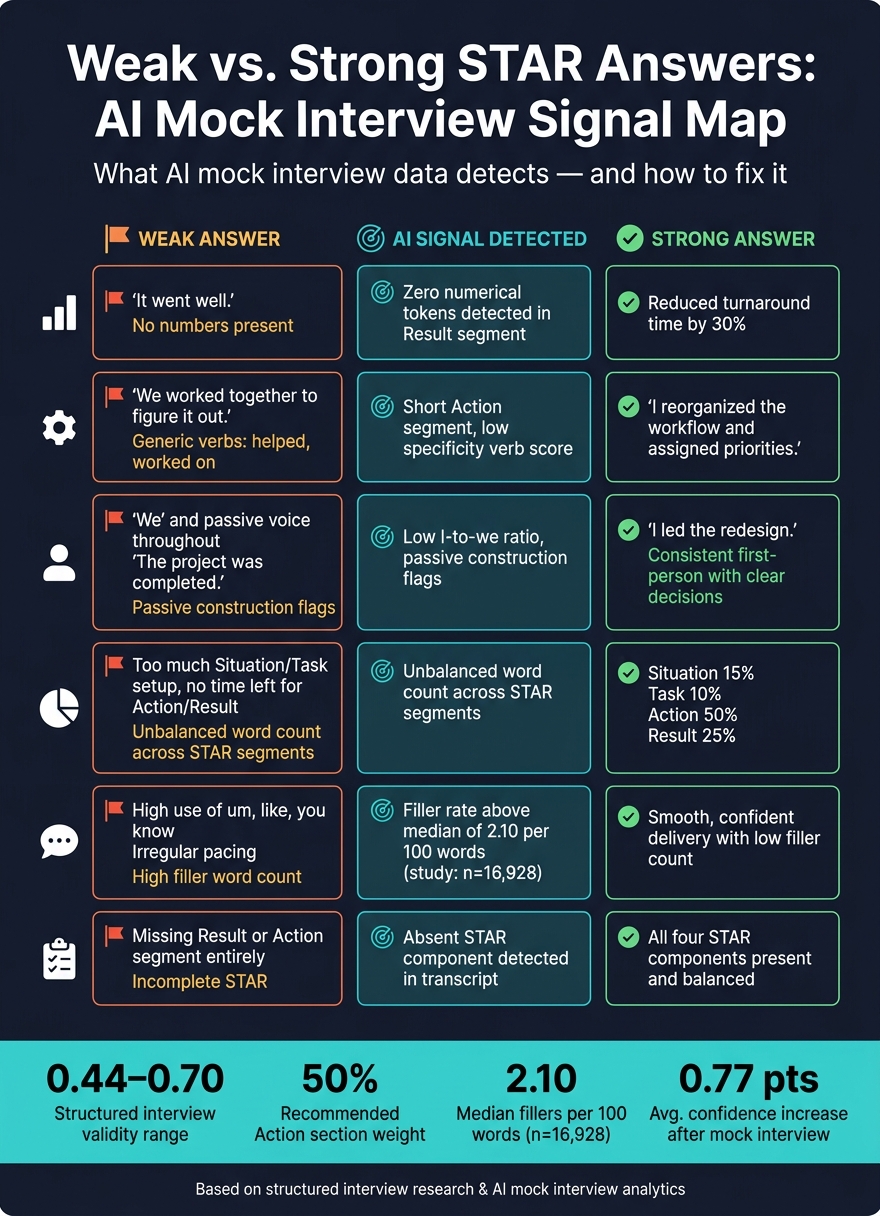
Weak vs. Strong STAR Answers: AI Mock Interview Signal Map
Missing results, vague actions, and weak ownership
AI mock interview reports often flag the same four STAR issues: missing results, vague actions, weak ownership, and poor structure.
These problems aren’t just a gut feeling. They show up in transcript-level signals.
For example, a low I-to-we ratio in the Action section can mean the candidate is talking about team effort without making their own role clear. Passive phrasing does the same thing. Saying “the project was completed” lands very differently from “I led the redesign.” One sounds distant. The other shows accountability.
Missing numbers are another plain warning sign. If the Result section doesn’t include percentages, dollar amounts, or time savings, the outcome can feel too soft for a U.S. hiring audience that expects measurable impact. When those details are missing, perceived impact, accountability, and clarity all take a hit.
These issues also show up in transcript and timing data.
| STAR Component | Weak Answer | Strong Answer |
|---|---|---|
| Situation | "We had a deadline issue, so I helped out." | "Our team was at risk of missing a client deadline." |
| Task | "I was supposed to help fix it." | "I was responsible for restructuring the workflow to recover the timeline." |
| Action | "We worked together to figure it out." | "I reorganized the workflow and assigned priorities." |
| Result | "It went well." | "We delivered on time and reduced turnaround time by 30%." |
| Ownership | "We" and passive voice throughout | "I" used consistently with clear personal decisions |
| Quantification | No numbers present | Specific percentage or business metric included |
Poor structure: too much context, not enough impact
Another common issue is structure. Many candidates spend too much time setting up the background. They use most of the answer on the Situation and Task, then run short on time before they get to the Action or Result, which is where the answer usually earns its weight.
U.S. career centers recommend a rough split of Situation 15%, Task 10%, Action 50%, Result 25%. AI mock interview reports can measure word-count balance across each part and flag when Situation and Task take over the transcript. That matters because Action and Result usually carry the most interview value.
How mock interview reports turn problems into fixable signals
This is where AI analytics helps most. It turns fuzzy feedback into something you can revise line by line. Each STAR weakness maps to a signal the system can detect and to a skill the interviewer is judging.
| STAR Weakness | AI Signal | Interview Competency Affected |
|---|---|---|
| Missing result | No quantified outcome, zero numerical tokens | Impact orientation, business awareness |
| Vague action | Short Action segment, generic verbs ("helped", "worked on") | Problem-solving clarity, execution |
| Weak ownership | Low "I" usage, passive constructions | Accountability, leadership potential |
| Poor structure | Unbalanced word count, absent STAR components | Communication, conciseness |
| Filler words | High "um/like/you know" count, irregular pacing | Confidence, preparation |
| Answer completeness | Missing Result or Action segment entirely | Storytelling, follow-through |
The key is to treat these signals as diagnostics, not verdicts. A low “I” count might come from a team-based project. Even then, the candidate still has to spell out what they did.
Once that pattern shows up in the report, revision gets much easier: tighten the weakest part first, then rebuild the answer around it.
Using AI mock interview data to strengthen STAR answers with Acedit
Once mock interview data shows which part of your STAR answer is falling flat, Acedit helps you work on that exact gap.
How Acedit supports STAR-focused practice
Acedit is a Chrome extension for live video interviews that detects questions, transcribes responses, and shows tailored suggestions in real time.
Where it helps most with STAR is personalization. Acedit uses your resume and LinkedIn profile to generate behavioral questions and suggested answers based on your own work history and the role you’re aiming for. So your STAR examples aren’t generic. They’re tied to your actual projects, job titles, and timelines.
Before a live interview, you can also run AI-simulated practice sessions and save STAR examples. These mock sessions can show weak parts in your STAR responses, which gives you a chance to fix them before the real conversation.
Which Acedit features address common STAR weaknesses
Each common STAR issue lines up with a specific Acedit feature:
| STAR Weakness | Acedit Feature | How It Helps |
|---|---|---|
| Missing results | LinkedIn profile integration | Brings forward quantified achievements |
| Vague actions | Advanced AI Response Suggestions | Shows more action-focused phrasing based on your role and the job description |
| Weak ownership | Custom STAR examples | Lets you pre-write first-person STAR stories tied to your own decisions |
| Poor structure | AI-simulated practice interviews | Spots uneven answers across sessions |
| Weak delivery | Real-time question detection + answer overlay | Helps you stay structured during live calls |
Acedit plan options and mock interview practice depth
Acedit has free and paid plans, and the main difference is how many simulations you can run. Research found that candidates who completed two or more mock sessions performed better in real interviews, with recorded gains in confidence and communication. More mock sessions mean more chances to revise - and more chances to fix specific STAR issues before the live interview.
Conclusion: Turn interview feedback into better STAR performance
Key takeaways from the research and data mapping
When the data shows where STAR answers fall apart, the next move is simple: revise the answer.
Structured interviews reward clear ownership and results-focused responses. So when a STAR answer is weak, candidates usually pay for it more.
AI mock interview data gives you something more useful than vague advice. It shows clear signals like result strength, action balance, and ownership language - the same three areas covered in the earlier signal map.
Use the report like a revision checklist. Look at the data, fix the weakest part of the STAR answer, then test it again. Research shows that targeted, behavior-specific feedback leads to better outcomes than unguided repetition alone.
Acedit fits neatly into this process by making each practice round measurable. It supports the loop with simulations, real-time suggestions, and personalized STAR examples.
Weak STAR answers are a data problem: spot the gap, rewrite the answer, and practice again.
FAQs
How do I know if my STAR answer is too vague?
Your STAR answer can fall flat if the Situation and Task eat up more than 30% of the response. When that happens, the setup takes over, and your main point gets lost.
Another common issue: weak detail in Action and missing numbers in Result.
For example, saying “I did research” is too broad. It doesn’t show how you worked or what you owned. Be specific about the tools you used, the steps you took, and your direct role.
And if you skip measurable results, the answer feels unfinished. Whenever you can, include numbers, time saved, revenue gained, error reduction, or any other clear outcome.
What metrics should I include in a STAR result?
Focus on outcomes you can point to. Show the impact you made with clear results whenever you can.
That usually means adding numbers like percentages, U.S. dollar amounts, time saved, or gains in efficiency. For example, you might mention a 20% productivity boost, $50,000 in annual cost savings, or a 35% drop in processing time.
If you don’t have exact figures, that’s okay. You can still show the result with details like positive feedback from a supervisor, restored trust with stakeholders, or lessons from the experience that led to better work later on.
How many mock interviews should I do before a real one?
Do enough mock interviews that your STAR delivery feels automatic. The goal is simple: smooth out your answers and fix any weak spots, especially missing actions or fuzzy results.
Acedit recommends practicing on a steady schedule with AI-simulated interviews. Free users get 2 practice simulations, Premium users get 6, and Premium Plus users get unlimited.
Pick the plan that gives you enough room to tighten your structure and nail your timing.