
Your skills deserve to be recognized - but fragmented systems often hold you back. Open standards fix this by enabling seamless sharing of verified credentials across platforms. Here's why it matters:
- 72% of organizations struggle to handle digital credentials, yet 91% of employers want verified ones.
- Without open standards, 60% of credential exchanges rely on time-consuming manual processes.
- Open standards ensure your credentials are portable, tamper-proof, and easily verified - saving time and boosting trust. You can also explore ways to use AI in your job search to further accelerate your progress.
The Career Growth Problem with Fragmented Skill Data
How Fragmented Skill Assessment Systems Work Against You
Your professional history is likely scattered across multiple platforms. Certifications might live on one site, course completions on another, and your work history somewhere else entirely. This disconnection doesn’t just create inconvenience - it actively holds you back.
Consider this: 60% of organizations report that inconsistent data models across platforms block the sharing of qualifications. On top of that, 56% cite the lack of agreed-upon APIs as a major barrier to getting skill data where it needs to go.
"Digital credentials are being issued at an unprecedented scale, while the infrastructure to move them into workforce systems is still developing." - Curtiss Barnes, CEO, 1EdTech
Because these systems don’t communicate effectively, you’re often stuck with manual processes to verify and share your qualifications. It’s a time drain that could be avoided with better integration.
How Fragmented Data Slows Career Progression
This fragmentation doesn’t just complicate data sharing - it impacts your career growth directly. When skill data can’t flow freely between platforms, you’re left with manual tasks like downloading and reuploading credentials. In fact, 60% of credential exchanges still rely on manual processes. This not only eats up your time but also increases the risk of errors.
There’s also a growing trust issue. With AI-generated resumes becoming more common, employers are more skeptical of unverified claims, leading many to compare AI interview preparation vs traditional methods to find reliable talent. Without standardized, tamper-proof credentials, even your legitimate qualifications can lose credibility. Jim Ireland, Executive Director of the HR Open Standards Consortium, highlights this concern:
"At the end of the day, interoperability doesn't mean much to employers unless it provides data they can actually trust and use."
The lack of interconnected systems doesn’t just cost you time - it can also cost you opportunities. As Jon Furr, SVP & Chief Data Ecosystem Officer at Strada Education Foundation, explains: "People lose time, credit, money, and trust in systems when learning can't move across a fragmented postsecondary education and work landscape."
Siloed Data vs. Standardized Data: A Side-by-Side Look
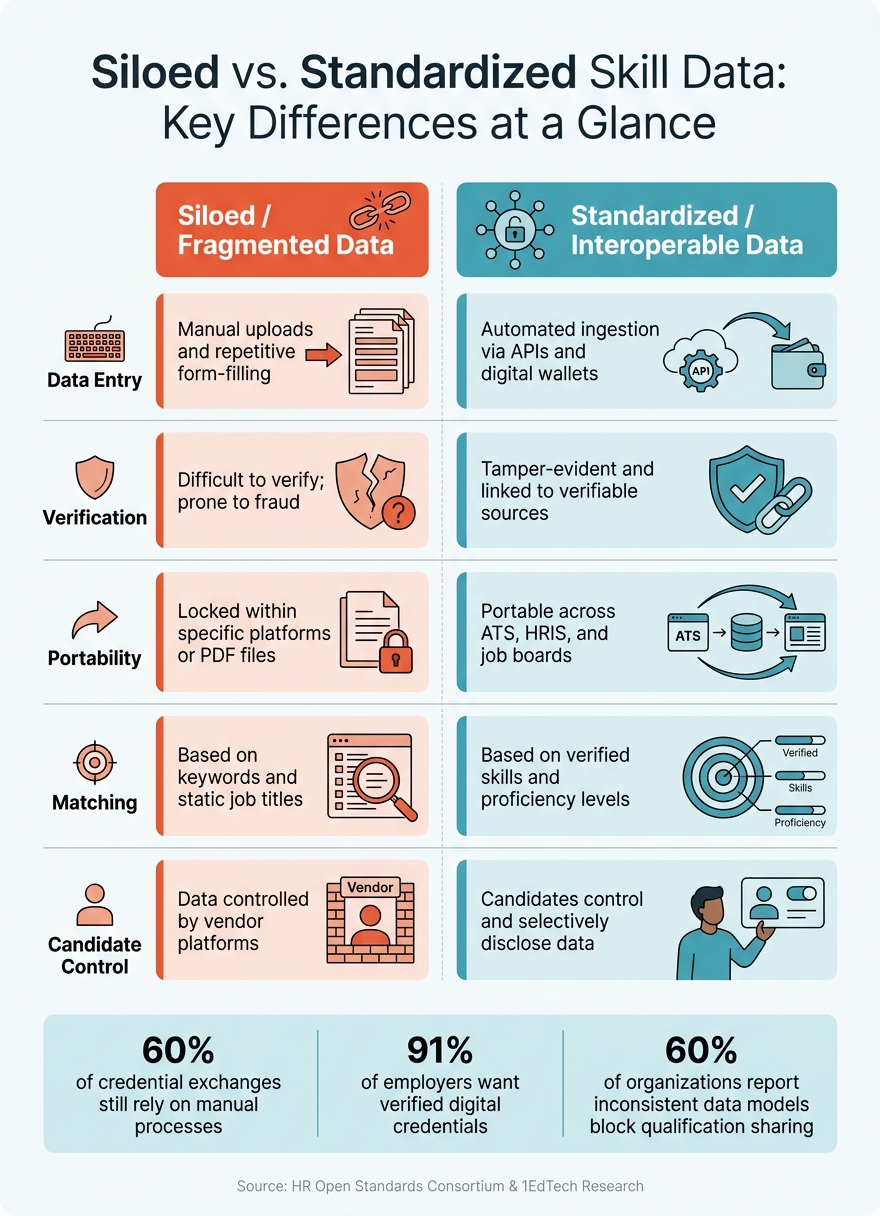
The difference between fragmented and standardized skill data is stark, especially when it comes to hiring. Standardized systems offer clear benefits over siloed ones, streamlining the entire process.
| Feature | Siloed/Fragmented Data | Standardized/Interoperable Data |
|---|---|---|
| Data Entry | Manual uploads and repetitive form-filling | Automated ingestion via APIs and digital wallets |
| Verification | Difficult to verify | Tamper-evident and linked to verifiable sources |
| Portability | Locked within specific platforms or PDF files | Portable across ATS, HRIS, and job boards |
| Matching | Based on keywords and static job titles | Based on verified skills and proficiency levels |
| Candidate Control | Data controlled by vendor platforms | Candidates control and selectively disclose data |
The contrast is undeniable. Siloed systems slow everything down and create unnecessary barriers for job seekers and employers alike. On the other hand, standardized data makes your qualifications easily portable, verifiable, and actionable - exactly what’s needed for a skills-driven hiring process.
sbb-itb-20a3bee
1EdTech & Digital Credentials Explained | Open Badges 3.0, Standards & Why They Matter (2026)
What Open Standards Do for Skill Assessment Data
Siloed vs. Standardized Skill Data: Key Differences at a Glance
What Open Standards Are and How They Work
Open standards establish a shared framework for how skill data is formatted, stored, and exchanged across various systems. Think of them as a universal translator that lets a university's learning platform communicate seamlessly with an employer's applicant tracking system. These standards rely on tools like GUIDs, JSON for machine-readable data, and RESTful APIs to ensure smooth data transfer. This means that when a skill or credential is earned on one platform, it retains its integrity and meaning as it moves to another. By addressing the fragmented nature of skill data, open standards play a critical role in enabling smoother career transitions.
How Open Standards Enable Data Portability and Interoperability
By creating a shared language, open standards make skill data highly portable. Verified credentials can move effortlessly between platforms without losing their meaning or requiring manual input. For instance, a credential earned through a university program can be directly integrated into a job board, digital wallet, or an employer’s HR system, saving time and reducing errors. They also empower individuals with control over their data. Using self-sovereign selective disclosure, individuals can decide which credentials to share with specific employers. Additionally, standards built on the W3C Verifiable Credentials framework ensure that these records are tamper-proof, allowing employers to verify their authenticity instantly - eliminating the need for lengthy background checks.
"The LER-RS is the skeleton key that unlocks HR interest in digital credentialing. It creates an interoperable way to move job seeker profiles between systems." - HR Open Standards Consortium
Current Standardization Efforts Worth Knowing
Several key initiatives are actively shaping the future of open standards for skill data. One standout example is the Trusted Career Profile (TCP), introduced on January 22, 2026, by HR Open Standards and the T3 Innovation Network. This universal standard connects Learning and Employment Records (LERs) with traditional HR systems, paving the way for more effective skills-based hiring. Jason Tyszko, Senior Vice President at the U.S. Chamber of Commerce Foundation, highlights its importance:
"By making verified experience portable and interoperable, the Trusted Career Profile helps employers focus less on credentials as proxies and more on skills as signals - unlocking better matches for both businesses and workers."
Other notable efforts include xAPI, an IEEE standard for tracking learning experiences; CASE, a framework from 1EdTech for exchanging competency data using GUIDs; and the Comprehensive Learner Record (CLR), which provides a verifiable snapshot of lifelong learning. On a global scale, the European Learning Model (ELM) supports credential recognition across 30 languages, utilizing over 500 data properties. These initiatives are bridging the gap between verified skill data and meaningful career opportunities, ensuring that credentials earned today translate into tangible progress tomorrow.
How Interoperability Supports Career Growth
Building a Complete Skill Profile
A traditional resume gives a static snapshot of your qualifications. An interoperable skill profile, on the other hand, creates a dynamic, consolidated record by pulling verified data from multiple sources. This includes education credentials, digital badges, work history, and competency assessments - all structured, machine-readable, and tamper-proof.
Interestingly, 76.8% of credential earners want to understand how their credentials connect to job opportunities immediately after earning them. An interoperable profile takes this a step further by combining verifiable credentials with self-attested information into a portable record you can carry across platforms. The best part? You stay in control. With controlled sharing, you decide what to reveal and when - offering a lightweight profile for initial screenings and more detailed records during later hiring stages.
But it’s not just about consolidating your credentials. Interoperability also ensures that skills are recognized accurately, improving job matching.
Faster Skill Recognition and Better Job Matching
One of the biggest advantages of open standards is their ability to fix skill naming inconsistencies. For example, one platform might list "React.js", while another simply says "React." Without standardization, automated systems can misclassify these as separate skills. Universal taxonomies like ESCO solve this by assigning unique identifiers to each competency, ensuring matching engines recognize them as the same skill.
This improvement has a tangible impact on job matching. In February 2026, Alexander Leonhard, founder of JobGrow.ai, implemented the Open Talent Protocol (OTP) and Open Job Protocol (OJP) to automate candidate matching. By integrating the ESCO API, his platform eliminated errors caused by naming variations for technical skills, significantly improving match accuracy.
"Taxonomies are infrastructure - ESCO URIs as skill identifiers eliminate an entire class of matching bugs." - Alexander Leonhard, Founder, JobGrow.ai
Supporting Lifelong Learning and Career Tracking
Interoperability doesn’t stop at better skill recognition - it also simplifies career tracking over time. The Comprehensive Learner Record (CLR) captures all your achievements, from courses and competencies to internships and skills, in a machine-readable format that spans your entire career - not just your latest job. As you earn new credentials or complete training, these updates integrate seamlessly into your record without requiring manual input.
Newer systems are taking this even further. For instance, WorkProof tracks how actively you develop new skills over a rolling 12-month period. A proctored certification from organizations like Microsoft or AWS carries more weight than a self-reported course because it includes a cryptographically signed attestation, which any platform can verify instantly. By automatically integrating these updates, open standards ensure your career data stays current and actionable, helping you transition from fragmented systems to a unified, forward-looking career path.
How Acedit Fits into Open Skill Data Workflows
How Acedit Uses Consistent Skill Data
Open standards provide a structured foundation of skill data, which tools like Acedit can tap into effectively. By adhering to the Open Talent Protocol (OTP) - a vendor-neutral JSON standard that helps software agents interpret professional profiles - Acedit accesses skill data already mapped to ESCO taxonomy identifiers (e.g., "S5.6.1") and standardized proficiency levels on a 1–5 scale. This eliminates the need for guesswork when interpreting skills like "React.js" or "stakeholder management", relying instead on universal identifiers.
Acedit uses OTP's three disclosure tiers - Metadata, Profile, and Deep - to extract only the relevant skill data. For basic preparation, it pulls lightweight profile data, while advanced interview prep involves integrating work samples, assessments, and certifications. This structured approach ensures Acedit can deliver its career readiness tools with precision.
Acedit Features That Support Career Readiness
Acedit's LinkedIn integration uses standardized data from your profile, resume, and target job descriptions to craft interview responses based on your documented experience. The custom STAR example feature further organizes your experience into clear narratives of Situation, Task, Action, and Result, making your skills easy for interviewers to evaluate.
Additionally, Acedit functions as a Chrome extension, working seamlessly across platforms like Zoom, Microsoft Teams, and Google Meet. This means your structured preparation flows directly into live interview settings, ensuring consistency from practice to performance.
How Data Consistency Builds Interview Confidence
When your skill data aligns across platforms, your interview responses feel polished rather than improvised. Acedit users report a 98% confidence boost, with over 15,000 questions practiced on the platform. This confidence stems from knowing that what you present in an interview matches your LinkedIn profile, resume, and verified credentials - thanks to Acedit's alignment process.
"Being able to prepare for interviews with real-time AI feedback was a game changer and made me feel confident for my interview." - William Johnson
The real-time coaching feature takes this a step further during live interviews. If an unexpected question arises, Acedit identifies it and provides a response suggestion tailored to your pre-loaded skill data, offering immediate, personalized support when you need it most.
What a Practical Open Standards Strategy Looks Like
Fragmented skill data can be a major roadblock to career advancement, but an open standards strategy provides a clear solution to tackle these issues effectively.
Key Parts of an Open Standards Framework
An open standards framework is built on interconnected components that make skill data portable, reliable, and usable across different systems.
At the heart of this framework is the Trusted Career Profile (TCP), which combines verified credentials like Open Badges and Comprehensive Learner Records (CLRs) with self-reported information. This creates a portable, tamper-resistant record that applicant tracking systems (ATS) can process automatically. Rich Skill Descriptors (RSDs) add depth to skill data by including detailed statements, categories, and links to occupational classifications. This ensures that skills are interpreted consistently by both employers and systems.
Using JSON-LD, resumes and skill records become machine-readable, making them compatible across platforms. Open APIs, such as the Jobs and Employment Data Exchange (JEDx), allow seamless data sharing between HR, assessment, and learning platforms without requiring custom integrations for each connection.
These key components set the stage for the roles and benefits that open standards bring to everyone involved in the hiring ecosystem.
Roles and Benefits for Each Stakeholder Group
Each stakeholder in the hiring process has a specific role to play and gains distinct advantages from adopting open standards.
| Stakeholder | Contribution | Key Benefit |
|---|---|---|
| Job Seekers | Manage digital wallets; selectively share credentials | Ownership of personal data, easier data portability, and fairer hiring practices |
| Employers | Define roles with RSDs; accept TCP-formatted records | Faster hiring, reduced verification costs, and protection against AI-generated resume fraud |
| Technology Providers | Certify tools via 1EdTech Build Portal; implement open APIs | Simplified integrations and access to a broader market |
| Educators | Issue CLRs and Open Badges aligned with skill frameworks | Better alignment with workforce needs and improved tracking of graduate outcomes |
"Employers are eager to embrace skills- and competency-based hiring, but current systems can be hard to change. By providing a more accessible and interoperable way to incorporate digital credentials, we're giving them tools to overcome those barriers." - Jim Ireland, Executive Director of HR Open Standards
How Open Standards Simplify Career Progress
One of the biggest advantages of open standards is cutting down on redundancy. Without them, job seekers repeatedly enter the same data, employers manually verify credentials, and tech providers rely on fragile, custom-built integrations.
With a TCP-formatted profile, verified skills travel seamlessly across job applications, learning platforms, and career tools - no need for repeated data entry or re-verification. Considering that 70% of U.S. companies use background checks, cryptographically signed credentials significantly reduce both the time and cost of verification. The result? A smoother journey from skill acquisition to employment, supported by interview with AI tools that refine preparation, with fewer opportunities for data to be misinterpreted or lost along the way.
Conclusion: Moving Forward with Open Standards
Fragmented data has long been a stumbling block in the hiring process, creating unnecessary hurdles for both job seekers and employers. Open standards present a clear path to overcoming these challenges. Right now, skill data is often locked away in platforms that don't communicate with one another. This lack of accessibility wastes time for job seekers and complicates verification for employers, slowing down the entire hiring process. Standards like the Trusted Career Profile (TCP) and machine-readable formats like JSON-LD aim to break down these barriers.
Jason Tyszko, Senior Vice President at the U.S. Chamber of Commerce Foundation, explains the potential of these standards:
"By making verified experience portable and interoperable, the Trusted Career Profile helps employers focus less on credentials as proxies and more on skills as signals - unlocking better matches for both businesses and workers."
This shift is particularly impactful for individuals whose skills don’t align with traditional degree requirements or keyword searches. It aligns with the broader goal of creating fairer opportunities for job seekers while ensuring employers can make better-informed hiring decisions.
The groundwork for this transformation is already in place. Recent updates to standards show real progress. As Curtiss Barnes, CEO of 1EdTech, points out, "If digital credentials are going to be adopted, they need to make hiring easier, not more complicated." Open standards provide the framework needed to achieve this simplicity.
For job seekers, the most practical step is to prioritize platforms and tools that support selective data sharing and portability. A seamless, portable career record can help you move forward confidently at every stage of your career.
FAQs
How do open standards make my credentials portable across platforms?
Open standards let you take your credentials wherever you go by storing them in a structured, machine-readable format. Platforms that adopt universal standards, such as the Comprehensive Learner Record (CLR) and Open Badges, make it easy to share and verify your skills and accomplishments. This means no more tedious manual data entry. Instead, cryptographically verified records can be recognized automatically across educational tools, applicant tracking systems, and workforce services - no matter what software they use.
What makes a digital credential 'verifiable' and tamper-proof?
Digital credentials are secure and trustworthy because they use cryptographic signatures. When an issuer signs a credential, it becomes tamper-proof - any unauthorized changes can be easily detected. These signatures are tied to the issuer's identity through public trust registries, enabling verifiers to confirm both the document's authenticity and its source without needing to contact the issuer directly. This approach ensures credentials are reliable, secure, and ready for automated verification systems.
What can I do today to start using open standards in my job search?
Start with a structured, machine-readable resume format such as the Trusted Career Profile (TCP) or Open Talent Protocol (OTP). These formats make your skills easily transferable and ensure compatibility with modern hiring systems. To strengthen your profile, use tools that validate your information and include verifiable certifications like Open Badges, which add an extra layer of trustworthiness. For additional support, platforms like Acedit offer real-time coaching and customized interview simulations to help you prepare effectively.