
Reach and impressions are two common metrics in social media analytics, and understanding their differences is crucial for tracking your content's performance effectively:
- Reach: The number of unique users who see your content. Think of it as the total audience size exposed to your post at least once.
- Impressions: The total number of times your content is displayed on a screen, including multiple views by the same user.
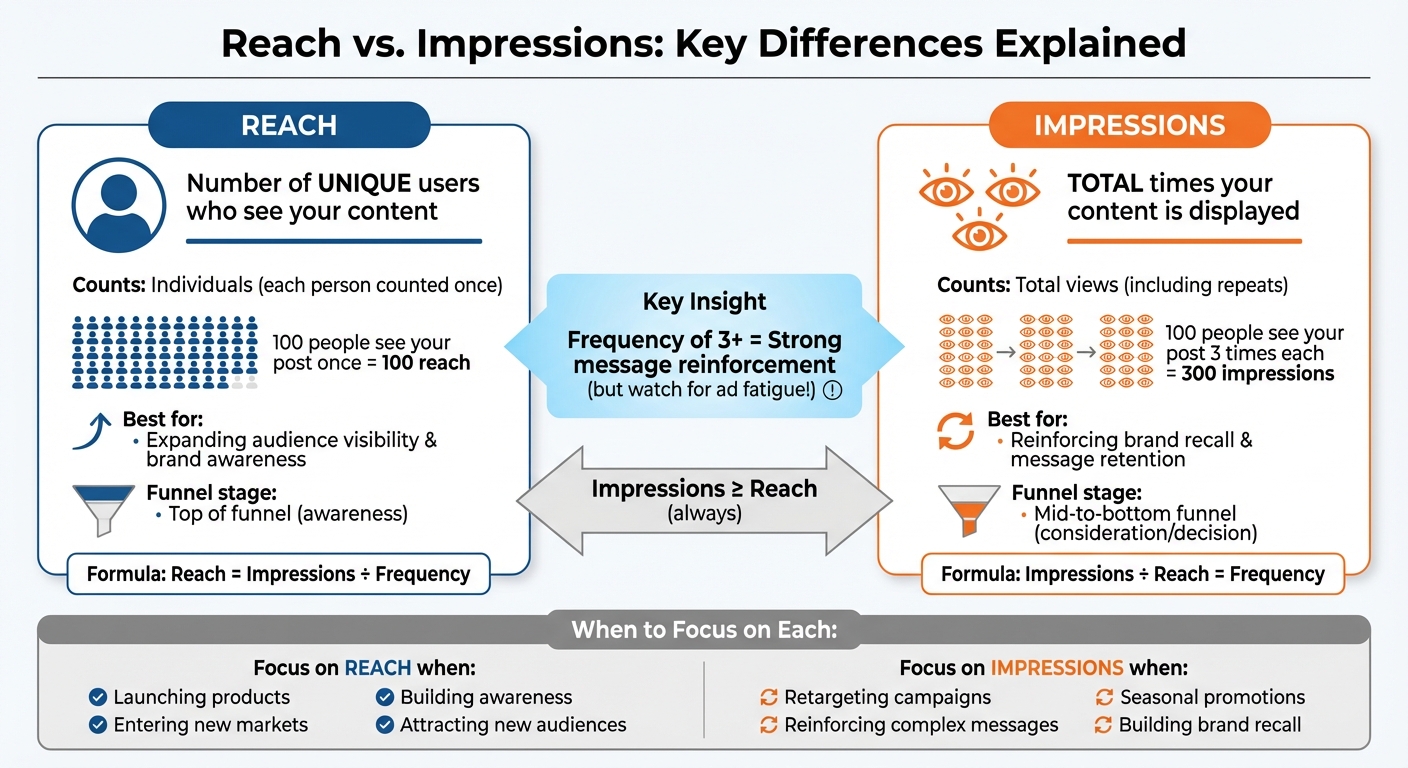
The key distinction is that reach counts individuals, while impressions count total views. For example, if 100 people see your post once, your reach is 100, but if each person views it three times, your impressions total 300.
When to focus on each:
- Use reach to measure how far your content spreads to new audiences.
- Use impressions to track repeated exposure and assess how well your message sticks.
A balance between these metrics is essential. High reach with low impressions suggests your content is reaching many people but lacks repeat engagement. High impressions with low reach indicates strong engagement from a smaller audience but limited growth.
Quick Comparison:
| Metric | Definition | Best For |
|---|---|---|
| Reach | Unique users who see your content once | Expanding audience visibility |
| Impressions | Total times content is displayed | Reinforcing brand recall |
To grow your personal brand, track both metrics and adjust your strategy based on your goals - whether it's reaching new people or keeping your message top of mind.
Reach vs Impressions: Key Differences and When to Use Each Metric
Reach vs Impressions: What's the difference and which one you need to track
sbb-itb-20a3bee
What is Reach?
Reach represents the total number of unique users who have seen your content at least once. Imagine it as counting attendees at an event - each person is counted only once, no matter how many times they walk by. For instance, if 500 different users view your LinkedIn post, your reach is 500, even if one person views it multiple times.
This metric differs from impressions, which track how often your content appears on screens. Let’s break down how platforms measure this key metric.
How Reach is Calculated
Platforms determine reach by identifying unique IDs or account names that interact with your content. A typical formula for calculating reach is:
Reach = Impressions ÷ Frequency.
For example, if your content generates 1,000 impressions with a frequency of 2, your reach would be 500 unique users.
Each platform has its own terminology for reach. Instagram refers to it as "Accounts Reached", TikTok uses "Reached Audience", Pinterest calls it "Total Audience", and YouTube tracks "Unique Viewers." It’s worth noting that reach is often an estimate rather than an exact number, particularly on platforms like Facebook and TikTok. Some platforms, such as Google Ads, even use statistical modeling to account for cross-device usage, ensuring that one person using both a phone and a laptop is counted as a single unique user.
Why Reach Matters
Reach helps you understand if your content is connecting with new audiences rather than circulating within the same group. It’s especially useful when launching a new service, entering a different industry, or building brand awareness.
For example, if your reach is high but engagement is low, it could mean your content is being seen but not resonating with viewers. On the other hand, strong reach numbers indicate that your content is breaking through to fresh audiences, giving your brand exposure to new potential followers.
What are Impressions?
Impressions count every instance your content is displayed on a screen, regardless of whether it gets any engagement. Unlike reach, which measures the number of unique viewers, impressions track every time your content appears.
For example, if you post a photo on Instagram and one person scrolls past it three times in a day, that counts as three impressions but only one reach. The table below outlines how various platforms measure impressions.
This concept also highlights the difference between "served" and "viewable" impressions. A "served" impression happens when content is delivered to a page, while a "viewable" impression occurs when the content actually appears on the screen. For an impression to be considered viewable, at least 50% of the content must be visible in an active browser for at least one second. This distinction is important because, for example, an ad that loads at the bottom of a page but is never scrolled into view might still count as served, even though no one actually saw it.
How Impressions are Calculated
Every platform has its own way of tracking impressions, but the general principle is the same: each display of your content counts as a new impression. For instance, on Facebook, if someone sees your ad, scrolls away, and then comes back to it later, each view is counted as a separate impression.
| Platform | How Impressions are Tracked |
|---|---|
| Counts every time an ad or post appears on a user's screen | |
| Tracks the total number of times a post, Story, or Reel is viewed, including multiple views by the same account | |
| TikTok | Counts "Total Video Views" for organic content, recording each exposure - even if it's from the same user |
| X (Twitter) | Logs every instance a post appears in a user's feed, search results, or profile |
| Measures the number of times a post, video, or article shows up in a user's feed (see our tips for LinkedIn optimization) | |
| YouTube | Counts impressions when at least 50% of a video thumbnail is visible on the screen for at least one second |
Why Impressions Matter
Impressions show how often your content is being seen, which can influence brand recall and strengthen your messaging. When impression counts are significantly higher than reach, it means your audience is seeing the same content multiple times. This repeated exposure can be especially useful in campaigns where multiple touchpoints are needed to drive action.
According to Hootsuite, a high impressions-to-reach ratio points to repeated exposure, which can help make your content more memorable. However, there’s a fine line to walk. While repeated exposure can boost brand awareness, showing the same content too often can lead to ad fatigue, where users grow bored or annoyed with your message.
To measure how frequently your content is being shown to the same audience, you can use this formula: Impressions ÷ Reach = Frequency. A frequency of 3 or higher generally indicates that your content is being shown repeatedly to the same group. This can be a smart strategy for reinforcement campaigns, but it’s important to monitor this ratio to avoid over-saturation. Balancing impressions and reach ensures your message is seen by a diverse audience without overwhelming a small group.
Main Differences Between Reach and Impressions
Reach measures the number of unique individuals who see your content, while impressions count every time your content appears on a screen - even if the same person views it multiple times. Essentially, reach focuses on unique viewers, while impressions tally total views.
Here’s how it works: if 100 people see your post once, your reach is 100. But if each person views it three times, impressions jump to 300. To put it simply, “Reach measures unique users who saw your content (counting each person once), while impressions count total views regardless of repetition”. This distinction is crucial, especially since 60% of marketing leaders struggle to prove the value of their efforts due to focusing on the wrong metrics.
Let’s break this down further in a side-by-side comparison.
Comparison Table: Reach vs. Impressions
| Feature | Reach | Impressions |
|---|---|---|
| Definition | Unique users who saw the content | Total times the content appeared on screens |
| Calculation Method | Count of unique account IDs or users | Total count of all views, including repeats |
| Primary Goal | Building audience and brand awareness | Reinforcing messages and boosting brand recall |
| Funnel Stage | Top of funnel (awareness) | Mid-to-bottom funnel (consideration/decision) |
| Typical Value | Lower than impressions | Higher than reach |
| Facebook Tracking | Available (split by Organic, Paid, and Viral) | Available (split by Organic, Paid, and Viral) |
| Instagram Tracking | Displayed as "Accounts Reached" | Replaced by "Views" as of May 2025 |
| X (Twitter) Tracking | Not natively tracked | Tracked as "Views" |
| LinkedIn Tracking | Not available via API | Available for posts |
| YouTube Tracking | Displayed as "Unique Viewers" | Counts thumbnail views (50% visible for 1+ second) |
Grasping these differences helps you decide when to focus on each metric.
When to Focus on Reach vs. Impressions
Choose reach when you’re introducing your brand to new audiences or launching a product. For example, if you’re entering a new market or rolling out a service, reach is your go-to metric for top-of-funnel campaigns. The goal here is to maximize visibility among unique viewers.
Impressions, on the other hand, are key when you’re reinforcing a message or aiming for repeated exposure. This is particularly effective in retargeting campaigns, seasonal promotions, or situations where repetition helps your audience better understand your message. For instance, if you’re running a campaign to explain a complex product, impressions ensure your message sticks.
Keep an eye on your frequency ratio - a value of 3 or higher indicates your audience is seeing the same content multiple times. However, if impressions are climbing while reach stays flat and engagement drops, it could signal ad fatigue. That’s your cue to refresh your content or expand your audience.
How Major Platforms Track Reach and Impressions
Different platforms define and measure reach and impressions in their own ways, which can impact your brand analytics. By understanding these variations, you can better interpret your performance data and refine your personal branding strategy. Let’s take a closer look at how Facebook, Instagram, and LinkedIn handle these metrics.
Facebook: Organic, Paid, and Viral Metrics
Facebook breaks down reach into three categories: Organic (unpaid), Paid (ad-driven), and Viral (boosted by user interactions). This approach helps you understand how people are discovering your content. Facebook combines these categories into a single "unique reach" metric, while tracking impressions over specific timeframes like 1-day, 7-day, and 28-day periods.
"Reach is the number of unique users who display any content from your Facebook Page or about your Page on their screens." – Facebook
Impressions, on the other hand, count every instance your content appears on someone’s screen. The Meta Business Suite provides a "Content Overview" feature where you can compare median reach across formats like videos, images, and Reels. For personal branding, paying attention to viral reach is especially useful, as it highlights how effectively your network amplifies your message. A solid organic reach rate on Facebook is typically around 5.5% of your total followers.
Instagram: Accounts Reached vs. Total Views
Instagram defines reach as "Accounts Reached", which represents the number of unique accounts that have seen your content at least once. It further breaks this down into views by followers and non-followers.
Since May 2025, Instagram has replaced impressions with views, a metric that captures how many times your content is displayed on a user’s screen. If your views significantly exceed the number of accounts reached, it means your existing audience is engaging with your content multiple times.
"Instagram officially discontinued the impressions metric and replaced it with views, which measures the number of times content is displayed on a user's screen." – Socialinsider
You can monitor these metrics through Instagram Insights or the Meta Ads Manager for more detailed analysis. For Reels, metrics like retention time and replays can provide deeper insights into how well your content resonates. While Instagram emphasizes repeated views, LinkedIn takes a more conservative approach tailored to professional users.
LinkedIn: Metrics for Professionals
LinkedIn provides precise metrics designed for professional branding. The platform uses "Unique Impressions", which count each time a signed-in member views your post. For an impression to be recorded, the post must be visible for at least 300 milliseconds and have at least 50% of its content in view.
"Impressions show the number of times each post is visible for at least 300 milliseconds with at least 50% in view on a signed-in member's device screen or browser window." – LinkedIn
Unlike Facebook or Instagram, LinkedIn doesn’t offer a traditional reach metric via its API. However, it does track profile views on a monthly basis, which can give you a sense of your professional visibility. The LinkedIn Analytics dashboard (under the Updates tab) tracks impressions, views, and clicks. Posts that generate active engagement, like comments and reposts, tend to gain more visibility, as LinkedIn’s algorithm rewards content that sparks meaningful interaction.
Why Both Metrics Matter for Personal Brand Growth
When it comes to personal brand growth, reach and impressions work hand-in-hand to tell the full story of your visibility. Reach captures the size of your unique audience, while impressions track how often your content is viewed, including repeat views. Together, these metrics provide a well-rounded picture: reach helps introduce your brand to new people, and impressions ensure your message stays fresh in their minds.
The interplay between reach and impressions also reveals how well your brand resonates. If impressions far outnumber reach, it’s a sign that your content is sticking with your audience. This balance is essential for building a brand that grows steadily over time.
Think of it like a funnel: reach sits at the top, driving awareness by exposing your brand to a broader audience. Impressions work in the middle, reinforcing your message through repeated exposure. If you have high reach but low impressions, your content may be spreading but failing to leave a lasting impression. On the flip side, high impressions with low reach show that you're engaging a smaller, loyal group. Striking the right balance ensures both growth and retention.
By strategically using reach to attract new audiences and impressions to reinforce your message, you can create a sustainable growth strategy.
Using Reach to Expand Your Audience
Reach is your go-to metric for growing your audience. It measures how many individual users see your content, making it a key indicator of how far your brand is spreading. To boost reach, consider posting during peak activity times, using 3–5 targeted hashtags, and experimenting with attention-grabbing formats like Reels or interactive polls. Reviewing LinkedIn reach data across platforms can also help you pinpoint where your efforts are most effective, so you can focus on the channels that deliver the best results.
Using Impressions to Measure Content Saturation
Impressions tell you how often your content is being seen, which helps you gauge how frequently your message is reaching your audience. A helpful way to track this is by calculating your frequency ratio (impressions divided by reach). A ratio of 3 or more is often a good benchmark for reinforcing your brand, but it can also signal ad fatigue if overdone. If impressions significantly outpace reach, it’s a strong indicator that your current audience finds your content engaging enough to revisit.
Improving Your Impressions-to-Reach Ratio
The impressions-to-reach ratio shows how many times, on average, each unique user views your content. A higher ratio strengthens brand recall and visibility. To improve this, repurpose high-performing evergreen content into different formats, ensuring your message reaches users in fresh ways without creating entirely new material. Increase your posting frequency to keep your brand in front of your audience, but be careful not to overdo it - quality still matters. You can also use AI for interview prep to refine how you communicate your brand's value. Engage actively with comments, use interactive features like polls, and consider promoting top-performing content to maximize its reach and impact.
| Goal | Primary Metric | Strategy |
|---|---|---|
| Brand Awareness | Reach | Target new audience segments, use hashtags, and create viral content |
| Brand Recall | Impressions | Focus on repeated exposure, retargeting, and building frequency |
| Audience Growth | Reach | Leverage collaborations and paid ads to attract fresh viewers |
| Engagement & Loyalty | Impressions | Deliver high-quality content and maintain consistent interaction |
Conclusion
Understanding the difference between reach and impressions is crucial for building a strong personal brand. While reach measures the number of unique viewers your content reaches, impressions track how often that content is displayed. Or, as it's often said: "Reach tells you how far your message traveled. Impressions tell you how often it showed up along the way."
Balancing these two metrics can transform your branding efforts. The frequency formula - impressions ÷ reach - offers valuable insights. For example, if you have high reach but low impressions, your content is reaching many people but not sticking. On the flip side, low reach with high impressions suggests a loyal audience engaging repeatedly with your content. Ideally, a frequency of 3 or more indicates your message is being reinforced effectively, but it could also point to ad fatigue if your content isn't engaging enough.
Use reach strategically when you're launching a new project, stepping into a new niche, or aiming to grow your audience. On the other hand, focus on impressions to reinforce complex ideas, establish authority, or encourage specific actions, like signing up for a newsletter or purchasing a course.
The secret lies in striking the right balance. Reach helps you expand your network and attract fresh followers, while impressions keep you top-of-mind and nurture familiarity, turning casual viewers into loyal supporters. By tracking both metrics and tweaking your approach based on the data, you can build a personal brand that not only grows steadily but also fosters meaningful connections with your audience.
FAQs
How can I effectively balance reach and impressions to grow my personal brand?
Balancing reach (how many unique individuals see your content) and impressions (the total number of times your content is displayed) is crucial for building your personal brand. Reach measures how far your message travels, while impressions reveal whether your audience is encountering your content repeatedly or if it's reaching new viewers.
To strike this balance, experiment with your posting schedule and content formats. Share at different times of the day, and vary your approach with videos, images, and text-based posts. Tailor your content to the platform’s algorithm by using relevant hashtags, tagging collaborators, and encouraging interactions like comments or shares. These tactics can help expand your reach while increasing impressions among your existing audience. Keep an eye on analytics to spot trends - if a post shows high impressions but low reach, consider refreshing it or tweaking your targeting to avoid audience fatigue. Repurposing well-performing content in a new format is another way to grab the attention of new viewers while reinforcing your message with loyal followers.
By consistently applying these techniques, you can grow your audience while staying connected with those already engaging with your content.
How can I increase the reach of my social media content?
To expand the reach of your social media content - the number of unique users who come across your posts - you need a well-thought-out, data-backed strategy. Start by diving into your platform's analytics to uncover what resonates with your audience. Pay attention to the topics they engage with, the formats they prefer, and the times they’re most active. Use these insights to fine-tune your approach.
Increase visibility by incorporating relevant hashtags, tagging collaborators or featured accounts, and encouraging your followers to share your posts. Consistency is key, so establish a regular posting schedule. Experiment with timing, such as early mornings or evenings, to align with peak activity periods when your audience is more likely to be online.
For professionals, tools like Acedit can elevate your LinkedIn presence by optimizing your profile. This not only helps you reach a broader audience but also ensures you’re connecting with the right people while building a stronger personal brand.
How do impressions influence brand awareness and audience interaction?
Impressions are essential for boosting the visibility of your content and enhancing brand awareness. When combined with a solid reach, impressions can help keep your brand in the spotlight, encouraging your audience to interact and engage.
Although impressions by themselves don’t promise immediate engagement, they lay the groundwork for creating recognition and familiarity - key elements for sustained growth over time.