
Healthcare hiring in the U.S. is under pressure, and AI can help cut hiring time, but people still matter at the last step. In short: AI is better at sorting large candidate pools, checking licenses and certifications, matching shifts and pay ranges, and helping employers fill jobs faster. Recruiters and hiring managers are still better at judging bedside manner, communication, team fit, and role context.
If I had to sum up the article in a few points, it would be this:
-
AI helps with speed and scale
- Some employers reported RN time-to-fill dropping from 59 days to as low as 20 to 30 days
- AI sourcing tools reported 67% less sourcing time
- Some teams saw cost-per-hire drop by up to 60%
-
Human review still matters
- AI can check licenses, certifications, specialty history, location, shifts, and pay
- Recruiters still do the better job on soft skills, AI interview assistance and judgment, references, and team fit
-
The best setup is usually both
- AI handles first-pass matching and forecast planning
- People make the final hiring call, especially for patient-facing roles
-
There are risks
- Biased training data can repeat hiring gaps
- Privacy rules matter when systems use staffing, scheduling, and clinical data
- Human review should stay in place
-
The pressure is not small
- The U.S. may face a shortage of up to 3.2 million healthcare workers by 2026
- There are projected to be 193,100 RN openings each year through 2032
- Physician shortages may reach nearly 140,000 full-time roles by 2036
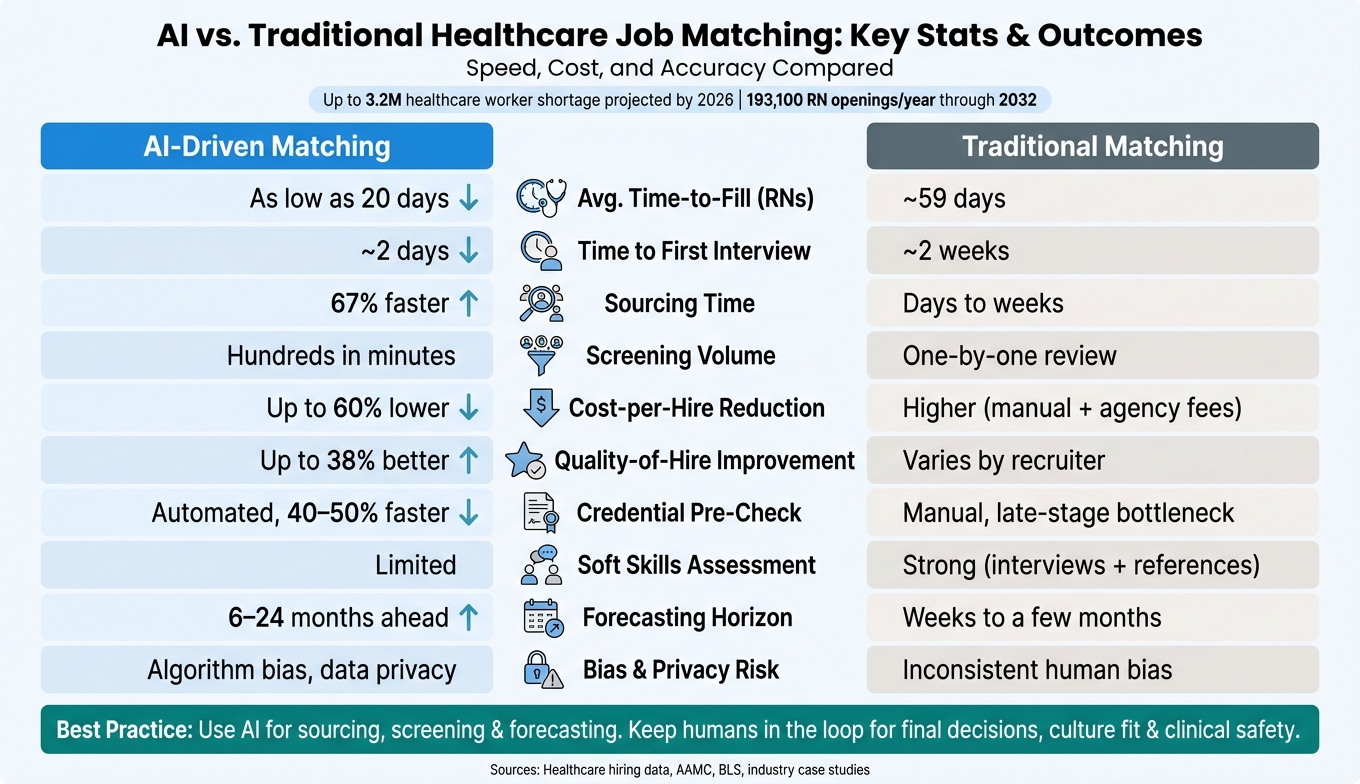
AI vs. Traditional Healthcare Job Matching: Key Stats & Outcomes
The Pros and Cons of AI in Healthcare | #Indeed
sbb-itb-20a3bee
Quick Comparison
| Criteria | AI-Driven Matching | Traditional Matching |
|---|---|---|
| Screening speed | Very fast; large volumes in minutes | Slower; one-by-one review |
| License and credential checks | Strong for early rule-based checks | Done by recruiters and compliance teams |
| Match inputs | Skills, specialty, location, shift, pay, history | Resume review, calls, recruiter notes |
| Soft skills review | Limited | Stronger |
| Time to first interview | About 2 days in reported cases | Often about 2 weeks |
| Interview preparation | AI-powered response suggestions | Manual prep and coaching |
| Cost | Can lower hiring costs | More recruiter time and agency cost |
| Forecasting staffing gaps | Can use historical and live data | Often spreadsheet-based |
| Main risk | Bias, privacy, over-reliance on automation | Slower process, smaller candidate review |
Bottom line: if you want faster hiring, AI has the edge. If you want a final read on patient-facing fit, people still do that part better. For most hospitals and clinics, a mixed approach makes the most sense.
That’s the core idea the article covers, with the main tradeoffs, numbers, and hiring outcomes in one place.
How AI-Driven Healthcare Job Matching Works
AI systems scan a candidate’s resume, license details, certifications, specialty background, work history, location, shift preferences, and pay expectations. Then they compare that information with open roles in real time to produce ranked matches and screen for basic eligibility before a recruiter steps in. With old-school screening, a recruiter has to check all of that by hand.
Data Points AI Uses to Match Healthcare Professionals
Match quality depends on what goes into the system. An ICU nurse with trauma center experience is not the same as a nurse whose work has mostly been in outpatient care, even if both hold the same RN license. AI can tell the difference by reading specialty depth, patient acuity, prior clinical settings, and how recent that clinical experience is, along with the core qualifications.
Location, availability, shift preferences, and pay expectations matter just as much. If a candidate wants a night shift role that pays $48 to $55 per hour within 25 miles of home, the system can steer that person away from roles outside those limits. That saves time for both the candidate and the hiring team. On the flip side, incomplete resumes or old credential details can lead to missed matches.
AI can also check for requirements like:
- An active state RN license
- Compact license eligibility
- BLS, ACLS, and PALS
- Board certification
- Specialty-specific credentials
If a credential is missing or expired, the system flags it early. That said, people still need to verify licensure status, expiration dates, and employer-specific credential rules.
How AI Supports Candidate Preparation After a Match
Once AI surfaces the right role, the next step is turning that match into an interview. A strong match helps, but it doesn’t handle the conversation for you. Healthcare workers still need to interview well, and AI tools can help close the gap between a solid profile and a solid first impression.
Tools like Acedit can generate personalized interview questions, tailor cover letters, and offer real-time interview coaching. That can be especially helpful in panel interviews and clinical scenario questions, where nurses, physicians, and allied health professionals may be asked about patient safety and clinical decision-making.
How Traditional Healthcare Job Matching Works
Traditional healthcare hiring leans on recruiters and staffing agencies to find, screen, and move candidates through the process. That hands-on model has its place. But compared with AI-driven matching, it usually takes more time.
Staffing Agencies, Recruiters, and Manual Screening
Recruiters usually source candidates from job boards, employee referrals, LinkedIn, and agency talent databases. Some jobs never appear in public listings at all. They get filled through recruiter networks and referrals instead - the hidden job market.
From there, a recruiter checks whether each candidate matches the facility’s requirements. That often means reviewing licensure, compact status, BLS/ACLS, board certification, work authorization, and recent experience. Since those requirements change by state and specialty, many recruiters rely on checklists to keep things straight. And one mismatch late in the process - like an active license in the wrong state - can stop a placement cold.
After that first screen, the recruiter sets up a phone or virtual interview. If the candidate looks like a fit, the recruiter sends a shortlist to the facility for formal interviews. Before an offer goes out, credentialing teams, compliance vendors, and background-check services may also need to review the file. It’s a thorough process, no doubt. Still, it can miss some of the nuance tied to a specific role.
Where Human Judgment Still Adds Value
This is where human judgment still matters. A recruiter who knows a unit well can often read things a checklist can’t. They may know the pace of the floor, the patient mix, or what a hiring manager tends to expect day to day. That kind of context helps them guide the right person toward the right job, even when two candidates look almost the same on paper.
Recruiters also look beyond credentials. They pick up on communication style, how someone handles pressure, and whether the role fits the person beyond what’s written on a resume. Reference checks matter here too, because they can bring up issues that a credential check would never catch. Recruiters also step in when a candidate is changing specialties, moving to a new area, or working through contract terms.
AI vs. Traditional Healthcare Job Matching: Efficiency, Accuracy, and Outcomes
Efficiency and Time-to-Hire
The first gap is speed. AI cuts down screening and scheduling delays that often drag out healthcare hiring.
In the U.S., healthcare hiring moves slowly. RN roles take about 59 days on average, and specialist roles can take much longer. That lag becomes a serious problem when a hospital needs ICU coverage by next week.
AI shortens steps that recruiters usually handle by hand. Platforms that use AI for sourcing and screening have reported a 67% drop in sourcing time and a 340% increase in candidate pools. In one healthcare organization, AI interview preparation vs traditional methods shows how asynchronous AI interviews cut time-to-fill from 73 days to 30 days - about 59% faster - while the team screened 23 of 34 candidates in one week, with only one HR director running the process.
| Factor | AI-Driven | Traditional |
|---|---|---|
| Avg. time-to-fill (RNs) | As low as 20 days in reported examples | ~59 days |
| Sourcing time | 67% faster | Days to weeks of manual outreach and follow-up |
| Screening throughput | Hundreds of profiles in minutes | Sequential, one-by-one review |
| Interview scheduling | Automated; many interviews set within 24 hours | Days of back-and-forth coordination |
| Credential pre-check | Automated, about 40%–50% faster | Manual, often a late-stage bottleneck |
For urgent roles like ED nurses, ICU staff, and primary care physicians, cutting even 10 to 20 days from the process can change patient capacity, overtime costs, and the need for temporary staff.
Matching Accuracy and Long-Term Fit
AI can weigh more variables at one time than a person doing manual screening. Some platforms report up to a 38% improvement in quality-of-hire after switching to advanced AI matching, along with fewer early terminations and no-shows.
Recruiters still bring judgment that software can't fully copy. They're often good at reading nuance, but manual review limits how many people they can compare side by side.
That matters because AI still struggles with softer signals. Bedside manner, tone, emotional intelligence, team chemistry, and communication style with patients and coworkers are still better judged through interviews and reference checks.
| Factor | AI-Driven | Traditional |
|---|---|---|
| Credential & license matching | Systematic, multi-factor scoring | Manual checklist review |
| Specialty alignment | High accuracy across large pools | Manual review can be strong for individual cases, but less scalable |
| Shift/schedule preferences | Factored into match score | Discussed in recruiter calls |
| Soft skills & culture fit | Limited; hard to encode in data | Human judgment, reference checks |
| Match quality improvement | Up to 38% better quality-of-hire | Varies by recruiter experience |
That’s why many hiring teams use a split approach: AI builds the shortlist, then people make the final call.
Speed matters, but the better test is whether the match still looks good after the person starts.
Outcomes for Candidates and Employers
For candidates, AI-driven matching often means faster feedback, more interview chances, and less time spent waiting. Time to first interview can fall from almost two weeks to about two days. For employers, that speed has a money angle too. Unfilled roles can cost U.S. providers about $3,000 to $7,000 per vacancy, and AI-supported hiring flows have been tied to cost-per-hire cuts of up to 60% in some healthcare organizations.
| Outcome | AI-Driven | Traditional |
|---|---|---|
| Time to first interview | ~2 days | ~2 weeks |
| Cost-per-hire reduction | Up to 60% | Higher due to manual hours and agency fees |
| Candidate experience | Faster updates, but less personal | More personal; slower communication |
The next question is whether these gains can help teams spot staffing needs before openings turn urgent.
Predictive Analytics, Risks, and the Bottom Line
Predictive Workforce Planning vs. Manual Forecasting
AI doesn't just match candidates to open jobs. It also helps healthcare teams spot staffing gaps before they turn into a scramble.
Predictive workforce planning tools pull from historical and live data, including patient acuity scores, admission patterns, seasonal illness trends, overtime levels, and turnover history, to estimate staffing needs months ahead for specific units like ICUs or respiratory therapy departments. That kind of visibility matters for roles like ICU nurses and respiratory therapists. Surveys show 87% of respiratory therapists say there is a local shortage, and 84% think a future shortage is likely or very likely. At the same time, RN turnover hit 22.5% in 2023, costing the average hospital between $3.6 million and $6.5 million each year in replacement and agency costs.
Manual forecasting works very differently. It leans on spreadsheets, past census data, and fixed staffing ratios, which means teams often respond only after shortages have already started.
That shift matters. Forecasting turns hiring from a reactive chore into something closer to workforce planning.
| Planning Capability | AI-Driven | Traditional/Manual |
|---|---|---|
| Data inputs | Admissions, acuity scores, overtime, EMR data, turnover history | Past census reports, manager experience, fixed ratios |
| Forecast horizon | 6–24 months ahead, unit- and role-specific | Weeks to a few months, often at department level |
| Turnover/burnout prediction | Models risk using absenteeism, shift patterns, and demographic factors | Relies on lagging signals like resignations and rising overtime |
| Scenario modeling | Simulates surges, new service lines, and policy changes | Limited ad hoc spreadsheet estimates |
| Update frequency | Dynamic, updates as new data arrives | Only when managers manually revisit assumptions |
These models can also flag retirement and turnover risk years in advance, which gives hiring teams more time to build talent pipelines.
Bias, Privacy, and Human Oversight in Healthcare Hiring
The same data that helps improve hiring fit can also create risk. If past hiring data reflects old inequities, such as lower representation of certain groups in leadership roles, an algorithm can pick up those patterns and repeat them. U.S. regulators, including the EEOC, have made it clear that biased algorithms can still play a part in unlawful discrimination, even when there was no intent to discriminate.
Privacy is another big issue. AI staffing tools often handle sensitive information, including performance metrics, EMR usage patterns, scheduling history, and patient acuity scores. That means organizations need clear rules around what data is collected, how it is protected, and what employees and candidates are told about its use.
Human oversight still has to stay in the loop:
- Recruiters check compliance and diversity.
- Hiring managers look at soft skills and team fit.
- Clinical leaders keep override authority when patient safety is on the line.
AI should support decisions, not make them on its own.
Conclusion: Key Takeaways for Healthcare Professionals
The tradeoff is pretty straightforward. AI brings speed, scale, and pattern recognition across large volumes of data. Human-led methods still bring nuance, relationship context, and judgment that matter for hard-to-fill clinical roles. Predictive analytics adds another piece to the mix: planning ahead instead of reacting after the fact.
For most U.S. healthcare organizations, the best path is a blended one. Use AI for sourcing, screening, and workforce forecasting. Keep human judgment at the center of final decisions, culture fit, and anything tied to clinical safety.
One part of the process still carries a lot of weight: the interview. After AI identifies a strong candidate, the next step is still a human conversation with a recruiter, hiring manager, or clinical leader about patient care philosophy, clinical scenarios, and team dynamics. Tools like Acedit can help with real-time interview coaching, role-specific questions, and interview simulations.
FAQs
Can AI replace healthcare recruiters?
No. AI can speed up hiring by screening resumes and building shortlists in about 5 minutes, but it can't fully replace healthcare recruiters.
Healthcare hiring depends on more than sorting data. It also calls for clinical judgment, patient trust, in-person interaction, and a careful read on soft skills, leadership, and team dynamics.
The best setup is a mix: use AI for data-heavy tasks, and keep human recruiters in charge of fit, relationships, and accountability.
How does AI check licenses and certifications?
AI-powered recruitment platforms use NLP to scan resumes, spot relevant licenses and certifications, and match them with job requirements in seconds.
To help these systems read your credentials the right way, put them in a dedicated section and list each one clearly. Use exact dates, and include compliance credentials such as BLS or ACLS.
What are the biggest risks of AI hiring in healthcare?
The biggest risks are algorithmic bias, limited transparency, and too much reliance on AI.
These systems often learn from historical data. That sounds fine on the surface, but there’s a catch: if the old data reflects biased decisions, the system can repeat them - or make them worse.
AI can also be hard to interpret. When it makes a mistake, it may not be clear why that happened, which makes the decision harder to question or fix.
And when hiring teams treat AI scores as final, they can miss qualified candidates who don’t match standard patterns on paper.