
When it comes to interviews, striking the right balance between professionalism and personal warmth is crucial. Employers want candidates who are reliable and skilled but also pleasant to work with. Too formal? You risk sounding robotic. Too casual? You might come off as unprepared. The sweet spot lies in "warm professionalism" - a mix of structured answers and genuine enthusiasm.
Here’s the key takeaway:
- Professionalism: Be punctual, dress appropriately, and use clear, respectful language. Adapt your tone to the industry and company culture.
- Personal Touch: Show enthusiasm, share relevant insights, and connect naturally without being overly casual.
- Preparation: Use frameworks like STAR (Situation, Task, Action, Result) to structure your answers while letting your personality come through in reflections.
With 82% of U.S. interviews now conducted remotely, nonverbal communication - like maintaining eye contact and using confident body language - matters more than ever. Practice realistic mock interviews, assess your performance, and refine your approach to align with the company’s expectations.
The goal? Present yourself as someone who’s capable, approachable, and ready to thrive in the role.
How to Be Likeable in Job Interviews (From a Former CEO)
sbb-itb-20a3bee
Formality and Personality in U.S. Interviews: What They Mean
Understanding how formality and personality play into interviews can make all the difference. Formality reflects professionalism - things like being on time, dressing appropriately, giving structured answers, and using a respectful tone. On the other hand, personality comes through in the way you connect - showing genuine enthusiasm, expressing warmth, and occasionally sharing a thoughtful opinion instead of sticking to rehearsed answers. Together, these elements create a balanced and approachable interview style.
What Formality Looks Like in an Interview
Formality is about more than just choosing professional attire. It’s a way to show you understand and respect the professional setting. This includes being punctual - whether that means arriving early in person or logging in a few minutes ahead for a virtual interview. Considering that 82% of first-round interviews in the U.S. now happen remotely, being prompt online is a must. It also involves giving clear, structured responses and maintaining a tone that respects the interviewer's time and position.
However, what counts as "formal" can vary by industry and location. For example, a New York firm might expect polished, direct communication with little small talk. Meanwhile, a San Francisco startup might lean toward a more casual vibe, encouraging first-name introductions and a conversational tone. Adapting to these norms shows your awareness of the professional culture you're stepping into.
Now, let’s explore how to bring personality into your interview style without crossing any lines.
How to Show Personality Without Losing Professionalism
The trick is to let your true self come through while keeping things professional. Think about how you'd interact with a respected senior colleague you’re comfortable with - it’s a mix of friendly warmth and professional respect.
You can show personality by reacting naturally when a topic excites you, sharing short, relevant personal insights, and expressing enthusiasm. Using proven interview strategies like storytelling can help you build this rapport naturally. Just steer clear of casual slang or overused fillers like "like" or "basically." According to a 2024 FlexJobs survey, 68% of hiring managers appreciate candidates who balance personality with professionalism.
This balance is crucial because employers are looking at more than just your qualifications - they’re also assessing how well you’d fit into their team.
Why Employers Want Both
When hiring managers interview candidates, they’re not just checking off a list of technical skills. They’re imagining how it would feel to work with you every day. Formality shows you’re reliable and take the process seriously, while personality gives them a glimpse of how you’d fit into the team dynamic and communicate effectively. Both are essential in today’s hiring environment, where competence and team compatibility are equally valued.
"Authenticity and professionalism aren't opposites - they're complementary." - Prashant, Founder, WordPandit
Here’s a quick look at how different interview styles are typically perceived:
| Style | Typical Behavior | Employer Perception |
|---|---|---|
| Overly Formal | Scripted answers, stiff posture, overly rigid tone | Comes across as robotic and unapproachable |
| Overly Casual | Slang, filler words, overly relaxed tone | Lacks professionalism and maturity |
| Warm Professional | Natural gestures, genuine enthusiasm, structured yet conversational tone | Seen as authentic, dependable, and a great cultural fit |
The warm professional approach strikes the perfect balance. It shows you have good judgment while leaving a lasting, positive impression on the interviewer.
How to Match Your Tone to the Industry and Company
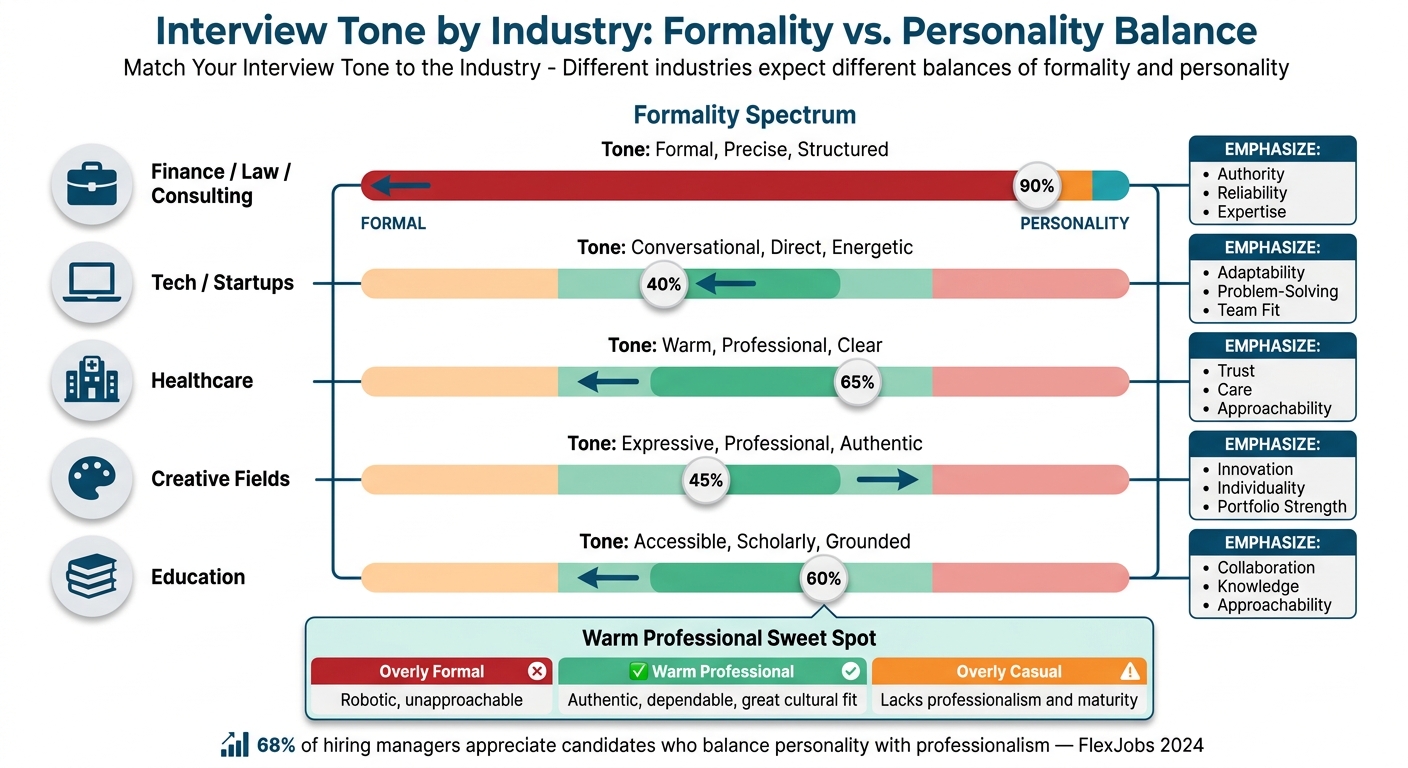
Interview Tone by Industry: Formality vs. Personality Balance
Matching your tone to the industry and company you're interviewing with is key to making a strong impression. Different industries call for distinct approaches - a law firm, for example, demands a more formal tone compared to a startup.
Formality Levels Across Industries
Every industry falls at a different point on the formality spectrum, requiring a thoughtful approach rather than a one-size-fits-all style. Here's a quick breakdown:
| Industry | Expected Tone | What to Emphasize |
|---|---|---|
| Finance / Law / Consulting | Formal, precise, structured | Authority, reliability, expertise |
| Tech / Startups | Conversational, direct, energetic | Adaptability, problem-solving, team fit |
| Healthcare | Warm, professional, clear | Trust, care, approachability |
| Creative Fields | Expressive, professional, authentic | Innovation, individuality, portfolio strength |
| Education | Accessible, scholarly, grounded | Collaboration, knowledge, approachability |
Even within the same industry, companies can emphasize different traits. For instance, consulting firms like McKinsey, BCG, and Bain each have unique focuses: McKinsey values personal impact and reflection, BCG prioritizes intellectual curiosity, and Bain highlights teamwork and data-driven results.
How to Read a Company's Culture Before the Interview
Start by exploring the company's "About Us" and "Careers" pages. The language they use can reveal a lot. This research helps you master interview prep questions by aligning your answers with their core values. A company that highlights "radical openness" likely has a very different culture from one that stresses "professional integrity".
"We don't care if you know the words on the wall. We care if you use those words to make hard choices when you are on your own." - Recruiter Perspective, Cruit Team
Next, check their LinkedIn and social media profiles. Are their posts polished and formal, or casual and conversational? This can give you insight into their communication style. Reviewing the LinkedIn profiles of your interviewers can also help you gauge their tone and approach before the interview.
For example, candidates preparing for Figma's 2026 internship program in August 2025 used the company's engineering blog and the "Figma Sans" design story to understand that Figma values craftsmanship and high-quality standards over speed. These insights helped them adjust their tone for the interview.
Adjusting for Company Size and U.S. Region
Beyond industry norms, company size also shapes the tone you should adopt. Startups often favor a conversational and flexible approach. Interviews may be led by founders or direct teammates and focus on your ability to wear multiple hats and make an immediate impact. In contrast, corporate interviews at larger firms are typically multi-stage and emphasize your track record, behavioral fit, and ability to navigate structured processes.
Geography matters, too. East Coast offices - like those in New York or Boston - tend to prefer fast, direct communication with minimal small talk. West Coast offices in California are generally more laid-back and collaborative, with longer personal exchanges before diving into business. Meanwhile, Southern states such as Texas and Florida value warmth and personal rapport, where skipping pleasantries might come across as abrupt. Even within the same company, regional offices can have distinct cultures, so researching the specific location of your interview is always a good idea as part of perfecting your interview preparation.
How to Structure Answers That Are Both Professional and Personal
Using the STAR Method
The STAR method - Situation, Task, Action, Result - is a simple yet effective way to organize your answers using interview questions and answers samples to help interviewers follow your thought process. Many modern interviews now incorporate STAR+R, with the "Reflection" step added at the end. This final piece is where you can let your personality shine, sharing what you learned and how the experience influenced your professional growth. Keep the context brief, focus on your actions, and wrap up with concise results and reflections.
This structure provides a solid foundation for weaving in your unique perspective.
Adding a Personal Touch to Structured Answers
To make your answers more engaging, highlight your decision-making process. Begin with an attention-grabbing hook, then explain why you chose a specific course of action. This approach not only captures interest but also reveals your judgment and values. For example, in the Action section, you could say: "I had two choices - escalate the issue immediately or draft a one-page proposal first. I went with the proposal because it gave the other team something concrete to consider." This small detail gives insight into your thought process and communication style.
Don’t shy away from using "I" to clearly emphasize your individual contributions.
Getting the Language Balance Right
Striking the right tone is essential for blending professionalism with authenticity. Even small word choices can make a big difference in how your response comes across:
| Aspect | Too Formal / Robotic | Balanced & Personal | Too Casual |
|---|---|---|---|
| Opening | "The situation was..." | "Back in 2024, I noticed..." | "So, there was this one time..." |
| Ownership | "The team achieved X." | "I led the migration by..." | "We just kind of did it." |
| Details | "I used various tools." | "I used Flink and Kafka to..." | "I used some tech stuff." |
| Reflection | "The goal was met." | "What I learned from this was..." | "It was a cool experience." |
Adding specific details - like dates, team sizes, or measurable outcomes - can make your story more relatable and believable. For example, saying "In July 2024, while working on a team of four," provides a clear and vivid context for your narrative.
"Used correctly, STAR helps you stay concise and confident. Used poorly, it can sound robotic. The goal is clarity, not memorisation." To practice these techniques, you can use an AI interview answer generator to refine your responses. - Tom Otto, ESL Instructor and Data Engineer
Using Nonverbal Communication to Project Confidence and Warmth
Projecting confidence and warmth during an interview goes beyond your words - how you present yourself physically and vocally matters just as much, which is why many candidates practice their interview with AI to refine these cues. Studies reveal that 55% of a first impression is based on visual cues, like posture and movement, while only 7% is influenced by what you say. Essentially, your body language speaks volumes before you even answer a question.
Body Language and Eye Contact
Small tweaks to your posture and gestures can significantly impact how you're perceived. Sit upright with open arms, lean forward slightly (10–15 degrees) to show interest, and keep your hand movements within the "strike zone" - the area between your waist and shoulders. These gestures are linked to higher perceived credibility.
For eye contact, aim to maintain it 50% of the time while speaking and 70% while listening. This balance demonstrates engagement and confidence without appearing too intense.
"When your words and body language conflict, people believe your body every time." - Science of People
Candidates who smile, lean in, and hold steady eye contact are more likely to advance to the next interview rounds. Pairing strong body language with effective vocal delivery enhances your overall presence.
How to Use Your Voice and Pace
Your voice plays a crucial role in how others perceive your confidence. Speak at a steady pace of 140–160 words per minute, enunciate clearly, and avoid filler phrases like "uh" or "like". Avoid "uptalk" (raising your pitch at the end of sentences), which can lower perceived confidence by 25%. Instead, use a falling intonation to convey authority and slightly lower your pitch to foster trust.
Take a two-second pause before responding to questions. This not only shows you’re thoughtful but also gives you control over the conversation.
"Whoever controls the quiet moments controls the talk." - Cruit Team
If you need time to think, replace fillers with composed phrases like, "That's a great question. Let me take a moment to find the best example." This keeps the tone professional and deliberate.
Mastering small talk is another key part of nonverbal communication, especially in U.S. interviews.
Handling Small Talk in U.S. Interviews
In the U.S., small talk is more than casual chatter - it’s often a "vibe check". It helps interviewers assess your social skills and how well you might fit with the team. Interestingly, informal conversations now make up about 40% of first-round interviews at mid-market companies, compared to just 18% in 2019.
Stick to neutral, light topics like recent company achievements, office observations, or shared professional interests. Keep your initial responses short - around 10 seconds - before elaborating.
"Interviews aren't just about proving you can do the job - they're also about showing you're someone people would actually want to work with." - Yale School of Management
Avoid personal topics like finances, politics, or religion, and steer clear of negativity, such as complaints about traffic or past employers. These subjects can derail the conversation and distract from your strengths. Instead, focus on creating a warm, positive interaction that sets the tone for the rest of the interview.
How to Practice and Improve Your Interview Balance
Once you've nailed down your nonverbal cues, the next step is refining your overall interview balance. This means finding the sweet spot between being professional and letting your personality shine.
Mock Interviews and Self-Assessment
Understanding the balance between formality and personality is one thing - delivering it under pressure is another. That’s where mock interviews come in. They help ease nerves by simulating the real experience, allowing you to focus more on building rapport and less on feeling tense.
Here’s how to make your practice sessions more effective: try answering the same set of questions in three different styles - formal, casual, and balanced. Record yourself on video for each version, then review and compare. You’ll quickly spot where you come across as confident and approachable, and where you might sound too stiff or overly relaxed.
After each session, evaluate yourself on key aspects like language, warmth, clarity, conciseness, and confidence using a 1–5 scale. Be specific about your observations. For example: "Clarity 3/5 - I answered the question, but I rambled and didn’t get to the point quickly." Repeating this across a few sessions will help you identify patterns and focus on areas where you can improve.
Using Acedit for Real-Time Interview Coaching
While mock interviews with a friend or mentor are invaluable, they aren’t always an option - especially if you’re cramming the night before an interview. That’s where Acedit can step in as a handy tool.
Acedit is an AI-powered Chrome extension that offers real-time coaching during video interviews on platforms like Zoom, Microsoft Teams, and Google Meet. It listens to the questions you’re asked and provides AI-generated response suggestions that you can adapt to your style. For prep work, you can feed it specific job descriptions and company details to generate tailored question sets. For instance, it might suggest more formal phrasing for a corporate finance role or a conversational tone for a startup position.
Additionally, Acedit lets you run AI-simulated practice interviews with timed questions. This helps you master the 1–2 minute answer length that’s typically expected in U.S. interviews. Its LinkedIn integration even aligns its coaching with your professional profile, ensuring responses that feel authentic to your experience. Acedit offers a free plan to get started, with premium options priced at $45 or $75 - no subscription required.
Using tools like Acedit alongside your self-assessment can help you refine your approach and boost your confidence.
Reflecting After Each Interview
Your practice shouldn’t stop once the interview ends. Within 24 hours, take a moment to reflect on how it went. Use a simple framework: write down three things that went well, two areas for improvement, and one specific action for next time.
Think about moments that felt awkward or off. Did you start with overly rehearsed language before settling in? Did a joke fall flat? Or maybe you shared a personal detail that didn’t quite tie back to the role? These reflections help you fine-tune your balance for future interviews.
Over time, tracking these observations across multiple interviews will reveal patterns in your natural tendencies. You’ll learn how to adjust your approach depending on the company or industry, ensuring you always strike the right tone.
Conclusion: How to Get the Balance Right Every Time
Striking the right balance between formality and personality in interviews is a skill that takes practice. Interviewers are assessing two key things at once - your ability to do the job and whether you'll fit in and stay motivated. Since your personality plays a role in both, leaning too far into extreme professionalism or being overly casual can work against you.
The trick is to adjust based on the situation. Whether you're delivering a detailed answer about finance or sharing a relaxed story about a startup experience, aligning your tone with the company's culture is crucial. Tools like the STAR method can help you stay on track while letting your personality shine through.
But remember, interviews are just one part of the equation. How you perform in an interview doesn't necessarily determine how you'll perform on the job. Research consistently highlights that Conscientiousness - being prepared, offering structured answers, and following through - is the most reliable predictor of job success across almost every profession. While showing warmth and enthusiasm helps build rapport, preparation and substance are what ultimately seal the deal.
For extra support, consider tools like Acedit, which provides real-time, context-aware coaching. With 87% of users feeling more confident and 84% seeing improved performance, targeted practice can make a noticeable difference.
At the end of the day, the goal isn’t to perform as someone you're not - it’s to present yourself clearly and confidently in a way that matches the context. This takes honest self-reflection, practice, and a willingness to adapt. Over time, finding that balance between professionalism and authenticity will feel natural. And when it does, you'll not only leave a lasting impression but also showcase your true abilities in the best possible light. You can further distinguish yourself by asking powerful interview questions that demonstrate your engagement and insight.
FAQs
How can I tell if I’m sounding too formal or too casual?
If your interview responses come across as overly stiff, packed with jargon, or unnecessarily complex, you might be leaning too formal. On the flip side, using too much slang, filler words, or being overly familiar can make you sound too casual. Think about how you'd write a well-thought-out email - clear, professional, but approachable. Tools like Acedit provide real-time coaching and simulations to help you strike that perfect balance and boost your confidence.
What’s the easiest way to adapt my tone to a company’s culture?
Using AI tools like Acedit makes it simple to analyze a company's communication style. Acedit reviews things like job descriptions, social media posts, and corporate materials to help you determine the appropriate level of formality. It also offers personalized, context-aware suggestions, making it easier to match your tone to the company's culture while still being genuine and engaging during interviews.
How can I show personality in a remote interview without overdoing it?
To let your personality shine in a remote interview, aim to be genuine while keeping things professional. Stick to your natural communication style - if you're naturally energetic, let that enthusiasm come through, and if you're more reserved, focus on building rapport through attentive listening. Small actions like smiling, nodding, and using natural gestures can help create a warm, human connection. Be careful not to overshare personal details, and if you're unsure about your tone or body language, tools like Acedit can provide helpful real-time feedback to find the right balance.