
Le coaching IA en temps réel transforme la façon dont les gens se préparent aux entretiens d'embauche en fournissant des retours instantanés et personnalisés lors des appels vidéo. Voici pourquoi cela fonctionne :
- Réduction de l'anxiété : 92 % des candidats ressentent de l'anxiété lors des entretiens, mais les outils IA aident à calmer les nerfs en offrant un soutien immédiat.
- La confiance compte : 75 % des responsables du recrutement privilégient la confiance, et le coaching IA augmente la confiance perçue jusqu'à 94 %.
- Conseils personnalisés : En analysant votre CV, votre profil LinkedIn et la description du poste, ces outils suggèrent des réponses personnalisées en temps réel.
- Amélioration des performances : Les utilisateurs constatent une augmentation de 40 % de la qualité des réponses et une augmentation de 35 % de la confiance lors des simulations.
- Retours en temps réel : L'IA évalue le ton, le rythme et les mots de remplissage, vous aidant à vous ajuster sur place.
Des plateformes comme Acedit simulent même des scénarios d'entretien réalistes, aidant les candidats à pratiquer et à affiner leurs compétences. Avec des taux d'adoption en croissance de 300 % depuis 2023, cette technologie devient une solution incontournable pour les demandeurs d'emploi qui cherchent à se démarquer.
Préparation aux entretiens : outils IA pour renforcer la connexion et la confiance
Comment fonctionne le coaching IA en temps réel
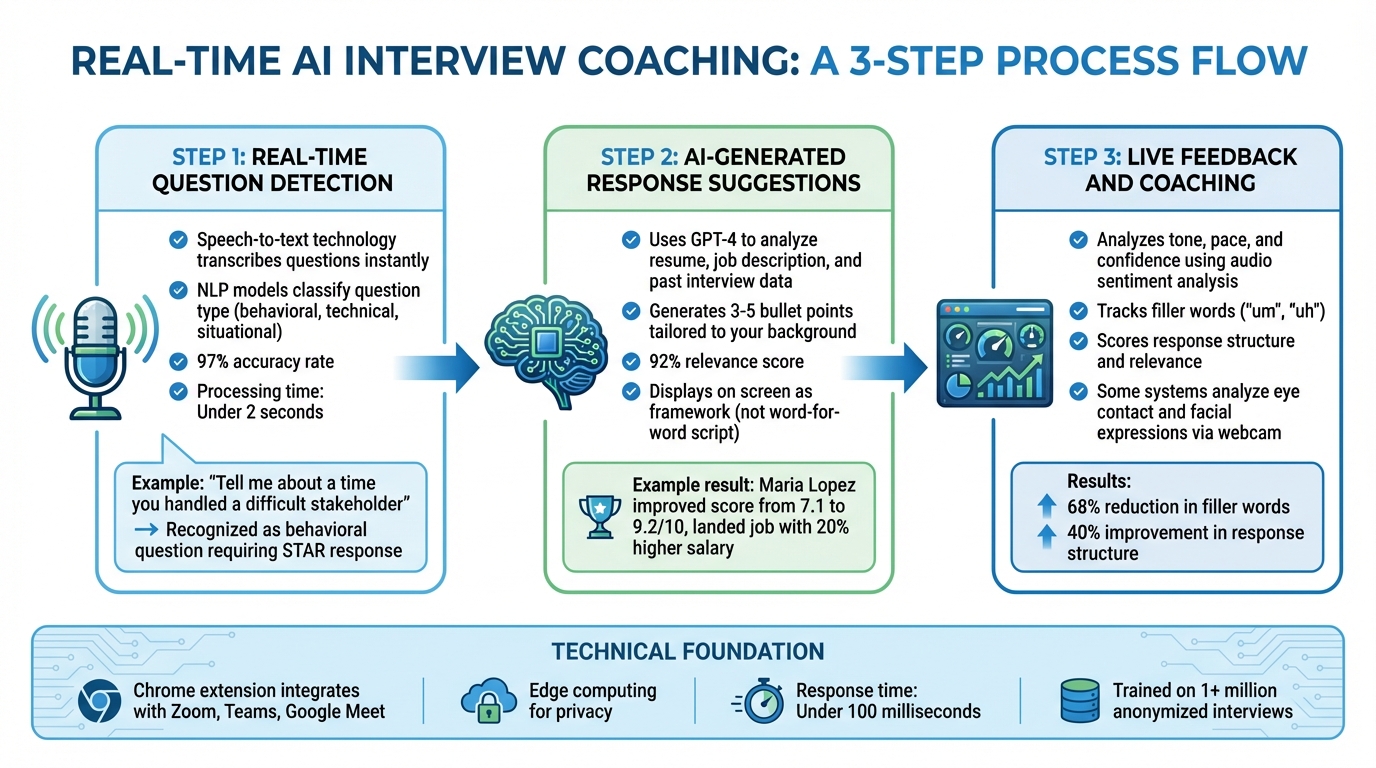
Le coaching IA en temps réel utilise une extension Chrome qui s'intègre de manière transparente aux outils de vidéoconférence basés sur navigateur comme Zoom, Microsoft Teams et Google Meet. Cette technologie fonctionne pendant votre entretien, en analysant les questions au fur et à mesure qu'elles sont posées et en offrant des conseils privés et instantanés. Elle combine la transcription vocale en texte, le traitement du langage naturel (NLP) et les grands modèles de langage (LLM) pour fournir un coaching personnalisé en moins de deux secondes.
Pour commencer, vous téléchargez votre CV, votre profil LinkedIn et la description du poste, créant ainsi une base de connaissances personnalisée. Pendant l'entretien, l'IA écoute, détecte les questions à l'aide de modèles NLP entraînés sur plus d'un million d'entretiens anonymisés, et les croise avec vos antécédents pour générer des suggestions de réponses personnalisées. Tout cela se fait localement, grâce à l'informatique en périphérie, garantissant votre confidentialité et maintenant les temps de réponse en dessous de 100 millisecondes.
Ce traitement en temps réel équipe les candidats pour gérer les entretiens sous haute pression avec une plus grande confiance.
Détection des questions en temps réel
L'IA utilise la technologie de transcription vocale en texte pour transcrire instantanément les questions au fur et à mesure qu'elles sont prononcées. Ses modèles NLP classifient ensuite chaque question - qu'elle soit comportementale, technique ou situationnelle - en deux secondes, avec un taux de précision impressionnant de 97 %. Cela permet au système de comprendre l'intention et le format de la question.
Par exemple, si un recruteur dit : « Parlez-moi d'une fois où vous avez géré un client difficile », l'IA la reconnaît comme une question comportementale qui appelle une réponse STAR (Situation, Tâche, Action, Résultat). Elle s'appuie ensuite sur des exemples de votre historique professionnel téléchargé, en s'assurant que vous êtes préparé à répondre avec confiance et à éviter ces moments de blanc gênants.
Une fois la question identifiée, l'IA passe rapidement à la création d'une réponse personnalisée.
Suggestions de réponses générées par l'IA
Après avoir reconnu la question, l'IA élabore une réponse personnalisée. En utilisant des modèles de langage avancés comme GPT-4, elle analyse votre CV, la description du poste et les données d'entretiens antérieurs pour générer des réponses qui mettent l'accent sur vos qualifications uniques et vos expériences pertinentes. Ce ne sont pas des scripts génériques - ce sont des suggestions personnalisées avec un score de pertinence de 92 %, s'alignant avec les recommandations d'experts 92 % du temps.
L'IA affiche 3 à 5 points à puces sur votre écran, fournissant un cadre que vous pouvez reformuler naturellement au lieu de lire mot pour mot. Prenez l'exemple de Maria Lopez, une ingénieure logiciel qui a utilisé Acedit en mars 2025 lors d'un entretien chez Google. Quand on lui a demandé : « Parlez-moi d'un projet difficile », l'IA a généré trois suggestions spécifiques basées sur son CV. Elle les a incorporées dans sa réponse, améliorant sa note moyenne de 7,1 à 9,2 sur 10. Le résultat ? Elle a décroché le poste avec un salaire 20 % au-dessus du taux du marché.
Retours en direct et coaching
En plus de générer des réponses, l'IA offre des retours en temps réel sur votre performance lors de l'entretien. Elle évalue votre ton, votre rythme et votre confiance en utilisant l'analyse du sentiment audio, suit les mots de remplissage comme « euh » et « hum », et évalue la structure et la pertinence de vos réponses. Certains systèmes analysent même les indices non verbaux comme le contact visuel et les expressions faciales via votre webcam.
Ces retours immédiats vous permettent de faire des ajustements pendant l'entretien. Les données montrent que le coaching en temps réel réduit les mots de remplissage de 68 % et améliore les scores de structure des réponses de 40 % lors des séances de pratique. C'est comme avoir un filet de sécurité, vous aidant à rester composé même face à des questions inattendues.
M'a aidé à me préparer et puis le jour J, les suggestions en direct pendant l'entretien m'ont permis de réussir.
Renforcer la confiance par la pratique et la simulation
L'impact de la répétition et des retours
La répétition est essentielle pour réduire l'anxiété lors des entretiens et renforcer la confiance. La pratique régulière avec les outils IA vous aide à devenir plus familier avec les scénarios d'entretien, les rendant moins intimidants. Selon un rapport 2024 de LinkedIn Learning, 70 % des demandeurs d'emploi ont connu une anxiété réduite après avoir utilisé des outils de pratique d'entretien IA, et 85 % ont signalé une fluidité de réponse améliorée après seulement trois séances.
Un avantage majeur du coaching IA est les retours instantanés qu'il fournit. Contrairement aux méthodes traditionnelles où les retours pourraient prendre des jours, les outils IA analysent votre performance sur place. Une étude 2023 de l'Université du Michigan a révélé que la pratique de simulation répétée avec l'IA a entraîné une réduction de 32 % des mots de remplissage comme « euh » et « genre » et une amélioration de 28 % des réponses structurées. Ces retours immédiats renforcent les habitudes de communication efficaces et affûtent votre livraison.
Les Glassdoor AI Insights de 2025 ont révélé que les utilisateurs qui ont complété 10 séances de pratique pilotées par l'IA ont vu une amélioration moyenne de 40 % des scores des entretiens simulés. Cette progression se traduit directement par une meilleure performance en utilisant des stratégies d'entretien éprouvées. Le renforcement de la confiance vient du fait de savoir que vous avez déjà abordé des questions similaires plusieurs fois, rendant l'expérience réelle plus gérable.
Simulation de scénarios d'entretien réalistes
Les outils IA vont au-delà de la pratique générique en simulant des environnements d'entretien réalistes. Ces simulations génèrent des questions de préparation aux entretiens adaptées à votre CV et au poste que vous visez. Au lieu de listes de questions statiques, les outils s'adaptent en temps réel, offrant des questions de suivi dynamiques similaires à ce que vous rencontreriez lors d'un entretien en direct. Cela vous prépare au flux imprévisible des conversations réelles, où une réponse peut mener à des investigations plus approfondies.
Des plateformes comme Acedit vont plus loin en répliquant divers formats d'entretien, y compris les entretiens comportementaux, techniques, d'étude de cas et en panel. En utilisant votre webcam, l'IA évalue à la fois la communication verbale et non verbale, en analysant des éléments comme les expressions faciales, le contact visuel et même les micro-expressions subtiles. Ce type de retour, souvent négligé dans les méthodes traditionnelles, aide à affiner votre présentation globale.
Pour ceux qui cherchent à maximiser leur préparation, le plan Premium Plus d'Acedit offre des entretiens de pratique simulés par l'IA illimités pour un paiement unique de 75 $. Cela vous permet de répéter différents scénarios jusqu'à ce que vous vous sentiez pleinement préparé. Les résultats parlent d'eux-mêmes : 89 % des utilisateurs signalent des améliorations de performance mesurables après seulement trois séances, et les utilisateurs réguliers connaissent des niveaux de confiance 3,2 fois plus élevés lors des entretiens réels. Comme l'a partagé Emily Thompson :
Le coaching pratique aligné sur des scénarios du monde réel a renforcé ma préparation aux entretiens.
Utiliser le coaching IA en temps réel dans votre stratégie d'entretien
Portez votre préparation aux entretiens au niveau supérieur en intégrant l'IA à votre stratégie d'une manière qui semble transparente et naturelle.
Préparation aux entretiens avec les outils IA
Commencez par installer Acedit et le synchroniser avec votre profil LinkedIn et votre CV. Cela permet à l'IA de générer des questions de pratique adaptées à votre historique professionnel et au poste spécifique que vous visez. En analysant l'offre d'emploi, l'outil crée des questions ciblées qui couvrent les scénarios comportementaux, techniques et situationnels - essentiellement en miroir ce que vous rencontrerez lors de l'entretien réel.
Visez 3 à 5 séances de simulation d'entretien IA par entretien. Cet équilibre vous aide à renforcer votre confiance sans surpréparation. Écrivez vos réponses et soumettez-les pour des retours IA instantanés. L'outil évalue votre structure, vos mots-clés et votre ton, vous aidant à affiner vos réponses. Pour rester organisé, utilisez la méthode STAR (Situation, Tâche, Action, Résultat) pour encadrer vos réponses. Votre objectif ? Atteindre des scores de préparation de 80 à 90 % avant le grand jour. Ce processus itératif non seulement affûte votre livraison mais réduit également les erreurs jusqu'à 40 %, en s'assurant que vos réponses se sentent polies mais authentiques.
Une autre excellente fonctionnalité est le téléchargement de vos histoires professionnelles les plus pertinentes. En faisant cela, l'IA peut adapter ses suggestions en fonction de vos réalisations réelles, rendant ses retours plus spécifiques et moins génériques.
Une fois que vos séances de pratique ont renforcé vos réponses, vous êtes prêt à profiter du coaching en temps réel pendant l'entretien lui-même.
Utiliser le coaching en temps réel pendant les entretiens
Pour l'entretien réel, configurez l'extension IA sur un écran secondaire ou dans votre navigateur. Que vous utilisiez Zoom, Microsoft Teams ou Google Meet, l'outil fonctionne discrètement, reconnaissant les questions en temps réel et offrant des suggestions en points à puces lors de brèves pauses. Pour garder les choses naturelles, limitez les coups d'œil aux suggestions à 10-15 secondes par réponse - cela garantit que vous maintenez le contact visuel et restez composé.
Pensez à l'IA comme un « coach qui chuchote » plutôt qu'un script. Utilisez ses suggestions pour rafraîchir votre mémoire ou organiser vos pensées, mais livrez vos réponses avec votre propre voix. Cette méthode est particulièrement utile pour gérer les questions inattendues. Au lieu de vous figer, vous aurez un filet de sécurité pour vous guider. Les utilisateurs ont signalé un renforcement de la confiance de 35 % quand ils utilisent les suggestions IA pour combler les lacunes lors de moments nerveux plutôt que de s'y fier mot pour mot. Pour rendre ce processus transparent, pratiquez avec cette technique lors de vos simulations afin qu'elle devienne une seconde nature et ne perturbe pas votre flux.
Mesurer les améliorations de confiance et de performance
L'évaluation des performances est une partie clé de la consolidation de la confiance acquise grâce au coaching IA en temps réel. Après l'adoption d'outils de coaching IA, il est crucial de mesurer leur impact. Des outils comme Acedit simplifient cela en suivant automatiquement votre progression via des tableaux de bord de performance. Ces tableaux de bord offrent une vue claire des métriques critiques au fil du temps, en analysant des facteurs comme la qualité des réponses et l'efficacité de la méthode STAR [5]. Cela vous donne des données tangibles pour suivre votre croissance [7].
Suivi de la progression avec les métriques IA
Acedit utilise une échelle de 1 à 5 pour évaluer les réponses selon des dimensions telles que la substance, la structure et la pertinence [6]. Cette approche vous aide à vous concentrer sur vos forces et les domaines nécessitant une amélioration. Par exemple, vous pourriez obtenir un 5 pour la pertinence mais seulement un 3 pour la structure, signalant le besoin d'affiner la façon dont vous appliquez le cadre STAR. De plus, l'outil suit la fréquence à laquelle vous adoptez ses suggestions - les utiliser plus de 70 % du temps indique un alignement avec votre style de communication [4].
Les chiffres parlent d'eux-mêmes : 94 % des utilisateurs signalent une confiance accrue, et 88 % constatent des améliorations notables dans la qualité de leurs réponses [1]. Ces gains sont soutenus par des scores générés par l'IA qui mesurent la progression séance après séance. Acedit surveille également l'« écart de précision de l'auto-évaluation », qui met en évidence les différences entre la façon dont vous percevez votre performance et vos résultats réels. Cette fonctionnalité renforce la conscience de soi et vous aide à vous concentrer sur les améliorations ciblées [6].
Utiliser les insights pour identifier les domaines de croissance
Armé d'analyses détaillées, le coaching IA en temps réel identifie les défis spécifiques qui vous retiennent. Les résumés de performance d'Acedit examinent votre profil LinkedIn, votre CV et vos réponses de pratique pour découvrir les lacunes entre votre expérience et les exigences du poste. Par exemple, si vos réponses obtiennent systématiquement un score faible en différenciation, la plateforme signale cela comme un domaine sur lequel travailler.
Élargir la variété des questions avec lesquelles vous vous sentez à l'aise de répondre est un autre signe de confiance croissante - à la fois en vous-même et dans l'outil IA [4]. Des métriques comme la fréquence à laquelle vous revisitez la plateforme au cours d'une semaine montrent davantage une confiance croissante dans ses recommandations [4]. Avec plus de 15 000 questions pratiquées par des professionnels, ces insights non seulement affinent vos stratégies d'entretien mais conduisent également à plus de confiance et à de meilleurs résultats professionnels [1].
Conclusion
Le coaching IA en temps réel transforme la préparation aux entretiens en s'attaquant à l'un des plus grands obstacles : la confiance. Avec des outils comme Acedit, vous obtenez un soutien instantané lors de moments critiques, vous aidant à éviter de vous figer ou d'oublier vos paroles. En adaptant les suggestions de réponses en fonction de votre CV, de votre profil LinkedIn et de la description du poste, ces outils garantissent que vos réponses se sentent naturelles et reflètent votre voix - pas seulement des conseils génériques [3].
Les chiffres racontent l'histoire : 94 % des utilisateurs se sentent plus confiants, 88 % remarquent une qualité de réponse améliorée, et 76 % signalent des taux de réussite plus élevés aux entretiens [1]. Comme l'a dit Ethan Brown :
Le copilote d'entretien IA m'a donné la confiance dont j'avais besoin pour aborder les questions difficiles, et cela m'a aidé à décrocher un emploi de rêve dans son domaine [2].
Ce qui rend cette approche remarquable est la façon dont elle comble la pratique et la performance. Grâce à des entretiens simulés illimités et des retours ciblés, vous ne vous préparez pas seulement pour le prochain entretien - vous construisez des compétences pour le long terme.
Que vous optiez pour le plan gratuit ou que vous investissiez 75 $ pour un accès premium, vous obtenez plus qu'un outil. Vous gagnez des cadres structurés, améliorez vos compétences en communication et renforcez votre conscience de soi - des ingrédients clés pour la croissance professionnelle. Avec plus de 15 000 questions pratiquées par des professionnels et une note utilisateur de 4,8/5, cette plateforme montre que la confiance grandit avec la préparation et le bon soutien [1].
FAQ
Est-il autorisé d'utiliser le coaching IA en temps réel lors d'un entretien ?
Oui, l'utilisation du coaching IA en temps réel lors d'un entretien est possible. Cet outil fonctionne discrètement, en analysant les questions et en offrant des suggestions de réponses personnalisées. Il garantit que vous restez composé et préparé sans attirer l'attention du recruteur.
Comment Acedit protège-t-il la confidentialité de mon CV et de mes données d'entretien ?
Acedit privilégie votre confidentialité en s'assurant que tous les outils IA - tels que la détection des questions et les suggestions de réponses - restent entièrement cachés aux recruteurs. Ces fonctionnalités fonctionnent de manière transparente en temps réel lors des entretiens sans envoyer vos données en dehors de la plateforme ou les partager avec des tiers.
L'utilisation de suggestions IA me fera-t-elle sonner comme un script ?
Les suggestions IA visent à rendre les réponses plus naturelles et pertinentes. En fournissant des suggestions spécifiques au contexte qui s'alignent sur vos antécédents et la question posée, elles aident à éviter un ton scriptural et encouragent une communication confiante et authentique.