
Want your engineering resume to stand out? Here’s the key: Use customizable templates designed for your field, ensure ATS compatibility, and focus on measurable achievements.
Why it matters:
- Over 98% of Fortune 500 companies use Applicant Tracking Systems (ATS) to filter resumes.
- Specialized templates outperform generic ones by 37% in technical hiring.
- Recruiters spend just 7.4 seconds scanning a resume - precision is critical.
What to do:
- Use ATS-friendly formatting: Stick to simple layouts, standard fonts, and avoid tables or graphics.
- Highlight technical skills: Include tools, programming languages, and methodologies relevant to your discipline.
- Show measurable results: Use metrics to quantify achievements (e.g., "Reduced costs by 18%").
- Tailor for the job: Match keywords and skills from the job description.
Key sections to include:
- Contact information
- Professional summary (2–3 sentences showing expertise or goals)
- Technical skills (grouped by category)
- Work experience (focus on accomplishments using the STAR method)
- Education, certifications, and licenses (e.g., P.E., PMP, AWS)
Pro tip: Save your resume as a .docx file for better ATS compatibility. Use AI tools to refine content and simulate ATS scans.
Takeaway: A well-crafted, discipline-specific resume with ATS-friendly design and quantifiable achievements can significantly boost your chances in today’s competitive engineering job market.
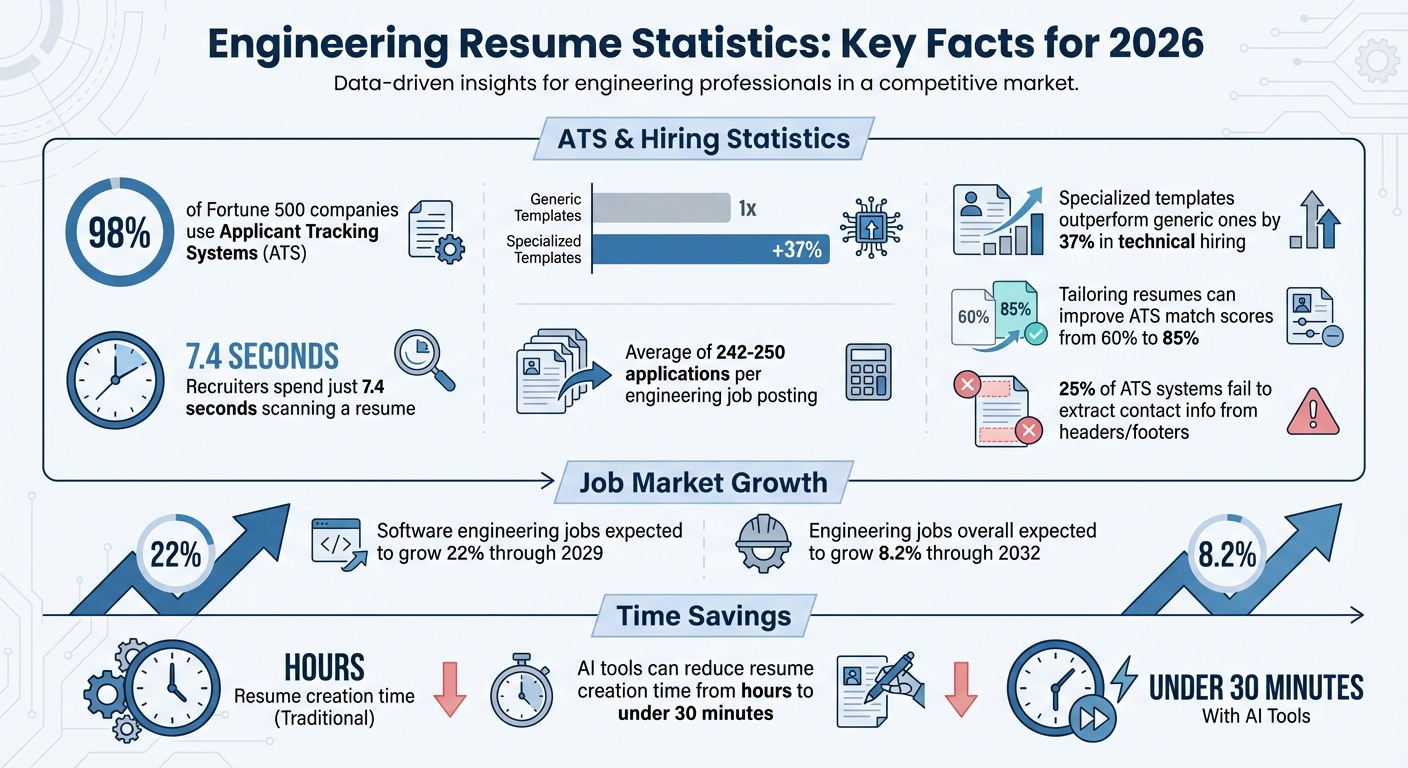
Engineering Resume Statistics: ATS Success Rates and Recruiter Behavior
The Best Resume Template for ATS Scanners in 2025 (Sample Template and Examples)
What to Include in Your Engineering Resume
Your engineering resume should paint a clear picture of your technical skills and professional accomplishments. With recruiters spending an average of just 7.4 seconds on their initial scan, every section needs to deliver critical information effectively.
Start with your contact information, including your full name, professional title (e.g., "Software Engineer" or "Civil Engineer"), phone number, professional email, city and state, and links to relevant profiles like LinkedIn or GitHub.
Next, include a professional summary or objective. This is your elevator pitch: 2–3 sentences that set the tone for the rest of your resume. Experienced engineers should use this section to emphasize years of experience and notable achievements. Recent graduates, on the other hand, can focus on their skills and career goals. Follow this with a technical skills section, where you list your expertise in tools, programming languages, and methodologies.
Your work experience should be listed in reverse-chronological order, with bullet points that highlight measurable achievements rather than just tasks. Include your education, noting your degree, university, graduation year, and any honors. If you're a recent graduate and your GPA is above 3.5, include it.
Finally, add certifications, licenses, and professional affiliations. Credentials like Professional Engineer (PE) or specialized certifications such as PMP or CMfgE can establish your credibility. If you're licensed, adding "P.E." after your name in the header can immediately showcase your qualifications. A section on projects or professional memberships (e.g., IEEE, ASME) can also demonstrate your hands-on experience and dedication to the field.
Professional Summary
The professional summary is a quick snapshot of your experience and accomplishments. Think of it as a way to introduce yourself, your expertise, and the value you bring.
For seasoned engineers, this section should highlight years of experience and specific results. For example:
"Mechanical Engineer with 8+ years optimizing HVAC systems for commercial buildings, delivering a 22% average reduction in energy costs across 15+ projects."
This approach immediately communicates your role, experience, and measurable impact.
If you're a recent graduate or switching careers, focus on your skills and goals instead. For example:
"Recent Civil Engineering graduate with hands-on experience in AutoCAD Civil 3D and structural analysis, seeking to apply sustainable design principles in transportation infrastructure projects."
Avoid generic statements like "hardworking engineer." Instead, let your accomplishments and technical focus do the talking.
Skills and Technical Expertise
The technical skills section showcases your proficiency with tools, software, and methodologies. Organizing your skills into categories makes it easy for both ATS systems and hiring managers to spot your expertise.
Here’s how you might group your skills:
- Programming Languages: Python, Java, C++
- Software: AutoCAD, MATLAB, SolidWorks
- Cloud/DevOps: AWS, Docker, Kubernetes
- Methodologies: Lean Six Sigma, Agile, HAZOP
Using both full terms and acronyms (e.g., "Application Programming Interface (API)") ensures your skills are recognized regardless of how they’re searched.
| Engineering Discipline | Key Technical Skills |
|---|---|
| Civil Engineering | AutoCAD Civil 3D, MicroStation, HEC-RAS, Roadway Design |
| Mechanical Engineering | SolidWorks, MATLAB, Finite Element Analysis (FEA), Thermodynamics |
| Electrical Engineering | PLC Programming, Circuit Design, PSpice, Embedded Systems |
| Software Engineering | Python, Java, Kubernetes, Docker, AWS/Cloud Architecture |
| Chemical Engineering | Aspen Plus/HYSYS, Process Control, HAZOP, RCA |
Don’t forget soft skills like leadership, teamwork, and communication. While technical know-how is crucial, these interpersonal abilities often tip the scales for roles that blend technical and managerial responsibilities.
Work Experience and Achievements
Your work experience section should focus on accomplishments, not just responsibilities. Use the STAR method (Situation, Task, Action, Result) to detail your contributions and quantify your impact.
For example, instead of saying "Responsible for testing equipment", you could write:
"Developed automated testing procedures, achieving a 30% reduction in testing time."
Or, instead of "Managed production line", try:
"Led a cross-functional team of 12 to redesign a production line, reducing bottlenecks by 15% and saving $200,000 annually in material costs."
Each job entry should include the company name, your role, employment dates, and 3–5 bullet points highlighting your key achievements. Start each bullet with a strong action verb like "Designed", "Implemented", or "Spearheaded" to convey initiative and impact.
Education and Certifications
The education section establishes your academic foundation, while certifications and licenses validate your professional qualifications. Include your degree title, university, graduation year, and any honors or distinctions. If you’re a recent graduate, you can also list relevant coursework and your GPA (if it’s above 3.5).
Certifications are especially important in regulated fields like civil or mechanical engineering. A Professional Engineer (PE) license, for instance, is often legally required for certain roles and immediately demonstrates your qualifications. Other valuable credentials might include:
- Engineer-In-Training (EIT)
- Certified Manufacturing Engineer (CMfgE)
- Project Management Professional (PMP)
- AWS Solutions Architect
- Certified SolidWorks Professional (CSWP)
Highlight these certifications prominently - either in a dedicated section or next to your name. For example, a licensed engineer might write "John Doe, P.E." at the top of their resume.
For technology-focused roles, cloud certifications like AWS Solutions Architect or Certified Kubernetes Administrator (CKA) can be essential. Similarly, industrial engineers might benefit from Lean Certification or a Six Sigma Black Belt, while electrical engineers could showcase credentials like Certified Electronics Technician (CET) or IPC Certification.
Memberships in professional organizations such as IEEE, ASME, or SAE also demonstrate your dedication to staying current in your field. These affiliations not only reflect your commitment but also keep you connected to the latest industry trends.
Engineering Resume Templates by Field
Create a resume that speaks directly to your engineering discipline. Using templates tailored to specific fields can help highlight the skills and terminology recruiters and Applicant Tracking Systems (ATS) are looking for. By focusing on the unique demands of each discipline, these templates ensure your qualifications stand out.
Software Engineering
Outline your expertise across programming languages like Java, Python, C++, and Ruby, as well as frameworks such as React, Node.js, and AngularJS. Don’t forget to include cloud technologies like AWS, Docker, and Kubernetes. To keep things organized, break your Technical Skills section into categories: Programming Languages, Frameworks, Cloud/DevOps, and Databases.
Include a dedicated Projects section with links to your GitHub or portfolio to provide tangible proof of your capabilities. Make sure your resume reflects your focus - whether it's backend, frontend, or full-stack development - and highlight experience with methodologies like Agile or microservices architecture. With software engineering jobs expected to grow by 22% through 2029 and each job posting attracting an average of 242 applications, these details can make a big difference.
Civil Engineering
Your resume should emphasize project management and structural design skills. Highlight tools like AutoCAD Civil 3D, Revit, Primavera, Suretrak, and STAAD Pro. When describing work experience, focus on specific projects. Include details like budgets, timelines, and compliance with building codes. Field inspection experience and involvement in transportation or sustainable design projects are also worth mentioning.
If you hold a Professional Engineer (PE) license, list "P.E." after your name in the header - it’s a quick way to show you meet the legal requirements for certain roles. These details, combined with the core resume structure, help you present a polished, targeted application.
Mechanical Engineering
Demonstrate your expertise in equipment design and thermal systems. Highlight familiarity with 3D CAD tools like SolidWorks and Pro-E CREO, along with skills in GD&T (Geometric Dimensioning & Tolerancing), FEA (Finite Element Analysis), and EPDMS.
Quantify your accomplishments wherever possible. For instance, instead of saying you improved efficiency, specify: "Increased manufacturing efficiency by 16% over two quarters while managing projects exceeding $100,000 in budget". Including these measurable results ensures your resume makes a strong impression.
Electrical Engineering
Focus on your skills in circuit design, power systems, and automation. Mention technical proficiencies like PLC programming (e.g., Siemens or Allen-Bradley systems), wiring diagram development, MATLAB/Simulink, and avionics troubleshooting.
Showcase achievements that demonstrate efficiency and innovation. For example, you might write: "Redesigned a product line, reducing manufacturing time by 30% in three months". Experience with embedded systems or PCB layout can also add value. Tailoring your resume to highlight these strengths ensures it aligns with industry expectations.
Manufacturing Engineering
Highlight your expertise in process optimization and quality assurance. Include experience with Lean Manufacturing, Six Sigma, production layouts, and workflow improvements. Use metrics to demonstrate your impact. For example, instead of a vague statement like "Managed production line", provide specifics:
"Led a cross-functional team to redesign a production line, reducing bottlenecks by 15% and saving $193,200 annually".
sbb-itb-20a3bee
How to Customize Your Engineering Resume Template
Think of a resume template as a starting point, not the final product. To stand out, you need to tailor it for every job you apply to. With over 98% of Fortune 500 companies relying on Applicant Tracking Systems (ATS), a generic resume can get filtered out before anyone even reads it.
Start by carefully analyzing the job description. Look for the key hard skills, soft skills, and certifications it mentions, and make sure your resume reflects those terms exactly. For instance, if the job calls for "AutoCAD", don’t use a broader term like "CAD software". Including both acronyms and full terms - like "FEA (Finite Element Analysis)" - is another smart way to ensure your resume aligns with ATS keyword searches.
Consider adding a "Core Skills" or "Technical Expertise" section near the top of your resume, right after your professional summary. This section should be easy to skim, with skills grouped into categories like "CAD & Design", "Analysis Tools", or "Cloud Platforms."
Making Your Resume ATS-Friendly
Content isn’t the only thing that matters - formatting plays a huge role too. Stick to a single-column layout and use standard fonts like Arial, Calibri, or Times New Roman. Avoid tables, graphics, or text boxes, as these can confuse ATS software. Use straightforward section headers like "Work Experience", "Education", and "Skills" to ensure your information gets categorized correctly.
"Many talented engineers get filtered out not because they lack skills, but because their resume formatting confuses the ATS or they're missing critical keywords." - The Interview Guys
Save your resume in a .docx file unless the job specifically asks for a PDF. Older ATS systems often process Word documents more reliably. Make sure your contact information is in the main body of the document, not in headers or footers, as ATS systems sometimes fail to extract details from those areas - up to 25% of the time.
Use standard date formats, like "January 2022 – December 2024" or "01/2022 – 12/2024", so the ATS can accurately calculate your experience. Also, avoid using custom bullet points, arrows, or other icons that might not translate properly during parsing.
Once your formatting is ATS-friendly, focus on crafting content that highlights your achievements.
Adding Metrics and Achievements
Recruiters spend an average of 6 seconds scanning a resume before deciding to move forward. That means every bullet point needs to pack a punch. Use a structure like Action Verb + Technical Task + Quantifiable Result. For example, instead of writing "Responsible for designing mechanical components", try:
"Engineered custom mechanical components using SolidWorks, reducing material costs by 18%."
The STAR method can help: describe the challenge, explain your action (including the tools or methodologies you used), and share the measurable result. Incorporate engineering methodologies like Lean or Six Sigma, and mention tools like MATLAB or FEA when relevant. In your resume summary, highlight your top 1–2 professional achievements, and for recent roles, include 3–5 bullet points with metrics. Tailoring your resume with specific keywords can improve its ATS match score from 60% to 85% or more.
Once your content is polished, consider using AI tools for an extra layer of refinement.
Using AI Tools for Resume Creation
AI tools can dramatically reduce the time it takes to create a resume, cutting it down from hours to under 30 minutes. These tools can help identify missing keywords and transform generic job duties into impactful, results-driven statements.
Platforms like Acedit go beyond resume writing. They offer features like interview coaching, tailored cover letter creation, and LinkedIn profile optimization. For example, Acedit’s AI-powered cover letter tool ensures your application materials align perfectly with your customized resume, while its LinkedIn integration keeps your professional brand consistent across platforms.
Before submitting your resume, use AI to simulate an ATS scan. Save your resume as a plain text file (.txt) to check for any formatting issues or missing sections. If the text looks garbled, it’s a sign you may need to adjust your formatting. Avoid tricks like "keyword stuffing" or hiding keywords in white text - modern ATS systems can detect these tactics and might automatically reject your application. Taking these extra steps ensures your resume is ready to make an impact.
Conclusion
Crafting an engineering resume that stands out in 2026 requires a thoughtful approach, blending strategic customization, ATS-friendly formatting, and measurable accomplishments. With over 250 applications vying for top engineering roles, your resume needs to work hard to grab attention.
Customizable templates play a key role here, tailored to highlight specific skills for different disciplines. For example, mechanical engineers might showcase expertise in GD&T callouts, while software developers could emphasize CI/CD pipeline metrics. By aligning your resume with job description keywords, structuring bullet points using the Action + Task + Result formula, and sticking to clean, single-column layouts, you can enhance its compatibility with applicant tracking systems.
As industry experts advise:
"Engineering resumes shouldn't be fancy or creative unless you're applying for UX/UI roles. Focus on readability and content organization. Your CAD designs can be creative - your resume format shouldn't be." - Adam, Resume.ai
Platforms like Acedit simplify the application process by offering AI-powered tools for cover letter creation and LinkedIn profile optimization. Features like unlimited Q&A generation and interview simulations ensure you're prepared for every stage of the hiring process, saving you time and effort.
Choose an engineering-specific template, tailor it with job-specific keywords, and refine accomplishments with AI-driven insights. With engineering jobs expected to grow 8.2% through 2032, a well-crafted resume can be your ticket to success. These strategies ensure your resume becomes a powerful asset in the competitive engineering job market.
FAQs
How can I make sure my engineering resume works well with ATS systems?
To ensure your engineering resume gets through an ATS (Applicant Tracking System), focus on incorporating keywords directly from the job description that align with the position you're targeting. Use clear section headings, concise bullet points, and simple formatting to make it easy for the system to interpret. Stick to standard fonts like Arial or Calibri, and steer clear of graphics, tables, or intricate layouts, as these can create parsing issues.
By keeping your design straightforward and tailoring the content to the role, you'll improve the chances of your resume being accurately processed and advancing in the hiring process.
What key sections should an engineering resume include?
An effective engineering resume should clearly showcase your skills, experience, and qualifications in a way that's easy to follow. To make your resume stand out, include these key sections:
- Professional Summary or Objective: A short introduction highlighting your background, top skills, and career goals.
- Work Experience: A detailed account of your engineering roles, projects, and achievements, emphasizing the impact you’ve made and your expertise.
- Education: Include your degrees, certifications, and relevant coursework - especially important in engineering fields.
- Technical Skills: List your proficiency with tools, software (like CAD), and any specialized engineering methods.
You might also want to add sections for certifications, leadership roles, or standout projects to further highlight your technical know-how and problem-solving skills. Tailor the content to match your specific engineering field - whether it's mechanical, electrical, civil, or software. A clean, well-organized resume with these elements can effectively showcase your qualifications and improve your chances of securing interviews.
What’s the best way to highlight measurable achievements on my engineering resume?
When crafting your engineering resume, focus on showcasing specific achievements backed by measurable outcomes. Numbers and metrics are your best friends here - use them to highlight the real-world impact of your work.
For instance, instead of writing something vague like "Improved system efficiency", go for something like: "Boosted system efficiency by 25%, cutting production time by 10 hours each week." This gives hiring managers a clear picture of your contributions.
If exact figures aren’t available, don’t hesitate to use ranges or estimates. Even an approximation adds weight to your accomplishments, showing you’re results-oriented and capable of delivering tangible value. This approach can make all the difference in the competitive engineering job market.