
Artificial intelligence is reshaping how cities operate in 2026, creating new career opportunities in government and urban management. With automation saving billions in costs and millions of labor hours annually, AI is driving demand for roles that combine technical expertise with policy and urban planning.
Here are four key career paths in AI-driven governance:
- AI Urban Planner: Uses machine learning and computer vision to modernize city planning. Salaries range from $137,000 to $237,000.
- AI Citizen Engagement Specialist: Designs AI-powered communication systems like chatbots to improve government-citizen interaction. Salaries range from $77,000 to $148,000.
- Smart City Data Governance Officer: Oversees urban data from IoT devices and ensures compliance with regulations. Salaries range from $114,000 to $270,000.
- AI Policy Advisor for Smart Infrastructure: Bridges AI capabilities and public policy to guide infrastructure projects. Salaries range from $78,000 to $110,000.
These roles address challenges like data management, ethical AI implementation, and public trust while offering competitive pay and strong job growth.
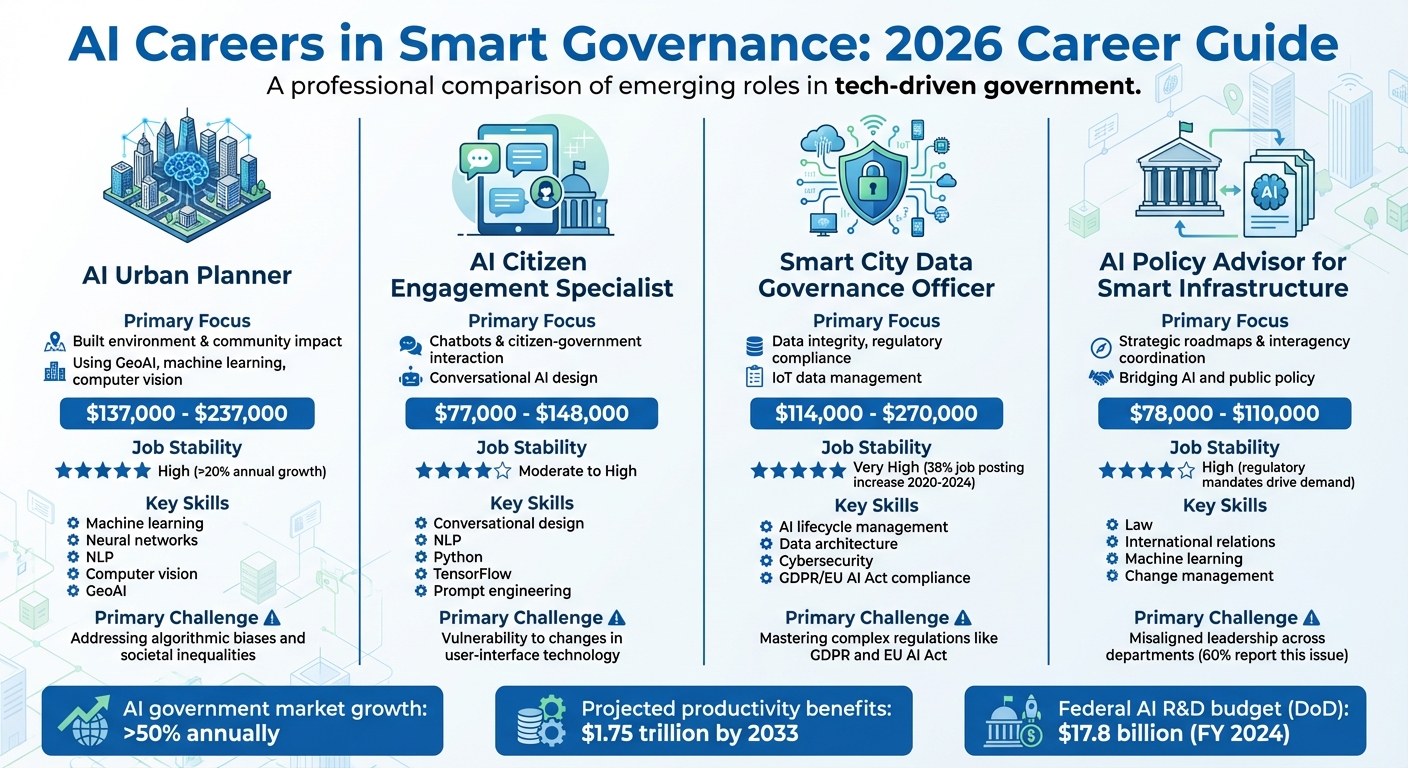
AI Smart Governance Career Paths: Roles, Salaries, and Challenges Comparison
1. AI Urban Planner
AI Urban Planners are reshaping the way cities are designed and managed by merging traditional city planning methods with advanced GeoAI techniques. Unlike their predecessors, who relied heavily on static maps and manual surveys, these professionals use tools like machine learning to predict infrastructure issues, computer vision to assess neighborhood conditions, and natural language processing to analyze public sentiment in real time. This shift requires a unique mix of technical expertise and analytical skills.
Required Skills
Key skills for this role include machine learning, neural networks, natural language processing, and computer vision. Additionally, professionals must be adept at working with high-quality datasets, identifying data gaps that could hinder AI performance, and addressing algorithmic bias. They also need to ensure transparency in AI-driven decisions and adhere to ethical guidelines for responsible implementation.
"AI will not replace planners; instead, it will provide a useful set of tools for a subset of planning tasks and enhance planning practice by allowing planners to refocus their work on the human components of planning".
Industry Demand
The demand for AI Urban Planners is growing, especially in U.S. cities adopting smart infrastructure. For example, Jacksonville, Florida, uses intelligent streetlights equipped with sensors for real-time traffic monitoring. On a broader scale, the federal government spends around $16 billion each year on documentation and record-keeping, creating a significant opportunity for AI-driven optimization. With over half of state and local officials reporting they struggle to complete their work within a standard 40-hour week due to administrative burdens, there’s a strong push to automate repetitive tasks, allowing professionals to focus on solving more complex challenges.
Salary Trends
Traditional urban planners earned a median annual wage of $83,720 as of May 2024, with the top 10% earning more than $128,550. However, roles that integrate AI expertise tend to command much higher salaries. For instance, MLOps Specialists, who oversee the deployment of AI systems, earn between $137,000 and $237,000. As cities move away from manual processes toward strategic, data-driven planning, professionals with a combination of AI skills and traditional planning knowledge are often at the higher end of the pay scale.
Key Challenges
AI Urban Planners face challenges such as dealing with inaccurate data and potential misuse by vendors. The transition from reactive to predictive planning also requires ongoing education and skill development. With the government market for generative AI applications expected to grow more than 50% annually and productivity benefits projected to reach $1.75 trillion by 2033, professionals in this field must balance the opportunities of AI adoption with the complexities of maintaining public trust and implementing these technologies responsibly.
2. AI Citizen Engagement Specialist
AI Citizen Engagement Specialists act as a bridge between government technology and citizen needs, focusing on creating and managing AI-driven communication systems. Their work involves designing chatbot dialogue flows and training voice assistants to interpret human intent and emotions, ensuring government services feel approachable and user-friendly. Unlike traditional public relations roles, this position requires both technical expertise and a deep understanding of how people interact with government systems. It also aligns with the broader digital shift in government operations, complementing roles like AI Urban Planner.
Required Skills
This role demands a mix of technical and interpersonal skills. Specialists need expertise in conversational design and natural language processing (NLP). They must be adept at writing effective prompts and training AI tools, such as chatbots and voice assistants, to handle complex, multilingual queries. Tools like Python, TensorFlow, PyTorch, and Pandas are essential for this work.
Beyond technical skills, ethical governance is critical. Specialists must address AI bias, ensure data privacy, and maintain transparency - key concerns as approximately 80% of organizations aim to establish ethics or AI governance committees by 2025. They also need to simplify AI outputs for public understanding and redesign workflows so that AI enhances, rather than complicates, citizen interactions.
Industry Demand
The demand for AI Citizen Engagement Specialists is growing rapidly at all levels of government. For example, the US Army's virtual assistant SGT STAR answered over 16 million user questions by 2016, effectively replacing the workload of 55 human recruiters with a 94% accuracy rate. Similarly, the Department of Homeland Security's EMMA virtual assistant processes around 500,000 questions each month. State and local governments are also increasing their reliance on AI assistants for continuous service delivery in areas like public health, transportation, and education. These technologies are projected to contribute $1.75 trillion annually to government productivity by 2033.
Salary Trends
Salaries for AI Citizen Engagement Specialists reflect the specialized nature of their work. Prompt Engineers and AI Interaction Specialists earn between $77,000 and $148,000 annually (converted from £60,000–£115,000). Meanwhile, AI–Human Workflow Specialists, who focus on integrating AI into existing systems, earn between $109,000 and $180,000 (converted from £85,000–£140,000). These figures often surpass those of traditional public engagement roles, particularly for professionals with both technical skills and experience in government or multilingual capabilities.
Key Challenges
The role comes with its share of challenges, particularly in addressing bias and fostering public trust. Specialists must regularly audit AI systems to prevent biases related to race, ethnicity, or gender. They also face hurdles like navigating complex regulations such as GDPR and the EU AI Act, as well as managing AI "hallucinations" - instances where AI generates incorrect or misleading outputs. Another challenge lies in redesigning workflows to integrate AI effectively without overwhelming staff or citizens. As TalentSprint emphasizes:
"The future doesn't belong to the most technical. It belongs to the most adaptable."
3. Smart City Data Governance Officer
With AI reshaping urban planning and how cities engage with their residents, managing data effectively has become a top priority. Smart City Data Governance Officers play a leadership role in overseeing urban data streams from IoT devices, traffic systems, and public services. Unlike traditional data managers who focus on storage and retrieval, these officers oversee the entire AI lifecycle. This includes auditing algorithms for bias, implementing strong cybersecurity measures, and ensuring compliance with both U.S. and international regulations. Their work is particularly crucial as a large portion of IoT-generated data remains unused.
Required Skills
This position requires deep knowledge of the AI lifecycle and expertise in applying metadata tagging across the five V's of data. Officers must also excel in data architecture, maintain high-quality standards, and implement cybersecurity measures to classify data by risk levels. Skills in data visualization are equally important, as real-time dashboards are often used to monitor city operations.
Beyond technical know-how, these officers need strong leadership and coordination abilities. They must bring together city departments, federal agencies, and private organizations while upholding ethical standards and maintaining public trust. For instance, a study revealed that 90% of senior civil servants in the UK require training in digital and data essentials to meet the demands of modern governance.
Industry Demand
The demand for Smart City Data Governance Officers is growing fast, particularly in municipal and federal sectors. For example, in November 2025, the U.S. Environmental Protection Agency launched an AI Governance Board and a Data Governance Advisory Committee to align with OMB M-25-21. They also released the 2025 AI Compliance Plan to manage sensitive financial and personal data within machine-learning systems. Meanwhile, U.S. cities are allocating significant budgets to upgrade digital infrastructure, and the global IoT market for smart cities is expected to grow from $300 billion in 2021 to over $650 billion by 2026. Cities like Barcelona, Paris, and Reykjavík have already appointed Chief Data Officers to lead these efforts.
Salary Trends
The specialized skill set required for this role often translates into higher salaries compared to traditional data management positions. While pay varies by location and agency, these roles typically come with competitive compensation, along with benefits and job security in federal and municipal sectors.
Key Challenges
Smart City Data Governance Officers encounter several hurdles. One major issue is the lack of adequate funding and sustainable financial models for data infrastructure. The sheer volume of data being generated often surpasses current storage and processing capabilities, forcing tough decisions about what data to keep. Additionally, legacy systems and bureaucratic resistance contribute to persistent data silos, complicating efforts to streamline operations.
Cybersecurity and public trust remain pressing concerns. Cyber threats pose ongoing risks, requiring robust oversight. For example, the City of Seattle’s Privacy and Cybersecurity Committee has implemented procedures to classify data by risk and provide opt-out options for residents.
As the OECD aptly states:
"The success of smart city projects largely depends on the availability and effective use of data."
sbb-itb-20a3bee
4. AI Policy Advisor for Smart Infrastructure
In the growing field of AI-driven governance, Policy Advisors play a crucial role in integrating AI into essential infrastructure systems. While technical developers focus on building the systems themselves, these advisors bridge the gap between cutting-edge AI capabilities and public policy, ensuring that smart infrastructure aligns with legal frameworks, ethical principles, and the needs of communities.
Required Skills
This role requires expertise that spans multiple disciplines, including law, international relations, and machine learning. Advisors need to anticipate potential "policy traps" and feedback loops early on, preventing long-term issues in infrastructure planning. A solid understanding of technical concepts is also essential, as they often oversee software teams and communicate progress effectively. Additionally, change management skills are critical; after all, 70% of an AI project's success depends on how well people and processes are managed, rather than just the algorithms themselves. These unique skill sets are fueling the demand for AI policy advisors in government and related sectors.
Industry Demand
The need for AI policy expertise is growing rapidly, especially within the federal government. For instance, the U.S. Department of Defense has proposed a $17.8 billion budget for fiscal year 2024 to fund research and development in areas like AI and other advanced technologies. Despite this, challenges remain: 60% of federal AI decision-makers report misaligned leadership, and only 25% of businesses have implemented comprehensive AI strategies. Career opportunities for AI policy advisors are diverse, spanning industry labs, think tanks, and government roles. Key positions can be found in agencies like the Department of Defense or the White House Office of Science and Technology Policy, with many top roles classified within the Senior Executive Service.
Key Challenges
AI policy advisors face significant hurdles when coordinating governance efforts across multiple government departments. Since AI policy requires collaboration across various agencies - each with its own authority and priorities - achieving alignment can be incredibly complex. Furthermore, about 60% of enterprise AI initiatives fail to scale without proper operational support, highlighting the need for integrated and well-planned strategies. Another pressing issue is data security, particularly the risk of third-party vendors mishandling sensitive government information. President Joe Biden emphasized this concern:
"Realising the promise of AI by managing the risk is going to require some new laws, regulations, and oversight".
Lastly, as AI takes over routine tasks, human workers are often left to manage only the most complex, high-pressure cases, which can lead to increased burnout. This underscores the importance of balancing technology adoption with workforce well-being.
Pros and Cons
Every career path comes with its own set of benefits and challenges. It's crucial to weigh these against your personal skills and professional goals.
AI Urban Planners combine cutting-edge technology with meaningful community work. According to the American Planning Association:
"If deployed responsibly, AI has the potential to assist planners in their work, improve existing planning processes, create efficiencies, and allow planners to refocus their work on the human factors of planning".
With the AI market projected to grow by over 20% annually, this role offers promising opportunities. However, it requires constant learning and expertise in "futures literacy" to stay ahead. A significant challenge lies in addressing algorithmic biases, which, if ignored, could worsen societal inequalities.
AI Citizen Engagement Specialists are in demand as governments increasingly use AI-driven chatbots to interact with citizens. This role is ideal for professionals with backgrounds in communications or social sciences, though technical skills are becoming more essential. Salaries for Prompt Engineers in this field generally range from $72,000 to $138,000. However, the role's reliance on user-interface design makes it susceptible to shifts in technology trends.
Smart City Data Governance Officers enjoy exceptional job stability. Combine Global Recruitment highlights:
"AI models live and die by their data".
AI-related job postings have surged by 38% between 2020 and 2024. While this career path offers stability, it requires navigating complex regulations such as GDPR and the EU AI Act, which can be a steep learning curve. On the flip side, this complexity ensures steady demand, as 80% of businesses express concerns about adopting AI without proper governance.
AI Policy Advisors for Smart Infrastructure benefit from regulatory mandates that drive job security. Salaries in AI-related policy roles are growing at nearly double the rate of their non-AI counterparts. For instance, AI Product Managers focusing on policy typically earn between $78,000 and $110,000. This career is accessible to those with expertise in law, public policy, or strategic studies. However, challenges include navigating interagency coordination and dealing with leadership misalignment - an issue reported by 60% of federal AI decision-makers.
The table below provides a snapshot of the key aspects of these career paths:
| Career Path | Primary Focus | Salary Range (USD) | Job Stability | Primary Challenge |
|---|---|---|---|---|
| AI Urban Planner | Built environment and community impact | Competitive public sector rates | High (>20% annual growth) | Addressing algorithmic biases and societal inequalities |
| AI Citizen Engagement Specialist | Chatbots and citizen-government interaction | $72,000 – $138,000 | Moderate to High | Vulnerability to changes in user-interface technology |
| Smart City Data Governance Officer | Data integrity and regulatory compliance | $114,000 – $270,000 | Very High | Mastering complex regulations like GDPR and EU AI Act |
| AI Policy Advisor | Strategic roadmaps and interagency coordination | $78,000 – $110,000 | High | Misaligned leadership across departments |
These roles illustrate the dynamic and evolving nature of AI-driven careers in smart governance. Each presents unique opportunities and challenges, requiring thoughtful consideration of personal strengths and industry demands.
Conclusion
AI Urban Planners bring artificial intelligence into physical infrastructure projects, Citizen Engagement Specialists improve public-facing systems, Data Governance Officers ensure data integrity, and Policy Advisors craft strategies for AI-related policies. These roles demand a mix of technical skills and expertise across fields like policy analysis, law, economics, and urban planning.
As the GSA IT Modernization Centers of Excellence explains:
"Though technical know-how is certainly important, without adequately understanding the challenge you are trying to address and getting buy-in from the mission and program team, the project will fail".
This highlights the importance of blending technical knowledge with an understanding of real-world challenges - a combination that defines success in these roles.
The job market for smart governance careers is strong. With AI investments growing at a 19% annual rate and more than 60% of government agencies expected to prioritize automation by 2026, opportunities in this space are expanding rapidly. These trends suggest an increasing demand for professionals across all four career paths.
For those entering the field, hands-on experience and flexibility matter more than chasing the perfect credentials. Instead of focusing exclusively on roles with "AI" in the title, consider related areas like technology policy, science policy, or national security. Many professionals get their start as data analysts, a role that often opens doors to positions in think tanks, Congress, or federal agencies. For U.S. federal jobs, regularly checking USAJOBS.gov and pursuing internships or fellowships can be effective strategies.
To prepare, tools like Acedit (https://acedit.ai) can help with real-time interview coaching and AI-powered preparation, ensuring you’re ready to succeed in the evolving world of smart governance.
FAQs
What key skills do you need for a career in AI-powered smart governance?
To thrive in AI-driven smart governance, you'll need a blend of technical know-how, analytical skills, and ethical judgment. Some of the core abilities include understanding data - how to interpret it and apply it meaningfully - alongside critical thinking to assess AI outputs and address potential biases. Staying flexible and open to change is also key, as technology evolves at a breakneck pace.
For more specialized roles like data scientists, engineers, or policymakers, expertise in areas such as data analysis, natural language processing, and AI model comprehension is a must. On top of that, leadership skills - like strategic planning, digital teamwork, and managing risks - are vital for guiding AI projects in a way that balances innovation with ethical considerations and public interest.
In short, combining technical expertise with ethical awareness and forward-thinking leadership is crucial for shaping responsible AI governance.
How do AI Citizen Engagement Specialists enhance interactions between governments and citizens?
AI Citizen Engagement Specialists leverage artificial intelligence to transform how governments connect with their citizens. By creating quicker, more personalized, and accessible communication methods, they help streamline interactions, making public services more responsive and relatable. Their work involves analyzing citizen data and feedback to guide governments in delivering services and information that feel relevant and meaningful, ultimately strengthening public trust and participation.
These specialists also deploy AI tools like chatbots and virtual assistants. These tools provide real-time assistance, answer queries, and gather feedback, cutting down on wait times and making services easier to access. Importantly, they pair these technologies with human oversight to ensure that interactions remain ethical, transparent, and aligned with public expectations. This thoughtful combination of AI and human input promotes stronger civic engagement and a greater sense of accountability.
What are the main challenges Smart City Data Governance Officers face when managing urban data?
Smart City Data Governance Officers face several hurdles when it comes to managing urban data effectively. A top concern is data privacy and security. Urban data often includes sensitive details about residents, infrastructure, and public services, making it a prime target for breaches or misuse. At the same time, officers must navigate a maze of ever-changing data protection laws to ensure compliance.
Another major challenge lies in building strong data governance frameworks. Urban data flows in from all kinds of sources - think IoT devices, sensors, and public records. This diversity makes data integration and standardization a tough task. Governance officers need to ensure the data remains accurate, accessible, and managed ethically to promote transparency and enable informed decision-making.
On top of that, embracing AI-driven governance models comes with its own set of demands. Organizations must invest in advanced technologies, upskill their teams, and ensure AI systems operate within ethical boundaries. Striking the right balance here is critical for creating smarter, more inclusive urban environments.