
If I wanted to break into self-driving cars, I’d do 4 things first: pick one role, learn the core tools, build proof through projects, and get my resume ready for that exact job using AI in your job search.
This field blends software, robotics, ML, controls, and safety. So the shortest path is not “learn everything.” It’s to choose one lane and build around it. Most entry-level roles ask for a degree in CS, EE, robotics, or mechanical engineering, plus tools like C++, Python, ROS/ROS2, Linux, and simulation platforms. And if I want to stand out, I need more than coursework: I need projects, test results, and at least basic knowledge of ISO 26262 and SOTIF.
Here’s the full checklist in plain English:
- Pick a role: perception, planning, controls, simulation, embedded systems, or safety/validation
- Choose a track: software-heavy or hardware-heavy
- Learn the core stack: C++, Python, ROS/ROS2, Linux, Git, simulators, and role-specific tools
- Study the right topics: algorithms, linear algebra, probability, control systems, and signal processing
- Build 1–2 focused projects: not random apps, but work tied to AV tasks
- Use AV datasets and simulators: like KITTI, nuScenes, CARLA, or Gazebo
- Get hands-on experience: internships, lab work, open-source, or student teams
- Know the safety basics: hazard analysis, risk assessment, ISO 26262, and SOTIF
- Show metrics: latency, precision, tracking quality, or scenario coverage
- Prepare for technical interviews and match your resume to the role: use the same terms hiring teams use
The main idea is simple: I don’t need to look ready for every AV job. I need to look ready for one.
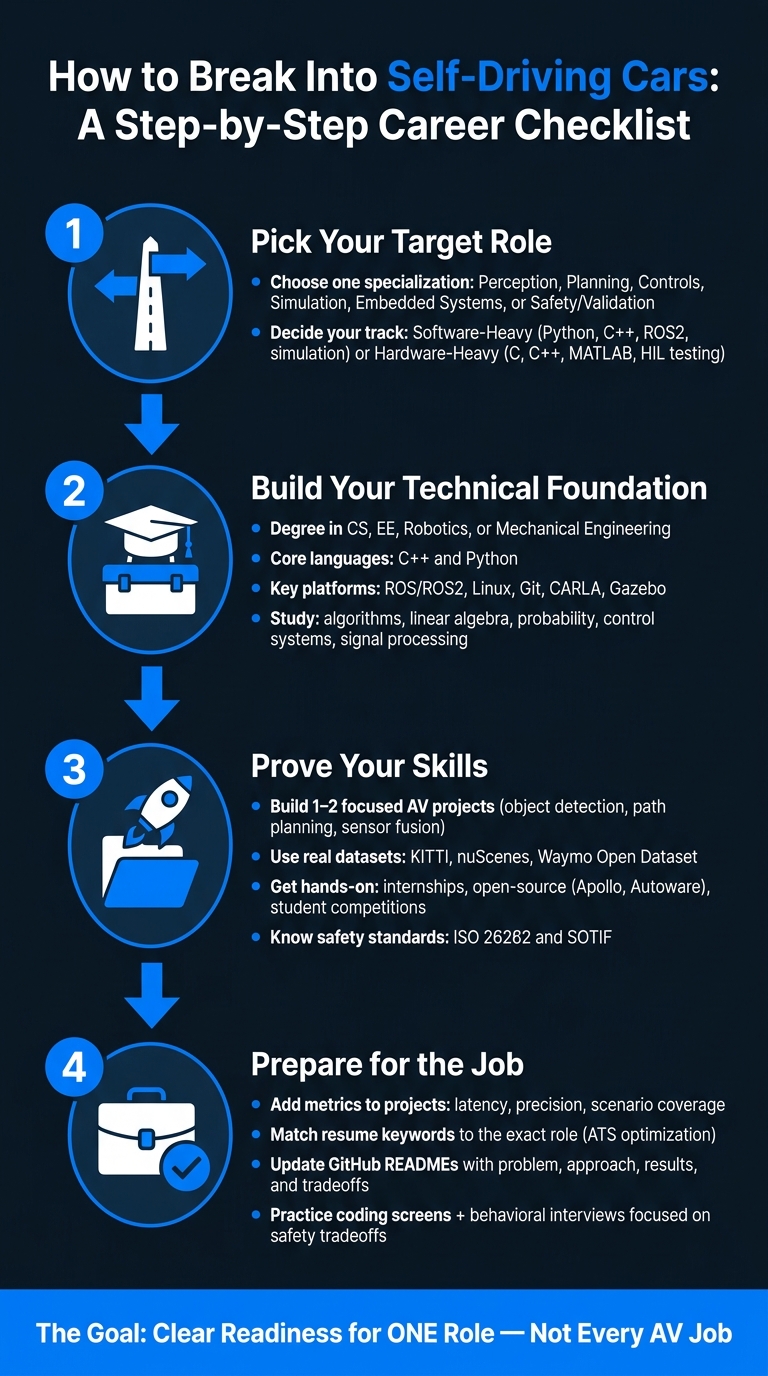
How to Break Into Self-Driving Cars: A Step-by-Step Career Checklist
Autonomous Vehicle (AV) Robotics Software Engineer Roadmap | Robotaxi | Self Driving Car
sbb-itb-20a3bee
Quick Comparison
| Area | What I’d Focus On |
|---|---|
| Role choice | Start with one specialty, not the full stack |
| Education | CS, EE, robotics, or mechanical engineering |
| Main languages | C++ and Python |
| Core platforms | ROS/ROS2, Linux, Git, simulators |
| Hands-on proof | Projects, internships, open-source work |
| Safety knowledge | ISO 26262, SOTIF, hazard analysis |
| Job prep | Metrics, project docs, role-matched resume, interview practice |
If I keep the process narrow and job-focused, the path into AV work becomes much easier to follow.
1. Pick Your Target Role in Autonomous Vehicles
Picking a lane early makes prep a lot easier. Start with one role, then build the skills that role asks for.
Choose a Specialization
AV jobs don’t all do the same thing. Each role solves a different problem and leans on its own set of tools:
- Perception – Understands the world around the vehicle using LiDAR, cameras, and radar. This includes object detection and tracking.
- Planning – Figures out what the vehicle should do next, from routing and collision avoidance to traffic law compliance.
- Controls – Handles steering, braking, and acceleration in real time.
- Simulation – Tests algorithms in virtual settings like CARLA or LGSVL before road testing.
- Embedded Systems – Works where hardware and software meet, using automotive protocols like CAN and LIN.
- Safety/Validation – Checks that systems meet standards like ISO 26262 before deployment.
A good way to sort this out is simple: try a few small, role-specific projects. You’ll usually feel pretty fast which kind of work clicks and which doesn’t.
It also helps to match the role to how you think. Strong programmers often lean toward perception or planning. Engineers who like system behavior and low-level work often end up in embedded systems or controls. If you like process, testing, and checking edge cases, safety and validation may be a better fit.
Know the Difference Between Software and Hardware Tracks
Once you’ve picked a role, choose your main track: software-heavy or hardware-heavy.
| Software Track | Hardware Track | |
|---|---|---|
| Role Focus | Algorithm and model development | Sensor integration and vehicle testing and validation |
| Primary Tools | Python, C++, PyTorch, ROS2 | C, C++, MATLAB/Simulink, RTOS |
| Testing Method | Simulation (CARLA, NVIDIA Drive Sim) | Hardware-in-the-Loop (HIL), physical labs |
| Typical Roles | Perception Engineer, Planning Engineer | Sensor Systems Engineer, Controls Engineer |
That split matters more than people think. Software roles tend to live in models, pipelines, and simulation. Hardware roles spend more time dealing with sensors, timing, test benches, and what happens when code meets an actual vehicle.
As David Anderson, Principal Mechanical Engineer at Torc, noted:
"Focused knowledge in your specific area of development... is critical to being successful. However, the ability to understand how the entire system works together is even more important." - David Anderson, Principal Mechanical Engineer, Torc
Pick one track first. Then make sure you understand how hardware and software limits affect the work on both sides.
2. Build Your Education and Technical Foundation
Relevant Degrees and Coursework
Most AV employers look for a bachelor’s degree in Computer Science, Electrical Engineering, Robotics, or Mechanical Engineering. You don’t need a degree called "Autonomous Vehicles" to get started. A lot of people enter the field through standard engineering or CS programs, then shape their path with electives, projects, or graduate study.
The classes that show up most often in job postings are data structures, algorithms, linear algebra, calculus, probability and statistics, control systems, and signal processing. An M.S. or Ph.D. is not required for entry-level roles, but it can help if you want to move into AI, machine learning, or research-heavy work.
Your target role should guide what you study. If you want to work on perception or planning, lean into algorithms and ML. If you’re aiming for controls or embedded systems, focus more on dynamics, signal processing, and systems work. The point is simple: pick electives that line up with the job you want.
Core Tools and Skills
C++ and Python are core languages for many AV roles. C++ is common in real-time, performance-heavy production code. That matters because AV software often runs in real-time loops at 10 Hz or faster. Python, on the other hand, is the go-to for prototyping, machine learning, and data work.
Here’s the skill stack that shows up again and again:
| Skill Category | Core Tools & Topics |
|---|---|
| Languages | C++, Python, SQL, MATLAB/Simulink |
| Frameworks | ROS/ROS2, PyTorch, TensorFlow, OpenCV |
| Perception | Sensor Fusion, LiDAR Processing, 3D Object Detection |
| Simulation | CARLA, LGSVL, Gazebo |
| Infrastructure | Linux, Git, CUDA, Docker |
| Safety | ISO 26262, SOTIF (ISO/PAS 21448) |
Spend time learning ROS/ROS2. It ties together sensors, messaging, and control logic, so it shows up all over AV development.
You should also practice with AV datasets like KITTI and nuScenes. That’s where things start to click. It’s one thing to read about perception pipelines. It’s another to work with raw sensor data and see what breaks.
This is the base you’ll use to prove you can do the work through projects, internships, and safety-focused experience. As you prepare for the hiring process, consider comparing AI interview prep vs traditional methods to refine your performance.
3. Show Your Skills Through Projects, Internships, and Safety Knowledge
This section is where your technical base starts to look like something an employer can check for themselves.
Build Portfolio Projects That Reflect AV Work
Once you know the basics, turn that knowledge into proof.
In AV hiring, tools matter less than showing that you can use them with good judgment. Employers want to see how you made decisions, what tradeoffs you chose, and what happened when things broke. A course list alone doesn't do that.
Pick one or two focused projects and build them well. A perception project using CNNs for object detection, a path-planning project in CARLA, or a sensor fusion pipeline that combines camera and LiDAR data all line up with the kind of work you'd do on the job. And the code is only part of it. The write-up matters just as much.
Document tradeoffs, failure cases, and test results.
Each project repository should have a clear README that explains your approach, the tools you used, simulation results, and measurable outcomes. If you test with large-scale datasets like Waymo Open Dataset, that helps show you're working at a realistic scale. Want another strong signal? Contributing to open-source AV platforms like Apollo or Autoware puts your work in front of engineers who already use those codebases.
Get Internships and Learn Safety Basics
After projects, internships help you see how AV work runs in practice.
They're one of the fastest ways to close the gap between school projects and actual vehicle systems. Try to target roles that match your area. That could mean internships at Waymo, Cruise, Aurora, Zoox, or NVIDIA in AI development, embedded systems, or software engineering. If you can't get a direct internship yet, research assistantships at university labs like Stanford's Center for Automotive Research or Berkeley's Intelligent Transportation Systems program can still give you hands-on exposure to sensor calibration, annotation review, and experimental path planning.
Student competitions help too. They show you can ship work under tight limits, not just in a neat classroom setup.
On the safety side, know the basics of functional safety, hazard analysis, risk assessment, ISO 26262, and SOTIF. Bring up ISO 26262 and SOTIF in your project README and in interview answers.
Add Certifications Where They Help
Certifications won't get you hired on their own, but they can show structured effort, especially if you're switching careers or don't yet have direct industry experience. The right one depends on the role you want.
| Certification | Best-Fit Role | What It Demonstrates |
|---|---|---|
| ISO 26262 Functional Safety | Safety / Systems Engineer | Hazard analysis, safety lifecycles |
| NVIDIA Deep Learning for AVs | Perception / ML Engineer | Deep learning for autonomous driving |
| SAE International AV Certification | Validation / General AV Engineer | Autonomous systems and industry standards |
| Udacity Self-Driving Car Engineer Nanodegree | Software / Robotics Engineer | Computer vision, sensor fusion, path planning |
The NVIDIA Deep Learning for Autonomous Vehicles credential is a strong signal of structured effort. It won't replace a solid portfolio. But when you pair certifications with good project work, they help back up your technical case.
Use these credentials to make your resume sharper and your interview answers stronger.
4. Get Your Resume, Portfolio, and Interviews Ready
Update Your Resume, LinkedIn, and Project Docs
Once your projects are in good shape, describe them the way hiring teams talk about the work. Name the tools, methods, and AV systems you actually used - C++, Python, ROS2, PyTorch, sensor fusion, SLAM, and LiDAR processing - and line them up with the job post so your resume has a better shot at passing ATS screening.
Don’t just say what you built. Show what changed because of it. Add metrics like precision, latency, or scenario coverage.
Your GitHub READMEs should back up your resume, not just sit there as placeholders. Spell out the problem, name the dataset or simulator, explain the architecture, and share the results, failure cases, and tradeoffs. That’s the kind of detail that helps someone quickly see how you think.
Your LinkedIn profile should match the main keywords on your resume and link straight to your repositories. That gives hiring managers direct proof of your work instead of making them hunt for it.
Practice Technical and Behavioral Interviews
Once your materials are cleaned up, move into interview prep. You should expect coding screens, plus questions on filtering, planning, sensor fusion, SLAM, real-time systems, and CAN or Ethernet.
Behavioral interviews matter just as much. Teams want to see how you handle bugs under pressure, work with people from other disciplines, and think through safety tradeoffs. Have a few solid examples ready from projects or internships that show how you solved a problem, not just that it ended up working.
Acedit can help with real-time interview coaching, tailored questions, and practice simulations.
Keep your explanations clear. Walk through your part of the work, then connect it to the full vehicle system. That makes it much easier for an interviewer to see the bigger picture.
Conclusion: Check Off the Basics Before You Apply
Once you’ve worked through the checklist above, use it as a gut check. Are you ready to apply yet? Pick one role, back it up with projects, and start applying when your portfolio lines up with the job.
Go deep in your specialty, but also know where that role sits in the full vehicle system. After you’ve chosen a lane and covered the safety basics, the next step is simple: show proof that you can do the work. Safety knowledge isn’t optional. Knowing standards like ISO 26262 is more and more expected before you apply.
After you choose your specialization, clean up your resume, LinkedIn, and portfolio. Make sure your keywords, project descriptions, and examples match the role you want.
The goal isn’t full-stack readiness. It’s clear readiness for one role.
FAQs
How do I choose the right AV role?
Start by figuring out where you fit best across the four main AV areas: perception, planning, control, and systems integration. A simple way to do that is to look at your strengths, your interests, and the kind of work you actually enjoy doing day to day.
It also helps to test a few paths. Try areas like software engineering, mechanical engineering, and hardware engineering to see what clicks. Sometimes the best fit isn’t obvious until you’ve built something, debugged it, or worked through a messy problem with a team.
You should also think about the type of work you want most. Do you lean toward AI research, embedded software, or operations and logistics? Those paths can feel very different in practice.
Hands-on projects, robotics competitions, and assessment tools can make this much clearer. They give you a chance to see what kind of role suits you - not just on paper, but in the kind of work you’d be happy doing week after week.
Do I need a master's degree to get started?
No. A master’s degree can help if you’re aiming for a more specialized role, but you do not need one to get started in autonomous vehicle development.
For many entry-level jobs, employers look for a bachelor’s degree in engineering, robotics, or computer science. That said, a degree isn’t the whole story. You can also build trust through internships, open-source projects, certifications, and skills you can clearly show.
If you’re getting ready for interviews, Acedit can help you present those skills in a clear, convincing way.
What should I include in an AV project portfolio?
Prioritize hands-on, end-to-end projects instead of leaning too hard on theory. Work on things like lane detection, sensor fusion with LIDAR and cameras, path planning, or custom simulation environments. Those projects do a much better job of showing what you can actually build.
Put each project on GitHub with a clear README that explains the problem, why you made certain technical choices, and what results you got, such as accuracy or processing speed. If you can, add a live demo or a video walkthrough too. That makes it easier for people to see your use of C++, Python, or ROS/ROS2 in action.