
Technical interviews are tough, but a clear and repeatable process can make them manageable. Here's a 5-step framework to tackle any technical interview question effectively:
- Understand the Problem: Restate the problem, ask clarifying questions, and define success criteria to avoid misunderstandings.
- Break It Down: Divide the problem into smaller, manageable parts and outline a brute-force solution to build on.
- Choose an Approach: Brainstorm multiple solutions, evaluate time and space complexities, and pick the simplest approach that meets constraints.
- Write the Code: Code step-by-step, use clear variable names, and keep your structure organized. Confirm your approach with the interviewer before starting.
- Test and Debug: Test with edge cases, debug systematically, and optimize your solution for better performance.
This structured approach helps you stay focused, communicate clearly, and showcase your problem-solving skills under pressure.
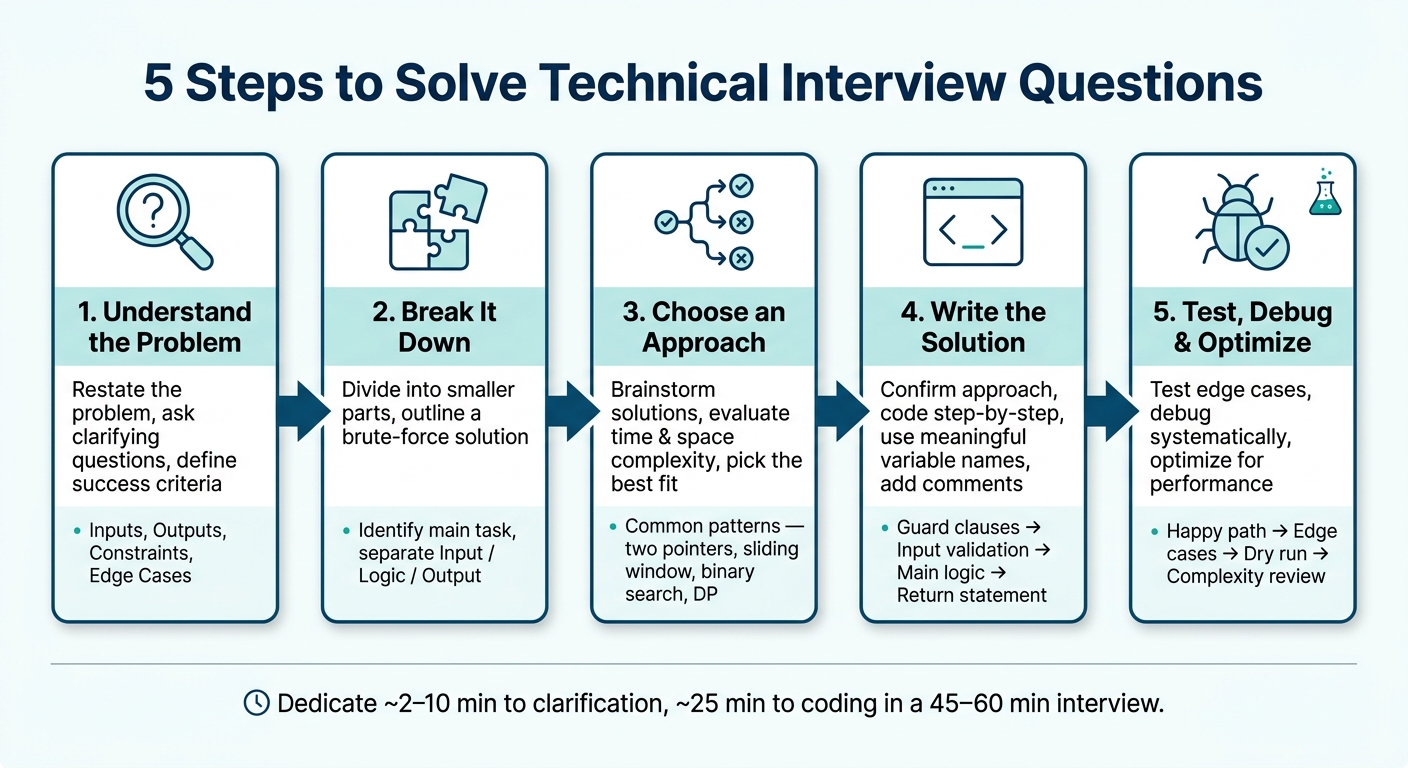
5-Step Technical Interview Framework
How to Solve ANY Coding Interview Question in 6 Steps
Step 1: Understand the Problem
Many candidates stumble within the first two minutes of an interview - not because they lack the knowledge, but because they dive into solving the problem without fully grasping what’s being asked. Taking the time to understand the problem thoroughly sets the stage for a well-structured solution.
Restate the Problem in Your Own Words
Before jumping into code, take a moment to summarize the problem. This step isn't just about politeness - companies like Google, Amazon, and Meta value clear communication. Restating the problem demonstrates your ability to process information and collaborate effectively.
"Repeat the question back to the interviewer in your own words, so that they can flag anything that you may have initially misunderstood." - Gareth Dwyer, IGotAnOffer
Start with something like, "So, if I understand correctly..." to invite feedback. Keep your summary brief - about 10–15 seconds - and focus on highlighting key terms, such as "contiguous subarray" or "maximum sum", which might hint at specific algorithmic approaches like sliding window techniques. After this, ask clarifying questions to ensure you’re on the right track.
Ask Clarifying Questions
Once you’ve restated the problem, follow up with targeted questions to address any ambiguities. Interviewers often leave details vague to see if you can identify critical constraints, so asking questions is not just acceptable - it’s expected. Focus on areas like inputs, outputs, constraints, and edge cases:
| Category | Example Questions |
|---|---|
| Inputs | "Can the array be empty or null?" / "Are the numbers always non-negative?" |
| Outputs | "Should I return the indices or the values?" / "What if no solution exists?" |
| Constraints | "What's the maximum input size?" / "Is there a target time complexity?" |
| Edge Cases | "How should I handle duplicates?" / "Is the input always sorted?" |
If you’re interviewing for a senior role, consider asking about trade-offs or scalability. Questions like "Are there memory constraints?" or "Should I optimize for latency or accuracy?" can help you refine the problem further.
Define What a Correct Solution Looks Like
Before writing any code, establish clear criteria for success. This includes confirming the expected output format, addressing edge cases, and understanding performance requirements. Experts suggest dedicating 2–10 minutes of a standard 60-minute interview to clarification and planning before you even touch the keyboard.
For example, knowing that n can reach 10,000,000 immediately rules out an O(n²) solution. Identifying these constraints early ensures you don’t waste time pursuing an approach that won’t work.
"Clarifying first prevents you from building the wrong solution - a common failure at Microsoft, Apple, and other companies that value precision." - InterviewPilot
Always wait for the interviewer to confirm your understanding before moving forward. This simple step can save you from solving the wrong problem perfectly. With a clear and precise understanding in place, you’re ready to break the problem down further.
Step 2: Break the Problem into Smaller Parts
Once you've got a solid grasp of the problem, resist the urge to dive straight into coding. Jumping in without a clear plan often leads to mistakes and wasted effort. Instead, break the problem into manageable components. This not only organizes your approach but also demonstrates a structured problem-solving process to interviewers.
Identify the Main Task and Sub-Problems
Start by pinpointing the primary goal and any smaller challenges within the problem. For example, repeated calculations might hint at caching or dynamic programming, while sorted data could suggest binary search. If you're dealing with contiguous subarrays, sliding window logic might be the way to go.
Next, outline a basic brute-force solution. Even if it's inefficient, explaining it out loud shows you understand the core logic. Plus, it gives you a safety net if time runs out and you can't implement the optimal solution.
"A brute force that you can code quickly is better than a half-explained 'optimal' solution." - InterviewPilot
Don’t forget to plan for edge cases early on. This keeps your main logic clean and reduces the risk of errors.
Separate Input, Logic, and Output
Think of your solution in three clear stages: input, logic, and output. Defining these before you start coding can make your approach much clearer.
- Input: Confirm the data types and size ranges. For instance, are you working with integers, strings, or something else? Is the input size small enough for a brute-force approach, or do you need something faster?
- Logic: Break the problem into clear, actionable steps. For example, you might say: "Step 1: build a frequency map, Step 2: walk through the buckets, Step 3: collect the results".
- Output: Decide if the output requires specific ordering, how to handle ties, or whether additional sorting is necessary.
As you plan, narrate your thought process out loud. It’s not just about solving the problem but showing why you’re choosing a particular approach. As a former FAANG interviewer explained:
"Saying 'I'm choosing a sliding window here because the problem asks for an optimal contiguous subarray under a constraint' scores higher than silently writing the same correct solution." - Codeintuition
At companies like Google and Amazon, interviewers often evaluate your reasoning process separately from your code’s correctness. By clearly explaining your breakdown, you’re showing more than just technical skills - you’re demonstrating how you think.
With your problem broken into smaller, logical parts, you’re now ready to move on to selecting the best solution in the next step.
Step 3: Explore and Choose an Approach
Now that you've broken down the problem, the next step is to decide on the best strategy to solve it before diving into the code. By identifying the key components of the problem, you can determine the most effective solution pattern. It's important to consider multiple approaches and analyze their efficiencies before settling on one.
Brainstorm Multiple Solutions
Start with a brute-force solution as your baseline. While it may not be the most efficient, it ensures correctness and provides a fallback option if needed.
Next, look for patterns in the problem. For instance:
- Sorted data often suggests techniques like binary search or two pointers.
- Contiguous subarrays might point to a sliding window approach.
- Overlapping subproblems are a strong indicator for strategies like dynamic programming or memoization.
According to InterviewPilot, about 80% of FAANG-style interview problems can be categorized into eight core patterns: two pointers, sliding window, binary search, BFS/DFS, tree traversals, dynamic programming, monotonic stacks, and heaps. Developing the ability to recognize these patterns is a skill that pays off in technical interviews.
Evaluate Time and Space Complexity
Once you've brainstormed potential solutions, evaluate each option based on time and space complexity. The size of the input can guide you toward the most practical approach.
| Input Size (n) | Acceptable Time Complexity | Likely Patterns |
|---|---|---|
| n ≤ 20 | O(2ⁿ) or O(n!) | Backtracking, Permutations |
| n ≤ 100 | O(n³) | Triple-nested loops |
| n ≤ 10,000 | O(n²) | Nested loops, simple DP |
| n ≤ 100,000 | O(n log n) | Sorting, Binary Search, Heaps |
| n ≤ 10,000,000 | O(n) | Linear scan, Two Pointers, Hashing |
"Constraints tell you the answer. Reading constraints first rules out entire families of approaches before you think about them." - InterviewPilot
Don't forget to factor in the time-space trade-off. For example, using a hash map can reduce time complexity from O(n²) to O(n), but it will require O(n) additional space. Top-tier companies expect you to not only perform complexity analysis but also explain and justify your reasoning.
Pick the Best-Fit Solution
Select the simplest approach that meets the problem's constraints. It doesn’t have to be the most clever solution - what matters is that it works and is efficient. Clearly explain your choice before you start coding. For example, you might say, "I'll use a sliding window here," or "This problem seems to fit a dynamic programming approach because of its overlapping subproblems." This kind of structured reasoning is a quality that interviewers actively look for.
If you're still unsure, go ahead and implement the brute-force solution. A working solution with less-than-ideal complexity is almost always better than an incomplete attempt at a more optimal one.
sbb-itb-20a3bee
Step 4: Write the Solution
With your strategy mapped out, it's time to bring your plan to life through code. Here, clarity and organization are just as critical as writing correct logic.
Write Code in Logical Steps
Before jumping into coding, take a moment to confirm your approach with the interviewer: "Does this approach sound reasonable to you?" This quick check can save you from investing time in a solution that might miss the mark.
Once you have the go-ahead, code step by step. Start with guard clauses to handle edge cases, such as null values, empty inputs, or single-element scenarios. Then, follow a clear sequence: input validation → variable initialization → main logic → return statement. This structure not only keeps your code clean but also makes it easier for the interviewer to follow your thought process.
"Writing code before having a plan... is a trap. You end up writing code that doesn't solve the right problem, then spending twenty minutes refactoring." - John Sonmez, Founder, Rockstar Developer University
In a typical 45-minute interview, aim to dedicate around 25 minutes to coding. This leaves you enough time to test and refine your solution.
Use Clear and Meaningful Variable Names
Variable names might seem like a minor detail, but they can make a big difference in how readable your code is. While single-letter names like i or j might be tempting, they can make your logic harder to follow and prone to subtle errors.
"Meaningful variable names:
leftandright, notiandjfor two-pointer indices." - InterviewPilot
Choose names that describe a variable's role in the code. For instance, in a sliding window approach, left and right clearly indicate the pointers’ function. For a hash map tracking character positions, a name like char_last_index_map immediately tells the interviewer what the data represents. When working with standard patterns, stick to their conventional names - like slow and fast for detecting cycles in linked lists. Thoughtful naming can make your code almost self-explanatory, reducing the need for excessive comments.
This brings us to the next point: when and how to use comments effectively.
Add Comments Where Needed
Comments should clarify your intentions, not restate what the code already shows. Focus on explaining why you made a choice, especially when the reasoning might not be obvious at first glance.
A single, well-placed comment per key decision is usually enough. For instance, if you set up a hash map, you might add: # O(1) lookup to track character frequency. When initializing a sliding window, a brief note about its purpose can help. These small explanations demonstrate that you understand the logic behind the patterns you're using rather than just applying them mechanically.
"Comment your key decisions: A one-line comment when you set up a hash map or a window is enough to signal understanding." - InterviewPilot
As Gareth Dwyer from IGotAnOffer advises: "Include descriptive variable names, structure the code well, consider boundary conditions or empty inputs... If you realize you've forgotten an important function, simply go back and insert it, while clarifying what you're doing out loud."
Step 5: Test, Debug, and Optimize
Now that your solution is written, it's time to put it to the test. This phase is where you ensure your code not only works but works well. Testing, debugging, and refining your solution are crucial steps that can make a big difference in how it's perceived. As the DEV Community aptly notes:
"Interviewers at strong companies often consider a solution that hasn't been tested by the candidate as incomplete - regardless of whether it appears correct."
Test with Edge Cases
Begin by testing the "happy path" - standard inputs that confirm your core logic is functioning as intended. Once that's out of the way, dive into edge cases. These include scenarios like empty arrays, null values, single-element inputs, duplicate values, negative numbers, and the largest possible input size. Ideally, you should identify these edge cases during the problem-reading phase, so you're prepared to test them immediately after coding.
A great way to test is through a dry run. Take a small example and manually trace the code, updating variables step-by-step. Speak your thought process aloud - for instance, "At this point, left is 0 and current_sum is 4." This shows the interviewer that you're not just writing code but thinking critically about how it behaves. Once you've worked through these tests, move on to debugging any issues that arise.
Debug Common Errors
When errors pop up, resist the urge to make random fixes. Instead, isolate the problem using simpler examples. Common culprits include off-by-one errors, unhandled null or empty inputs, and incorrect loop conditions. If the interviewer hints at a specific case, take it as a clue that your solution might have a gap there. Finding and fixing these bugs on your own is often viewed as a positive:
"Catching your own bugs during testing is actually a positive signal. It shows you write tests and debug methodically." - John Sonmez, Founder, Rockstar Developer University
Once you've addressed the bugs, it's time to think about performance.
Optimize for Better Performance
With a correct solution in hand, evaluate whether it can be made more efficient. Use the complexity guidelines discussed earlier to assess whether your approach is acceptable given the input size.
If there are trade-offs involved, explain them clearly. For example, you could say, "I can reduce space from O(n) to O(1) by using two pointers instead of a hash map, but that would require modifying the input array." This kind of explanation demonstrates a strong understanding of algorithmic trade-offs. After optimizing, re-test your solution with all edge cases to confirm it still works as intended.
Using Acedit for Technical Interview Preparation
Success in technical interviews often hinges on a methodical approach, and Acedit takes this to the next level with its tech-driven tools. After mastering the five-step framework, you can use Acedit, an AI-powered Chrome extension, to sharpen your skills and boost your confidence for live technical interviews. Let’s dive into how its real-time coaching, adaptive mock interviews, and tailored preparation tools can elevate your performance.
Real-Time Coaching and Feedback
Acedit integrates seamlessly into your browser during video calls on platforms like Zoom, Microsoft Teams, and Google Meet. As interview questions are asked, the AI instantly picks up on them and suggests responses tailored to your experience and the role you're applying for - all without being visible to the interviewer. It also offers live feedback on your tone and filler word usage, helping you maintain a polished and professional demeanor.
"Assisted with preparing me and then on the day, the live prompts during the interview helped me nail it." - Sophia Lang
Practice Questions and Mock Interviews
Acedit provides AI-driven mock interviews that mimic real technical interview scenarios by adapting follow-up questions based on your responses. With over 15,000 practice questions available, users report an impressive 98% confidence boost on average. The free plan includes 2 simulated sessions and 4 practice Q&As per job listing, while the Premium Plus plan, priced at $75 as a one-time fee, grants unlimited access to all features.
Personalized Preparation Tools
Acedit tailors its preparation process by integrating your LinkedIn profile and custom STAR (Situation, Task, Action, Result) examples. This ensures that the feedback and suggestions you receive are aligned with your actual career history and the specific role you're pursuing. The result? Practice sessions and live interviews feel more relevant and personalized to your unique background.
"The preparation modules made me ready for any interview scenario. Highly effective!" - Michael Roberts
Conclusion: Preparing for Technical Interviews with a Clear Plan
Technical interviews require a specialized set of skills. As John Sonmez, Founder of Rockstar Developer University, explains:
"Technical interviews are their own skill. They're separate from being a good developer."
Excelling in these interviews goes beyond understanding the process. It hinges on consistent, timed practice, clear communication of your thought process, and recreating the high-pressure conditions of a real interview.
To build this skill set, focus on structured problem sets like the Blind 75 or NeetCode 150. These collections cover essential patterns in areas like arrays, trees, and dynamic programming. Practice solving each problem within 35 minutes to simulate interview conditions. If a problem proves challenging, revisit it after three days to reinforce your understanding.
For an extra edge, tools like Acedit can tailor your preparation to specific job roles. By analyzing job descriptions, it generates role-specific questions, helping you sharpen your skills in areas that matter most. Users report a 98% confidence boost on average, and with over 15,000 questions available, there's plenty of material to work through.
Success in technical interviews comes down to a clear plan, consistent practice, and leveraging tools that provide actionable feedback.
FAQs
How do I know which algorithm pattern to use?
To pick the best algorithm pattern, start by assessing the problem's constraints, input size, and structure. For smaller inputs (like n ≤ 20), brute force methods might work just fine. But when dealing with larger inputs (e.g., n ≤ 10^5), you'll need more efficient approaches, such as two pointers or binary search.
Pay attention to clues within the problem, like keywords ("sorted array") or objectives ("shortest path"). These hints can guide you toward core patterns like sliding window, BFS/DFS, or dynamic programming. Matching the right pattern to the problem is key to finding a solution efficiently.
What should I ask to clarify the problem fast?
When tackling a technical interview question, it’s smart to clarify key details upfront. Ask about input types, constraints, and edge cases before diving into the code. For instance, you might ask: What is the size of the input? Can negative numbers or sorted inputs be expected? Are there any specific conditions to consider? These questions demonstrate that you’re well-prepared and help ensure you’re solving the right problem from the start.
How do I test my solution under interview time pressure?
To test your solution under tight time constraints, here’s what you can do:
- Set aside dedicated time for testing: Once you've finished coding, test it with straightforward examples, tricky edge cases, and scenarios where it might fail.
- Manually trace your code: Go through it step by step with specific inputs to identify any mistakes or unexpected behavior.
- Explain your approach clearly: Talk through your testing process out loud to demonstrate your attention to detail and confidence.
Using a timer during practice sessions can help sharpen your speed and precision.