
AI tools are transforming how candidates prepare for energy sector interviews. Whether you're targeting roles in renewable energy, grid optimization, or AI-driven energy management, tools like Acedit can help you stand out by:
- Detecting and summarizing live interview questions in real-time.
- Generating personalized, structured responses using the STAR method.
- Offering tailored mock interview simulations with feedback on tone, pacing, and content relevance.
- Assisting with AI-driven cover letter creation and LinkedIn profile optimization.
- Providing live assistance during virtual interviews with discreet, context-aware suggestions.
Key Benefits:
- Real-time question detection with 95% accuracy.
- 92% relevance in AI-generated responses tailored to energy roles.
- 89% of users report improved performance after simulations.
- Lifetime access plans starting at $45, with free options available.
Acedit bridges technical expertise and job-specific expectations, helping you communicate your skills with clarity and confidence. Here's how to master your online interviews using these tools.
10 Power Energy Market Interview Questions You Must Prepare
sbb-itb-20a3bee
Checklist Item 1: Use Acedit for Real-Time Question Detection
Acedit's Chrome extension is designed to instantly detect interviewer questions during virtual sessions. By using natural language processing, it identifies question patterns - whether it’s something like, “How would you approach grid optimization?” or “Describe your experience with renewable energy forecasting.” Within just 1–2 seconds, the extension flags these questions and displays them on your screen for easy reference. Setting it up is quick, allowing you to tap into these real-time insights right away.
The extension works seamlessly with the web versions of Zoom and Microsoft Teams, making it accessible for most virtual interview platforms. Once installed, it operates discreetly, remaining invisible to the interviewer. To get started, simply install the extension, grant the necessary permissions, and enable "Live Mode" before the interview begins. During the session, flagged questions will appear clearly on your screen. While the basic detection feature doesn’t require an account, signing up unlocks additional tools like response suggestions and other advanced features.
Acedit’s accuracy is impressive, with a 95% success rate in recognizing industry-specific terms. It can instantly pick up on energy-sector jargon such as “predictive maintenance,” “smart grids,” or “net-zero goals.” Even accents don’t throw it off, which is particularly valuable in technical interviews where missing a key detail could hurt your response.
Users have reported a 94% boost in confidence when using Acedit. For in-person interviews, the tool can capture audio through your device’s microphone, allowing you to reference flagged questions on a laptop or tablet. Its low-latency processing ensures smooth performance, even in noisy environments, helping to reduce stress during high-pressure moments.
This real-time question detection tool is a solid starting point for tackling energy-sector interviews with confidence.
Checklist Item 2: Generate Personalized Responses with Acedit
Acedit goes beyond just detecting questions - it crafts responses that align with the specific demands of your desired role.
By analyzing your resume, the job description, and company details, Acedit tailors answers to match what the role requires. For example, you can paste the full job description - whether it's for a plant operator or an AI analyst - into the platform. Acedit then generates custom question-and-answer pairs, incorporating industry-specific keywords to make your responses relevant and precise.
The platform uses the STAR method (Situation, Task, Action, Result) to structure responses. This method is particularly effective for energy sector interviews. For instance, if you're applying for an AI analyst role, you might describe a time when you faced an unexpected system issue, the steps you took to resolve it, and the measurable improvements that followed. This format highlights your problem-solving skills and showcases results in a clear, professional way.
Different energy roles require tailored preparation. Plant operators might focus on safety protocols or equipment troubleshooting, while AI analysts could emphasize data-driven projects like predictive maintenance or grid optimization. Renewable energy specialists could spotlight achievements such as grid integration projects or meeting compliance milestones. With Acedit, you can input specific scenarios to connect your technical expertise to real-world challenges in your field.
Users report impressive results with Acedit: a 92% relevance score for personalized responses, a 2.8× improvement in response quality and structure, and an 87% boost in interview confidence. The tool’s context-aware suggestions ensure your answers align with the company’s needs, role expectations, and even its culture.
To make the most of Acedit, refine the AI-generated responses by replacing generic examples with your own career experiences. For example, instead of a vague statement about improving processes, detail how you enhanced prediction accuracy using historical data. This combination of personal authenticity and structured guidance can give you a real edge in energy sector interviews.
Checklist Item 3: Practice with Acedit's Interview Simulations
Once you've worked on real-time question detection and crafted personalized responses, it's time to refine your delivery with Acedit's AI-driven interview simulations. These simulations are designed specifically for the energy sector, generating questions tailored to your desired role. Whether you're aiming for a position in smart grid engineering, grid optimization, renewable energy forecasting, or IoT sensor analytics, Acedit presents scenarios that mirror the challenges you'd face in actual interviews. For example, if you're preparing for a renewable energy forecasting role, you might encounter a question like: "How would you integrate weather pattern data to improve solar output predictions?"
After each response, Acedit provides detailed feedback on your tone, pacing, and how well your answers align with your resume. You might get insights such as, "Your explanation of smart grid vulnerabilities took 45 seconds - aim for 30-60 seconds to keep the interviewer engaged," or "Adopt a more assertive tone when discussing grid optimization challenges." This level of feedback ensures that your delivery becomes polished and impactful.
What sets Acedit apart is its adaptive AI questioning. It adjusts follow-up questions based on your previous answers, simulating the flow of a real interview. This dynamic interaction prepares you for the unpredictable nature of live interviews. And the results? 89% of users report measurable improvement after just three sessions, with a 3.2x boost in confidence during actual interviews. These simulations effectively bridge the gap between theoretical preparation and real-world interview experiences.
Acedit also integrates seamlessly with LinkedIn, syncing your responses with your professional profile. This ensures your answers align with your documented experience, achieving 96% accuracy in reflecting your professional background. If your response veers off track, the AI flags it, offering feedback like: "Your answer mentions unrelated solar experience; connect it back to your listed grid engineering projects for better consistency." This feature keeps your preparation grounded and prevents inconsistencies that could raise concerns in a real interview.
For the best results, set aside 20-30 minutes daily to practice mock questions related to energy roles you're targeting. Track your session scores to monitor progress and build on the confidence gained from earlier AI tools. With 78% of regular users receiving job offers and a 4.8/5 rating from over 15,000 practiced questions, Acedit's simulation tool is a game-changer, turning anxious candidates into confident professionals ready to excel in high-stakes energy sector interviews.
Checklist Item 4: Create AI-Driven Cover Letters and Optimize LinkedIn Profiles
Once you've nailed your interview prep, it’s time to make sure your written materials showcase your energy sector expertise just as effectively. Acedit’s AI-powered cover letter tool takes the guesswork out of crafting personalized applications. By analyzing both job descriptions and your resume, it generates cover letters tailored to specific roles, complete with industry-relevant keywords. For example, if you’re applying for a grid optimization role, the AI might craft a statement like:
"Leveraged predictive maintenance models to reduce turbine downtime by 20% in renewable projects, utilizing digital twins for real-time asset simulation."
This method doesn’t just list your skills - it weaves your past projects, like managing sensor data or virtual modeling, into a narrative that aligns with the job requirements. The result? A cover letter that resonates with hiring managers and stands out.
But it doesn’t stop there. Acedit ensures your LinkedIn profile mirrors the same level of professionalism. By syncing content between your cover letters and LinkedIn, it maintains consistent messaging across your applications. For instance, if your LinkedIn profile highlights "Expert in digital twins for grid optimization", Acedit might generate cover letter content such as, "Developed digital twins to enhance grid stability, aligning with my LinkedIn projects." This consistency strengthens your professional story and makes your profile more cohesive.
Acedit also boosts your chances with Applicant Tracking Systems (ATS). Its Smart Job Requirement Matching tool enhances keyword alignment, often achieving an impressive 80–90% match rate. These optimizations deliver tangible benefits: 94% of users report better application responses, and employers are 3.1 times more likely to reply.
Just like Acedit’s live interview simulations sharpen your responses, its cover letter and LinkedIn tools elevate your overall application. Using Deep Profile Analysis, the system extracts your key skills, achievements, and industry experience, blending them into narratives that match your writing style as seen on your resume and LinkedIn profile. With 92% of users rating the AI-generated writing as "professional" or "excellent", you can confidently submit materials that reflect both your technical expertise and your professional voice. This ensures your application package is polished, cohesive, and ready to impress.
Checklist Item 5: Use Acedit for Live Interview Assistance
Imagine this: you're in a live interview, and the hiring manager asks, "How would you implement AI-driven energy management for our smart grid infrastructure?" That's where Acedit's invisible Chrome extension becomes your secret weapon. Whether you're on Zoom, Microsoft Teams, or Google Meet, this tool uses speech-to-text AI and energy-specific natural language processing (NLP) to provide real-time, tailored response suggestions. It's like having a personal coach in the room, turning your preparation into a confident, dynamic performance.
For example, if you're discussing AI applications like renewable forecasting or predictive analytics for grid stability, Acedit pulls from your LinkedIn profile and custom STAR examples to generate responses that reflect your actual experience. If a question about reducing grid outages comes up, the AI might suggest: "Highlight predictive analytics for demand forecasting - mention how machine learning models reduce outages by 20-30%, discuss IoT integration for real-time monitoring, and connect to solar output prediction projects." This means you can tackle complex topics with clear, data-driven answers - no need to rely on memory alone.
The results speak for themselves. Users report a 94% increase in confidence, 88% improvement in response quality, and an overall 98% confidence boost during interviews. As Sophia Lang shared:
"Assisted with preparing me and then on the day, the live prompts during the interview helped me nail it".
To get started, enable the recording feature (⌘+Shift+Y or Ctrl+Shift+Y) when you join your browser-based meeting. The tool remains completely invisible to your interviewers, allowing you to seamlessly integrate the suggestions into your responses. Practice with mock sessions beforehand - 94% of users feel more prepared after using AI-assisted interviews. For maximum effectiveness, upload your STAR examples on smart grid projects or renewable energy integration so the AI can tailor its suggestions to your achievements.
Acedit offers flexible plans to suit different needs. The Premium Plus plan ($75 one-time) includes unlimited AI-assisted interviews with advanced suggestions, while the Premium plan ($45 one-time) provides three sessions and LinkedIn integration. Even the free plan offers limited live assistance, giving you a confidence boost without any upfront cost. With Acedit, everything you've practiced comes together when it counts, helping you articulate your expertise in the energy sector with clarity and precision.
Acedit Pricing Comparison
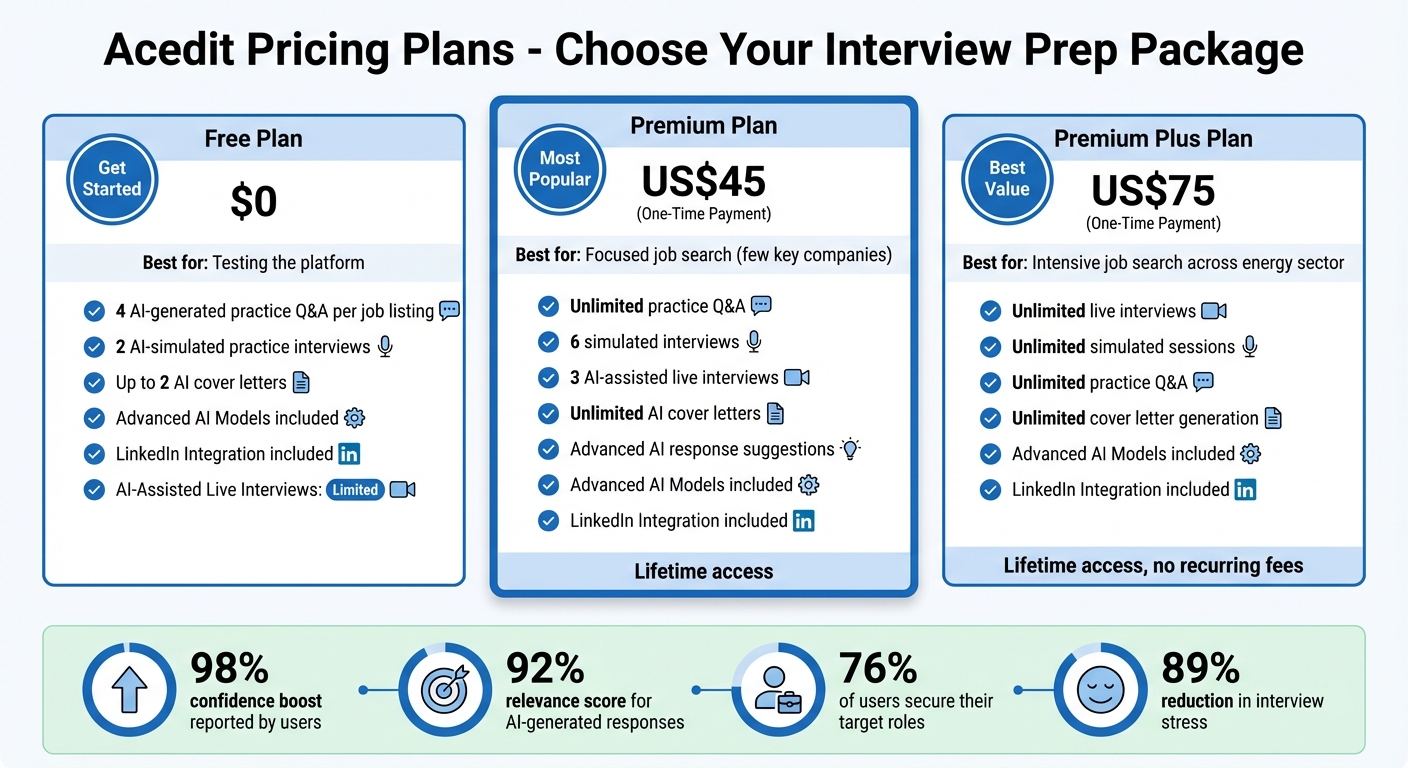
Acedit Pricing Plans Comparison for Energy Job Interview Preparation
Acedit provides three pricing options tailored for professionals preparing for energy sector interviews. Here’s how they stack up:
The Free plan ($0) is a great starting point, offering 4 AI-generated practice Q&A per job listing, 2 AI-simulated practice interviews, and up to 2 AI cover letters. It's ideal for testing the platform before making a commitment. You can also explore ways to use AI in your job search to maximize your efficiency. For those applying to a few energy companies, the Premium plan (US$45 one-time payment) unlocks unlimited practice Q&A, 6 simulated interviews, and 3 AI-assisted live interviews, complete with advanced AI response suggestions. If your job search is more intensive - like exploring roles in renewable energy or grid engineering - the Premium Plus plan (US$75 one-time payment) provides unlimited live interviews, simulated sessions, and cover letter generation.
The one-time payment structure guarantees lifetime access, removing the stress of recurring subscription fees. This is especially helpful for energy professionals navigating career transitions or extended job searches. For instance, the Premium Plus plan is perfect for those juggling multiple applications, ensuring you won't run out of live interview credits during critical final rounds with major employers.
| Feature | Free Plan ($0) | Premium (US$45 One-Time) | Premium Plus (US$75 One-Time) |
|---|---|---|---|
| AI-Assisted Live Interviews | Limited | 3 sessions | Unlimited |
| AI Practice Q&A | 4 per job listing | Unlimited | Unlimited |
| AI-Simulated Mock Interviews | 2 | 6 | Unlimited |
| AI Cover Letter Generation | 2 maximum | Unlimited | Unlimited |
| Advanced AI Models | Included | Included | Included |
| LinkedIn Integration | Included | Included | Included |
The Free plan is also useful for ensuring compatibility with your browser and video conferencing tools like Zoom, Microsoft Teams, or Google Meet. If you’re preparing for a few key interviews - say, with companies like NextEra Energy or Siemens Energy - the Premium plan offers advanced AI interview preparation vs traditional methods and STAR method integration to help you excel. On the other hand, the Premium Plus plan is the go-to choice for those casting a wide net across the energy sector, allowing unlimited practice for scenarios like AI-driven grid optimization or renewable forecasting. With this pricing breakdown, you can pick the plan that best fits your career goals in the energy industry.
Energy-Specific Preparation Tips
To excel in energy sector interviews, combine your Acedit-powered prep with targeted research and a strong grasp of technical concepts. The energy industry demands more than just general interview readiness - it requires a deep understanding of its unique challenges and trends. Start by leveraging Acedit’s personalized Q&A feature to dissect the job description. Feed it details like the role requirements, your resume, and recent company updates - such as announcements about a new solar farm or grid modernization efforts. This approach helps you craft responses that directly address the company’s priorities and challenges. From there, focus on detailed research to refine your strategy.
In-depth research helps you craft a compelling technical narrative. Use AI tools to analyze quarterly earnings reports or investor call transcripts from companies like NextEra Energy or Siemens Energy. Search for terms like "growth areas", "priorities", or "investments." For example, if a utility is focused on expanding its smart grid infrastructure, prepare STAR (Situation, Task, Action, Result) stories that highlight your experience with IoT systems or demand forecasting. As Rajat Sachdeva explains:
Deep research isn't about memorizing facts. It's about gathering insights that allow you to frame your experience as the perfect solution to their specific problems and goals.
Technical expertise is equally critical. Be ready to discuss how AI is reshaping energy operations. For instance, in 2024, Google’s DeepMind improved wind energy forecast accuracy by 20%, demonstrating how machine learning can enhance renewable energy efficiency. Practice explaining key topics like predictive maintenance for solar panels, natural language processing (NLP) for emissions compliance, or reinforcement learning for managing decentralized energy assets. Use examples from your own work to show practical application.
Finally, test your entire interview workflow a few days before the big day. Use an AI simulation to refine your delivery - eliminating filler words, improving pacing, and tightening transitions. Prepare five to seven STAR stories focused on areas like safety, sustainability, or problem-solving, and quantify your results (e.g., "reduced downtime by 15%"). These steps ensure your preparation aligns with the technical and strategic demands of the energy sector.
Conclusion
With its real-time coaching, tailored responses, and interactive simulations, Acedit is designed to meet the specific challenges of energy sector interviews. The results speak volumes: users report a 98% confidence boost on average, and AI-generated responses hit a 92% relevance score for industry-specific questions. Even more impressive, 76% of candidates who use Acedit's real-time coaching secure their target roles, while experiencing an 89% reduction in interview-related stress. This success stems from Acedit’s ability to detect live questions during video interviews and provide discreet, context-sensitive suggestions. Whether you're addressing technical topics like smart grids, IoT sensor analytics, or renewable forecasting models, Acedit ensures you stay composed and articulate.
What sets Acedit apart is its focus on personalization. By integrating your LinkedIn profile, resume, and job descriptions, it crafts responses that highlight your actual achievements - steering clear of generic templates. This means your answers use the right terminology and align with company priorities, like improving grid efficiency or advancing renewable energy forecasting. As William Johnson, a satisfied user, shared:
"Being able to prepare for interviews with real-time AI feedback was a game changer and made me feel confident for my interview."
In today’s competitive energy job market, smart preparation is essential. Acedit equips you with master interview prep questions with unlimited practice sessions, STAR method integration, and live interview support, helping you showcase not just your technical skills but also your ability to fit seamlessly into a company’s culture. These features not only sharpen your technical readiness but also elevate your professional narrative, ensuring you stand out. With cost-effective, one-time payment plans, Acedit offers a practical investment in your career growth.
FAQs
Can Acedit be used during a live interview?
Acedit can be a game-changer during live interviews. It provides real-time coaching, picks up on questions as they’re asked, and discreetly suggests responses. The best part? It works in the background, so the interviewer has no idea, allowing you to stay confident and well-prepared throughout the conversation.
What info should I upload to get better Acedit answers?
To help Acedit generate better responses, consider uploading your latest resume, details about your target job (including the job description), and your LinkedIn profile if available. This information allows Acedit to analyze your skills, experience, and career goals, providing tailored interview questions and feedback. Adding LinkedIn data gives the AI a deeper understanding of your professional background, leading to even more personalized insights.
Does Acedit work for in-person energy interviews too?
Yes, Acedit provides support for in-person energy interviews through real-time coaching, question detection, and response suggestions. These tools are tailored to assist you during both virtual and face-to-face interviews, ensuring you feel prepared and respond with confidence.