
Virtual interviews are no longer just video calls - they now use AI to analyze speech, tone, and body language in real time. This technology helps candidates improve their responses through AI interview simulation and gives recruiters instant data to make better hiring decisions. Here's what you need to know:
- Key Problems Solved: AI addresses issues like long hiring times, inconsistent interviews, and lack of objective data.
- Real-Time Insights: AI tools analyze speech, tone, and gestures within milliseconds, offering feedback during the interview.
- Benefits for Candidates: 94% feel more confident, and 88% improve their answers using AI tools.
- Benefits for Recruiters: Time-to-hire can drop by 90%, with 60% less time spent on screening.
AI tools like Acedit integrate with platforms like Zoom and Teams, providing discreet, tailored feedback to candidates while helping recruiters identify top talent faster. This is transforming how interviews are conducted and evaluated.
I Built an AI Coach that Analyzes Your Job Interviews Like a Real Coach
sbb-itb-20a3bee
Core Technologies Behind Real-Time AI Analysis
Real-time AI interview analysis relies on a seamless interplay of three technologies that work together to process and respond to the dynamic elements of a virtual interview in mere fractions of a second. Here's how each technology contributes to this rapid and intelligent process.
Speech-to-Text and Natural Language Processing
Through low-latency streaming pipelines, audio is captured and stabilized for near-instant text conversion and intent detection - achieved in just 150–250 milliseconds. Once the audio is transcribed, Natural Language Processing (NLP) engines step in, using advanced algorithms to classify the type of question being asked. Whether it's behavioral, technical, or situational, the system identifies keywords like "leadership" or "conflict" to determine if structured responses, such as those following the STAR method, are appropriate.
From there, the transcribed text is directed to specialized micro-agents. For example, a STAR Agent might handle behavioral questions, while a Coding Reasoning Agent focuses on technical queries. These systems also go beyond simply capturing words - they automatically filter out filler phrases and summarize key points using cutting-edge generative AI models like Pegasus 1.1. This is crucial because spoken words account for just 7% of communication during an interaction.
Computer Vision for Non-Verbal Communication
Speech analysis is only part of the equation. Computer vision technology steps in to analyze non-verbal cues, such as facial expressions, posture, and gestures. By tracking facial landmarks, the system maps the user’s face and uses Convolutional Neural Networks to detect subtle muscle shifts that reveal fleeting emotions like joy, fear, or doubt.
Additionally, the technology monitors eye contact patterns and blink rates to gauge confidence and focus. Pose estimation identifies whether a candidate is leaning in - suggesting engagement - or slouching, which might indicate low energy. Since non-verbal cues make up 55% of communication, these insights are critical. In fact, 70% of users who compare AI interview preparation vs traditional methods and practice with AI-driven simulation tools report significant improvements in their interview readiness. Advanced emotive AI models can now interpret up to 48 distinct emotional states, moving beyond basic categories like "happy" or "sad" to assess complex traits such as curiosity, empathy, and leadership energy.
Real-Time Feedback Algorithms
The final piece of the puzzle is the feedback algorithms, which integrate data from transcriptions, vocal tone, facial cues, and body language to deliver instant performance insights. Using tools like Parselmouth, these algorithms analyze vocal features such as jitter, tone, and energy levels to assess engagement and confidence. They also detect filler words, stutters, pauses, and false starts through transcription models like CrisperWhisper.
Step-by-Step: How AI Analyzes Virtual Interviews
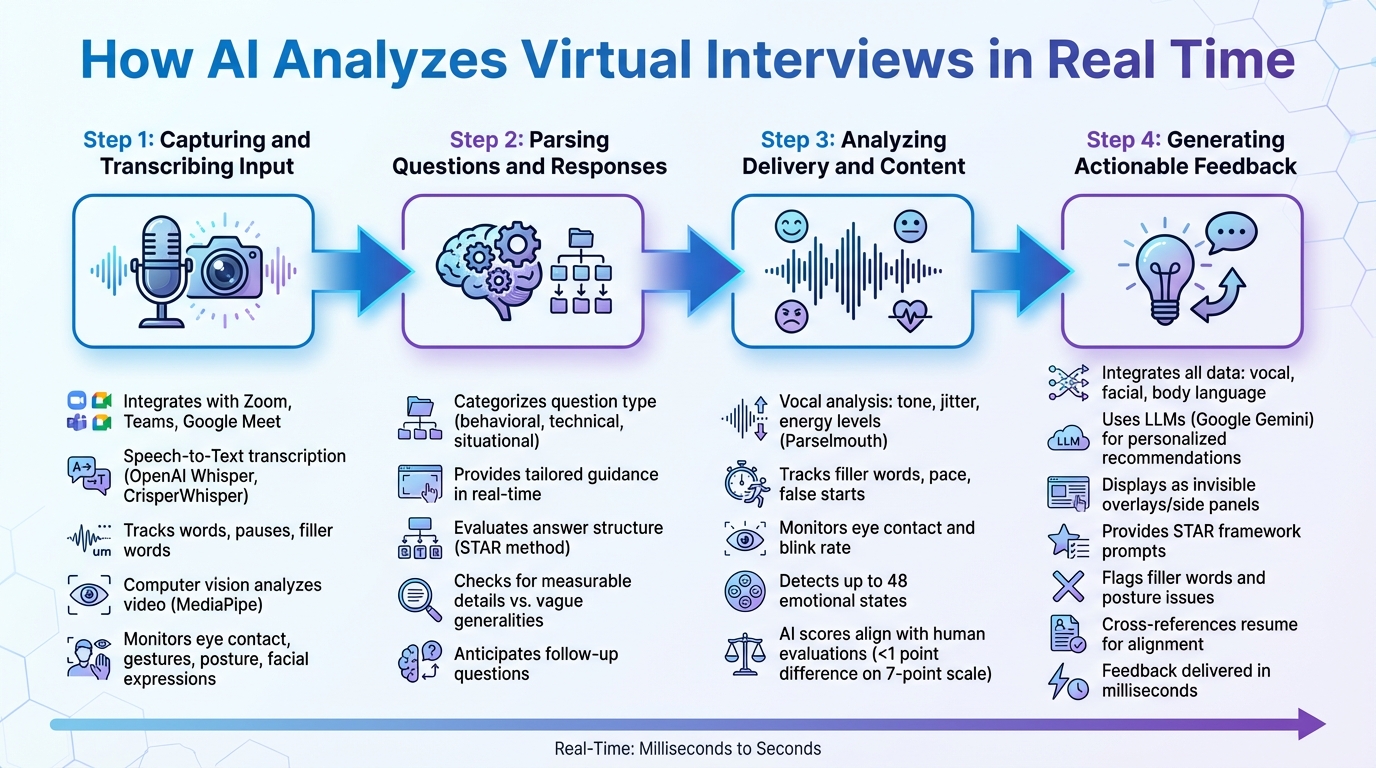
4-Step AI Virtual Interview Analysis Process
When you sit down for a virtual interview, AI technology works behind the scenes in a structured, four-stage process. Understanding this process is a key part of perfecting your interview preparation. Each stage builds on the last, delivering a thorough evaluation of your performance.
Step 1: Capturing and Transcribing Input
The journey starts as soon as you join the interview. AI tools seamlessly integrate with platforms like Zoom, Microsoft Teams, and Google Meet, capturing both audio and video streams. Speech-to-Text models, such as OpenAI Whisper or CrisperWhisper, transcribe your speech, noting every word, pause, and filler to assess how confidently you communicate. Simultaneously, computer vision models like MediaPipe analyze video feeds to track body movements - eye contact, hand gestures, and posture. Facial expressions, like smiles, are identified using techniques like modified Haar Cascades.
Step 2: Parsing Questions and Responses
Once your words are transcribed, the AI shifts focus to understanding the conversation. It categorizes the interviewer’s question - whether it’s behavioral, technical, or situational. This real-time classification allows the system to offer tailored guidance during the interview.
Your answers are then evaluated for structure and detail. For example, if you’re responding to a behavioral question, the AI checks whether you’re using the STAR method (Situation, Task, Action, Result). It also looks for measurable details in your response rather than vague generalities. This analysis happens in real time, helping the AI anticipate potential follow-up questions before they’re even asked.
Step 3: Analyzing Delivery and Content
The AI doesn’t just focus on what you say - it also evaluates how you say it. Tools like Parselmouth analyze vocal features such as tone, jitter, and energy levels to assess your engagement and confidence. The system tracks filler words, speaking pace, and false starts, which might indicate nervousness.
Non-verbal cues are equally important. The AI monitors your eye contact and blink rate to measure focus. Facial expressions and vocal patterns are analyzed to detect emotional states - ranging from anxiety to confidence. Advanced models can identify up to 48 nuanced emotions, creating a comprehensive picture of your delivery. In a UC Berkeley study from Fall 2024, AI-generated performance scores were shown to align closely with human evaluations, differing by less than one point on a 7-point scale.
Step 4: Generating Actionable Feedback
Finally, the AI pulls together all this data to provide immediate, practical feedback. Large Language Models like Google Gemini process the collected insights - vocal analysis, facial expressions, and body language - to generate personalized recommendations in real time.
This feedback can appear as overlays or side panels that remain invisible to others during screen sharing. For instance, if you’re answering a behavioral question, the AI might display a STAR framework with prompts for each step. If it notices excessive filler words or poor posture, it flags these issues so you can adjust on the spot. The system can even cross-reference your resume to ensure your answers align with your professional experience, helping you articulate your strengths under pressure.
"A real-time AI interview assistant solves this final-mile problem by listening to the live conversation, detecting question types, and generating complete, structured answers in milliseconds." - Beyz AI
How Acedit Improves Real-Time Interview Analysis
Acedit takes advantage of advanced AI frameworks to deliver personalized, real-time feedback for job candidates. By integrating seamlessly as a Chrome extension, it works directly in your browser during live interviews on platforms like Zoom, Microsoft Teams, and Google Meet. This makes it a practical tool for boosting your performance with proven interview strategies without disrupting the flow of the interview.
Real-Time Question Detection and Response Suggestions
Acedit features Invisible Question Detection, which listens to live audio and identifies interview questions as they’re asked. Once a question is detected, the AI provides structured response prompts that remain hidden from the interviewer.
Its tailored approach enhances your ability to respond effectively. For example, when faced with behavioral questions, Acedit generates STAR-structured responses using your work history. For technical questions, it offers logical breakdowns or relevant context. According to Acedit’s internal metrics, AI-generated responses achieve a 92% relevance score when combined with profile data.
"Assisted with preparing me and then on the day, the live prompts during the interview helped me nail it." - Sophia Lang
Speech Pattern Monitoring and Live Feedback
Acedit doesn’t just focus on what you say - it also analyzes how you say it. By monitoring your speech patterns in real time, the tool provides actionable feedback. For instance, if you’re speaking too quickly or your response lacks specific metrics, it might suggest “slow down” or “add a specific result” to help you refine your answer without disrupting the conversation.
Users have reported an 88% improvement in response quality and an 84% boost in overall performance. Additionally, active users experience a 2.8x improvement in response structure thanks to these real-time adjustments.
Integration with Job-Seeker Profiles
Acedit pulls information from your resume, LinkedIn profile, and the job description to ensure every suggestion is tailored to your background and the role you’re pursuing. This level of customization makes your responses far more relevant. In fact, LinkedIn integration alone results in 3.5x more relevant answers compared to generic AI suggestions, with a 96% accuracy rate in reflecting your professional experience.
Key Benefits of Real-Time AI Analysis for Job Seekers
Real-time AI analysis is changing the game for job seekers, tackling common hurdles that even seasoned professionals face during interviews. This technology boosts confidence, sharpens communication, and leads to better hiring outcomes.
Building Confidence and Reducing Anxiety
Interview nerves often stem from cognitive overload - juggling how to answer questions, manage body language, and stay composed all at once. AI tools ease this burden by offering real-time support, typically within 1.5 to 2 seconds of detecting a question. If you stumble or pause, these tools provide instant phrasing suggestions to help you recover smoothly.
The results speak volumes: users report a 94% boost in confidence and an 89% drop in stress during interviews. This confidence comes from knowing the AI is monitoring your speech, pacing, and filler words like "um" or "like", and offering real-time feedback for quick adjustments. Tools like Acedit, which use invisible browser overlays, also eliminate the fear of being caught using assistance.
"Even the best candidates blank under pressure. AI Interview Copilot helps you stay calm and confident with real-time cues and phrasing support when it matters most." - Max Durand, Career Strategist
Improving Communication and Presentation Skills
AI doesn’t just help you stay calm - it also helps you communicate better. It evaluates your responses in real time, ensuring they align with frameworks like STAR (Situation, Task, Action, Result) and match the job description. The technology also monitors delivery, offering actionable tips like "slow down" or "add a specific metric" to refine your verbal skills.
The benefits are clear: users experience immediate improvements in how they structure and deliver answers. AI tools go a step further by personalizing suggestions based on your resume or LinkedIn profile, making advice 3.5x more relevant than generic feedback. This tailored support ensures your responses are both polished and specific, giving you an edge in presenting your qualifications effectively.
Increasing Interview Success Rates
By reducing stress and enhancing communication, AI tools significantly improve hiring outcomes. Candidates using real-time AI support report a 76% success rate in interviews. They also secure jobs faster, averaging 4.5 weeks to land a position - 5x quicker than the U.S. average of 22.6 weeks.
One standout feature is how AI handles curveball questions. Through dynamic scaffolding, it adapts follow-up suggestions on the fly, helping you maintain coherent and relevant responses even when the conversation takes an unexpected turn. This real-time adaptability ensures you stay composed and on track throughout the interview process.
Conclusion
AI has reshaped virtual interviews, turning simple recordings into tools capable of analyzing speech and facial expressions in real time. By leveraging technologies like speech-to-text processing, natural language understanding, and computer vision, these systems transform intangible soft skills into measurable data. For instance, facial recognition and eye-tracking technologies boast accuracy rates of 97.35% and 92.73%, respectively. This evolution offers exciting opportunities for job seekers navigating the interview process.
For candidates, the benefits are tangible. Real-time coaching tools, such as Acedit, provide discreet assistance during live interviews. These tools can instantly detect questions and suggest tailored responses based on your resume, LinkedIn profile, and the job description. They tackle common challenges like handling unexpected questions or managing nervous moments. By quantifying performance and delivering actionable feedback, these systems complement traditional preparation methods.
The impact is clear: candidates using real-time AI tools report a 76% interview success rate. Beyond the numbers, these tools help structure responses effectively with frameworks like STAR, ensure clarity and proper pacing in delivery, and provide strategies for recovering from tricky questions.
Whether you opt for a free version or a premium plan with unlimited sessions, AI-powered interview tools offer a valuable edge. They don’t replace preparation but act as a reliable coach, helping you showcase your qualifications with confidence and precision.
FAQs
Can interviewers see my AI prompts?
Interviewers cannot see your AI prompts during an interview. These tools are built to function in the background, providing assistance quietly and without making their presence known.
How accurate is AI at reading tone and body language?
AI has the ability to assess tone and body language by analyzing various nonverbal signals, including facial expressions, eye contact, posture, gestures, and vocal tone. It can pick up on subtle details like micro-expressions and tiny movements - things that might escape human notice. This capability provides a more nuanced understanding of interactions, especially in virtual interview settings.
Is it allowed to use AI during a live interview?
Using AI during a live interview can be a helpful resource. These tools are built to offer real-time feedback, helping candidates fine-tune their answers on the spot without drawing attention from the interviewer. They can analyze the questions being asked, propose better phrasing, and assist in improving responses - all while keeping the flow of the interview smooth and uninterrupted.