
Initiative questions are a staple in interviews, appearing in over 80% of them. These questions help employers assess whether you take action independently, solve problems effectively, and add value without needing constant direction. Responding well showcases your ability to identify opportunities, make decisions, and deliver results.
Key points to know:
- Common Questions: Expect prompts like "Tell me about a time you took initiative" or "Describe a situation where you improved a process."
- What Employers Look For: Independence, sound judgment, resourcefulness, and measurable results.
- Best Answer Structure: Use the STAR method (Situation, Task, Action, Result) to provide clear, impactful responses.
- Preparation Tip: Develop 3–5 specific examples highlighting your ability to take initiative and achieve results.
To prepare for your interview, focus on creating concise STAR stories that emphasize your actions and the outcomes you achieved. Tailor your responses to the role and back them with data whenever possible. Tools like Acedit can help refine your answers and boost confidence during interviews.
"WHEN HAVE YOU SHOWED INITIATIVE AT WORK?" (Interview Question and TOP-SCORING ANSWERS!)
sbb-itb-20a3bee
Why Employers Ask About Initiative
Employers ask about initiative to gauge whether you wait for instructions or take action to resolve challenges. Companies value employees who can spot and address problems on their own. Why? Because proactive individuals need less oversight and consistently deliver results without relying on external motivation.
"Initiative is informal leadership - influencing outcomes without formal authority." - Revarta
These questions also reveal how you balance independence with sound judgment. Employers want to see if you can take calculated risks and innovate while staying aligned with the company’s goals. It’s not just about taking action - it’s about making thoughtful decisions that benefit the organization without stepping into reckless territory.
Initiative also plays a big role in team dynamics. Employees who take the lead often inspire their colleagues, solve problems before they escalate, and introduce new ideas that keep the team moving forward. This kind of proactive mindset doesn’t just boost individual performance - it elevates the entire team and contributes to the company’s long-term success.
The qualities tied to initiative - like ownership, resourcefulness, and foresight - are directly linked to job performance. Employees who are driven by internal motivation take pride in their work. They find solutions, anticipate challenges, and make improvements that last. Understanding this sets the stage for how you can highlight these traits in interview questions to ask and answer.
Common Initiative Questions You'll Encounter
General Initiative Questions
One of the most frequent prompts you’ll face is "Tell me about a time you took initiative". Variations might include "Describe a time you went above and beyond your job duties" or "Tell me about a time you solved a problem without clear direction." These types of questions aim to uncover how proactive you are in tackling challenges.
Another common angle is efficiency and problem-solving, with prompts like "Describe a situation where you improved a process or system." These assess your ability to identify inefficiencies and make impactful changes. Similarly, questions such as "Tell me about a time you took action without being asked" or "Describe a project where you assumed leadership" focus on informal leadership and initiative.
You might even be asked about situations where your initiative didn’t go as planned. For example, "Tell me about a time you took initiative, but it didn’t work out." This helps interviewers gauge your resilience and how well you learn from setbacks. Recently, with the rise of technology, questions like "How do you use AI tools to improve your work?" or "Describe a time you replaced a manual process with automation" have become more common.
Questions Tailored to Specific Roles
The nature of initiative-related questions often varies depending on the industry or role.
- In technology, the focus might be on process automation, reducing technical debt, or improving systems. You could hear, "Have you ever replaced manual processes with automation?"
- For healthcare, questions are often tied to patient care and safety, such as "Describe a time you took the initiative to address a safety concern."
- In finance, interviewers may look for examples of risk awareness and compliance, asking something like "Describe a time you identified a risk others missed."
- Sales and marketing roles often emphasize revenue growth and customer experience, with prompts like "Tell me about a time you improved a customer’s experience or boosted revenue."
- Operations positions might include questions like "Describe a time you identified an opportunity to increase efficiency."
- For customer-facing roles, expect questions about proactive problem-solving, such as "Describe a time you resolved a client issue before it escalated" or "Tell me about a resource you created to improve customer satisfaction."
These tailored questions help interviewers evaluate how well your initiative aligns with the unique demands of the role. Understanding these patterns can help you prepare responses that showcase your ability to take meaningful action.
What Interviewers Evaluate in Your Answers
Key Traits to Demonstrate
When tackling initiative-based questions, interviewers are looking for signs that you'll go beyond the basics of your role. They want to see that you can take ownership by independently driving projects from start to finish. Balancing this independence with sound judgment - knowing when to act on your own and when to seek input - is equally important.
"Organizations need people who identify and solve problems before being asked, not just those who complete assigned tasks." - Revarta
Another critical area is your ability to be resourceful and persistent. Employers want to know if you can find the tools, information, or people needed to get the job done. Overcoming challenges and pushing for improvement are key indicators of someone who will add value to their team. These traits, when demonstrated effectively, can highlight your potential for delivering measurable results.
Showing Measurable Results
Numbers speak louder than general statements. Whenever possible, back up your answers with specific outcomes and examples - like cost savings, time reductions, or efficiency improvements. For instance, saying, "I reduced reporting time by 35%" paints a far clearer picture than vague phrases like "I improved efficiency."
To make your impact stand out, connect your actions to tangible benefits for the company. Did you save money, improve customer satisfaction, or streamline a process? Providing "before and after" context is key. For example, you could mention reducing manual reporting errors from 20 per week to just 3.
These measurable outcomes not only strengthen your responses but also help you craft effective STAR examples, which will be explored in the next section.
How to Structure Your Answers with the STAR Method
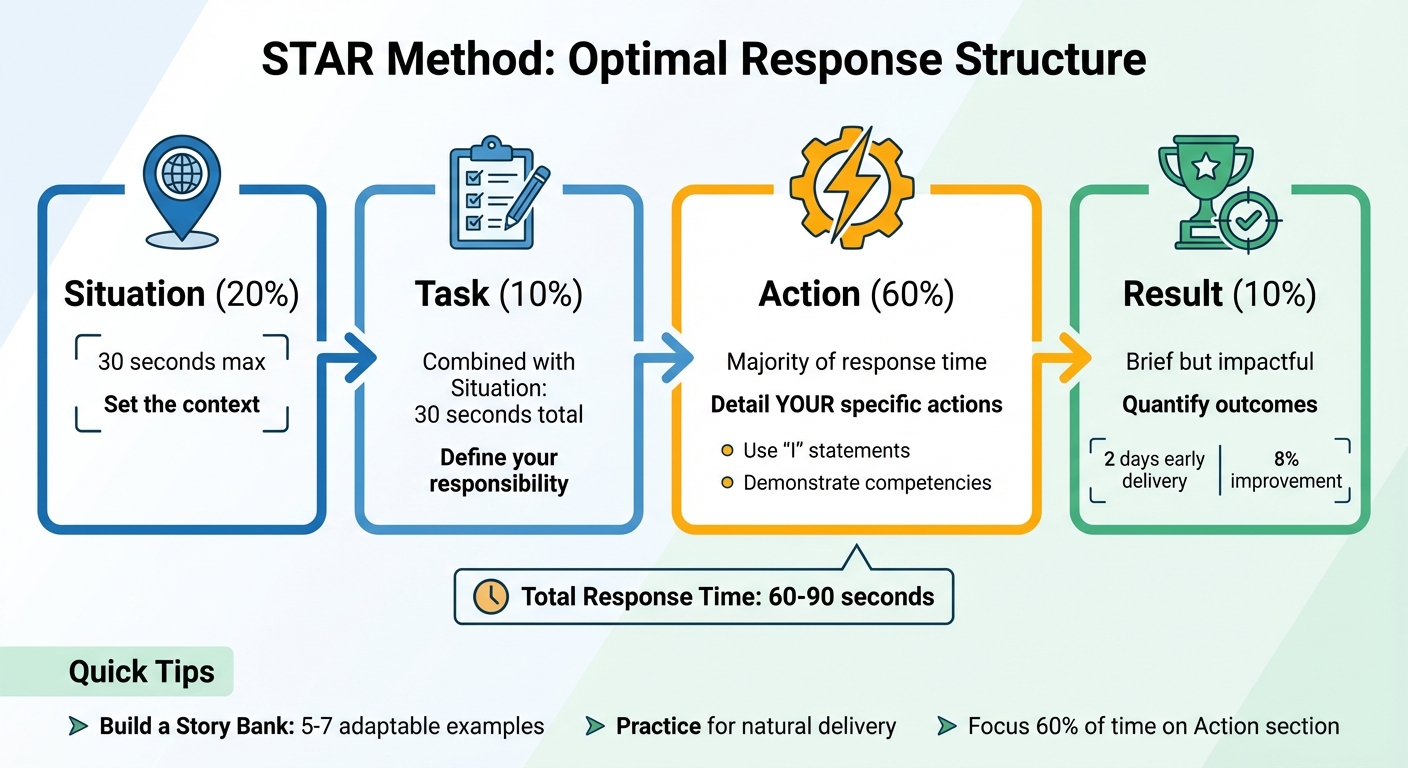
STAR Method Interview Response Structure with Time Allocation
The STAR method - Situation, Task, Action, Result - is a straightforward way to structure your interview responses. It keeps your answers focused, prevents unnecessary tangents, and ensures you hit all the key points of your story. This method is especially useful for showcasing initiative, a quality highly valued in competitive interviews.
Here’s how to break down your response: dedicate 20% to the Situation, 10% to the Task, 60% to the Action, and 10% to the Result. In practice, this means spending no more than 30 seconds on the Situation and Task combined, leaving the majority of your time to detail your actions and outcomes. For example, you might say, “I delivered the project two days early” or “I achieved an 8% improvement in valuation”.
The Action section is the heart of your answer. It’s where you demonstrate your skills and initiative.
"The Action section should consume 60% of your total interview response time. This is where you demonstrate specific examples of the competencies in the job description: analytical thinking, communication skills, leadership skills, and initiative." - Cara Mu, CMO at Cook'd AI
To make your contributions clear, use "I" statements. Instead of saying, "We implemented a new process", try, "I identified the bottleneck and designed a new workflow." This approach highlights your individual role and shows how you took the lead.
One way to master interview prep questions is by creating a "Story Bank" of five to seven examples that you can adapt to different questions. Rehearse these stories to ensure they’re concise, clear, and fit within the recommended timing. This practice will help you deliver polished responses that leave a lasting impression.
Preparing for Initiative Questions with Acedit
Acedit builds on established strategies like the STAR method to help you shine in initiative-based interviews. By combining AI-powered tools with practical applications, it ensures your answers are both polished and personalized.
The Acedit Chrome extension offers real-time interview support. It analyzes your resume and LinkedIn profile to create customized STAR examples rooted in your actual work experience. This approach ensures your responses come across as genuine, not rehearsed. You can even upload a job description, and the AI will tailor answers to align with the company's values - whether it's showcasing proactive problem-solving skills in operations or identifying untapped sales opportunities.
With the mock interview simulator, you can practice 10–15 common initiative-related questions using top mock interview apps. These simulations provide instant feedback on your delivery, helping you refine responses to prompts like, "Tell me about a time you identified a problem before others", or, "Describe a situation where you exceeded your job responsibilities." This focused preparation reinforces the initiative traits discussed earlier. According to Acedit data, 94% of users feel prepared for actual interviews, and 91% notice improved response quality after targeted practice sessions.
During live interviews, Acedit's real-time coaching integrates seamlessly with platforms like Zoom, Microsoft Teams, and Google Meet. The AI listens to questions as they're asked and provides instant STAR-structured suggestions that you can adapt in real time. This feature has contributed to a 76% boost in overall interview success rates and an 89% reduction in interview-related stress for users. Additionally, the system achieves a 92% relevance score, meaning its suggestions closely align with your experience and the role's requirements.
Acedit Features for Initiative Questions
Acedit’s Smart Profile Analysis identifies key initiative traits in your work history, such as persistence, creativity, and measurable results. Premium users can upload their own STAR notes, which the AI refines into polished, professional responses while keeping your unique voice intact. The LinkedIn Fine-Tuning feature ensures your "Action" and "Result" components include specific details and quantifiable achievements, like improved efficiency or successful project outcomes.
Users report a 2.8x improvement in response quality and structure when using Acedit’s tailored suggestions. Additionally, 87% feel more confident knowing they have personalized support during interviews.
Acedit Pricing and Plans
Acedit offers three pricing tiers to suit different levels of preparation:
| Plan Name | Price | Key Preparation Features |
|---|---|---|
| Free Plan | $0 | Limited Q&A (4), 2 simulations, STAR examples |
| Premium | $45 (One-Time) | Unlimited Q&A, 6 simulations, advanced suggestions |
| Premium Plus | $75 (One-Time) | Unlimited everything, no restrictions |
These one-time payment plans eliminate the hassle of recurring fees. Premium and Premium Plus users also gain access to advanced AI models, which generate more refined responses and allow integration of pre-prepared STAR examples - perfect for high-stakes behavioral interviews.
Conclusion
The strategies we've explored highlight how taking initiative can be a game-changer in interview success. Questions about initiative are your chance to demonstrate proactive problem-solving and stand out from the crowd. The secret? Structured preparation. Develop 3–5 concise STAR stories from your experiences that clearly illustrate how you spotted gaps, proposed solutions, and delivered results.
"Even the best candidates blank under pressure." - Kevin Durand, Career Strategist
This is why practice is so essential. Rehearse your STAR stories until they flow naturally in 60–90 seconds. This not only helps you stay composed under pressure but also ensures you can effectively communicate the measurable impact of your actions.
For additional support, Acedit offers personalized, AI-driven coaching to enhance your preparation. From tailored STAR examples to real-time interview guidance, it equips you to approach interviews with confidence instead of stress.
Whether you're just beginning your job hunt or gearing up for a critical interview, the right tools and consistent practice can set you apart. By taking the lead in your preparation, you not only excel in interviews but also demonstrate the proactive mindset that every employer values.