
AI tools for resume creation are transforming how job seekers approach applications. They save time, optimize for ATS systems, and are cost-effective, but they come with drawbacks like generic output and risk of detection. Here's a quick breakdown of the three main options for crafting resumes:
- AI Tools: Fast, affordable, and ATS-friendly but lack personalization and may be flagged by recruiters.
- Professional Writers: Offer tailored, high-quality resumes but are expensive and slower.
- DIY Resumes: Cost nothing and allow full control but require significant time and effort.
Quick Overview:
- AI tools are great for speed and budget-conscious users but need manual edits for a personal touch.
- Professional writers excel in creating polished resumes for complex career paths or senior roles.
- DIY resumes give you complete control but demand a lot of time and effort.
For most job seekers, a hybrid approach - starting with AI and refining manually - might strike the best balance between efficiency and authenticity.
What Hiring Managers See When a Resume Is AI-Generated
1. AI Resume Builders
AI resume builders are reshaping how job seekers craft their resumes, offering a mix of speed and technical precision. These tools use natural language processing to analyze job descriptions, pinpoint critical keywords, and create ATS-friendly resumes in just minutes .
Speed
One of the standout benefits of AI resume builders is their efficiency. While traditional resume writing - researching trends, tailoring content, and formatting - can take hours, AI tools can generate a polished resume in mere minutes . This speed is especially helpful for those applying to multiple roles or working under tight deadlines.
Cost
AI resume builders are also easy on the wallet. Many platforms offer free versions or subscriptions for less than $20 a month. For instance, Kickresume starts at just $7 per month. In comparison, hiring a professional resume writer can cost $200 or more. For job seekers on a budget, these tools provide professional formatting and ATS optimization without the hefty price tag.
ATS Optimization
When it comes to ATS (Applicant Tracking System) optimization, AI tools shine. They ensure resumes are formatted correctly, avoiding design elements like tables and graphics that can confuse ATS software. They also standardize headers and even provide compatibility scores tailored to specific job descriptions . However, there’s a catch: overloading resumes with keywords can backfire. Modern ATS systems may flag excessive keyword use, and human recruiters might find it off-putting.
Personalization
Despite their technical strengths, AI resume builders often fall short in creating resumes that feel personal. One recruiter shared:
"You can totally tell when someone has used AI, because suddenly I have six applications that all have the same sort of structure and format".
AI tools struggle to capture your unique career story or align with a company's mission and values unless you provide detailed input . They rely on the information you supply, so specifics like your achievements and measurable results need to come directly from you .
Strategic Positioning
AI tools also face challenges with more nuanced career situations. While advanced platforms can sometimes help with career transitions by highlighting transferable skills, they often misrepresent gaps in employment or non-traditional career paths . They may also miss subtle cues that human writers use to emphasize cultural fit or career progression. Manual tweaks are often needed, such as swapping generic terms like "overseeing" with more precise ones like "managing".
Risk of Detection
A growing number of hiring managers - 74%, to be exact - can identify AI-generated resumes due to predictable patterns and overused phrases. In fact, 82% of U.S. hiring managers report being able to spot AI-crafted materials . Some employers even use tools like GPTZero to detect AI-generated text. Being flagged for using AI can have serious consequences, with about 10% of job seekers being rejected after employers discovered they used ChatGPT for their applications .
This underscores the importance of using AI tools thoughtfully. As Coursera Staff advises:
"AI is a tool that can support your resume creation, but it shouldn't go unchecked. You know your industry, experience, and skill set best".
Always double-check technical skills suggested by AI. Some tools might add expertise, like JavaScript or Scrum, that you don’t actually possess, simply to align with job descriptions . Ultimately, AI resume builders are best used as a starting point, with personalized edits needed to fully tell your professional story.
2. Professional Resume Writers
Professional resume writers bring your career story to life by offering personalized consultations, creating resumes that reflect your voice while aligning with the hiring company's values. Let’s break down the key aspects - cost, speed, personalization, strategic positioning, and ATS optimization - to understand the benefits and challenges they bring.
Cost
Hiring a professional resume writer can be a significant investment. Prices range widely, from $139 to over $700, depending on the provider and your career level. For instance, ZipJob’s packages start at $139, while Resume Spice charges between $479 and $699. Some services, like Indeed Resume Services, offer lower-cost options, such as feedback sessions, video consultations, or full rewrites. On the other hand, AI resume tools are generally more budget-friendly, with costs ranging from free to about $30 per month.
Speed
While AI tools can whip up a draft in just 10–15 minutes, professional resume writers take a more thoughtful approach. Typically, it takes 2–7 business days to deliver a polished resume. This extra time allows for consultations, careful drafting, and revisions, ensuring the final product is tailored and high-quality.
Personalization
Personalization is where professional writers truly shine. Through detailed consultations, they capture your unique voice and career journey. As Simone Wu, Senior Content Editor at Michael Page, puts it:
"AI lacks the nuance and personal touch a human can provide. A cover letter, for instance, is an opportunity to infuse personality and warmth, elements that are challenging for AI to replicate accurately".
By focusing on your real-life experiences, professional writers also eliminate the risk of factual inaccuracies that can sometimes occur with AI-generated resumes.
Strategic Positioning
Professional resume writers are skilled at addressing tricky career situations, such as employment gaps or unconventional career paths. They can weave diverse experiences into a cohesive narrative that aligns with the values of potential employers. Using carefully chosen language tailored to specific companies, they position your application to stand out in a competitive job market.
ATS Optimization
Both professional writers and AI tools aim to make resumes compatible with Applicant Tracking Systems (ATS). However, human experts often achieve a better balance. Instead of cramming in keywords, they seamlessly incorporate essential terms into a well-crafted narrative. This approach ensures your resume not only passes ATS filters but also remains engaging and easy to read.
Risk of Detection
Unlike AI-generated resumes, which may raise red flags during the hiring process, professionally written resumes are original and personalized. They easily pass scrutiny, avoiding the risks associated with automated detection tools.
sbb-itb-20a3bee
3. DIY Human-Written Resumes
Creating your own resume gives you the ultimate say in how you present your story. Unlike automated tools or professional services, a DIY resume offers complete control and allows you to tailor every detail to reflect your unique voice. The trade-off? While it's cost-free, it does demand a significant time investment - polishing and formatting a resume can take hours of focused effort.
Cost
When it comes to affordability, DIY resumes are unbeatable. Hiring a professional resume writer can easily cost $200 or more, making the DIY route especially appealing for recent graduates, career switchers, or anyone trying to save money.
Speed
The biggest downside of a DIY resume is the time it takes. Unlike AI tools that churn out drafts in minutes, crafting a resume by hand requires hours of careful attention. You'll need to write compelling descriptions, fine-tune the language, ensure consistent formatting, and proofread multiple times. It’s a time-intensive process, but the results can be worth it.
Personalization
One of the greatest strengths of a DIY resume is how personal it can be. You have the freedom to let your authentic voice shine through, something AI tools often struggle to replicate. Jamie Johnson, a career advisor at the University of Phoenix, emphasizes this point:
"The problem is, if it sounds too good, it doesn't sound like you".
Reading your resume out loud can help ensure it feels natural and genuinely reflects who you are. This approach not only adds authenticity but also lets you strategically craft your career story.
Strategic Positioning
Writing your resume manually allows you to frame your experiences in a way that aligns with a specific job or company. For example, you can highlight time spent raising children as evidence of strong project management skills or present a failed startup as proof of entrepreneurial resilience and adaptability. These subtle but impactful narratives require human judgment and creativity - qualities no AI tool can fully replicate.
ATS Optimization
Getting your resume through an Applicant Tracking System (ATS) without AI assistance takes effort, but it’s doable. You'll need to carefully review job descriptions to identify relevant keywords and weave them naturally into your resume. Stick to standard headers like "Work Experience" and "Education" to avoid confusing the system. Keep the formatting simple - steer clear of tables, charts, images, or colored fonts that might trip up the ATS. Including measurable achievements, like "boosted sales by 30%", can also make your resume stand out while staying ATS-friendly.
Risk of Detection
One clear advantage of a DIY resume is that it eliminates any risk of being flagged by AI-detection tools some employers use. By manually crafting your application, you ensure full control over your narrative and avoid any potential scrutiny tied to AI-generated content. While it takes more time, this method guarantees your resume remains authentic and entirely your own.
Advantages and Disadvantages
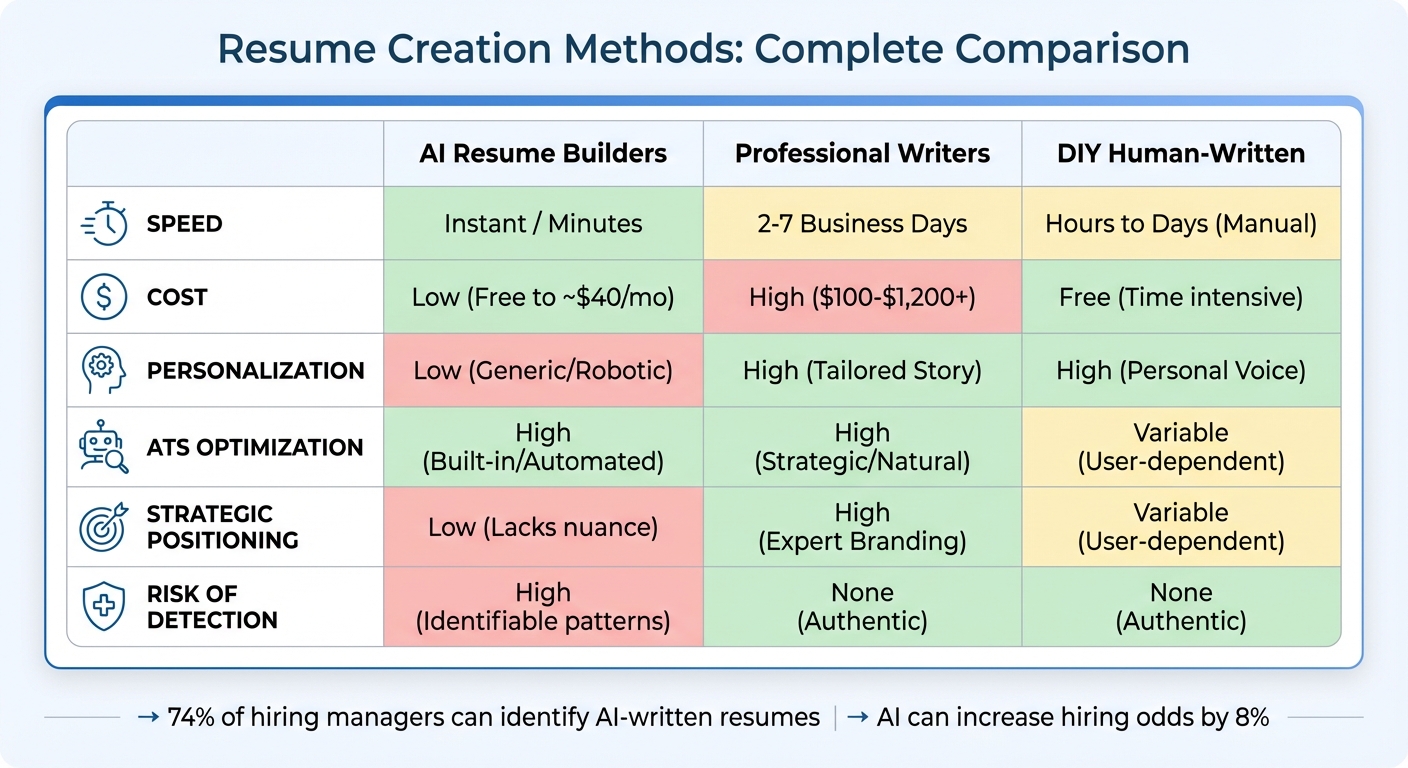
AI vs Professional vs DIY Resume Creation: Cost, Speed & Features Comparison
Let’s break down how AI resume builders, professional resume writers, and DIY human-written resumes compare across key factors that matter most to job seekers. Here’s a side-by-side look:
| Feature | AI Resume Builders | Professional Writers | DIY Human-Written |
|---|---|---|---|
| Speed | Instant / Minutes | 2–7 Business Days | Hours to Days (Manual) |
| Cost | Low (Free to ~$40/mo) | High ($100–$1,200+) | Free (Time intensive) |
| Personalization | Low (Generic/Robotic) | High (Tailored Story) | High (Personal Voice) |
| ATS Optimization | High (Built-in/Automated) | High (Strategic/Natural) | Variable (User-dependent) |
| Strategic Positioning | Low (Lacks nuance) | High (Expert Branding) | Variable (User-dependent) |
| Risk of Detection | High (Identifiable patterns) | None (Authentic) | None (Authentic) |
This table captures the pros and cons of each method, helping to clarify their strengths and limitations.
Here’s what the data tells us: AI can increase hiring odds by 8% and boost wages by 8.4%. However, its predictable formatting can make your resume blend in with others. In fact, 74% of hiring managers say they can spot AI-written content, and nearly half of job seekers now use generative AI for resumes or cover letters.
"If you take two identical workers with the same skills and background, the one with the better-written resume is more likely to get hired", says Emma van Inwegen, PhD candidate at MIT Sloan.
This is why hybrid strategies are becoming more popular. By 2026, many job seekers are expected to start with a quick AI-generated draft and then refine it with a personal touch or professional guidance. This approach not only saves time but also addresses AI’s lack of nuance.
Ultimately, the best choice depends on your goals. For entry-level or high-volume applications, AI delivers speed and convenience. For career changes or executive roles, professional writers are worth the investment. And if you want complete control and authenticity, the DIY route is your best bet.
Conclusion
Deciding on the best resume strategy depends on your career stage and goals. If you're just starting out or switching fields, AI tools can be a big help. They speed up the process, optimize for Applicant Tracking Systems (ATS), and handle formatting with ease. However, many hiring managers can spot AI-generated patterns, so it’s crucial to double-check every detail and infuse your personal voice.
For senior or specialized roles, where storytelling and personal branding are key, AI tools may fall short. As career coach Jenny Foss explains:
"GAI will only analyze objective, available data. So if you are looking to add creativity and personality, you'll still have to fine-tune."
A balanced approach often works best. Start with your own draft, outlining your real achievements and specific metrics. Then, use AI to polish the language and optimize for keywords. Just be sure to review everything carefully to avoid inaccuracies.
Think of AI as a helpful assistant, not a decision-maker. Career consultant Elaine Cartas puts it this way:
"AI is a tool and doesn't make choices. You are a human and you have the privilege of making choices."
Ultimately, your resume should showcase your genuine accomplishments and tell your unique story. After all, you’ll need to confidently discuss every detail during interviews.
FAQs
How can I make an AI-generated resume feel more personal and authentic?
To give an AI-generated resume a personal touch, start by tailoring it to showcase your own experiences, achievements, and personality. While AI tools are great for offering a polished structure, helpful keywords, and professional language, the key is to add the specific details that make your story unique.
Instead of directly copying the AI-generated text, treat it as a starting point. Add your own voice by including real examples and insights that highlight your skills and accomplishments. Focus on showcasing your contributions and the soft skills that set you apart. This not only makes your resume feel more genuine but also helps avoid any red flags from recruiters or automated systems that might detect overly generic, AI-driven content.
By combining the efficiency of AI with your personal input, you’ll end up with a resume that’s professional, authentic, and uniquely suited to you.
What are the benefits of combining AI tools with personal input for creating a resume?
Using a hybrid approach to crafting your resume combines the speed and precision of AI with the authenticity of your personal input. AI tools are great for tackling tasks like formatting, optimizing keywords, and ensuring your resume meets ATS (Applicant Tracking System) standards. These features help your resume pass automated screenings while saving you valuable time and effort.
But here's where your personal touch comes in: adding details about your achievements, weaving in storytelling elements, and showcasing emotional intelligence. These aspects make your resume stand out and feel genuinely yours, steering it away from seeming overly mechanical. This balance of technology and individuality ensures your resume not only looks professional but also highlights what makes you unique - giving you a competitive edge in the job market.
How do professional resume writers balance ATS optimization with a personal touch?
Professional resume writers know how to walk the fine line between making resumes ATS-friendly and keeping them personal and engaging. They strategically weave in keywords from job descriptions to ensure the resume clears automated screenings. At the same time, they highlight the candidate's unique experiences, achievements, and personality to make the document stand out.
Rather than stuffing resumes with buzzwords, they focus on telling a story - providing context for accomplishments that resonate with recruiters. This thoughtful approach ensures the resume works well for both ATS systems and human reviewers. While some professionals may use AI tools to polish resumes, their main priority is always authenticity and a personalized touch.