
AI is cutting jobs now, but the bigger shift is inside jobs, not just the loss of jobs. In 2026, AI was linked to 101,743 U.S. job cut announcements, or 23% of all announced cuts. At the same time, about 7.9 million jobs face high displacement risk, while many other roles are being reshaped instead of erased.
If I had to boil this down, I'd say this:
- Entry-level workers get hit first, because AI now handles many starter tasks.
- Pay and promotion paths are tightening in AI-exposed fields.
- Companies can save time with AI, but they often struggle to turn that time into output and profit.
- The best fixes are early reskilling, internal moves, AI interview assistance, and wage insurance.
- Policy matters, especially when layoffs climb and young workers lose their path into work.
Here’s the core idea in plain English: AI isn’t wiping out every job. It’s removing parts of jobs, shifting hiring, and putting pressure on workers whose tasks are routine and screen-based. That includes junior roles in software, finance, analysis, admin work, and similar office jobs.
What matters most is who is exposed and what to do next. Workers need AI fluency, communication skills, and a plan to move into work that still depends on judgment and human contact. Employers need to check tasks before cutting staff and build training into AI rollouts from the start. And public support should step in early, not after people have already been out of work for months.
| Main issue | What’s happening | Best response |
|---|---|---|
| Entry-level jobs | Starter tasks are being automated | Train for nearby growing roles |
| Mid-career pressure | Lower pay and weaker promotion paths | Build AI-use skills and domain depth |
| Company rollout problems | Time savings don’t always turn into output | Redesign workflows and train staff |
| Layoff shock | Workers may land in lower-paid jobs | Use wage insurance and retraining |
| Labor market strain | Hiring slows before job loss shows up | Track layoffs and support workers early |
So if you want the short version: AI job displacement is less about one big wave of unemployment and more about a slow squeeze on routine work, junior hiring, and career ladders. The fix is not one thing. It’s a stack of moves that helps people shift into the next job before the damage spreads.
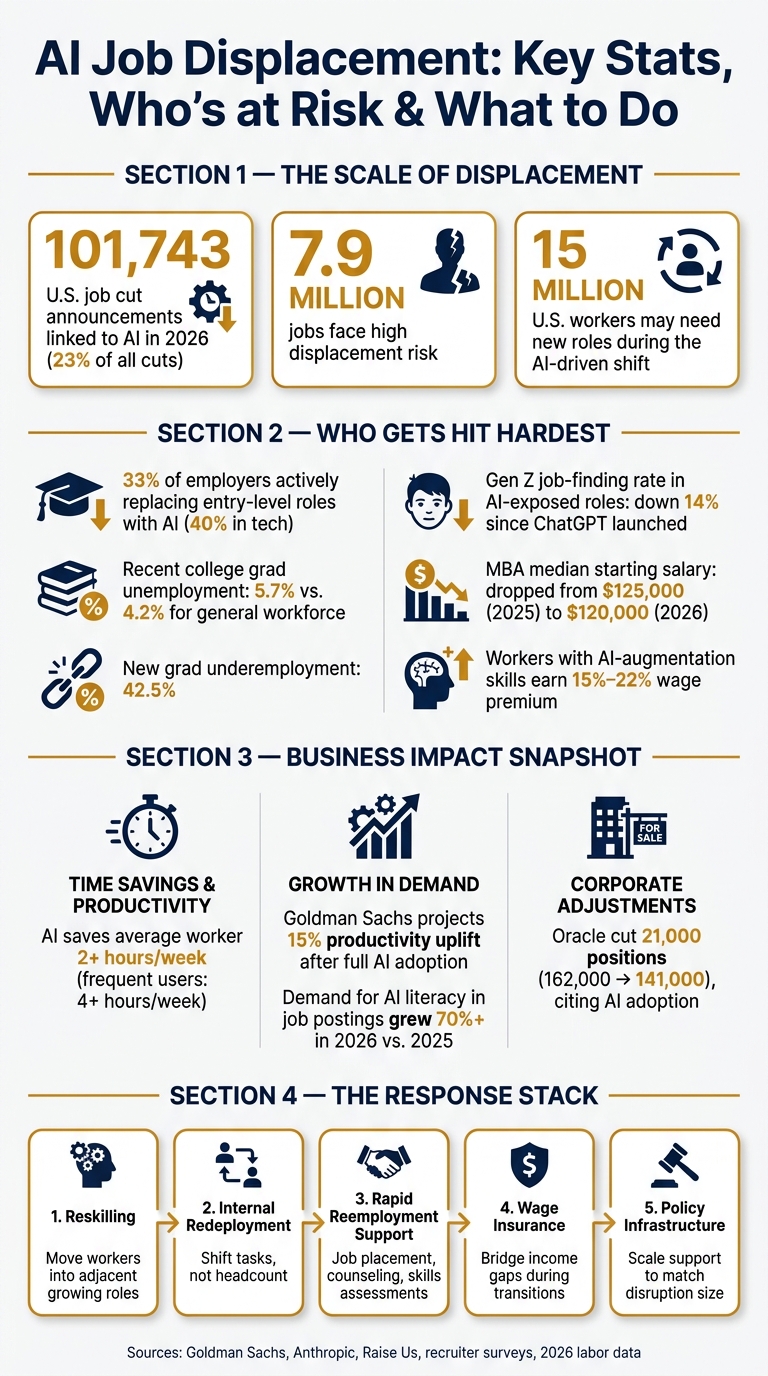
AI Job Displacement: Key Stats, Who's at Risk & What to Do
The Main Problems AI Job Displacement Creates
Who Gets Hit First: Entry-Level and Lower-Wage Workers
The first hit lands at the bottom of the hiring ladder. AI is taking over routine tasks like drafting, summarizing, basic coding, and data entry. Those jobs once gave new hires a way to learn by doing. Now, as those training tasks disappear, employers are making entry-level roles harder to get.
The data makes that plain. One-third of employers, 33%, say they are actively replacing entry-level roles with AI, and in tech that climbs to 40%. Recent college graduate unemployment reached 5.7% in Q1 2026, compared with 4.2% for the general workforce, and underemployment for new grads hit 42.5%. Major financial institutions including Goldman Sachs and Morgan Stanley have also stopped backfilling departed junior analyst positions, as AI tools now handle market data compilation and initial due diligence memos that used to require human staff.
The bigger issue is what happens next. When companies stop hiring juniors, they are not just trimming payroll today. They may also leave themselves short on trained people a few years from now.
And once that early-career path tightens, the pressure spreads into pay, promotions, and career movement.
Career and Income Effects for Displaced Professionals
For people who have already been pushed out, the damage goes past losing a job. Getting back in often means taking less pay, moving into a different line of work, or both. In a June 2026 recruiter survey, median starting salaries for MBA graduates were projected to fall from $125,000 in 2025 to $120,000 in 2026 as companies rethink headcount. At the same time, workers who can show AI-augmentation skills earn a 15%–22% wage premium, a sign of weaker bargaining power in AI-exposed occupations.
Promotion paths are tightening too. More human work is shifting away from producing first drafts and early output, and toward using AI in your job search and checking AI-generated results. That makes it harder for junior workers to build experience and show what they can do on the job. The job-finding rate for Gen Z workers ages 22–25 in AI-exposed occupations has fallen 14% since ChatGPT launched. For younger workers, the route into a long-term career is getting narrower.
sbb-itb-20a3bee
Business and Industry Challenges During AI Adoption
Productivity Gains, Transition Costs, and Talent Gaps
As workers pushed out by AI look for new jobs, employers run into a different problem: getting actual output gains from AI.
That sounds simple on paper. It usually isn't.
The savings don't come from buying a model and plugging it in. They come from redesigning work, training people, and putting rules in place for how AI should be used. In many cases, those pieces cost more time and money than leaders expect. Adoption costs often stretch well past models and infrastructure because workflow redesign, change management, and training are what make adoption stick.
Goldman Sachs projects a 15% productivity uplift after full AI adoption. Generative AI also saves the average worker more than 2 hours per week, and frequent users save at least 4 hours. Those numbers sound strong. But many companies still miss the amount of organizational redesign needed to turn early time savings into steady returns.
One of the most common ways this goes off track is pretty easy to picture: a company adds AI, then requires a human to check almost everything it produces. At that point, AI stops being a time-saver and turns into an expensive review layer.
The talent side makes things harder. Demand for AI literacy in job postings grew more than 70% in 2026 compared to 2025. At the same time, workers who have both domain knowledge and AI fluency are still hard to find. That mismatch slows deployment and pushes returns further out.
How AI Adoption Affects Employers, Workers, and Operations Differently
These pressures don't land the same way for everyone.
- Employers take on governance, integration, and change management costs while aiming for long-term labor savings.
- Workers deal with retraining demands and wage pressure during the transition, even though AI may free up 2 to 4 hours per week.
- Operations face workflow disruption, shifts in decision authority, and the risk of AI mistakes inside core processes.
A recent case shows how direct the impact can be. Oracle's June 2026 SEC filing reported a headcount reduction of 21,000 positions, dropping from 162,000 to 141,000, and it explicitly cited AI adoption as a cause.
Those cuts can bring legal risk too. AI-driven layoffs may trigger the federal WARN Act or state mini-WARN statutes if AI was a substantial factor. That means layoff notice rules can add yet another cost layer, along with more compliance risk.
So while AI can save time, the path from time saved to business value is rarely clean. For employers, workers, and operating teams, the hard part isn't just using the tools. It's reshaping the system around them.
Practical Solutions for Workers and Employers
Reskilling for Roles That Are Growing, Not Disappearing
The best response is to move workers into nearby roles before job loss turns into a long-term problem. That means focusing reskilling on adjacent jobs, not trying to teach every skill under the sun. New roles are clustering around work that still depends on judgment, accountability, and people skills.
Radiology is a good example. Demand and pay are still high, even after years of claims that the field would be replaced. You can see the same pattern in other sectors too.
AI literacy is also becoming basic job knowledge. Workers usually don't need to build models themselves. But they do need to understand what AI can do, what it can't do, and how to use it with care. Healthcare, construction, and government are adding jobs as well, in part because so much of the work is physical or built on human relationships.
That same idea applies inside companies too.
Redeployment and Internal Mobility Inside Organizations
This shift at the task level gives employers another option besides layoffs: move people into other roles. Microsoft, for example, cross-trained early-career lawyers across departments as AI started handling routine legal analysis. Moves like that usually start with a task-level audit. In plain English, companies look at which parts of a job are easy to automate and which parts still call for judgment, relationships, or accountability.
That split matters. It helps employers decide what to automate and what still needs a person in the loop. Paid training time, skills assessments, and role-based learning plans can also make these shifts less hard on workers who are ready to learn something new.
When a company can't make an internal move work, the next step is helping people land somewhere else.
Job-Search Support for Displaced Workers
For workers who lose their jobs, the main goal is simple: get them back into work fast, especially work that still needs human judgment. Roughly 15 million U.S. workers may need new roles during the AI-driven labor shift.
That means workers need to show AI fluency, communication skill, and adaptability clearly in resumes, applications, and interviews. Tools like Acedit can help with:
- real-time interview coaching
- question detection
- tailored Q&A
- simulations
- cover letters
- LinkedIn integration
State-level pilot programs are starting to help too, with wage insurance and worker retraining. In June 2026, Raise Us launched wage-insurance and retraining pilots in Utah, Arkansas, Maryland, and Connecticut. The idea is pretty practical: give workers a financial bridge when the next job pays less than the one they left.
Policy Response and Conclusion: Making AI Transitions More Manageable
Education Reform, Transition Assistance, and Labor Market Support
Once reskilling, redeployment, and job-search help have done what they can, policy becomes the safety net.
Past programs worked best when they kicked in early and matched the scale of the shock. In 2026, the most useful policy package looks pretty practical: community college, apprenticeship, and employer partnerships linked to local worker shortages; wage insurance; portable benefits that follow workers across jobs and training; and unemployment insurance that expands on its own during layoff spikes. Anthropic's proposed tiered model offers a clear starting point - wage insurance and retraining support at 5% unemployment, expanded UI and targeted aid at 10%, and more sustained income support at 15% or higher.
It also helps to add real-time tracking for AI-related layoffs and hiring slowdowns, so support gets to workers sooner instead of showing up after the damage is already done.
Key Takeaways on Problems and Solutions
AI displacement won't hit every worker the same way. Routine, entry-level, and gateway roles face the highest near-term risk. Those are the jobs many workers without four-year degrees use as stepping-stones to better pay.
Taken together, these steps make displacement less chaotic and more manageable. The best response comes in layers:
| Response Layer | What It Does |
|---|---|
| Reskilling | Moves workers into adjacent, growing roles before job loss becomes long-term |
| Internal redeployment | Keeps workers employed while their tasks shift |
| Rapid reemployment support | Speeds reemployment through job placement, career counseling, skills assessments, and relocation support |
| Wage insurance | Covers income gaps so workers can take new roles without financial freefall |
| Policy infrastructure | Scales support to match the size of the disruption |
For workers, the main move is to build AI fluency and transferable skills now, not after a layoff. For employers, the job is to review tasks before cutting headcount and bake retraining into AI rollout plans from day one. For government, the task is simple to say, even if it's harder to do: make job transitions faster, easier, and less financially brutal - and act before a full-blown crisis forces the issue.
AI Job Displacement: The REAL Impact and Solutions
FAQs
Which jobs are most at risk from AI right now?
Jobs most at risk are the ones built around repetitive, document-heavy, rule-based mental work.
That covers roles like data entry clerks, telemarketers, bookkeepers, basic customer service agents, junior copywriters, paralegals focused on document review, and some entry-level software development and junior analyst jobs.
The sectors likely to feel this most include Information, Finance and Insurance, and Professional, Scientific, and Technical Services.
How can workers prepare before AI affects their role?
Start by looking at your day-to-day work and separating the parts that are routine from the parts that depend on judgment, people skills, and empathy. That gives you a clearer view of what AI can handle and where you still matter most. From there, build your AI literacy by learning the main tools, so you can work faster and step into roles where people and AI work side by side.
If your current job is highly exposed, it may make sense to move toward a more stable field, a more strategic role in your industry, or a hybrid position that blends technical skills with human decision-making. Acedit can help with interview simulations, personalized Q&A, and tailored coaching.
What should employers do instead of cutting staff first?
Instead of cutting jobs right away, employers should put more attention on redeployment and reskilling. They can also manage headcount through attrition and a deliberate hiring pause, rather than rushing into a hiring freeze.
Leaders should take a close look at open roles and ask a few plain questions. Does this work still need to be done by a person? Can the role be reshaped? How exposed is it to AI? And if the work changes, is it smarter to keep and retrain someone or replace them at a higher cost?
That kind of review helps companies slow down, think clearly, and make staffing decisions with more care instead of reacting in the moment.