
The legal industry is shifting rapidly, with 85% of clients now starting their attorney search on AI platforms like ChatGPT and Claude. Success no longer depends on Google rankings alone - it's about being cited as a trusted source by AI systems. Niche practices are thriving because AI prioritizes specific expertise and authority over broad, generic services.
Here’s what you need to know:
- AI-driven visibility matters: Traditional search volumes are dropping by 25%, while AI Overviews appear in 34.3% of legal searches.
- Specialization wins: 68% of clients prefer attorneys with niche expertise, which leads to higher fees and more referrals.
- AI tools improve efficiency: Firms using AI report saving 4+ hours weekly, cutting costs by 40%, and adding $100,000 in billable time per lawyer annually.
- Content is key: AI cites firms with clear, structured, and authoritative content.
The takeaway? Focus on building niche authority through AI-friendly content, structured data, and personalized client outreach. If AI doesn’t cite you, you risk becoming invisible to a growing pool of potential clients.
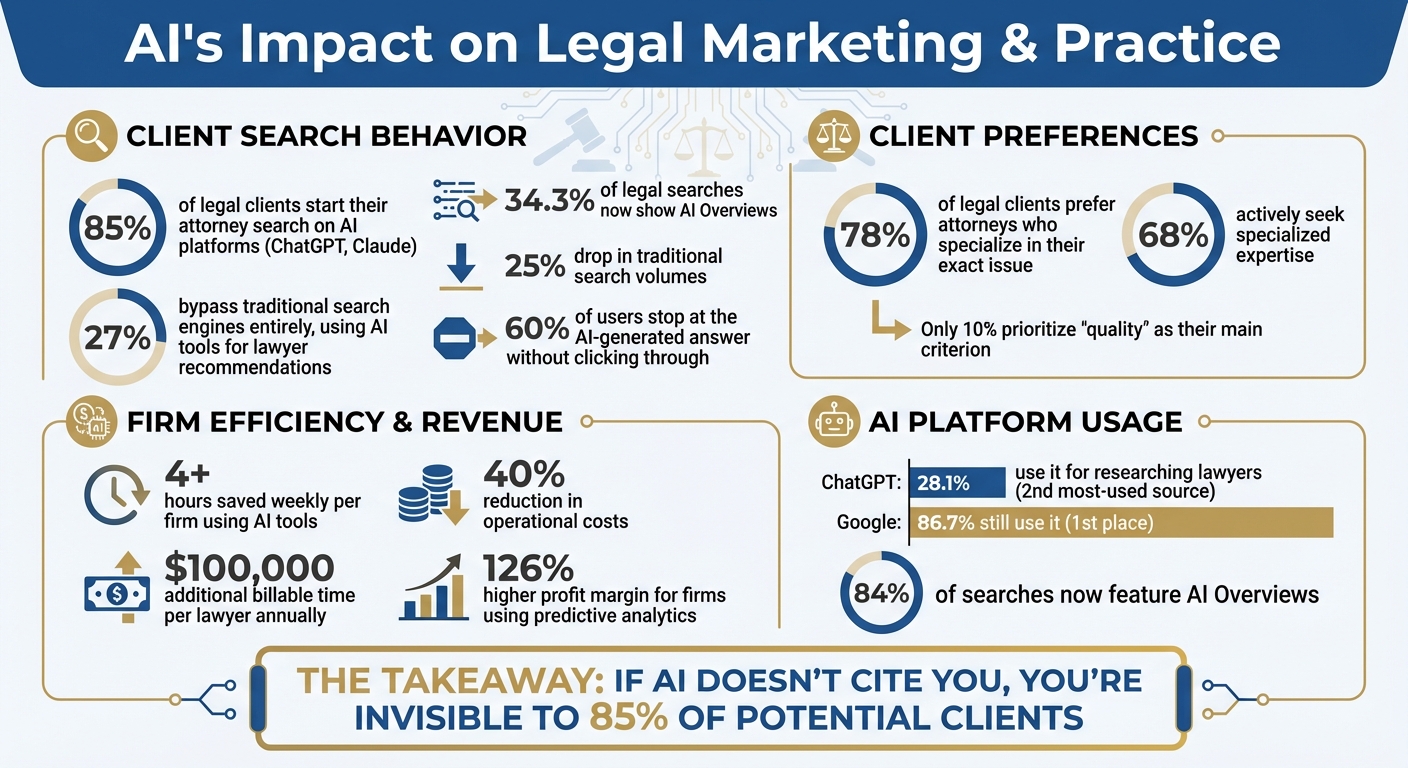
AI Impact on Legal Client Acquisition: Key Statistics for Law Firms
Future-Proofing Law Firm Marketing with AI and Smart Digital Strategies | Eric Ritter
sbb-itb-20a3bee
What Niche Visibility Means for Legal Professionals
Niche visibility is all about focusing your legal services and marketing efforts on a specific, well-defined segment of the market. Instead of presenting yourself as a generalist, you zero in on a particular practice area - like assisting H-1B startups in New York. The difference? General marketing casts a wide net, while niche visibility sharpens its aim on precise client needs and challenges.
In today’s digital-first world, visibility isn’t just about showing up in search results anymore. It’s about being credible enough to be cited by AI systems. Jeff Howell, Legal AI Strategist at Lex Wire Journal, explains:
"Visibility in legal marketing is no longer about appearing in search results. It's about being worthy of citation when AI systems recommend legal professionals to consumers".
Broad searches like "lawyer" tend to attract people browsing without a clear goal, while niche searches reflect a more specific intent. For example, 78% of legal clients prefer attorneys who specialize in their exact issue. The good news? You don’t have to limit your entire practice to build niche visibility. Instead, you can fine-tune your marketing message. Sally J. Schmidt, President of Schmidt Marketing Inc., puts it this way:
"The good news is that you do not need to narrow your practice to be considered an expert in a niche; you just need to narrow your message and marketing".
This approach allows you to maintain a diverse legal practice while positioning yourself as an expert in a particular area. By doing so, you can carve out space in less saturated markets, where you can command higher fees. This naturally leads to the next question: why is specialization so important for legal professionals?
Why Specialization Matters in Legal Practice
Specialization plays a key role in how clients perceive legal expertise. Research shows only 10% of clients prioritize "quality" when choosing an attorney, while 68% actively seek specialized expertise. Why? Because when it’s hard to evaluate legal quality, specialization becomes a stand-in for competence. For instance, a firm advertising "immigration appeals for healthcare professionals" is seen as more knowledgeable than one offering broad immigration services.
Specialization isn’t just about perception - it offers real operational advantages. Focusing on specific types of cases allows firms to create efficient systems and workflows, like automated intake processes, personalized answer suggestions, or standardized procedures. These not only reduce errors but also speed up case handling, improving both profitability and client satisfaction. On top of that, being known for a niche enhances referral opportunities. Other professionals are more likely to refer clients to someone with a clear specialty, knowing they’ll be in capable hands.
Financially, specialists often earn more because they solve highly specific problems with precision. This deeper value justifies higher fees. As Eric Elliott, CEO of VIP Marketing, explains:
"Niching isn't about becoming smaller; it's about becoming sharper".
Still, pursuing specialization comes with its own set of challenges.
Common Obstacles to Building Niche Visibility
Despite its benefits, many legal professionals shy away from specialization. One common fear is that narrowing their focus will limit opportunities. Ironically, trying to be a "full-service" lawyer often waters down your message, making it harder to stand out.
Another obstacle is resistance to change. Many attorneys take pride in their ability to handle any type of case, even though clients increasingly favor specialized expertise. The data backs this up - specialists tend to convert leads more effectively and can charge higher rates.
A lack of digital readiness can also hold firms back. Without strong digital infrastructure - like structured data, authority signals, and content that AI tools can cite - firms risk staying invisible in the growing world of AI-driven legal recommendations. Robyn Addis from 9Sail puts it bluntly:
"Being known for everything means being known for nothing".
Finally, there’s the challenge of aligning your digital presence with your niche. Even if a client is referred to your firm, a generic "full-service" website might fail to reinforce the specialized expertise that attracted the referral in the first place. On top of that, firms that don’t adopt structured systems for scaling up may struggle with inconsistent quality as their caseload grows.
Specialization may not be easy, but it’s a proven path to standing out and thriving in today’s competitive legal landscape.
How AI Tools Improve Niche Visibility
AI has shifted from being a futuristic concept to a practical tool that legal professionals can use right now to boost their visibility in specialized practice areas. The numbers speak for themselves: 85% of legal consumers now begin their attorney search using AI-powered platforms, and 27% bypass traditional search engines entirely, turning to AI tools like ChatGPT for lawyer recommendations. This isn’t about replacing your expertise - it’s about amplifying how potential clients discover it.
Let’s break it down into three key areas where AI tools make a difference: uncovering demand before your competitors, creating content that positions you as an authority, and reaching the right clients with tailored messages. The urgency is clear - AI Overviews now appear in roughly 84% of searches, and legal topics specifically show AI summaries in 34.3% of queries. If your firm isn’t showing up in these AI-driven results, you risk missing out on a growing pool of potential clients.
What’s more, AI simplifies market research, eliminating the need for technical expertise. Businesses using predictive analytics report a 126% higher profit margin compared to those that don’t. Let’s explore how AI identifies opportunities and sharpens your online strategy.
AI-Powered Market Research for Finding Opportunities
In the past, identifying a niche often relied on instinct or expensive consultants. AI changes the game by analyzing vast amounts of data to pinpoint areas where demand is increasing and competition is weak. Tools like Crayon and SparkToro track online behaviors to uncover trends, such as a rise in searches for immigration issues among healthcare professionals.
AI also excels at competitive intelligence. Platforms like Semrush and SimilarWeb analyze competitors’ keyword rankings, ad spending, and content strategies to reveal gaps in the market. For example, if rivals dominate "estate planning" but overlook "estate planning for blended families with special needs children", that’s a niche you can own. AI doesn’t just show what others are doing - it highlights what they’re not.
Large Language Models (LLMs) like ChatGPT can even act as research assistants. Asking, “Who is the best attorney for agricultural estate planning in Iowa?” reveals which firms dominate AI recommendations and where you can step in to build authority. As LeanLaw Firm Blog puts it:
"The riches are in the niches. Defining a clear niche for your legal services is not just about narrowing your focus; it's about sharpening your edge in a competitive market".
Predictive analytics goes a step further by analyzing client data to uncover unmet needs. For instance, noticing that users searching for family law often visit mediation-related pages could signal an opportunity to specialize in collaborative divorce for high-net-worth families. AI can even act as your “marketing coach,” using your client personas and top-performing case data to refine your strategy.
| AI Tool Category | Specific Tools | What It Finds |
|---|---|---|
| Market Insights | Crayon, SparkToro | Emerging demand patterns in specific legal fields |
| Competitor Analysis | Semrush, SimilarWeb | Keywords and market gaps where rivals under-invest |
| Content Research | Surfer AI, Jasper, ChatGPT | Long-tail client questions and sub-niche topics |
| Sentiment Analysis | Brandwatch, Sprout Social | Service gaps based on competitor reviews and complaints |
Content Creation and SEO with AI
AI doesn’t just help you find your niche; it helps you dominate it. Creating content that ranks well - and gets cited by AI systems - requires a strategic approach. A proven method is building a "topic cluster." Start with a comprehensive pillar page (2,000–4,000 words) covering your niche broadly, then support it with shorter articles addressing specific subtopics. This signals expertise to both search engines and AI systems.
Here’s why this matters: ChatGPT is now the second most-used source for researching lawyers at 28.1%, second only to Google at 86.7%. Your content needs to appeal to both. As David Arato, JD, Founder of Lexicon Legal Content, explains:
"Topic clusters give AI engines what they're searching for: organized, interconnected expertise proving you know your legal domain inside and out".
Technical precision is key. Using a semantic triple structure - simple statements like "Texas requires personal injury claims to be filed within two years" - makes it easier for AI to extract and cite your content compared to dense legal jargon. Each paragraph should provide a complete answer to a specific question.
Schema markup is another crucial tool. Structured data (e.g., LawFirm, Attorney, LegalService, and FAQPage) helps AI understand your credentials and services. For example, use headings like “What is the statute of limitations for personal injury in Florida?” and answer directly below.
Different AI platforms favor different formats. Repurpose your content accordingly: use narrative text for ChatGPT, comparison tables for Google AI Overviews, and FAQ formats for Perplexity. Tables, in particular, are highly effective since AI systems extract data from them more accurately than from plain text.
Off-site mentions are also critical. They have the strongest correlation (0.67) with appearing in AI results. Keep your content fresh by updating niche pages every 90 days with new case examples and statistics. Finally, ensure accessibility by avoiding JavaScript barriers and configuring your robots.txt to allow bots like ChatGPT-User, PerplexityBot, and ClaudeBot.
Personalized Client Outreach Using AI
When it comes to niche markets, generic outreach won’t cut it. Potential clients want to feel understood, and AI helps you deliver personalized experiences at scale.
Predictive lead scoring analyzes user behavior to identify top prospects. For example, if someone engages repeatedly with your “estate planning for business owners” page, reads related blog posts, and downloads a guide, AI flags them as a high-priority lead.
Dynamic personalization takes it further. For instance, a personal injury firm specializing in medical malpractice can use AI to tailor ads, customize landing page content, and craft niche-specific email campaigns through tools like Clio Grow.
AI-powered chatbots ensure 24/7 client engagement, answering common questions instantly - even late at night - so potential clients feel supported during urgent legal situations.
Practical Steps for Building Niche Visibility with AI
AI is transforming legal marketing, and now it’s time to put these ideas into action. Moving from strategy to execution involves creating an online presence that AI can easily interpret, monitoring performance with advanced analytics, and positioning yourself as a leading authority in your field. Here’s how you can get started.
Creating an AI-Driven Online Presence
Start with an answer-first approach. Each section of your content should begin with a clear, concise response to a legal question. For instance, if someone asks, “How long do I have to file a personal injury claim in Texas?” give them the specific answer right away - don’t bury it under layers of background information. This approach caters to both human readers and AI systems indexing your content.
Consistency matters. Ensure your firm’s Name, Address, and Phone (NAP) details are identical across your website, Google Business Profile, and key directories like Avvo and Justia. AI systems rely on this uniformity to verify your firm as trustworthy and legitimate.
To further boost your visibility, implement structured data and organize your content into clusters that showcase your expertise. Incorporate multimodal content, such as short videos with transcripts, as AI now indexes these formats for voice and video searches.
Strengthen your E-E-A-T signals - Experience, Expertise, Authoritativeness, and Trust. Include detailed attorney bios that list bar numbers, years of practice, and case results. Reference specific statutes or case law to demonstrate your knowledge. As Jeff Howell, Esq., explains:
"Answer engines are not deciding which ten blue links to show. They are deciding whose content and reputation they trust enough to stand in for the answer when a real person asks for help."
Once your online presence is optimized, the next step is to measure its impact using AI-powered analytics.
Using AI Analytics to Track Performance
Traditional metrics like page views are no longer enough. Track traffic from AI platforms like ChatGPT, Perplexity, and Google AI Overviews using tools such as Google Analytics 4 (GA4). These AI referrers can reveal how often your content is being recommended.
Conduct monthly manual prompt tests. Enter 10–15 common client questions into AI tools and check whether your firm is mentioned. Note whether the mentions are explicit (your firm’s name) or implicit (contextual references). For example, a December 2025 Wellows analysis showed that Kirkland.com had a 0.04% citation score across 40 corporate law queries - one implicit mention and no explicit ones. Identifying such gaps can guide improvements in your schema markup, client reviews, and directory listings.
Competitive intelligence tools like Semrush AI Toolkit or Ahrefs Brand Radar can help automate this monitoring process, giving you a clearer picture of how well your strategies are working.
Armed with these insights, you can refine your efforts and focus on building thought leadership.
Building Thought Leadership with AI
Becoming a trusted source means creating content that AI systems frequently cite. Start by building a dedicated Q&A hub on your website, answering the top 15–20 questions your clients typically ask. Use FAQ schema to make these answers easily accessible to AI.
Repurpose your most authoritative content into multiple formats - social media posts, newsletters, or webinar outlines. This reinforces your expertise across different platforms.
Develop a 90-day roadmap for authority-building activities. Focus on third-party validations like publishing articles in bar journals, presenting at CLE events, or speaking at industry conferences. These efforts bolster your credibility and make your expertise more visible to AI systems.
Don’t overlook multimedia. Upload accurate transcripts for webinars or podcasts. For instance, a 45-minute webinar on "Navigating Texas Probate Law" with a proper transcript becomes searchable content, increasing the likelihood of being cited by AI.
As Jeff Howell, Esq., notes:
"Visibility in legal marketing is no longer about appearing in search results. It's about being worthy of citation when AI systems recommend legal professionals to consumers."
Monitor your progress by tracking AI-referrer sessions in GA4 and adjusting your content based on what drives the most citations. The goal isn’t to achieve perfection but to continually refine your approach using real data on how AI evaluates and recommends your expertise.
Conclusion
The way clients find and evaluate attorneys is shifting dramatically, thanks to AI-powered platforms. With 85% of legal consumers starting their search through AI and traditional search volumes dropping by 15–25%, adapting to this new reality is no longer optional - it’s essential for staying relevant.
In this AI-driven landscape, it’s not just about showing up in search results anymore. Your goal should be to become the trusted source that AI cites. Why? Because with 60% of users stopping at the AI-generated answer, being mentioned first can make or break your ability to attract new clients. To achieve this, your firm needs a focused digital strategy that puts your expertise front and center.
Smaller and mid-sized firms actually have a leg up here. AI systems prioritize clear, verifiable expertise, which allows niche practitioners to hold their own against larger firms. By showcasing detailed attorney bios, jurisdiction-specific knowledge, and proven case results, you can establish authority in your area of practice without needing a massive marketing budget.
To thrive in this environment, start by auditing your online presence. Add schema markup to your site, create a Q&A hub to answer common legal questions, and track AI referrals using tools like GA4. Regularly test how AI platforms reference your firm to ensure you’re staying visible. As Jeff Howell, Esq., aptly puts it:
"Visibility in legal marketing is no longer about appearing in search results. It's about being worthy of citation when AI systems recommend legal professionals to consumers".
FAQs
How can I get AI tools to cite my law firm?
To boost the likelihood of AI tools referencing your law firm, focus on producing high-quality, authoritative content that highlights your expertise. Prioritize E-E-A-T principles - Expertise, Authoritativeness, and Trustworthiness - to establish credibility. Share expert insights through well-researched articles, contribute to respected legal publications, and maintain an active, professional online presence. Additionally, optimize your website for search engines and use structured data to make it easier for AI systems to identify and cite your firm as a reliable source.
What’s the best way to choose a profitable legal niche?
To find a legal niche that brings in profits, start by identifying areas where client demand is strong, but competition is relatively low. AI tools can be incredibly helpful here, offering insights into market trends and helping you spot opportunities. Once you have some ideas, test them through focused marketing efforts and gather feedback from potential clients to see what resonates.
It’s also important to pick a niche that aligns with your skills and interests. This not only boosts your credibility but also keeps you motivated to excel. For example, emerging areas like AI-related legal services are gaining traction. Specializing in such fields could give you an edge and set you up for long-term success in a rapidly expanding market.
What schema markup should a law firm add first?
For law firms, implementing the LegalService schema markup is a smart move. Why? It helps search engines and AI tools clearly interpret your firm's practice areas, services, and overall credibility. These elements play a crucial role in improving your visibility in AI-driven search results.