
LinkedIn is no longer just an online resume - it's where professionals connect, share expertise, and grow their influence. But standing out is tough. Common challenges include:
- Consistent Content Creation: Time constraints, imposter syndrome, and burnout make regular posting difficult.
- Maintaining Authenticity: Over-reliance on AI can lead to generic, robotic content.
- Profile Visibility: Weak headlines, missing keywords, and incomplete profiles reduce searchability.
- Network Management: Building meaningful connections takes time and effort.
AI can help solve these issues by:
- Streamlining Content Creation: Generate posts, expand on comments, and maintain your voice with tools like ChatGPT or Jasper.
- Boosting Engagement: Use AI to draft comments, schedule posts, and track performance.
- Optimizing Profiles: AI tools like Teal or Resume Worded enhance SEO with targeted keywords and polished summaries.
- Managing Connections: AI identifies key contacts, tracks engagement, and personalizes outreach.
Grow Your Personal Brand on LinkedIn with AI
Common LinkedIn Personal Branding Problems
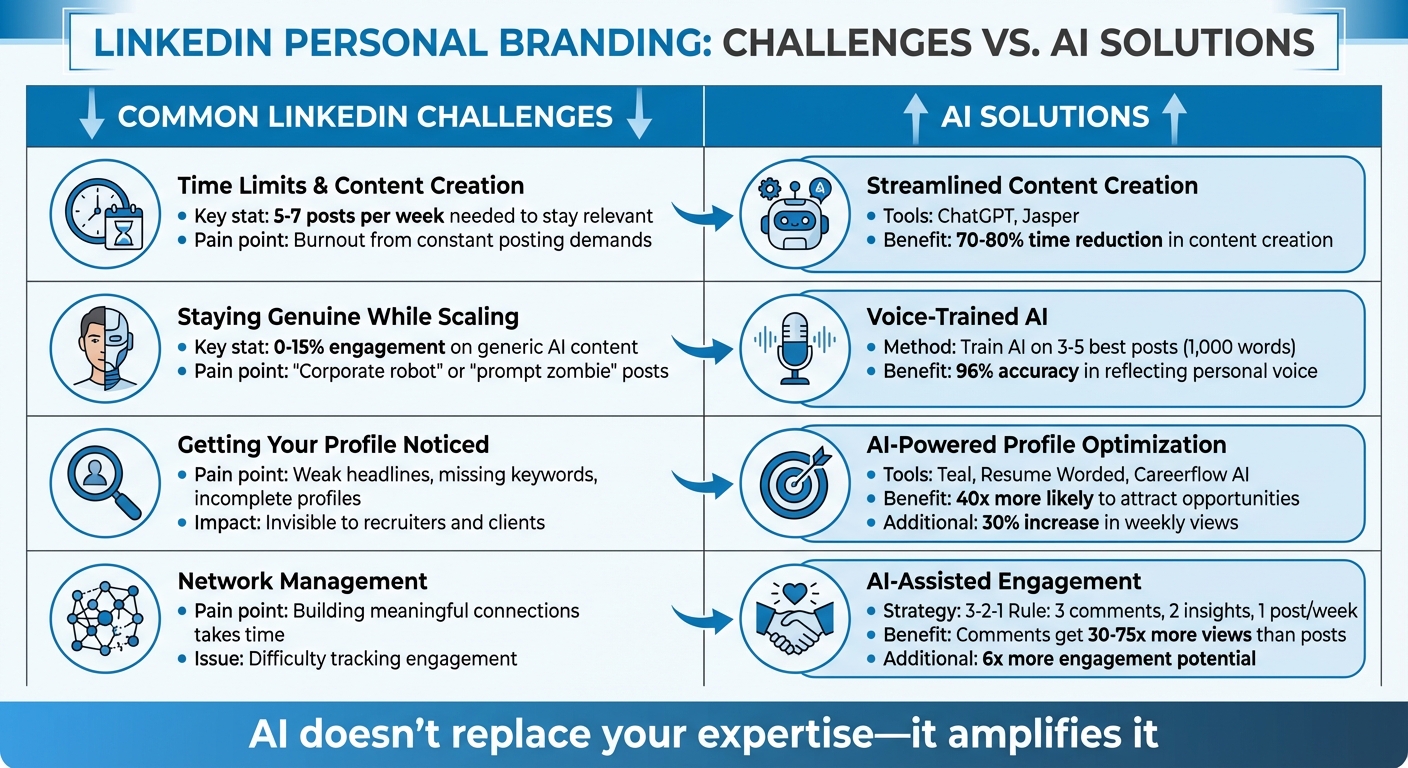
4 LinkedIn Personal Branding Challenges and Their AI Solutions
Building a strong LinkedIn presence seems simple - until you dive in and realize how many challenges can pop up. For many professionals, what starts as an exciting opportunity can quickly turn into a source of stress.
Time Limits and Content Creation
One of the toughest challenges? Finding time to consistently create content. Michael Maximoff, Co-Founder & Managing Partner at Belkins, summed it up perfectly:
"Continuously creating and publishing content for my niche audience was certainly one of the biggest challenges, especially while I was running and managing multiple businesses and projects on the side".
Between full-time jobs, client work, and personal responsibilities, carving out time for LinkedIn often feels impossible. And it’s not just about the time - it’s also about the mental energy needed to brainstorm ideas, craft posts, respond to comments, and engage with your network. Many aim to post 5–7 times a week to stay relevant, but that pace can lead to burnout. Kasey Jones, a coach and consultant for startup founders, offers a blunt truth:
"If it's not on my calendar, it doesn't happen".
Without scheduling time specifically for LinkedIn, it’s easy for content creation to fall by the wayside. And then there’s the issue of self-doubt. Freelance content writer Nupur Mittal explains how imposter syndrome can hold people back:
"Thinking and feeling like an imposter makes you less confident even though you have the skills and expertise".
Even when professionals have valuable insights to share, doubt can stop them from hitting "post." And if time and confidence weren’t enough, there’s also the challenge of staying relatable.
Staying Genuine While Scaling
As professionals ramp up their content efforts, a new problem often arises: how to stay authentic while increasing output. Many turn to AI tools for help, but relying too much on automation can backfire. Posts can end up sounding like they were written by a "corporate robot" or, as some call it, a "prompt zombie".
Why does this happen? AI tools pull from existing data, which means they often produce generic, average results. If you post these AI drafts without adding your own perspective, your content risks blending into the background. The unique voice that draws people to you in the first place gets drowned out.
The numbers tell the story. AI-generated "About" sections that lack personalization receive just 0% to 15% of the engagement compared to profiles written with a personal touch. The issue isn’t AI itself - it’s treating it as a substitute for your own insights. Successful professionals use AI to organize their thoughts, not to replace them.
But even the best content can fall flat if your profile isn’t optimized.
Getting Your Profile Noticed
A well-crafted post won’t help much if your LinkedIn profile is invisible. Poor search optimization is a common issue. Many profiles miss opportunities by having weak headlines, skipping important keywords in the "About" section, or leaving skills lists incomplete. These oversights make it harder for recruiters or potential clients to find you.
Another mistake? Treating your profile like a resume. Profiles that focus solely on past job duties instead of showcasing the value you bring today are less likely to grab attention. Viveka von Rosen, Founder of Beyond the Dream Board, highlights how easy it is to fix this:
"I'm just going to let this LinkedIn profile misrepresent me because I don't have the energy to shift it into what I'm doing now. No, it's a couple of prompts and suddenly the whole profile has changed".
| Challenge | Root Cause | Impact on Personal Brand |
|---|---|---|
| Lack of Ideas | Imposter syndrome & Curse of knowledge | Valuable insights stay hidden, reducing engagement |
| Time Management | Balancing content with work and life | Burnout and inconsistent posting |
| Scaling Authenticity | Over-reliance on generic AI tools | Loss of trust and a robotic tone |
| Low Visibility | Weak SEO and incomplete profiles | Harder to attract ideal clients or employers |
These challenges highlight why many professionals struggle with LinkedIn, but they also set the stage for smarter, AI-driven strategies to boost both content creation and profile visibility.
How AI Improves LinkedIn Content Creation
AI can address many of the challenges of creating LinkedIn content without making your posts feel robotic or impersonal. The trick is to use AI as a collaborator rather than a replacement. When used correctly, AI speeds up content creation while preserving your unique voice.
Personalized Content for Large Audiences
AI tools can be trained on your best-performing posts - about 3 to 5 posts totaling around 1,000 words - to capture your tone, style, and quirks. By analyzing your LinkedIn profile, including your skills, achievements, and career history, AI generates content that's over three times more relevant compared to generic outputs. In fact, users report a 96% accuracy rate in how well AI reflects their professional experience when connected to their profile data.
The training process is straightforward. Start by creating a simple "Do/Don't" list for the AI, specifying what to avoid (e.g., "formal corporate jargon") and what to focus on (e.g., "personal anecdotes" or "data-backed insights"). Then, feed the AI a few of your top posts to help it learn your voice. Refresh this training data periodically to keep up with your evolving style.
One effective strategy is the "Comment-to-Post" method. Save insightful comments you've written on others' posts and ask AI to expand those ideas into full LinkedIn posts. This ensures your original perspective remains central while AI handles structure and flow.
But AI isn't just for creating content - it also makes ongoing engagement much easier.
Simplifying Engagement with AI
After tailoring your content to reflect your voice, AI can streamline your engagement efforts. Consistent interaction on LinkedIn is crucial, but it can also be time-consuming. This is where AI tools can step in to save time.
Take commenting, for example. Thoughtful LinkedIn comments often receive 30–75 times more views than original posts and can drive up to six times more engagement. However, crafting these comments can be tedious. Some AI tools can refine your drafts and offer multiple stylistic variations based on the tone of the original post. Whether you're aiming for a professional, casual, or supportive tone, these tools help you stay authentic while reducing effort.
For busy professionals, the 3-2-1 Rule offers a manageable strategy: comment on three posts, share two insights, and publish one original post each week. AI can generate "comment starters" that reference specific ideas from the original post and add a fresh perspective, cutting the time spent on each interaction by 75% to 80%.
AI-powered scheduling tools also help maintain consistency. By batching content in advance, you can avoid the daily scramble to post.
Michael Maximoff, Co-Founder & Managing Partner at Belkins, shares how AI has helped him stay active on LinkedIn:
"Continuously creating and publishing content for my niche audience was certainly one of the biggest challenges... if it wasn't for my team and the tools/technology we have available to us today, my brand and influence wouldn't be a thing."
AI doesn't replace your expertise - it amplifies it. By taking care of drafting, formatting, and scheduling, AI frees you up to focus on sharing your unique insights.
AI-Powered Profile Optimization for Better Visibility
Your LinkedIn profile isn't just a digital resume - it's a dynamic tool that can either open doors or leave you unnoticed. In 2026, LinkedIn's AI Hiring Assistant categorizes candidates into "Top Fit" groups based on profile data. If your profile isn't optimized, you risk being left out of the running.
Here's why it matters: professionals with optimized profiles are almost 40 times more likely to attract opportunities. Fully completed profiles see a 30% increase in weekly views, while verified profiles enjoy 30% more messages and engagement overall. One key step to standing out? Fine-tuning your profile's SEO to align with recruiter searches.
SEO and Keyword Optimization
Keywords are the backbone of visibility. Recruiters rely on search terms to find candidates, and AI tools can help you pinpoint the exact words they’re using. These tools analyze thousands of job postings in real time and suggest where to strategically place those terms in your profile.
Take this example: a mid-level marketer used an AI keyword tool to add 15 impactful terms to her headline. The result? Her profile views skyrocketed by 366%, and connection requests jumped by 78% - all in just 30 days.
"A headline that aligns with a recruiter's search terms can be the difference between a missed opportunity and a conversation starter." - Resumly
Platforms like Careerflow AI and Teal go further by scanning your profile for gaps, such as missing skills or weak headlines, and then guiding you toward an "All-Star" status. They even highlight priority keywords that should appear early in your headline and summary to boost alignment with LinkedIn's algorithms.
Don’t overlook the "Featured" section of your profile. Uploading case studies or portfolios here can give you a hidden edge. LinkedIn's AI uses Optical Character Recognition (OCR) to index text within PDFs, which can elevate your search rankings. While keywords are crucial, your headline and summary also need to resonate with both AI systems and human recruiters.
Headline and Summary Improvements
Your headline has just 220 characters to grab attention - and you only have about 6 seconds to make an impression. AI tools can transform a basic title like "Marketing Manager" into something far more compelling, such as: "AI-Powered Product Manager | Driving Data-Driven Growth in B2B SaaS." This approach ensures LinkedIn’s algorithm categorizes you correctly while also catching a recruiter’s eye.
The summary, or "About" section, is your chance to tell a story. AI tools can help draft this narrative, but it’s up to you to make it personal. The first two lines are critical - LinkedIn’s AI uses them to create three-sentence summaries for recruiters. A strong structure can make all the difference. One effective format includes:
- Hook: Highlight the problem you solve.
- Problem: Address an industry challenge.
- Solution: Share your unique approach.
- Proof: Include quantifiable results.
- Call to Action: Encourage engagement.
Profiles with complete summaries receive 3 times more views and messages than those without. To avoid sounding robotic, customize AI-generated drafts with specific metrics (e.g., "increased revenue by 30%") and a touch of your personality. Data-driven accomplishments also boost your "Match Confidence" score by 27%, making you more appealing to LinkedIn's AI Hiring Assistant.
Finally, make it a habit to update your profile quarterly. This triggers a "Recency Boost", which helps you stay visible in recruiter dashboards. By integrating these steps, you can create a profile that works seamlessly with AI while showcasing your personal brand to its fullest potential.
sbb-itb-20a3bee
Managing Your Network with AI
Building a strong network isn't just about amassing contacts - it's about cultivating relationships that matter. AI tools can help by filtering out irrelevant connections and focusing on meaningful ones. Forget mass, generic outreach. Instead, leverage AI to identify key decision-makers, track engagement opportunities, and strengthen valuable relationships.
The trend is undeniable: 70% of employers now value a personal brand over a traditional resume. Your network plays a huge role in shaping that brand, and AI offers the tools to manage these relationships efficiently while keeping interactions genuine and intentional. This sets the stage for adopting smarter strategies in choosing and engaging with your connections.
Finding the Right Connections
AI can dive into LinkedIn profiles to suggest connections based on shared industries, interests, career paths, or mutual contacts. For example, LinkedIn Sales Navigator uses AI to identify influencers and decision-makers in your field, helping you focus your efforts on meaningful outreach rather than random connections.
One effective tactic is creating an engagement list - a curated group of high-priority connections whose content you regularly engage with. AI helps track which professionals are most active, ensuring your network fosters interaction. This approach pays off: companies with active brand advocates report up to 300% more engagement.
"AI-powered tools help strategically expand and nurture valuable contacts, based on specific interests and industry focuses." - Kalebru
AI can also summarize trending posts in your industry, helping you spot professionals leading important conversations that might otherwise fly under the radar. Regularly auditing your network with AI insights - like quarterly reviews - ensures your connections remain relevant and valuable by removing inactive or outdated profiles. Once you've refined your network, staying in touch with thoughtful, consistent communication is key.
Managing Engagement with AI Help
After identifying your top connections, the next challenge is engaging with them effectively. Personalized interaction can be tough to scale, but AI makes it manageable. Advanced tools can help you draft tailored comments or direct messages that reference shared content or specific professional contexts. Instead of bland "great post" replies, AI enables you to craft thoughtful responses that expand on ideas or ask insightful follow-up questions.
Some AI tools even track top commenters and generate contextually relevant comments, helping you engage more meaningfully with your priority contacts. LinkedIn’s comment impression metrics highlight how these thoughtful, AI-assisted interactions can boost your visibility beyond just your own posts. When reaching out to new connections, AI can help you craft messages that reference shared milestones or relevant articles, improving response rates significantly.
AI also integrates your engagement across platforms. For instance, tools like Zapier can sync your LinkedIn activity with other systems, such as sending Slack alerts when new leads engage or adding contacts to your CRM. Additionally, AI-powered relationship tracking tools can remind you to reconnect with key individuals at optimal times, ensuring those relationships continue to grow.
"Using AI doesn't make your personal brand less authentic. It makes it more efficient - and honestly, more sustainable." - Jennifer Aust
Building Your AI-Driven Personal Branding Strategy
Using AI to shape your personal branding strategy on LinkedIn can help you maintain a consistent and impactful presence. Take Valerie Chapman, for example - she leveraged ChatGPT in 2024–2025 to craft a branding plan that earned her 140 million impressions, clarified her values, and refined her headline. This approach led to major partnerships.
With LinkedIn now boasting over 1.2 billion members as of 2025, standing out isn’t just about posting occasionally. It’s about having a system that keeps your brand visible without exhausting you. AI can handle repetitive tasks, leaving you free to focus on building trust and relationships. Start by setting clear goals, selecting the right tools, and creating a routine to keep your brand active and engaging.
Setting Your Personal Branding Goals
AI can streamline your branding efforts, but it all starts with defining what you want to achieve. Set measurable goals like "generate 10 leads per week" or "get 100 reactions per post". Use AI to analyze your positioning - feed it details about your services, audience, and their priorities.
For example, input customer reviews or job descriptions into ChatGPT to uncover the top five pain points of your ideal customer profile (ICP). If your target is startup founders, AI might highlight challenges like time management, team building, and funding. These insights can form the basis of your content strategy.
Your goals should also align with emotional triggers. Are you aiming to inspire curiosity, build trust, or foster a sense of belonging? Optimized LinkedIn profiles are nearly 40 times more likely to attract career opportunities, but only if your messaging resonates with your audience. Decide whether your focus is on landing new job opportunities, establishing thought leadership, or building a consulting business. Then, let AI help refine your messaging to hit the mark.
Choosing the Right AI Tools
The right tools can make all the difference. Here’s how you can match AI tools to your personal branding needs:
- Profile Optimization: Tools like Resume Worded or LinkedIn's AI coach can evaluate your profile and suggest improvements. They’ll help you identify critical keywords for your headline, about section, and experience descriptions.
- Content Creation: Use tools like Saywhat for generating content ideas and infographics, or train ChatGPT models to reflect your unique voice.
- Scheduling and Consistency: Platforms like Buffer or Draftly allow you to plan and automate your posts, ensuring a steady flow of content.
Here’s a quick overview of how AI tools fit into your strategy:
| Branding Step | AI Tool Examples | Primary Benefit |
|---|---|---|
| Goal Setting | ChatGPT, Claude | Defines ICP and measurable objectives |
| Profile Optimization | Teal, Jobscan, Resume Worded | Boosts search visibility and recruiter views |
| Content Creation | Postwise, Jasper, Saywhat | Generates ideas, drafts, and infographics |
| Scheduling | Buffer, Hootsuite, Draftly | Ensures consistent posting |
| Analytics | Shield, LinkedIn Analytics | Tracks engagement and refines strategy |
Staying Consistent Over Time
Consistency is more important than perfection. Fully completed LinkedIn profiles generate 30% more weekly views than incomplete ones, but maintaining a strong profile and content calendar takes planning. Train your AI tools with examples of your best posts and clear instructions to keep your tone authentic.
"AI is a collaborator, not a replacement. Treat it like a junior strategist that needs your guidance".
Repurpose your top-performing posts using tools like Buffer’s "Share Again" feature to keep your content fresh. If you’re running out of ideas, try the "commenting first" method - expand on thoughtful comments you’ve left on others’ posts using AI to create full articles.
Regular audits are essential. Every two to four weeks, review your performance using LinkedIn Analytics. Check which companies and job titles are viewing your profile. If they don’t align with your goals, use AI to tweak your keywords. This ensures your content isn’t just consistent but also effective in moving you closer to your objectives. With 91% of professionals preferring interactions tied to LinkedIn profile data, keeping your profile updated and aligned with your content is critical for building credibility.
Conclusion
AI has reshaped the way professionals approach building and maintaining their personal brands on LinkedIn. It can cut content creation time by 70–80%, increase professional compensation by 20–40%, and generate five times more inbound opportunities. From improving search visibility to brainstorming content ideas and analyzing audience engagement, AI tools have become indispensable for many.
Think of AI as a partner in your branding journey. As Alan Cassinelli from Blaze AI explains:
"AI has shifted the paradigm from scarcity to abundance. The question is no longer whether to leverage AI tools, but how to deploy them strategically".
Let AI handle the groundwork - drafting outlines, identifying keywords, and suggesting post ideas. But don’t stop there. Add your personal touch by refining AI-generated content with your own experiences and insights. Avoid publishing raw AI outputs; instead, ensure everything you post reflects your authentic voice.
Start small. Choose one or two tools that address your top priorities, whether that’s optimizing your profile, creating content, or managing your posting schedule. Use LinkedIn Analytics to track progress and refine your strategy. The key isn’t automating everything but using AI to stay consistent and avoid burnout while keeping your individuality front and center.
For example, tools like Acedit can polish your profile and simplify content creation, aligning perfectly with these strategies.
Your personal brand is your competitive edge. By letting AI handle repetitive tasks, you can focus on meaningful connections, sharing your expertise, and staying visible in your field. The tools are ready and accessible - start using them to achieve your branding goals. When you combine AI’s efficiency with your unique perspective, your brand will stand out in even the most competitive spaces.
FAQs
How can AI help create authentic LinkedIn content?
AI can be a handy tool for creating LinkedIn content that matches your tone and personal brand. By analyzing your previous posts or using specific prompts, it can generate ideas and drafts that feel aligned with your style.
However, to keep your content feeling genuine, think of AI as a partner rather than a replacement. Add your own thoughts, tweak the tone, and fine-tune the language so it truly reflects your personality. This approach lets you save time while still producing LinkedIn posts that connect with your audience in an authentic way.
How can AI help improve my LinkedIn profile and personal branding?
AI can play a big role in improving your LinkedIn profile and boosting your personal brand by offering tailored advice and actionable insights. For instance, AI tools can review your headline, summary, skills, and achievements to suggest updates that align with what recruiters or potential connections are actively searching for. This ensures your profile feels polished and relevant.
Beyond profile optimization, AI can help you stay active on LinkedIn by generating ideas for posts and identifying the best times to share them. This makes it easier to maintain a consistent presence. On top of that, AI tools can pinpoint potential connections that match your career goals and even provide tips for networking more effectively. By using these tools, you can fine-tune your LinkedIn strategy and stand out in your industry.
How can AI improve your LinkedIn engagement and networking?
AI can help you level up your LinkedIn game by making your interactions more personal, efficient, and purposeful. It can analyze your profile and audience to suggest tailored content, craft optimized replies, and even pinpoint the best times to post - giving your visibility and engagement a serious boost.
On top of that, AI tools can spot trending topics, recommend hashtags, and suggest content formats that align with your audience's interests. Need to grow your network? AI can identify the right professionals to connect with, making your outreach smarter and more effective. The result? Turning passive connections into active opportunities for collaboration and career growth.