
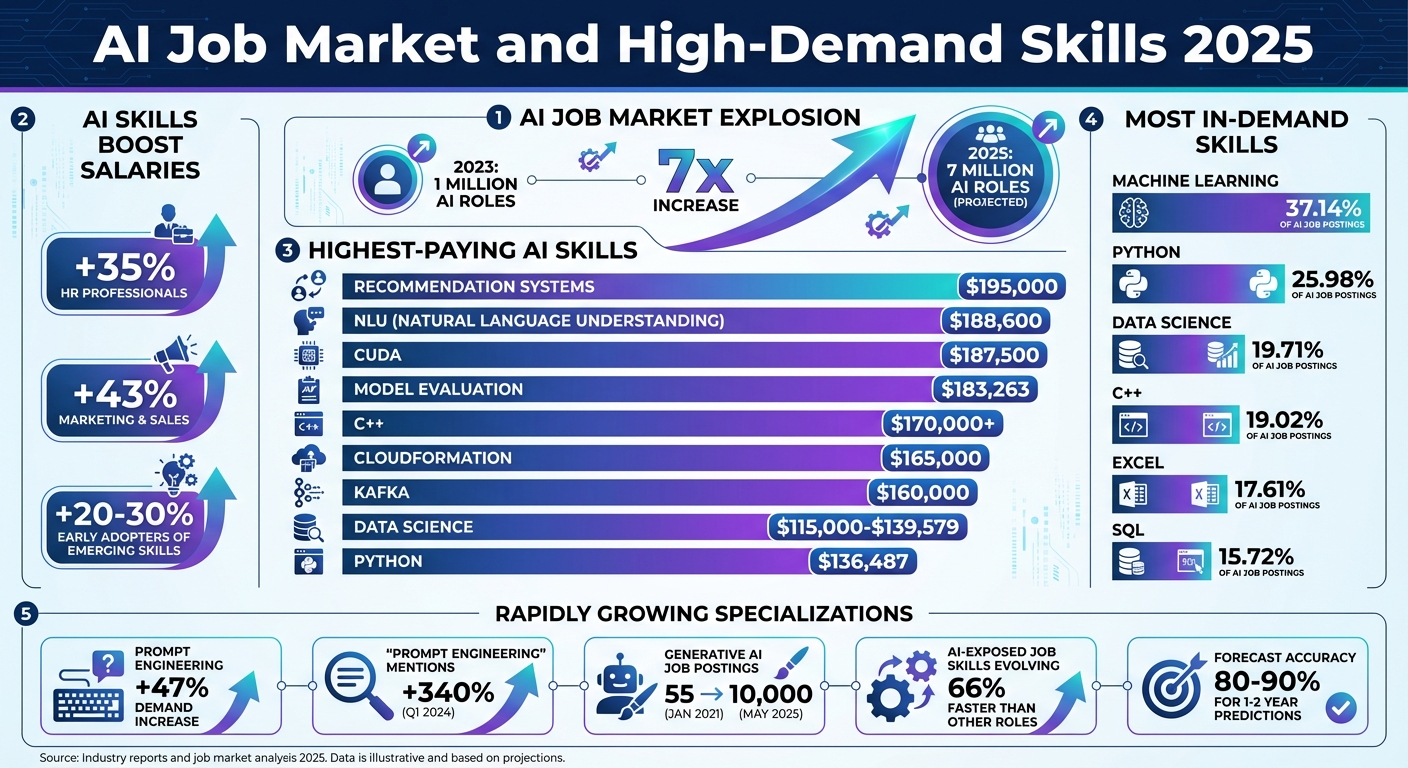
AI is reshaping the job market, with roles requiring AI expertise growing from 1 million in 2023 to 7 million by 2025. While traditional job postings are declining, AI-focused roles are surging, creating new opportunities for professionals with the right skills. Key findings include:
- AI literacy boosts salaries: HR professionals with AI skills saw a 35% pay increase, while marketing and sales roles rose by 43%.
- Machine learning dominates demand: Skills like Python, MLOps, and tools such as MLflow and Kubernetes are highly sought after.
- Emerging roles: Prompt engineering and AI personalization are rapidly growing, with salaries exceeding $195,000 for specialized skills.
- AI tools for career growth: Platforms like Acedit and Microsoft's Copilot analyze skill gaps and help job seekers prepare for AI-focused roles.
AI uses job postings, labor data, and economic indicators to predict which skills will thrive, offering a roadmap for professionals to align with future trends. By focusing on these insights, you can stay ahead in a rapidly evolving job market.
AI Job Market Growth and High-Demand Skills for 2025
How AI Is Changing the Skills Employers Look For
sbb-itb-20a3bee
How AI Predicts Future Skill Demands
AI doesn’t just respond to today’s workforce needs - it anticipates what’s next. By analyzing massive datasets with advanced algorithms, AI can forecast which skills will be in demand well before the hiring market catches up. This forward-looking capability relies on a combination of techniques that work together to map out the shifting dynamics of the job market. Let’s dive into how these methods shape predictions, starting with how AI interprets employer language.
Natural Language Processing of Job Postings
Natural Language Processing (NLP) combs through millions of job listings on platforms like LinkedIn and Indeed, identifying patterns in how employers describe their ideal candidates. Beyond simply counting keywords, NLP normalizes similar terms (e.g., “ML” and “machine learning”) to ensure accurate insights. By tracking how often specific skills appear and monitoring changes in their frequency, NLP uncovers trends that signal which capabilities are gaining momentum. This real-time analysis helps professionals spot opportunities early - long before the competition floods the market.
Machine Learning Analysis of Labor Data
Machine learning takes things further by analyzing three primary data streams: real-time job postings, standardized skill databases like O*NET and ESCO, and broader economic indicators such as GDP growth and industry investments. These algorithms identify skill clusters - groups of related skills that often appear together in high-demand roles. Using forecasting models like ARIMA, Prophet, and LSTM, AI predicts skill demand for up to five years with impressive accuracy. Current models achieve 80–90% precision for short-term forecasts (1–2 years). Tools like ML-driven "Skill Gap Analyzers" can then compare your current abilities against these forecasts, offering personalized learning paths to align your skills with future market needs.
Predictive Modeling with Economic Indicators
AI also incorporates broader economic data to strengthen its predictions. By pulling information from sources like the Bureau of Labor Statistics and combining it with real-time signals from Google Trends, LinkedIn job growth data, and reports from firms like Gartner and McKinsey, AI ensures its forecasts are grounded in multiple perspectives. This triangulation method uses weighted scoring - assigning, for example, 30% to BLS data and 40% to LinkedIn trends - to prioritize reliable signals. Skills that show consistent growth of 15% or more year-over-year over a 12–24 month period are flagged as emerging opportunities. Professionals who acquire these skills early can potentially earn 20–30% more than their peers, making these insights a powerful tool for career planning.
Data Sources Behind AI Predictions
AI's ability to forecast trends depends heavily on the quality and variety of data it processes. When it comes to predicting which skills will shape the job market, AI systems rely on three primary data sources: real-time job postings, government labor databases, and specialized industry reports. These inputs fuel the analytical models described earlier, ensuring predictions are both timely and informed.
Platforms like LinkedIn and Indeed provide a constant stream of fresh job postings, offering real-time insights into emerging trends. For example, during Q1 2024, mentions of "prompt engineering" in job listings spiked by an impressive 340%. By continuously crawling such platforms, AI identifies patterns, tracks skill demand, and highlights sudden shifts in the labor market.
In addition to this dynamic data, government labor databases bring a layer of reliability and long-term perspective. Resources like the Bureau of Labor Statistics (BLS) and the Occupational Information Network (O_NET) offer detailed data on over 900 occupations and 55,000 jobs. These databases include 10-year employment projections and standardized skill frameworks, making them invaluable for long-term forecasting. While O_NET updates its profiles annually, it prioritizes frequent updates for rapidly evolving areas, such as technology-related skills.
Finally, industry reports from organizations like Statista, Lightcast, and Burning Glass Technologies help validate trends observed in job postings. These reports ensure that sudden spikes in demand reflect actual market changes rather than temporary fluctuations. By cross-referencing job board data with expert analyses, AI can distinguish genuine shifts from short-lived trends.
"Missing and/or delayed government data releases make assessing true economic conditions more difficult." - Indeed Hiring Lab
High-Demand Skills Predicted for 2025
AI-driven insights, based on real-time and historical data, are painting a clear picture of the skills that will dominate the job market in 2025. These predictions align with the rigorous methods used to analyze emerging trends in the workforce.
Technical Skills on the Rise
Machine learning stands out as a core skill, appearing in 37.14% of AI-related job postings, translating to roughly 16,130–16,760 listings. The focus has shifted from theoretical knowledge to applied machine learning, emphasizing deployment, reliability, and scalability through MLOps practices. Since modern AI systems depend on ML models for data analysis and predictions, these skills are essential.
Employers are prioritizing professionals experienced in tools like MLflow, Kubeflow, and TFX to automate workflows and ensure real-time monitoring of AI systems. The goal is to maintain reliable performance in production environments.
Python continues to dominate as the go-to programming language in AI development, appearing in 25.98% of job postings, with an average salary of $136,487. On the other hand, roles requiring C++ - especially in high-performance computing - offer even higher average salaries, exceeding $170,000. This is particularly critical in industries like robotics and autonomous vehicles, where direct hardware interaction is key.
"AI skills are in high demand due to the rapid growth of AI technologies and the increasing automation of business processes, which require skilled professionals to enhance efficiency and reduce costs." - Hanna Volchek, VP of Talent, Vention
Specialized roles are also gaining traction. For instance, prompt engineering has seen a 47% increase in demand, with professionals combining technical skills and industry knowledge earning 30% more. As automation reshapes the workforce, the World Economic Forum estimates that while 85 million jobs may be displaced by 2025, 97 million new roles will emerge, tailored to an AI-driven economy.
AI and Machine Learning Engineering Skills
The role of AI engineers is evolving. Employers now expect expertise across the entire AI lifecycle, from development to deployment and maintenance. The growing emphasis on MLOps reflects AI's transition into a critical component of business operations.
Skills in deployment frameworks like Kubernetes and Docker, as well as cloud platforms such as AWS, GCP, and Azure, are highly sought after. In fact, DevOps-related AI roles offer salaries ranging between $130,000 and $150,000. Emerging fields like multimodal AI, which integrates text, images, and audio, are driving demand for tools such as LangChain and CrewAI. Similarly, agentic AI - focused on autonomous systems capable of independent decision-making - is expected to gain traction by 2025.
Employers are also placing a premium on model interpretability tools like SHAP and LIME, ensuring AI systems are deployed responsibly and transparently.
Data Science and Big Data Engineering
Data engineering remains a cornerstone of AI, with clean, scalable data forming the backbone of every system. Data science is mentioned in 19.71% of job postings, with salaries ranging from $115,000 to $139,579. However, the role has expanded far beyond basic data analysis.
Modern data engineers need expertise in ETL processes, pipeline design, and cloud orchestration. SQL appears in 15.72% of AI-related job listings, while Python remains indispensable for data manipulation and modeling. Interestingly, Microsoft Excel still features in 17.61% of postings, underscoring its role in initial data cleaning and analysis.
Infrastructure-related skills are commanding top salaries. For example, CloudFormation expertise averages $165,000, while Kafka skills bring in around $160,000. These capabilities also overlap with software development, where integrating AI into applications is becoming increasingly vital.
Software Development for AI Systems
As AI becomes embedded in applications, software developers skilled in integrating AI functionalities are in high demand. Python appears in 4,450 out of 15,000 AI-related job listings, but success in this field requires more than just proficiency in one language.
"Python remains the lingua franca for a vast array of AI sub-disciplines, including machine learning (ML), deep learning (DL), natural language processing (NLP), and computer vision (CV)." - California Learning Resource Network
For high-performance tasks, C++ expertise is invaluable. This skill appears in 19.02% of AI job postings, with salaries exceeding $170,000 on average. Its ability to interact directly with hardware makes it critical for industries like autonomous vehicles and robotics.
The rise of prompt engineering and large language model (LLM) optimization has created a new niche in software development. Skills in prompt chaining, retrieval-augmented generation, and LLM fine-tuning are now essential, reflecting a 47% increase in demand for professionals who can harness the power of LLMs.
AI Personalization and Predictive Maintenance Roles
Personalization is a driving force in AI, with expertise in recommendation systems commanding the highest median salary at $195,000. These systems are crucial for matching users with relevant products and content, especially in e-commerce and media platforms.
Similarly, skills in Natural Language Understanding (NLU) average $188,600, fueled by the growing reliance on chatbots and voice assistants for customer engagement. As conversational AI becomes more integral to businesses, demand for specialists in this area continues to rise.
Model evaluation is another key area, with salaries averaging $183,263, reflecting the importance of rigorous testing for accuracy and reliability. Additionally, proficiency in CUDA, essential for GPU-based high-performance computing, averages $187,500, making it critical for training large models and scaling AI systems effectively.
AI Tools for Identifying High-Demand Skills
AI-powered platforms are now making it easier than ever to pinpoint the skills employers are actively seeking. For example, Indeed's Hiring Lab uses the GenAI Skill Transformation Index (GSTI) to analyze nearly 2,900 U.S. work skills. Their findings? A striking 41% of these skills are undergoing significant transformation due to generative AI, and 26% of jobs are on the brink of major change. Similarly, Lightcast highlights the growing demand for generative AI-related skills. Job postings mentioning these skills skyrocketed from just 55 in January 2021 to almost 10,000 by May 2025.
This data doesn’t just identify trends - it also lays the groundwork for tools that help job seekers close skill gaps and prepare for interviews with precision.
These AI tools are game-changers for benchmarking your abilities against what the market needs. Take Aura's AI Jobs Report, for instance. It tracks trends in IT and software hiring and reveals that AI-related positions hit 35,445 in Q1 2025, with a median salary of $156,998. Platforms like Microsoft's Copilot and other specialized AI agents analyze labor market data to highlight gaps between the skills you currently have and those in demand. The stats are compelling: skills tied to AI-exposed jobs are now evolving 66% faster than other roles, compared to just 25% the year before. These insights make it easier to focus your efforts on targeted skill-building and interview preparation.
Using Acedit for Skill-Aligned Interview Preparation
Once you’ve identified the skills employers are after, the next step is showing you’ve got them during interviews. That’s where Acedit comes in. This platform takes market trends and turns them into actionable tools for interview prep. It tailors questions specifically for AI-related roles, ensuring you’re ready to showcase your expertise. By integrating with LinkedIn, Acedit pulls in your skills, achievements, and career milestones, matching them to the requirements of your target role.
But Acedit doesn’t stop there. Its Chrome extension works during live interviews on platforms like Zoom, Microsoft Teams, and Google Meet. It detects questions in real time and provides AI-generated suggestions with an impressive 92% relevance rate. For behavioral questions, it applies the STAR methodology - helping you structure answers that highlight both your technical know-how and soft skills. Users have reported an 87% boost in confidence and an 84% improvement in interview performance thanks to these tailored suggestions.
Acedit also offers a practice environment where you can simulate interviews for specific high-demand roles. With over 9,658 questions practiced and more than 2,446 jobs landed by its users, the platform has proven its ability to align preparation with market needs. By generating responses based on your actual work history rather than generic templates, Acedit ensures your answers feel authentic and directly address the technical skills employers are seeking in 2025's competitive AI job market.
How to Upskill Using AI Forecasts with Acedit
Tap into AI-driven job market insights to identify the skills shaping the future. For instance, PwC's 2025 Global AI Jobs Barometer analyzed nearly a billion job ads and found that skills in AI-exposed roles are evolving 66% faster than those in other fields. Similarly, the Bureau of Labor Statistics predicts a 17.9% growth in software developer employment from 2023 to 2033, far outpacing the industry average of 4.0%. Lightcast data adds to this picture, showing a surge in generative AI job postings. Together, these forecasts provide a clear direction for your learning efforts, helping you focus on the skills that will matter most in the years ahead.
After identifying key skills like machine learning engineering or data science, connect your LinkedIn profile to Acedit. This tool analyzes your work experience, endorsements, and accomplishments to assess how well your current expertise aligns with high-demand roles. If Acedit detects gaps - such as missing experience in areas like predictive maintenance or big data engineering - it flags these as opportunities to upskill. By comparing the language in your profile to industry-specific job descriptions, Acedit pinpoints exactly where you need to grow.
Once you know your gaps, start practicing. Acedit’s interview simulations let you rehearse explaining the new skills you’re learning. Simply input the role you’re targeting - say, "Generative AI Engineer", a position that saw 7x growth in postings - and engage in tailored Q&A sessions. The platform uses current market data to generate questions and even suggests responses based on your work history. This approach helps you confidently articulate your experiences using the STAR method, ensuring your answers are clear and impactful.
As you continue building your expertise, update your LinkedIn profile to reflect the skills forecasted for 2025. Acedit’s AI-powered cover letter tool can help you craft application materials that highlight these new capabilities. This boosts your visibility in high-demand sectors like IT and software, where AI-related jobs reached 35,445 openings in Q1 2025, with a median salary of $156,998. Real-time coaching during mock interviews further refines your ability to discuss technical projects, ensuring you’re ready to showcase skills like predictive modeling or AI personalization - exactly what employers are looking for.
Conclusion
AI-powered forecasting is changing the way we approach career planning, shifting it from reactive job searching to a more strategic and forward-thinking process. By examining millions of job postings, economic trends, and skill taxonomies, AI can identify where talent gaps are likely to appear. This insight helps you focus on learning the skills that will be in demand, giving you a chance to stay ahead of workforce changes and potentially boost your earning potential.
Throughout this guide, we've seen how AI's ability to analyze trends not only predicts shifts in the job market but also equips job seekers with tools to adapt. Platforms like Acedit take this further by connecting skill development with practical tools for career advancement. For example, by linking your LinkedIn profile, Acedit can match your skills to emerging opportunities. Its features - like interview simulations, AI-generated cover letters, and tailored STAR examples - help you confidently communicate your expertise in areas such as predictive modeling and big data engineering.
To stay competitive, it’s important to regularly review skill forecasts - every six months is a good benchmark - and compare them with broader reports like the World Economic Forum's Future of Jobs. Use these insights to validate your learning goals and update your LinkedIn profile with the most in-demand skills. This proactive approach ensures you're ready for the evolving roles and opportunities that will define the job market in 2025 and beyond.
FAQs
How accurate are AI skill forecasts for 2025?
AI skill forecasts for 2025 are often reliable because they draw from extensive datasets, industry patterns, and job market trends. However, their accuracy hinges on the quality of the data being used and can sometimes reflect inherent biases. To achieve the most reliable insights, it's wise to pair AI-driven predictions with human expertise.
Which AI skills should I learn first for the biggest payoff?
To get the most out of your efforts, concentrate on in-demand AI skills such as machine learning, data analysis, and natural language processing. Mastering tools and frameworks like Python, TensorFlow, and PyTorch is also essential. With hiring trends leaning toward proven expertise, certifications in AI are becoming more important than ever.
Combining these technical abilities with soft skills like critical thinking and effective communication can give you an extra edge in advancing your career. For interview preparation and skill refinement, platforms like Acedit can be a valuable resource.
How can Acedit help me prove these skills in interviews?
Acedit leverages AI-powered tools to help you shine during interviews. By analyzing your LinkedIn profile, it crafts tailored responses that emphasize your experience and accomplishments, aligning them with the job's demands. Beyond that, it offers real-time coaching, practice questions, and simulated interviews to boost your preparation and confidence. With personalized feedback, Acedit ensures you showcase your strengths effectively, giving you a better shot at landing the role.