
AI now helps supply chains spot trouble earlier, cut response time, and lower disruption cost. In this guide, I’d sum it up like this: if you want better service during shocks, you need clean data, early-warning models, decision support, and a short list of metrics that show if the work is paying off.
Here’s the plain-English version:
-
AI helps before, during, and after disruptions
- before: risk detection, demand sensing, supplier scoring
- during: rerouting, stock moves, backup supplier choice
- after: recovery tracking, playbook updates, simulation
-
Data is the starting point
- ERP, TMS, WMS, supplier systems, IoT, weather, port, and news feeds all matter
- poor IDs, missing timestamps, and bad labels lead to weak alerts
-
The main resilience goals stay the same
- visibility
- anticipation
- readiness
- agility
- recovery
-
A few numbers stand out
- 65% of supply chain pros say AI affects tech buying decisions
- demand for supply chain roles with AI skills grew 387% from Q1 2023 to Q1 2026
- one supplier-risk case gave 91 days of early warning and cut disruptions by 28%
- one digital-twin case cut recovery time from 21 days to 11 days
-
The best first use cases are narrow and measurable
- ETA prediction
- inventory risk alerts
- supplier risk scoring
- demand anomaly detection
-
What to track
- OTIF
- lead time variability
- forecast accuracy
- time-to-recover
- disruption cost in U.S. dollars
-
For job seekers, the message is simple
- employers want people who can explain trade-offs between service, cost, and risk
- hiring teams care about results like lower stockouts, better OTIF, and less expedite spend
If I had to boil the full article down to one line, it would be this: AI does not fix a weak supply chain on its own, but it can help teams see risk sooner, decide faster, and recover with less damage.
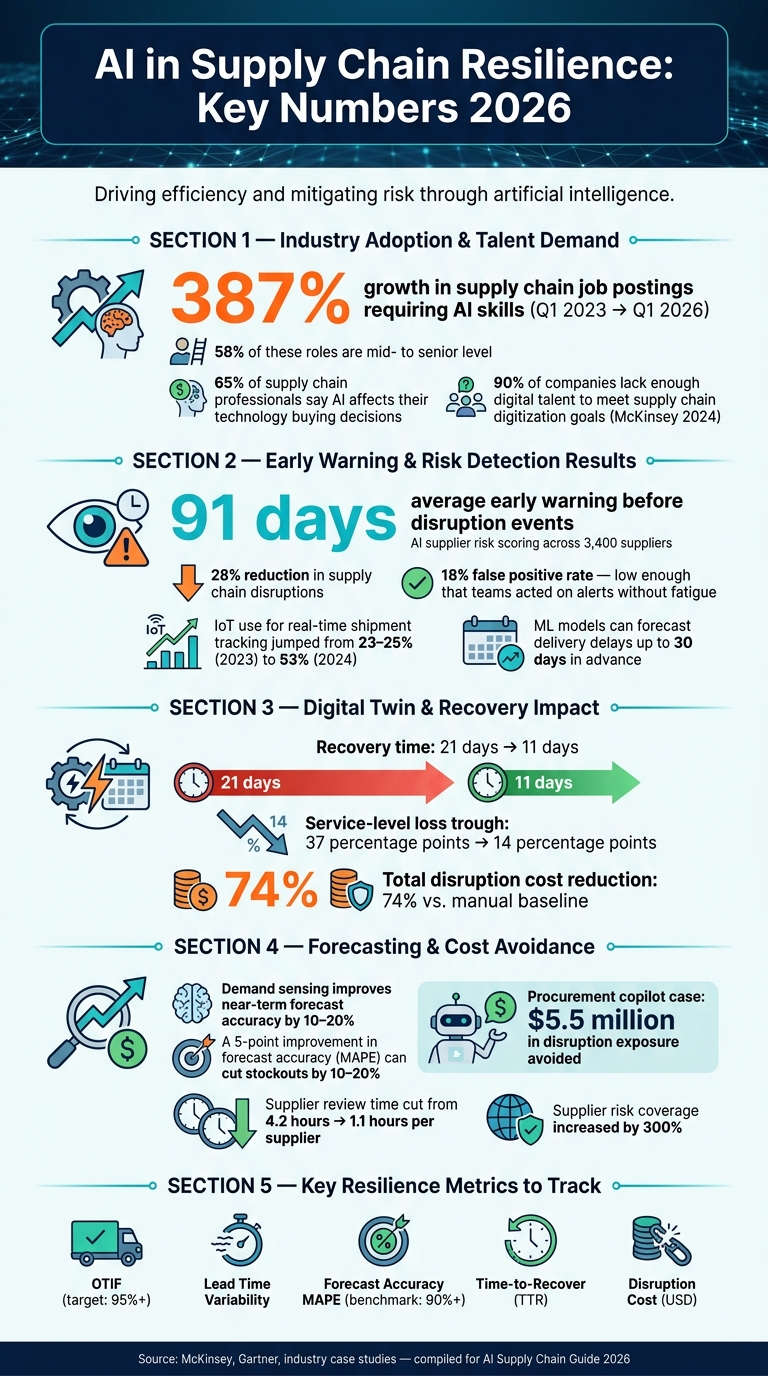
AI in Supply Chain Resilience: Key Stats & Impact Numbers 2026
How AI-Native Supply Chains Are Redefining Resilience
sbb-itb-20a3bee
Data, Visibility, and Early Warning Systems
AI is only as good as the data behind it. That data layer powers visibility, anticipation, and faster recovery. Without it, AI can't spot risk early or point to the right next move.
Before a model can flag a disruption or suggest a reroute, your organization needs a connected data layer that pulls supply chain signals into one place. In most cases, that sits inside a control tower.
The Core Data Inputs AI Needs to Detect Risk
Four internal systems supply most of the signal.
ERP tells AI what is supposed to happen: planned orders, purchase orders, bills of materials, production plans, and customer commitments. TMS shows how transport is performing in practice: planned versus actual pickup times, transit durations, dwell at terminals, and carrier exceptions. WMS tracks inventory as it moves: receipts, outbound shipments, inventory movements, storage locations, and capacity across distribution centers. Supplier and procurement systems add lead times, contracts, compliance status, quality incidents, and performance history for supplier risk scoring.
Then there's the physical world. IoT sensors and telematics extend visibility beyond system records. GPS and telematics can spot unusual stops or route deviations. Temperature and humidity sensors can flag spoilage risk in refrigerated food, pharma, and chemical shipments. Equipment sensors on conveyors, forklifts, trucks, and production equipment can detect stress patterns that point to breakdowns before they snowball into missed orders. In a 2024 visibility survey, IoT use for real-time shipment tracking jumped from 23%–25% in 2023 to 53% in 2024.
External feeds fill the gap between what your systems know and what the outside world is doing. The biggest ones usually include weather and storm data affecting ports like Los Angeles, Houston, and Savannah; port and carrier APIs for berth congestion, gate queues, and sailing schedules; trade and regulatory updates on tariffs, sanctions, and export controls; and financial and news feeds that surface supplier bankruptcies, labor strikes, or factory incidents. Machine learning models parsing satellite imagery, port-congestion feeds, and social media chatter can forecast delivery delays up to 30 days in advance.
| Data Source | What It Feeds AI | Primary Risk It Helps Detect |
|---|---|---|
| ERP | Orders, materials, production plans | Demand-supply mismatches, order-at-risk |
| TMS | Shipment milestones, carrier events | Transit delays, SLA breach probability |
| WMS | Inventory positions, movements | Stock-outs, overstock, DC capacity issues |
| Supplier systems | Lead times, compliance, performance | Vendor reliability decline, single-source risk |
| IoT / telematics | Location, temperature, equipment health | In-transit damage, equipment failure, route deviation |
| Weather / port APIs | Storm tracks, congestion, schedules | Lane disruptions, port delays |
| Trade / news feeds | Tariffs, sanctions, bankruptcies, strikes | Supplier financial risk, regulatory exposure |
Why Data Quality and Governance Determine Model Reliability
Bad data can turn a control tower into a false-alert machine. The usual problems are dirty master data, inconsistent identifiers across ERP, TMS, and WMS for the same SKU or supplier, and missing or misaligned timestamps that stop AI from learning accurate transit-time distributions. Sparse IoT data and inconsistent exception labels make the model weaker too.
McKinsey identifies high-quality master data as one of three core ingredients for supply chain resilience, alongside end-to-end visibility and scenario planning.
Treat data governance as a resilience investment, not just an IT task. In plain terms, that means:
- Assign owners to SKU, supplier, transport, and inventory data
- Enforce standardized IDs across systems
- Set validation rules with automated checks
- Refresh key data, especially inventory positions and shipment milestones, at intervals that match decision speed
These controls help stabilize forecasts, reduce false positives, and improve planner trust.
With clean data and shared visibility in place, AI can move from detection to action.
AI Use Cases Across Monitoring, Forecasting, Response, and Recovery
Once the data layer is live, AI can move from detection to action across monitoring, response, and recovery.
Forecasting and Detection for Supplier, Transport, and Demand Risk
The resilience workflow runs in a loop: monitor → detect → assess → respond → recover → learn. At each step, AI does a different job to help keep goods moving.
During monitoring, anomaly detection models scan streaming KPIs like lead times, fill rates, and transit times. The moment performance drifts past expected thresholds, the system flags it. That helps with anticipation. If late deliveries start rising from a certain port or supplier, teams can see it early, before it turns into a service problem.
Demand sensing sharpens short-term forecasting by updating projections daily or even hourly using POS, e-commerce, weather, and promotion data. In practice, that can improve near-term forecast accuracy and cut forecast error by about 10–20%.
At the assess stage, risk scoring pulls the picture together. These engines combine supplier reliability history, route disruption probabilities, and financial exposure into a ranked dashboard. Say a Tier 1 supplier shows slipping on-time performance right before a U.S. holiday peak. The score may be high enough to trigger a pre-emptive capacity reservation with a backup source. That ranking then feeds the response step.
Response Workflows: Rerouting, Inventory Reallocation, and Supplier Substitution
When a disruption hits, AI turns risk signals into clear recommendations. This is where agility becomes visible on the ground.
For rerouting, optimization engines compare alternate carriers, open capacity, hours-of-service limits, and customs requirements. Then they suggest the best path, along with the cost and lead-time trade-offs.
Inventory reallocation follows the same logic. AI can shift stock between DCs to protect service levels while keeping transfer cost as low as possible.
For supplier substitution, AI risk engines rank backup suppliers by lead time, quality, cost, and compliance. From there, they recommend how much volume to place with each source.
Across all three, one rule stays the same: human approval remains in the loop. AI supports decisions by surfacing options, sizing up trade-offs, and flagging compliance issues. But planners and managers keep final authority, especially when decisions are high-cost, strategic, or regulated.
Scenario Planning with Digital Twins and Simulation
AI also helps before a disruption starts. This is where readiness gets built.
A digital twin is a virtual replica of the physical network: plants, warehouses, ports, transport lanes, and suppliers. It stays updated with live operational data. When paired with AI, it can simulate specific disruption scenarios and compare recovery options before a team has to make a call under pressure.
One AI-driven digital twin simulation study found that trough service-level loss dropped from 37 percentage points to 14, recovery time fell from 21 days to 11 days, and total disruption cost decreased by about 74% versus a manual baseline.
Teams use twins to test port closures, supplier outages, and weather events before they happen. Response deals with today’s disruption. Simulation gets the team ready for the next one. Over time, those simulations turn into the playbooks people use when a live event hits.
Tools, Metrics, and Implementation Priorities
Tool Categories and Where They Fit in the Operating Model
Once AI can detect and predict risk, the next job is picking the tools, metrics, and workflows that turn alerts into action.
Five tools sit at the center of a resilience program. Predictive analytics platforms spot risk patterns and forecast events like late shipments, demand spikes, or supplier disruption. Optimization engines suggest the best allocation, routing, or replenishment moves under constraints. Digital twins support scenario testing before a disruption hits. Control towers send alerts, exceptions, and actions into day-to-day operations. And generative AI assistants help teams query data, summarize exceptions, draft incident updates, and support decisions. Put together, these tools improve visibility, anticipation, agility, and recovery across the resilience loop.
These tools need to live inside the work people already do. S&OP teams use prediction and scenario tools. Procurement teams use supplier risk scoring. Logistics teams use ETA prediction and control-tower alerts. Risk teams handle escalation.
Governance matters from day one. The main requirements are explainability, exception handling, model monitoring, and human sign-off. A simple operating pattern works well: AI recommends, humans approve, systems execute. That setup has a big effect on how fast teams respond and recover.
The Metrics That Show Resilience Value
These tools only matter if they improve measurable resilience results. No single metric tells the whole story. The goal is to track whether AI is improving resilience, not just efficiency.
| Metric | What It Measures | Why It Matters |
|---|---|---|
| OTIF | On-time, in-full delivery rate | Delivery reliability |
| OTIF stability | Week-to-week OTIF variance | Consistency matters, not just a high average |
| Lead time variability | How uneven lead times are | Network instability signal |
| Forecast accuracy (MAPE) | Mean absolute percentage error | A common benchmark is 90%+; a 5-point improvement can cut stockouts by 10%–20% |
| Time-to-recover (TTR) | Days to return to normal after a disruption | Speed of recovery |
| Disruption cost | Premium freight, lost sales, idle labor during recovery | Total financial exposure |
When OTIF falls below 95%, that’s the practical trigger for contingency plans. The link to dollars is pretty direct. Fewer stockouts help protect revenue. Lower TTR means less idle production time. Lower premium freight lands straight in the freight budget.
How to Choose First Use Cases and Build a Business Case
Start small and focused. The best first use cases usually have three things in common: clean data, frequent exceptions, and a clear owner. ETA prediction, inventory risk alerts, supplier risk scoring, and demand anomaly detection fit that pattern well. These are the kinds of problems where AI can produce fast, measurable results.
Supplier risk scoring stands out as a strong place to begin. One AI-driven case covering 3,400 suppliers and 8,200 inter-supplier relationships delivered a 91-day average early warning before disruption events and a 28% reduction in supply chain disruptions, with a false positive rate of just 18%. That rate was low enough that procurement teams acted on alerts without fatigue. In another case, a procurement copilot deployment for a Tier-1 Korean electronics manufacturer increased supplier risk coverage by 300% and avoided $5.5 million in disruption exposure, while cutting supplier review time from 4.2 hours to 1.1 hours per supplier.
Build the business case around payback. Estimate hard savings from avoided stockouts, lower premium freight, and fewer production interruptions. Add soft savings from faster decisions and lower expedite labor. Then subtract implementation costs, including software, integration, change management, and internal time.
It also helps to show leadership a range instead of one single promise. Use:
- a conservative case
- a base case
- an upside case
That makes the likely return and risk range easier to see. State everything in U.S. dollars and include a clear payback period for budget approval. A clear payback story makes pilot approval and rollout much easier.
Roles, Hiring Demand, and Key Takeaways
The Roles and Skills Employers Want in AI-Enabled Supply Chains
As AI moves out of planning decks and into day-to-day operations, hiring is changing with it. Companies now need people who can turn data into clear operating choices, not just reports.
Common roles include supply chain analysts, logistics planners, risk managers, data analysts, AI/ML specialists, operations research analysts, and digital transformation leads. Each of these roles helps teams monitor issues, forecast demand and risk, respond to disruptions, and recover faster when things go sideways.
On the skill side, employers keep asking for forecasting, optimization, ERP/TMS/WMS fluency, risk analysis, Python, SQL, and data visualization. Job postings also often mention tools such as SAP IBP, Oracle Cloud SCM, Kinaxis RapidResponse, Blue Yonder, Power BI, and Tableau. The strongest candidates don't just know the tools. They can explain tradeoffs between service, cost, and risk, then use data to support the call.
Where Hiring Is Growing and How Job Seekers Can Prepare
Hiring is strongest in manufacturing, retail, e-commerce, 3PLs, healthcare, food and beverage, and global sourcing organizations. That makes sense. These are the areas where disruption can hit hard and fast.
The numbers back that up. Analysis of 35 million job postings found that demand for supply chain roles requiring AI skills grew 387% from Q1 2023 to Q1 2026, and 58% of these roles were at the mid- to senior level. McKinsey's 2024 supply chain risk survey also found that 90% of companies say they do not have enough digital talent to hit their supply chain digitization goals. That's a big opening for people who start building the right skills now.
For job seekers, the next move is simple: show proof in interviews. Hiring teams want stories tied to results, not vague talk about AI. Good examples include projects that:
- improved forecast accuracy
- reduced stockouts
- shortened recovery time
- improved OTIF service
- lowered expedite costs
In this field, interviewers tend to care more about exception handling and cross-functional coordination than abstract AI theory. Tools like Acedit can help candidates practice with interview coaching, personalized Q&A, and simulated interviews.
Conclusion: A Practical Roadmap for AI-Driven Resilience
For operators, AI-driven resilience works best when it starts with reliable data, early warning, decision support, and measurable service and recovery metrics. Clean data and strong visibility come first. After that, teams can add early-warning use cases before stepping into deeper automation.
For job seekers, this is now a clear path. Employers want people who mix analytical fluency, systems knowledge, and sound judgment, especially in mid- to senior-level roles. And with the talent gap this wide, people who prepare well now have a strong shot.
FAQs
How much clean data do we need to start?
There’s no fixed minimum. What matters most is data quality and reliability, not sheer volume.
Start with clean, standardized data. Missing records or noisy inputs can hurt accuracy, so teams usually focus first on cleanup work like deduplication, text parsing, and normalization. If data is missing or biased, models may use official government benchmarks, such as Bureau of Labor Statistics data, to estimate realistic figures.
Which AI use case should we pilot first?
Start with a small-scale pilot, not a full rollout. Pick one process you can control, like testing a new routing algorithm on just 10% of lanes.
Then measure a few clear numbers, such as:
- Cost per stop
- Detention fees
- Expedited freight spend
That gives you a clean way to test the idea, compare results against a baseline, and show business impact before you scale it out. Just make sure the pilot includes strict data checks and clearly defined success metrics from day one.
What skills do employers want most in this area?
Employers want people who bring both logistics know-how and AI fluency to the table. That usually means hands-on skill with Python and SQL, plus experience with TMS, WMS, and ERP systems. Just as important, they want someone who can connect model output to business impact, like lower freight spend, leaner inventory, and fewer emergency shipments.
The strongest candidates tend to stand out in a few areas:
- Machine learning, optimization, and data quality
- Problem framing, experiment design, and explaining ROI
- Critical thinking, leadership, and translating between technical and non-technical teams
It’s not enough to build a model that looks good on paper. Hiring teams want proof that you can use data to help the business make better calls and move goods with less waste and less chaos.