
Job interviews can be tricky, and when people from different backgrounds meet, misunderstandings often arise. Here's the issue: what’s polite or professional in one place might seem odd or even wrong somewhere else. For example:
- Eye contact: In the U.S., it shows confidence. Elsewhere, it might seem rude.
- Silence: Americans find it awkward, but in Japan or Thailand, it shows respect.
- Calm behavior: Seen as wisdom in East Asia but as low energy in the U.S.
These differences can lead to unfair judgments. Employers might misread a candidate’s behavior, and candidates might struggle to communicate their strengths.
The solution? Employers should standardize questions, focus on skills, and train to spot biases. Candidates can prepare by learning local norms and practicing clear communication.
Cross Cultural Interviews: Bridging the Gap
How Cultural Assumptions Lead to Miscommunication
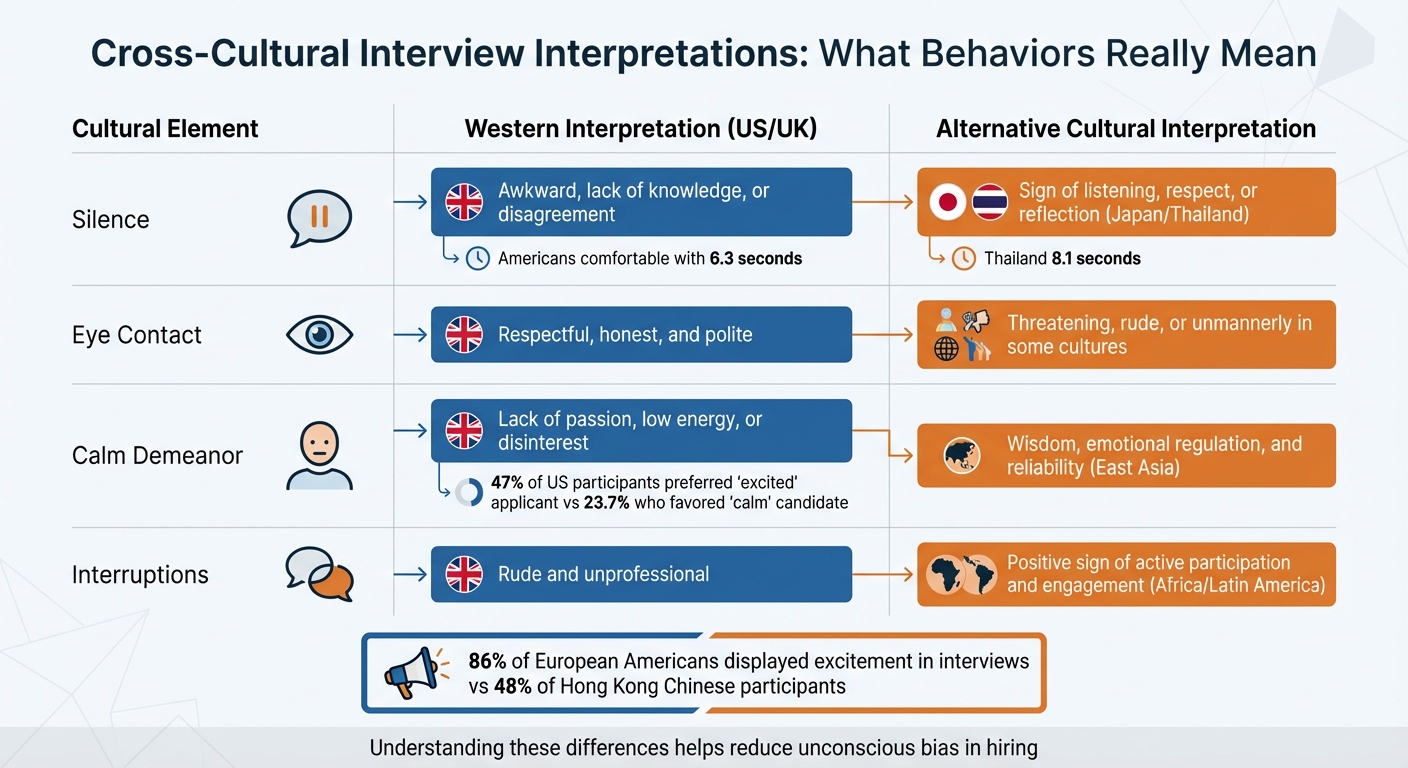
How Cultural Differences Affect Interview Interpretation: A Cross-Cultural Comparison Guide
Cultural assumptions act like invisible filters. When an interviewer assesses a candidate, they’re not just evaluating qualifications - they’re unconsciously measuring behaviors against their own cultural norms. Here’s the issue: what’s seen as "professional" or "confident" in one culture might be interpreted entirely differently in another. This creates a breeding ground for misinterpretations, especially when it comes to nonverbal cues and communication styles.
The problem runs deeper than just being aware of cultural differences. Interviews are high-pressure situations, and under stress, interviewers often rely on quick judgments. These snap decisions are heavily influenced by cultural stereotypes, even if unintentionally. Research shows that "gut feelings" frequently drive hiring decisions, but these instincts often reveal more about the interviewer’s cultural background than the candidate’s actual abilities.
"People think that their gut feelings say something about the other person's character, but our data suggest that people's gut feelings also say something about the culture that they themselves come from." – Dr. Jeanne Tsai, Psychology Professor, Stanford University
Take this example: a study involving 300 participants at a U.S. company found that 47% preferred an "excited" applicant, while only 23.7% favored a "calm" candidate, even though both were equally qualified. This reflects American cultural values, where enthusiasm signals ambition and leadership potential. In contrast, many East Asian cultures value calmness and composure as signs of wisdom and reliability. This disconnect contributes to the "bamboo ceiling", where Asian Americans are underrepresented in senior leadership roles, partly because their calm demeanor is wrongly interpreted as a lack of leadership potential.
Recognizing Implicit Bias in Interviews
Cultural norms shape everything from how we perceive silence to how we interpret body language. The issue isn’t just that cultures differ - it’s that interviewers often assume their own norms are universally "correct." This ethnocentric mindset leads to judgments about candidates’ behaviors being "right" or "wrong" based solely on the interviewer’s cultural standards.
Culture influences what behaviors we notice, how we categorize them, and how we interpret them. For instance, if a candidate avoids direct eye contact or speaks softly, an interviewer might feel uneasy or dismiss the candidate as unsuitable - even though such behaviors might be perfectly appropriate in the candidate’s culture.
The concept of "culture fit" often disguises this bias. Harvard Business School Professor Youngme Moon explains it plainly:
"The truth is the soft stuff is often a euphemism, in many cases, for bias; for people being able to use their discretion to hire people who are just like them, that they are comfortable with, that look like them, that act like them, and talk like them."
These biases play out in real-world scenarios, leading to frequent misunderstandings.
Examples of Misunderstandings Caused by Cultural Differences
Implicit bias often results in predictable patterns of misinterpretation. For example, a study comparing application videos found that 86% of European Americans displayed excitement, while only 48% of Hong Kong Chinese participants did the same. When interviewing with U.S. employers, the reserved demeanor of Hong Kong candidates is often mistaken for disinterest or low energy, even though they’re demonstrating what their culture views as professional composure.
Nonverbal cues are another source of confusion. Eye contact is a classic example: in Western cultures, it’s seen as respectful and honest, but in some cultures, it can come across as rude or even threatening. Similarly, silence means different things across cultures. Americans tend to find silence awkward after just 6.3 seconds, while in Thailand, it’s comfortable for up to 8.1 seconds. An American interviewer might misinterpret a Thai candidate’s thoughtful pause as uncertainty, while the candidate is simply taking time to craft a careful response.
Communication styles can also clash. For instance, a candidate from Saudi Arabia might wait for the interviewer to lead the discussion, reflecting cultural norms around respect for authority. In New York, this could be misread as a lack of confidence or social awkwardness. Similarly, a German candidate’s direct and formal communication style - standard in Germany - might strike a British interviewer as overly rigid.
Even small details carry cultural significance. In Mediterranean cultures, mentioning personal networks or influential contacts is a common way to establish credibility. In many European settings, however, this might be seen as inappropriate or unprofessional. Without cultural awareness, interviewers often misread these behaviors as flaws rather than recognizing them as cultural norms.
Here’s how cultural cues can lead to contrasting interpretations:
| Cultural Element | Western Interpretation (e.g., US/UK) | Alternative Cultural Interpretation |
|---|---|---|
| Silence | Awkward, lack of knowledge, or disagreement | Sign of listening, respect, or reflection (e.g., Japan/Thailand) |
| Eye Contact | Respectful, honest, and polite | Threatening, rude, or unmannerly in some cultures |
| Calm Demeanor | Lack of passion, low energy, or disinterest | Wisdom, emotional regulation, and reliability (e.g., East Asia) |
| Interruptions | Rude and unprofessional | Positive sign of active participation and engagement (e.g., Africa/Latin America) |
Cultural assumptions, if left unchecked, can turn into barriers that prevent interviewers from seeing candidates’ true potential. Recognizing and addressing these biases is crucial for creating a fairer and more inclusive hiring process.
Communication Styles Across Cultures
Continuing from our discussion on nonverbal cues, let's dive into how verbal communication styles and language differences impact interview dynamics. Successful communication in interviews relies on both what is said and how it is conveyed within a cultural context.
Explicit vs. Implicit Communication
In Western cultures like the U.S. and Canada, communication tends to be direct and straightforward. This low-context style means information is delivered clearly, feedback is often blunt, and a "yes" typically signals agreement. Candidates are expected to openly highlight their achievements and skills.
By contrast, many East Asian and Southeast Asian cultures lean toward implicit, high-context communication. Here, much of the meaning is conveyed through context, nonverbal signals, and an emphasis on maintaining social harmony. For example, a Japanese candidate might share fewer explicit details, assuming the interviewer can infer the broader context.
Even a simple word like "yes" can highlight these differences. In Filipino communication, shaped by values such as pakikisama (group harmony) and hiya (saving face), "yes" or a nod might mean "I hear you" or "I understand" rather than a firm agreement. Western interviewers may misinterpret this as a commitment, while the candidate sees it as a polite acknowledgment.
These cultural factors also influence how candidates present their achievements. Filipino professionals, for instance, may downplay their accomplishments to avoid seeming boastful. However, Western interviewers might misread this modesty as a lack of confidence or qualifications.
Such differences in communication styles can become even more complex when language barriers enter the equation.
Handling Language Barriers
Language barriers in interviews go beyond vocabulary issues; the real challenge often lies in understanding context and intent. For example, idiomatic expressions can easily confuse non-native speakers. If an American interviewer asks, "Can you hit the ground running?" the metaphor might leave a candidate puzzled.
Technical jargon can also cause confusion, as terms familiar in one country may carry different meanings elsewhere. As the University of Oregon points out:
"Pragmatics shows us that culture speaks. It is not voiceless, and it can influence language".
Sarcasm is another potential pitfall, as its subtle nuances often don't translate well across cultures. Even basic differences in formality - like how to address a hiring manager - can lead to awkward moments if the candidate's cultural expectations around hierarchy and respect differ from the interviewer’s.
To overcome these challenges, interviewers can adjust their approach. Simplify language, avoid idioms, and explain technical terms to ensure clarity. If a candidate pauses, give them time to process rather than jumping in to fill the silence. Instead of relying on polite affirmations, use scenario-based questions such as "What would you do if…" and follow up with "Why?" to gain deeper insights into the candidate's thought process. These strategies help create a clearer, more inclusive dialogue, enabling interviewers to focus on the substance of a candidate's responses rather than surface-level communication differences.
How Nonverbal Cues Vary Across Cultures
Nonverbal cues play a critical role in communication, often reinforcing - or even contradicting - spoken words. Research suggests that around 65% of meaning in social interactions comes from nonverbal signals. These signals, however, differ widely across cultures, and interviewers may unintentionally place more importance on them than on a candidate’s actual responses when evaluating qualities like trustworthiness. Let’s take a closer look at how these cues differ by region.
Regional Differences in Nonverbal Communication
Eye contact is one of the most nuanced nonverbal behaviors in cross-cultural settings. In countries like the U.S., U.K., Australia, and Western Europe, maintaining direct eye contact is often interpreted as a sign of respect, confidence, and attentiveness. However, the appropriateness of eye contact varies greatly depending on the cultural context. Experts Geoff Ribbens and Greg Whitear explain:
"Look someone in the eyes during a conversation in the USA, Australia, UK and western Europe, and you're showing your respect for the speaker. Do the same in some Asian, African, and Latin American countries, however, and your unbroken eye contact could be considered aggressive and confrontational."
In many Asian, African, and Latin American cultures, deliberately avoiding eye contact with authority figures is seen as a gesture of respect. Meanwhile, in Middle Eastern cultures, intense and sustained eye contact between individuals of the same gender can foster trust, but similar behavior between different genders is often considered inappropriate.
Handshakes, another common nonverbal cue, also carry different meanings. In the U.S. and Germany, a firm handshake is viewed as a mark of professionalism, while Japan favors a gentler handshake, and France prefers a light one. Even something as simple as a nod can vary: while it typically means "yes" in most cultures, it can signify "no" in Bulgaria and Greece. Similarly, in India, a side tilt of the head is often used to indicate agreement.
Other gestures can also lead to misunderstandings. For example, folding your arms is often seen as defensive in many cultures, but in Sweden, it signals active listening. Sitting cross-legged can be considered disrespectful in Japan when facing elders, and pointing the soles of your feet at someone is deeply offensive in many Middle Eastern, Indian, and Muslim communities. Even the seemingly universal "OK" hand gesture can mean vastly different things - from "okay" to "worthless" or even a rude insult - depending on the cultural context.
Impact on Perceived Competence and Confidence
These cultural differences in nonverbal communication can significantly influence hiring decisions, often in ways that disadvantage candidates unfamiliar with Western norms. For instance, research involving eight employers and four candidates revealed that smiling and maintaining eye contact are the primary facial behaviors Western employers rely on to assess hireability. Since nonverbal cues are often perceived as more instinctive and honest than spoken words, interviewers may unconsciously give them more weight than a candidate's actual qualifications. As communication expert Robert Jersek points out:
"Nonverbal communication is usually seen as more honest and revealing because it is often instinctive and unconscious."
This reliance on nonverbal cues can create challenges for candidates from cultures that emphasize humility or indirect forms of expression. The situation becomes even more complicated when verbal and nonverbal messages don’t align. If a candidate verbally expresses enthusiasm but their body language doesn’t match Western expectations of confidence, interviewers might question their sincerity. However, this mismatch often stems from cultural differences rather than any lack of honesty or enthusiasm.
sbb-itb-20a3bee
Adapting Interview Questions for Different Cultures
When navigating the complexities of cultural differences in communication styles, tailoring interview questions can help reduce potential biases. Many recruiters unknowingly rely on culturally skewed frameworks, which can lead to unfair assessments. To address this, adopting culturally sensitive and structured interview methods is key. Research highlights that structured interviews are far more reliable than unstructured ones, which are often poor predictors of actual job performance. Iris Bohnet, writing for Harvard Business Review, explains:
"Unstructured interviews consistently receive the highest ratings for perceived effectiveness from hiring managers, dozens of studies have found them to be among the worst predictors of actual on-the-job performance - far less reliable than general mental ability tests, aptitude tests, or personality tests."
By focusing on job-specific competencies and reframing questions, recruiters can create a level playing field, enabling candidates from all backgrounds to showcase their abilities effectively.
Rephrasing Common Questions
Standard interview questions can unintentionally disadvantage candidates from cultures that prioritize humility or indirect communication. To address this, consider rephrasing traditional questions to make them more inclusive and competency-focused. For instance:
- Instead of asking, "What is your biggest weakness?", try "Tell me about a time you failed." This invites candidates to reflect on a specific situation, emphasizing their self-awareness and problem-solving skills.
- Replace the broad "Why are you interested in this role?" with "What specific aspects of this role align with your career goals, and what unique value can you bring to the team?"
- To assess soft skills like teamwork, opt for behavioral prompts such as "Tell me about a time when you worked effectively as part of a team" or "Describe a misunderstanding with a teammate and how you resolved it." These questions encourage candidates to share relevant, actionable examples.
Avoid asking identity-based questions about topics like native language, religious practices, or family plans. Not only are these irrelevant to job performance, but they may also violate legal guidelines. As noted by MIT Career Advising & Professional Development:
"In general, illegal questions relate to a candidate's race, gender, age, religion, marital status, nationality, or disability and are irrelevant to the candidate's ability to perform the job."
Using Behavioral and Situational Questions
Behavioral and situational questions are particularly effective for evaluating candidates from diverse backgrounds because they focus on past experiences and factual scenarios rather than subjective impressions. For example:
- Instead of asking about hobbies or personal interests, which can unintentionally introduce cultural bias, consider questions like "Tell me about a time when you had to adapt to a colleague's working style to complete a project."
- Another effective prompt is "Describe a situation where others on your team disagreed with your ideas. How did you handle it?".
Ensuring fairness means asking all candidates the same set of questions in the same order, under consistent conditions, and within a standardized time frame. Using structured evaluation tools, such as behaviorally-anchored rating scales, can further enhance consistency in assessing responses. This approach not only improves the accuracy of hiring decisions but also leaves rejected candidates feeling approximately 35% more satisfied compared to unstructured interviews. Dr. Melissa Harrell, a hiring expert at Google, highlights:
"Structured interviews are one of the best tools we have to identify the strongest job candidates (i.e., predictive validity). Not only that, they avoid the pitfalls of some of the other common methods."
When evaluating responses, focus on their specificity, relevance to the role, and recency. A structured and standardized process minimizes subjective bias, ensuring every candidate has an equal opportunity to demonstrate their qualifications, regardless of cultural differences.
Best Practices for Interviewers to Reduce Bias
Creating a fair interview process starts with clearly defining the job's tasks, required knowledge, and essential skills before drafting any questions. This approach ensures that assessments are grounded in job-related criteria rather than subjective impressions. Once the key job criteria are established, standardize your interview questions. Ask every candidate the same questions in the same order to ensure that differences in responses reflect actual performance, not inconsistencies in evaluation standards.
Training interviewers to recognize and address unconscious bias is another critical step. Francesca Gino, a professor at Harvard Business School, emphasizes:
"Awareness training is the first step to unraveling unconscious bias, because it allows employees to recognize that everyone possesses them and to identify their own".
This training should go beyond basic diversity concepts, helping interviewers understand how their personal backgrounds may shape their perceptions. These foundational measures create a solid framework for more specific practices that further reduce bias.
Implementing Structured Interviews
Structured interviews are an effective way to minimize bias and ensure fair hiring decisions. Start by using behaviorally-anchored rating scales, which provide clear examples of what qualifies as poor, good, or excellent responses. This method ensures that evaluations remain consistent across candidates. Additionally, including diverse interview panels introduces multiple perspectives, which can further mitigate bias.
For example, in June 2017, Jill Koob, Vice President of Sales Solutions at Employer Flexible, adopted a structured hiring process for an operations analyst role. By using blind resume reviews and asking the same 10 questions to three finalists, Koob rated their responses on a scale of one to five. This systematic approach led to hiring - and later promoting - a candidate who excelled in objective skill assessments.
Building Cross-Cultural Communication Skills
Standardized processes are essential, but personal growth in cross-cultural communication can also help interviewers make fairer evaluations. Developing cultural competence involves continuous learning, self-reflection, and an active effort to improve awareness, knowledge, and interpersonal skills. Interviewers can focus on building five key abilities: mindfulness, cognitive flexibility, tolerance for ambiguity, behavioral flexibility, and cross-cultural empathy.
Self-reflection plays a significant role in this process. Interviewers should examine their own cultural influences - such as family dynamics, historical context, and personal thought patterns - to understand how these factors shape their perspectives. Reading memoirs, novels, or watching documentaries can provide valuable insights into diverse worldviews. Additionally, interacting with a variety of groups outside the workplace helps interviewers see candidates as individuals rather than just applicants. Small but meaningful actions, like learning the correct pronunciation of a candidate's name or asking for their preferred pronouns, can also foster immediate rapport.
Using AI Tools for Candidate Preparation
While interviewers work to reduce bias, candidates can benefit from tools that help them navigate the interview process, especially when cultural differences are at play. AI platforms like Acedit offer real-time coaching, multilingual practice, and personalized feedback. These tools help candidates master frameworks such as the STAR method (Situation, Task, Action, Result), which may feel unfamiliar to individuals from cultures that favor more implicit or non-linear communication styles.
Mock interview simulations allow candidates to practice under realistic conditions, refine their verbal delivery, and improve their responses to behavioral questions. AI can even analyze job descriptions and resumes to generate tailored questions, helping candidates align with the specific expectations of a role. By equipping candidates with tools to navigate diverse communication styles, interviewers can focus solely on assessing job-related competencies. This technology bridges communication gaps, ensuring that all candidates are evaluated based on their true abilities.
Conclusion
Cross-cultural misunderstandings in interviews can act as roadblocks, preventing organizations from tapping into a wealth of diverse talent. As Commisceo Global aptly states:
"Cultural awareness is necessary to ensure that candidates are not discriminated against through misperceptions, stereotypes and poor judgements".
Addressing this issue requires effort from both interviewers and candidates. Interviewers need to recognize that professionalism, confidence, and credibility can look different depending on cultural norms. For instance, limited eye contact might be a sign of respect, and a reserved demeanor could reflect cultural values rather than a lack of enthusiasm. Adopting structured interviews, diversity training, and standardized evaluation criteria can help reduce subjective biases and create a fairer process.
On the other hand, candidates can prepare themselves to navigate these cultural nuances. Researching local interview customs, seeking guidance from a cultural mentor, or using tools like Acedit to practice responses can help them feel more confident and prepared. Andy Molinsky, writing for Harvard Business Review, highlights another crucial aspect of preparation:
"You probably have a strategy for learning how to behave appropriately in a new culture. But do you have a forgiveness strategy? If not, you ought to develop one".
This reminder underscores the importance of being adaptable and resilient when facing unfamiliar cultural expectations.
FAQs
How can interviewers reduce cultural bias during the hiring process?
Minimizing bias in interviews starts with understanding that personal backgrounds and cultural norms can shape how interviewers perceive candidates. The focus should remain on evaluating job-related skills and qualifications, rather than cultural differences.
One effective approach is using structured interviews, where every candidate is asked the same set of pre-approved questions and assessed with a consistent scoring system. Providing training on cultural differences and common biases - like "cultural noise" - can also help interviewers interpret responses more fairly. Additionally, assembling diverse interview panels, making an effort to pronounce names correctly, and using pronouns respectfully contribute to a more equitable process.
AI tools like Acedit offer extra support by identifying biased language, suggesting neutral follow-up questions, and ensuring uniformity during interviews. These tools help create a fairer and more inclusive experience for all candidates.
How can candidates effectively prepare for cross-cultural interviews?
To get ready for a cross-cultural interview, start by diving into the business etiquette of the host country. Learn about their norms for greetings, eye contact, and communication styles. This kind of preparation not only helps you avoid accidental missteps but also shows genuine respect for the interviewer’s cultural background. Taking the time to reflect on your own cultural assumptions can also make it easier to understand the questions being asked and the behaviors you observe.
Practice is your best ally here. Try mock interviews that mimic the cultural style of your target country. This will give you the chance to fine-tune your language, adjust your pacing, and align your non-verbal cues. Tools like Acedit can offer tailored feedback to help you shape responses that are culturally appropriate. You might also want to practice with a mentor or a peer who knows the culture well - they can point out any blind spots you might not notice on your own.
When the interview day arrives, approach the conversation with curiosity and humility. Be an active listener, take a moment to ensure you fully understand the questions, and don’t hesitate to ask clarifying questions - just make sure they’re respectful. By blending thorough research, thoughtful practice, and an open-minded attitude, you’ll set yourself up to communicate effectively and leave a strong impression in a cross-cultural setting.
Why is understanding nonverbal communication important in cross-cultural interviews?
Nonverbal communication - things like eye contact, gestures, facial expressions, and personal space - can speak volumes, especially in cross-cultural interviews. These subtle cues often say more than words and can heavily influence how an interviewer perceives a candidate. A simple smile or handshake, if misinterpreted, might unintentionally convey disinterest or even disrespect, potentially affecting the connection and overall impression.
Cultural norms play a big part in how body language and emotions are understood. For example, in the U.S., employers often look for candidates who come across as enthusiastic and confident. But in other cultures, those traits might not be emphasized in the same way. By learning and adjusting to these expectations, candidates can avoid confusion and present themselves in the best light.
Tools like Acedit can be a game-changer. They offer real-time feedback during practice interviews, helping job seekers fine-tune their nonverbal communication to better match U.S. workplace norms. Honing these skills doesn’t just prevent awkward moments; it also shows professionalism, confidence, and an awareness of cultural nuances - qualities that leave a lasting positive impression.